Michael Jan Friedman
Author of Reunion
About the Author
Author Michael Jan Friedman was born in 1955. He has written approximately sixty books of fiction and nonfiction with the majority of them set in the Star Trek universe. His work has appeared on the New York Times bestseller list. He has also written more than 150 comic books and for television and show more radio. One of his best known television credits is the Star Trek: Voyager episode "Resistance." (Bowker Author Biography) show less
Series
Works by Michael Jan Friedman
Gespensterschiff / Planet des Untergangs / Die Augen der Betrachter. Star Trek (1994) — Contributor — 19 copies
Phenomenons: The Wind And Fire 3 copies
Star Trek, Bd.3, Mission auf Modala (Star Trek - Die Abenteuer des Raumschiffs Enterprise) (1995) 3 copies
Legends of the DC Universe #17 2 copies
Raumschiff Enterprise Das nächste Jahrhundert Nr. 4 — Author — 2 copies
The Darkstars (1992-) #1 2 copies
Legends of the DC Universe #16 2 copies
Legends of the DC Universe #15 2 copies
Darkstars #3 1 copy
Second Chances [short story] 1 copy
Samuel Beckett 1 copy
Star Trek - the Next Generation: Reunion by Jan Michael Friedman (1-Aug-1992) Mass Market Paperback 1 copy
Thelas And Other Stories 1 copy
Headless 1 copy
Cabal 1 copy
Wildstorm! No.04 Stormwatch 1 copy
Identity Crisis 1 copy
Firetrap 1 copy
After Earth 1 copy
Darkstars #1 1 copy
Associated Works
Ghost Hunting: True Stories of Unexplained Phenomena from the Atlantic Paranormal Society (2007) 362 copies, 24 reviews
The Ultimate Super-Villains: New Stories Featuring Marvel's Deadliest Villains (1996) — Contributor — 22 copies
Tagged
Common Knowledge
- Legal name
- Friedman, Michael Jan
- Birthdate
- 1955-03-07
- Gender
- male
- Occupations
- writer (television | radio | comics)
- Organizations
- Science Fiction and Fantasy Writers of America
- Nationality
- USA
- Birthplace
- New York, New York, USA
- Places of residence
- Long Island, New York, USA
- Associated Place (for map)
- New York, USA
Members
Reviews
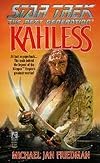
Michael Jan Friedman’s Star Trek: The Next Generation – Kahless takes place between the events of “All Good Things…”, the finale episode of Star Trek: The Next Generations, and the seventh feature film, Star Trek: Generations. At the beginning of the story, a cleric discovers a scroll which purportedly disproves the historicity of Kahless the Unforgettable, upon whose teachings Klingon society is founded and whose clone is the current Emperor, helping to legitimize Gowron’s power show more as Chancellor. Meanwhile, in the Federation, Worf finds his faith shaken as he had always looked to the stories of Kahless as a guide to help him with his crisis of identity, growing up on Earth and becoming the only Klingon in Starfleet. Captain Jean-Luc Picard worries about how this scroll might destabilize the Klingon Empire now that relations between the Federation and the Empire are normalized following his diplomatic efforts. The Kahless clone reaches out to Worf and Picard, seeking their help when he discovers a conspiracy within the Klingon Defense Force to overthrow Gowron.
Friedman alternates between the Heroic Age around the 9th century, in which he retells the legends of Kahless, and the Modern Age of 2371, where he follows the story of the conspiracy and the involvement of Picard and Worf as they investigate it. The two narratives examine nuances of Klingon culture while deconstructing the nature of myth and its power to shape societies as well as the essential truths it can communicate, despite the factual accuracy of the story. As Picard observes in the story, “Kahless was the Klingon Everyman, a mirror in which every last son of Qo’noS might find the noblest parts of himself” (pg. 292). To that end, Friedman’s narrative will appeal to those interested in Klingon culture and the power of myth. Though the Star Trek novels rarely impact the canon of the films and series, this one is particularly enjoyable and unlikely to find itself pre-empted by a later show or film. show less
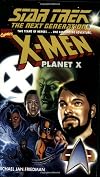
Star Trek: The Next Generation: Planet X (Star Trek: the Next Generation / X-Men) by Michael Jan Friedman
This book was a steaming pile of pungent, worm-infested dog diarrhea... but NOT because it attempted to marry Star Trek:The Next Generation (STNG) with Marvel Comics' "X-Men" (XM) series. In fact, that part actually didn't go too badly. It was author Michael Jan Freidman's basic writing skills that were the disaster. Here's a run-down:
The Good
Crossovers between different comic, television or movie series rarely go well, even under the best of circumstances. On the face of it, a STNG novel show more with an X-Men tie-in looks like a horrible idea. On closer inspection though, these series complement each other in a a number of ways. In the history of the Star Trek universe, the Kahn character (Ricardo Montalban in the movies) led a bunch of genetically-enhanced supermen (in the Nietzsche sense, not the DC Comics sense) in a rebellion which started World War III... that's easy enough to tie in with the whole X-Men theme of super-mutants. In this book, the X-Men are from an alternate timeline of Earth, which crossed over with the Star Trek timeline becuase the Borg.. blah, blah, blah.. it all sounded plausible enough for the level of suspension-of-disbelief which STNG and X-Men already ask of their readers. The STNG and XM characters are already sort of ideologically alligned because both franchises are already preachy as hell about social issues, tolerance, acceptance, world peace and the like.
Micheal Jan Friedman also does well going off on pseudoscienific jibber-jabber tangents about things like how the transporters on the Enterprise teleport things differently than how the X-Man "Nightcrawler" can teleport. That seems like the sort of thing Star Trek fans usually get a hardon over, so kudos to Friedman for playing to his audience.
The whole subplot with Erid Sovar learning he has mutant superpowers is done reasonably well, too. This is the sort of storyline you see in most of the X-Men stuff... the general public is terrified of what mutants might do with their newfound powers. Erid is scared about what's happening to him, and feels isolated -even from loved ones. Other young mutants in a similar situation deal with the experience differently. Telekinetic character "Rahatan" uses his gifts to advance his megalomaniacal political ambitions. There's always one bad apple in these stories, huh? Overall, this storyline had some potential; the dynamic between Erid and Corba might have been interesting, had it been developed.
The Bad
The real problem with this book is that Micheal Jan Friedman writes with all the skill of a meth addict with Attention Deficit Disorder, who's just started learning English as a second language. The following is an incomplete list of Friedman's crimes against the written word:
1) The exposatory dialogue is hamfisted and awkward. On p.86, for example, Friedman introduces a minor character, Relda Sovar (Erid's brother, it happens) by first dropping his name, when another character says to him:
"I've always said that Reldo Sovar knows his twentieth century artists."
How often do you call your friends by their full name in conversation?
On the next page, we learn Reldo is a security guard when the same friend teases him:
Homesick? A big, bad security officer like you?"
Ugh....
The excruciating pain of Friedman's exposition is greatly magnified by what he feels the readers need explained to them. I mean... this is a Star Trek/ X-Men fanfic novel, right? Isn't it safe to assume that the only people remotely interested in reading this trash are fans of Star Trek and/or the X-Men? So why does Friedman devote a paragraph on page 21 telling us that the transporters on the Enterprise convert matter into energy, transmit that energy to some destination point, and then turn the energy back into matter? If you consider yourself a fan of Star Trek but you still needed this little refresher course on transporters, this book is probably taking away valuable time you should be using to finish your Clown College applications. Not much later, Friedman also feels the need to explain to us that CDR Worf is a Klingon, and thus has difficulty being chummy and showing affection the way most humans do. I don't consider myself a super fanboy, but I think I had more or less gathered that much about Worf over the years.
2) Storm: Yeah, the Halle Berry character. Since when did she become the undisputed leader of the X-Men, ordering everybody else (including Wolverine) around like a petty dictator? She never did in any of the X-Men comics or movies. And what purpose does this modification of her personality/role serve? None that I can see; it's just weird. And the Picard/Storm love interest? It feels very inauthentic, like a random bedpost notch designed to Kirk-ify CAPT Picard. The last thing Picard (or anybody else) needs is Kirk-ification.
3) Wolverine: The X-Men movies got Wolverine right. He's a man trying to hold back animalistic impulses. He's got a lot of humanity, but he's struggling with the trauma of past forced surgeries and brainwashing by some shadowy government agency. He's also got a lot of identity issues, because a portion of his memory is missing. He comes across as a very three dimensional and sympathetic character in the first two X-Men movies. In this book, however, he's a ridiculous asskicking bozo who calls everybody "Bub", and then on page 133 he says "Yer' darn tootin'" unironically. Wait a second... does this novel also have a tie-in with that show "Hee Haw"? The cover art doesn't seem to reference it. Maybe they couldn't fit the big cartoon donkey in between Data's head and that looming "X" logo.
4) Michael Jan Friedman has a pathologic obsession with where people are standing in relation to one another. He clutters up his writing, subjecting readers to tedious accounts of what order people walk into a room, or who's in front of who when they are walking down the hallway. For serious. You think I'm joking? Check this out (page 132):
Just then, [Picard] heard the chimes that signify the presence of a visitor outside his ready room. He leaned back in his chair and faced the door.
"Come," Picard said.
A moment later, the door opened, revealing Commander Riker. But as the first officer entered the room, Picard saw the man wasn't alone.
Storm walked in after him. Then came Banshee and Woverine. One by one, the X-Men took up positions on the oppostie side of Picard's desk, each with the same determined expression on his or her face.
"They wanted to see you, sir," said Riker.
The captain nodded. "Thank you, Number One."
He turned to the mutants. "Would any of you like a seat?"
Storm shook her head. "No. Thank you."
Resting his elbows on the armrests of his chair, Picard made a steeple of his fingers. "All right, then. What can I do for you?"
Banshee looked to Storm. So did Wolverine.
"Go ahead, 'Ro'", said the mutant in the mask.
Storm regarded the Captain. "It is very simple," she said. "We would like to help."
That's really the way Friedman wrote it. Half a page to walk into a room and offer help? Jesus Christ, a person could go insane reading this stuff. Who does Micheal Jan Friedman need to fuck around here to get an editor?
What's that? Do I think I could do better?
I know I could.
Here's my revision of the same passage:
The door chimed.
"Come"
Riker entered, with the X-Men in tow.
"Sir, they requested a meeting with you."
Storm approached the desk, "It's about the situation on Xhaldia, Jean-Luc. We'd like to help."
Done. That wasn't so hard, was it?
5) The surprise party for Worf: The less said the better. If you didn't see that coming a mile away, there are plenty of neurologists in the Yellow Pages who should be qualified to help you.
6) The planet suddenly plagued with a rash of superpower-enhanced mutants is called "Xhaldia". Oh look! There's an "X" in its name. That's so... oh, forget it.
The Ugly
Up to the last page, this book was just a bit of light bubblegum reading; nothing to take too seriously. Nothing prepared me for the surprise ending, and I am deadly serious when I say it was a GENUINE surprise. At first, I wasn't sure what I was reading... how it was intended, or whether it was even supposed to be real. When I put the meaning of it together, it was like a horse kicking me in the chest. It's on the very last page of the book... two pages after the story ends, to be exact; on the "About the Author" page. Right there in black-and-white it says it: Michael Jan Friedman has authored thirty-two books. Thirty-two.
Oh! the Humanity... show less
The Good
Crossovers between different comic, television or movie series rarely go well, even under the best of circumstances. On the face of it, a STNG novel show more with an X-Men tie-in looks like a horrible idea. On closer inspection though, these series complement each other in a a number of ways. In the history of the Star Trek universe, the Kahn character (Ricardo Montalban in the movies) led a bunch of genetically-enhanced supermen (in the Nietzsche sense, not the DC Comics sense) in a rebellion which started World War III... that's easy enough to tie in with the whole X-Men theme of super-mutants. In this book, the X-Men are from an alternate timeline of Earth, which crossed over with the Star Trek timeline becuase the Borg.. blah, blah, blah.. it all sounded plausible enough for the level of suspension-of-disbelief which STNG and X-Men already ask of their readers. The STNG and XM characters are already sort of ideologically alligned because both franchises are already preachy as hell about social issues, tolerance, acceptance, world peace and the like.
Micheal Jan Friedman also does well going off on pseudoscienific jibber-jabber tangents about things like how the transporters on the Enterprise teleport things differently than how the X-Man "Nightcrawler" can teleport. That seems like the sort of thing Star Trek fans usually get a hardon over, so kudos to Friedman for playing to his audience.
The whole subplot with Erid Sovar learning he has mutant superpowers is done reasonably well, too. This is the sort of storyline you see in most of the X-Men stuff... the general public is terrified of what mutants might do with their newfound powers. Erid is scared about what's happening to him, and feels isolated -even from loved ones. Other young mutants in a similar situation deal with the experience differently. Telekinetic character "Rahatan" uses his gifts to advance his megalomaniacal political ambitions. There's always one bad apple in these stories, huh? Overall, this storyline had some potential; the dynamic between Erid and Corba might have been interesting, had it been developed.
The Bad
The real problem with this book is that Micheal Jan Friedman writes with all the skill of a meth addict with Attention Deficit Disorder, who's just started learning English as a second language. The following is an incomplete list of Friedman's crimes against the written word:
1) The exposatory dialogue is hamfisted and awkward. On p.86, for example, Friedman introduces a minor character, Relda Sovar (Erid's brother, it happens) by first dropping his name, when another character says to him:
"I've always said that Reldo Sovar knows his twentieth century artists."
How often do you call your friends by their full name in conversation?
On the next page, we learn Reldo is a security guard when the same friend teases him:
Homesick? A big, bad security officer like you?"
Ugh....
The excruciating pain of Friedman's exposition is greatly magnified by what he feels the readers need explained to them. I mean... this is a Star Trek/ X-Men fanfic novel, right? Isn't it safe to assume that the only people remotely interested in reading this trash are fans of Star Trek and/or the X-Men? So why does Friedman devote a paragraph on page 21 telling us that the transporters on the Enterprise convert matter into energy, transmit that energy to some destination point, and then turn the energy back into matter? If you consider yourself a fan of Star Trek but you still needed this little refresher course on transporters, this book is probably taking away valuable time you should be using to finish your Clown College applications. Not much later, Friedman also feels the need to explain to us that CDR Worf is a Klingon, and thus has difficulty being chummy and showing affection the way most humans do. I don't consider myself a super fanboy, but I think I had more or less gathered that much about Worf over the years.
2) Storm: Yeah, the Halle Berry character. Since when did she become the undisputed leader of the X-Men, ordering everybody else (including Wolverine) around like a petty dictator? She never did in any of the X-Men comics or movies. And what purpose does this modification of her personality/role serve? None that I can see; it's just weird. And the Picard/Storm love interest? It feels very inauthentic, like a random bedpost notch designed to Kirk-ify CAPT Picard. The last thing Picard (or anybody else) needs is Kirk-ification.
3) Wolverine: The X-Men movies got Wolverine right. He's a man trying to hold back animalistic impulses. He's got a lot of humanity, but he's struggling with the trauma of past forced surgeries and brainwashing by some shadowy government agency. He's also got a lot of identity issues, because a portion of his memory is missing. He comes across as a very three dimensional and sympathetic character in the first two X-Men movies. In this book, however, he's a ridiculous asskicking bozo who calls everybody "Bub", and then on page 133 he says "Yer' darn tootin'" unironically. Wait a second... does this novel also have a tie-in with that show "Hee Haw"? The cover art doesn't seem to reference it. Maybe they couldn't fit the big cartoon donkey in between Data's head and that looming "X" logo.
4) Michael Jan Friedman has a pathologic obsession with where people are standing in relation to one another. He clutters up his writing, subjecting readers to tedious accounts of what order people walk into a room, or who's in front of who when they are walking down the hallway. For serious. You think I'm joking? Check this out (page 132):
Just then, [Picard] heard the chimes that signify the presence of a visitor outside his ready room. He leaned back in his chair and faced the door.
"Come," Picard said.
A moment later, the door opened, revealing Commander Riker. But as the first officer entered the room, Picard saw the man wasn't alone.
Storm walked in after him. Then came Banshee and Woverine. One by one, the X-Men took up positions on the oppostie side of Picard's desk, each with the same determined expression on his or her face.
"They wanted to see you, sir," said Riker.
The captain nodded. "Thank you, Number One."
He turned to the mutants. "Would any of you like a seat?"
Storm shook her head. "No. Thank you."
Resting his elbows on the armrests of his chair, Picard made a steeple of his fingers. "All right, then. What can I do for you?"
Banshee looked to Storm. So did Wolverine.
"Go ahead, 'Ro'", said the mutant in the mask.
Storm regarded the Captain. "It is very simple," she said. "We would like to help."
That's really the way Friedman wrote it. Half a page to walk into a room and offer help? Jesus Christ, a person could go insane reading this stuff. Who does Micheal Jan Friedman need to fuck around here to get an editor?
What's that? Do I think I could do better?
I know I could.
Here's my revision of the same passage:
The door chimed.
"Come"
Riker entered, with the X-Men in tow.
"Sir, they requested a meeting with you."
Storm approached the desk, "It's about the situation on Xhaldia, Jean-Luc. We'd like to help."
Done. That wasn't so hard, was it?
5) The surprise party for Worf: The less said the better. If you didn't see that coming a mile away, there are plenty of neurologists in the Yellow Pages who should be qualified to help you.
6) The planet suddenly plagued with a rash of superpower-enhanced mutants is called "Xhaldia". Oh look! There's an "X" in its name. That's so... oh, forget it.
The Ugly
Up to the last page, this book was just a bit of light bubblegum reading; nothing to take too seriously. Nothing prepared me for the surprise ending, and I am deadly serious when I say it was a GENUINE surprise. At first, I wasn't sure what I was reading... how it was intended, or whether it was even supposed to be real. When I put the meaning of it together, it was like a horse kicking me in the chest. It's on the very last page of the book... two pages after the story ends, to be exact; on the "About the Author" page. Right there in black-and-white it says it: Michael Jan Friedman has authored thirty-two books. Thirty-two.
Oh! the Humanity... show less
I loved Kahless. I wasn't sure that I would, because as much as I love Worf as a character, the Klingon race has often times been a little too raw for me in my time as a Star Trek fan. But as the book progressed, I realized in "Kahless" we are treated to a complicated and fair look at who the Klingon are. And the word complicated is appropriate here, because that's also part of the plot -- as Klingons grapple with what the truth of their legendary hero "Kahless" really was like, you get a show more layered and deeper look at both a character and a whole race. It's not just snarls, angry confrontations, and nasty food (like what sometimes we got with the Klingons on the shows), but a beautiful look at characters.
The book alternates, chapter by chapter, between the modern world where the Klingon (as well as Picard) are dealing with new information, and the "heroic era" which tells the story of the actual Kahless. We flip back and forth and move forward through both stories, and it's pretty riveting. show less
Michael Jan Friedman’s Star Trek: The Next Generation/X-Men: Planet X is a delightful crossover that shouldn’t work, but somehow does and will entertain fans of both franchises who can remember the heyday of 1990s nerd culture. It appeared when both Star Trek and the X-Men were at the heights of their respective franchises’ popularity and captures the essence of what made both great. The story itself takes place during the Dominion War, with the Enterprise-E on its way to Starbase 42 show more for a conference between the Federation and their Klingon allies. Lt. Commander Worf joins the Enterprise along the way for his expertise (pg. 20), but the ship must divert when the X-Men appear on Starbase 88. When last the Enterprise crew met them, they were transported to the X-Men’s timeline shortly after the events of Star Trek: First Contact due to the effects of the time-traveling Kang the Conqueror’s timehook (pg. 53). While the Enterprise and her crew returned to their proper time, the X-Men found themselves pulled along in the time wake, arriving twelve months later. Now, the X-Men may be able to help the Federation as people on Xhaldia are mutating upon reaching the age of 22. Meanwhile, an unknown alien race called the Draa’kon has attacked the planet, seeking to capture the transformed people of Xhaldia. The Enterprise crew and the X-Men will have to combine their respective unique talents and personalities to save the transformed from the Draa’kon and from Xhaldian persecution.
Friedman clearly has fun thinking up interactions between the X-Men and the Enterprise crew. For example, Storm and Captain Jean-Luc Picard have something of a flirtationship (pgs. 50-57), Worf and Wolverine bond as warriors (pgs. 70-74), and Data can harmonize with Banshee (pg. 99). He also works in references to “The Inner Light” (pg. 56), “Hide and Q” (pg. 222), Q, the Traveler, the Founders, and more (pg. 48). Further, he includes references to two of the great Marvel creators by naming members of Worf’s away team Ditko and Kirby (pg. 167). Though Professor Xavier does not appear in this story, Dr. Beverly Crusher creates a holographic simulation of him to consult with about the transformed Xhaldians, noting the “resemblance” between the Professor and Captain Picard (pg. 199). Best of all, Friedman made this connection two years before Patrick Stewart portrayed Professor X in the first X-Men film.
This is the third Star Trek/X-Men crossover. The first was a 1996 comic written by Scott Lobdell and featured the X-Men meeting Captain Kirk and the crew of the original Enterprise during its five-year mission. In the second, Dan Abnett and Ian Edginton described the crew of the Enterprise-E meeting the X-Men after the events of Star Trek: First Contact. These stories were made possible by Marvel’s brief Paramount Comics line, under which they published their licensed Star Trek comics based on the various series and original titles like Starfleet Academy and Early Voyages. Here, Friedman concludes the crossovers with the X-Men, with an epilogue that’s particularly fitting for both franchises. Strange as this Star Trek/X-Men crossover may seem, Trek has since crossed over with DC’s Legion of Superheroes in 2011-2012, with Doctor Who in 2012, with Planet of the Apes in 2014-2015, with DC’s Green Lantern twice in 2015, and with the Transformers franchise in 2018-2019, though all of the crossovers after the X-Men occurred exclusively in comic book form and were facilitated by IDW holding the Star Trek comic license. show less
Friedman clearly has fun thinking up interactions between the X-Men and the Enterprise crew. For example, Storm and Captain Jean-Luc Picard have something of a flirtationship (pgs. 50-57), Worf and Wolverine bond as warriors (pgs. 70-74), and Data can harmonize with Banshee (pg. 99). He also works in references to “The Inner Light” (pg. 56), “Hide and Q” (pg. 222), Q, the Traveler, the Founders, and more (pg. 48). Further, he includes references to two of the great Marvel creators by naming members of Worf’s away team Ditko and Kirby (pg. 167). Though Professor Xavier does not appear in this story, Dr. Beverly Crusher creates a holographic simulation of him to consult with about the transformed Xhaldians, noting the “resemblance” between the Professor and Captain Picard (pg. 199). Best of all, Friedman made this connection two years before Patrick Stewart portrayed Professor X in the first X-Men film.
This is the third Star Trek/X-Men crossover. The first was a 1996 comic written by Scott Lobdell and featured the X-Men meeting Captain Kirk and the crew of the original Enterprise during its five-year mission. In the second, Dan Abnett and Ian Edginton described the crew of the Enterprise-E meeting the X-Men after the events of Star Trek: First Contact. These stories were made possible by Marvel’s brief Paramount Comics line, under which they published their licensed Star Trek comics based on the various series and original titles like Starfleet Academy and Early Voyages. Here, Friedman concludes the crossovers with the X-Men, with an epilogue that’s particularly fitting for both franchises. Strange as this Star Trek/X-Men crossover may seem, Trek has since crossed over with DC’s Legion of Superheroes in 2011-2012, with Doctor Who in 2012, with Planet of the Apes in 2014-2015, with DC’s Green Lantern twice in 2015, and with the Transformers franchise in 2018-2019, though all of the crossovers after the X-Men occurred exclusively in comic book form and were facilitated by IDW holding the Star Trek comic license. show less
Lists
Awards
You May Also Like
Associated Authors
Statistics
- Works
- 232
- Also by
- 18
- Members
- 17,842
- Popularity
- #1,232
- Rating
- 3.4
- Reviews
- 174
- ISBNs
- 332
- Languages
- 7
- Favorited
- 7