
Greg Cox
Author of The Q Continuum: Q-Space
About the Author
Writing in the popular science fiction/horror genre, Greg Cox knows how to please readers with the right combination of humor, action, and gore, with good inevitably triumphing over evil. Within the wide readership of Trekkies, Cox is probably best known for his ambitious trilogy written for the show more Star Trek: The Next Generation series. In Q-Space, Q-Strike and Q-Zone (1998), the Starship Enterprise visits the exotic locale and ever-present aliens of the Q Continuum. The author has also written and co-written more than eight other titles. Marvel Comics fans also recognize Cox's contributions to their series of cult heroes, avengers, and villains in titles such as Iron Man: Operation A.I.M (1996) and Spider-Man: Goblins Revenge (1996). Cox's approach is well-illustrated in two horror titles he has edited: Tomorrow Sucks (1994), a scientific history of vampirism and Tomorrow Bites (1995), a scientific history of lycanthropy. In the Transylvanian Library: A Consumer's Guide to Vampire Fiction the author has compiled a bibliography of 250 authors, dating from 1819 and including synopsis, critical evaluation, and notes on film and television adaptations. Greg Cox was born in 1959 and is an editor at Tor Books. He is a frequent contributor to The New York Review of Science Fiction. (Bowker Author Biography) Greg Cox is the author of the bestselling "Q Continuum" trilogy, as well as such popular "Star Trek" novels as "Assignment: Eternity", "The Black Shore", "Devil in the Sky" (with John Gregory Betancourt), & "Dragon's Honor" (with Kij Johnson). He has also written several novels featuring such characters as the Avengers, the X-Men, & Iron Man, & (with T.K.F. Weiskopf) edited two anthologies of science fiction horror. (Bowker Author Biography) show less
Series
Works by Greg Cox
The Eugenics Wars: The Rise and Fall of Khan Noonien Singh, Volume One (2001) 533 copies, 11 reviews
Battle On!: An Unauthorized, Irreverant Look at XENA: Warrior Princess (Xena, Warrior Princess) (Not "Zena") (1998) 30 copies
The Transylvanian Library: A Consumer's Guide to Vampire Fiction (Borgo Literary Guides) (1993) 9 copies
The Official Godzilla Movie Novelization Omnibus (Godzilla, Godzilla: King of the Monsters) (English Edition) (2025) 4 copies
The Librarians Trilogy: The Librarians and the Lost Lamp, The Librarians and the Mother Goose Chase, The Librarians and the Pot of Gold (2020) 3 copies
Dubious Pleasures 2 copies
Firetrap 2 copies
Catwomen 2 copies
Endangered Species 2 copies
Unsolved Histories 1 copy
Sideshow Slayer 1 copy
Cold Blood 1 copy
Associated Works
The Further Adventures of Batman, Volume 2: Featuring the Penguin (1992) — Contributor — 101 copies, 1 review
Further Adventures of Xena: Warrior Princess (Xena: Warrior Princess (Berkley)) (2001) — Contributor — 55 copies, 1 review
Bruce Coville's Book of Nightmares II: More Tales to Make You Scream (1997) — Contributor — 51 copies
The Ultimate Super-Villains: New Stories Featuring Marvel's Deadliest Villains (1996) — Contributor — 23 copies
Star Trek Explorer: "A Year to the Day That I Saw Myself Die" and Other Stories (2024) — Contributor — 10 copies
Tagged
Common Knowledge
- Legal name
- Cox, William Gregory
- Other names
- Appleton, Victor
- Birthdate
- 1959
- Gender
- male
- Occupations
- science fiction writer
novelist
editor - Organizations
- Science Fiction and Fantasy Writers of America
TOR Books (consulting editor) - Awards and honors
- Scribe Award (Grandmaster, Faust Award, 2018)
- Agent
- Russell Galen
- Nationality
- USA
- Places of residence
- Oxford, Pennsylvania, USA
- Map Location
- USA
Members
Reviews

I think I'm going to have to give up on these novelizations of comic stories, because for the most part, they're too limited by their medium. Marv Wolfman's Crisis on Infinite Earths novelization was great because he played to the strengths of his medium by transforming the multiverse-shattering epic into a personal story. But Cox's novelizations of Infinite Crisis, 52, Countdown, and now Final Crisis have not really done this; instead they mostly transcribe the dialogue and the action. But show more Cox captures none of the feeling of the stories he's novelizing: I may not have known what to make of Final Crisis, but there's not denying that it's epic and overwhelming and in turns despairing and triumphant. In Cox's telling, all of this is flat, just events without emotional resonance. There's no added depth here; his insights into the characters tend to repeat what they already communicate in dialogue. While Wolfman communicated something new with his novelization of his own story in the original Crisis, and Denny O'Neil's novelization of Knightfall was an adequate substitute for a set of comics I'll probably never get to, reading an outside author's take on comics I've already read hasn't really done much for me thus far. show less
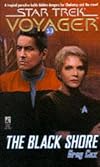
Though I liked the show a lot — minus a couple of character caveats, this is the first book I’ve ever tackled in the Star Trek universe dealing with the Voyager crew. This also happens to be one of the most enjoyable reads I’ve ever experienced in the book franchise based on the various shows. Whether it’s the Original Star Trek, Next Generation, or Deep Space Nine, everyone knows the quality of writing and stories for the paperbacks of their continuing adventures in that universe show more can run from dreadful to really good — but sadly, heavily weighted toward the former. Usually the characterization is off, or the story is lackluster, or the writing is terrible. I’m ecstatic to say that NONE of those things apply here.
Greg Cox has done a marvelous job of capturing the essence of the characters from the show, and he’s wrapped them in an entertaining and enjoyable story that while no new shakes, is like a splendid episode we simply weren’t allowed to see. Sure, if you critically examine it upon finishing, it has some standard similarities to an oft-repeated narrative — a seeming paradise with a dark underbelly — but it’s so well done and so entertaining, while you’re reading you simply don’t care. There’s humor and drama, a few thrills, a few dark moments but not so much it takes away from the good feeling throughout that you’re “watching” a lost episode.
Perhaps Cox’s greatest achievement is the way he chose to criss-cut the story, seamlessly flowing from one portion of the crew to the next to give us, the “viewer,” a cohesive overall picture, just as the film editors did on the show. Other writers in the Star Trek universe often choose to focus on one or two main characters, perhaps to make it easy on themselves, but Cox takes the road less traveled, giving most of the crew a chance to shine, and moments that provide us humor or drama, even a tiny bit of insight. It makes this one feel full and well-rounded, much more like a terrific episode where everyone is involved. That brings me to my next point:
By including Harry, Paris and Chakotay, Tuvok and Kes, Neelix and The Doctor, and especially Kes, this lessens the role the grating Janeway has to play in this. If you’re one of the millions like myself who laments that producers did not cast Erin Gray in the role of Janeway, and went with Kate Mulgrew instead, you don’t have to worry about the character as she was written, or as portrayed by Mulgrew, nearly ruining another great episode with her caustic, Kathryn Hepburn-level grating voice, and condescending personality. To be fair, that was the way Janeway was written, but I truly believe Gray would have brought more to the role, and perhaps found a way to dissuade the six people who wrote her character from turning her into such an infuriating mess. With her “screen time” wisely lessened here, though she does play an important role as Captain, she slides down the literary palate much easier here than in the show.
On the technical side, I did run into a number of typos in the print version — either an actual typo, or a “to” missing in a couple of sentences, for example — but they appear in as many mainstream books as they do self-published, despite what you hear from reviewers trying to pull the wool over your eyes. In this case, as is so often the case, it was ticky-tack stuff not relevant enough, nor frequent enough to ever become a distraction, or even an annoyance. And, this was a pretty big book as well. I only mention it as a preemptive strike because someone else is certain to laser in on it. Trust me, it’s nothing. If it was, I’d tell you.
I won’t go into fine detail about the plot on this rare occasion, since the premise is well explained on the back cover of the book and in the introduction of the listing, but suffice it to say I LOVED this one, and had an enjoyable time flying through it. For those wondering about the time frame on this one, Kes is still with Neelix, and Paris and Torres aren't even beginning to come together yet. A great read; a blast, in fact, and a book I’ll be keeping around so I can read it again at a later date. That says it all. show less
Greg Cox has done a marvelous job of capturing the essence of the characters from the show, and he’s wrapped them in an entertaining and enjoyable story that while no new shakes, is like a splendid episode we simply weren’t allowed to see. Sure, if you critically examine it upon finishing, it has some standard similarities to an oft-repeated narrative — a seeming paradise with a dark underbelly — but it’s so well done and so entertaining, while you’re reading you simply don’t care. There’s humor and drama, a few thrills, a few dark moments but not so much it takes away from the good feeling throughout that you’re “watching” a lost episode.
Perhaps Cox’s greatest achievement is the way he chose to criss-cut the story, seamlessly flowing from one portion of the crew to the next to give us, the “viewer,” a cohesive overall picture, just as the film editors did on the show. Other writers in the Star Trek universe often choose to focus on one or two main characters, perhaps to make it easy on themselves, but Cox takes the road less traveled, giving most of the crew a chance to shine, and moments that provide us humor or drama, even a tiny bit of insight. It makes this one feel full and well-rounded, much more like a terrific episode where everyone is involved. That brings me to my next point:
By including Harry, Paris and Chakotay, Tuvok and Kes, Neelix and The Doctor, and especially Kes, this lessens the role the grating Janeway has to play in this. If you’re one of the millions like myself who laments that producers did not cast Erin Gray in the role of Janeway, and went with Kate Mulgrew instead, you don’t have to worry about the character as she was written, or as portrayed by Mulgrew, nearly ruining another great episode with her caustic, Kathryn Hepburn-level grating voice, and condescending personality. To be fair, that was the way Janeway was written, but I truly believe Gray would have brought more to the role, and perhaps found a way to dissuade the six people who wrote her character from turning her into such an infuriating mess. With her “screen time” wisely lessened here, though she does play an important role as Captain, she slides down the literary palate much easier here than in the show.
On the technical side, I did run into a number of typos in the print version — either an actual typo, or a “to” missing in a couple of sentences, for example — but they appear in as many mainstream books as they do self-published, despite what you hear from reviewers trying to pull the wool over your eyes. In this case, as is so often the case, it was ticky-tack stuff not relevant enough, nor frequent enough to ever become a distraction, or even an annoyance. And, this was a pretty big book as well. I only mention it as a preemptive strike because someone else is certain to laser in on it. Trust me, it’s nothing. If it was, I’d tell you.
I won’t go into fine detail about the plot on this rare occasion, since the premise is well explained on the back cover of the book and in the introduction of the listing, but suffice it to say I LOVED this one, and had an enjoyable time flying through it. For those wondering about the time frame on this one, Kes is still with Neelix, and Paris and Torres aren't even beginning to come together yet. A great read; a blast, in fact, and a book I’ll be keeping around so I can read it again at a later date. That says it all. show less
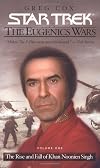
"It's all true!" Those words from Galaxy Quest fit for this stellar exercise in retconning!
I'd read this book when it came out, and recently got Kindle editions of the whole trilogy - it's a fun read. Carefully weaving 40+ years of Trek - and REAL - history into a narrative that explains how we didn't notice the "Eugenics War" and the rise (and fall) of Khan. Oh, and there's a story woven through with Kirk, Spock, McCoy, et al facing a new planet of genetic supermen.
On to the next volume!
I'd read this book when it came out, and recently got Kindle editions of the whole trilogy - it's a fun read. Carefully weaving 40+ years of Trek - and REAL - history into a narrative that explains how we didn't notice the "Eugenics War" and the rise (and fall) of Khan. Oh, and there's a story woven through with Kirk, Spock, McCoy, et al facing a new planet of genetic supermen.
On to the next volume!
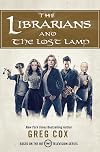
Based on the TV show, it feels like two books in one at times. It follows the Librarian Flynn in a 2006 story and jumps to the later Librarians in a 2016 story arc. Thankfully it is done well and seems seamless. In both story lines the Librarians are up against the 40 thieves on a hunt for Aladdin's Lamp.
As I enjoy the TV movies and the TV shows, I was a bit worried the book wouldn't be as good. Thankfully it was almost as good. I didn't realize Jones's attitude would annoy me more on the show more page than on TV, who knew. Still it was an enjoyable read. show less
As I enjoy the TV movies and the TV shows, I was a bit worried the book wouldn't be as good. Thankfully it was almost as good. I didn't realize Jones's attitude would annoy me more on the show more page than on TV, who knew. Still it was an enjoyable read. show less
Lists
Awards

You May Also Like


Associated Authors
Statistics
- Works
- 99
- Also by
- 29
- Members
- 9,192
- Popularity
- #2,611
- Rating
- 3.6
- Reviews
- 152
- ISBNs
- 239
- Languages
- 6
- Favorited
- 2

