
Dafydd ab Hugh (1960–2026)
Author of Invasion!: The Final Fury
About the Author
Series
Works by Dafydd ab Hugh
Associated Works
The Year's Best Science Fiction: Eighth Annual Collection (1991) — Contributor — 416 copies, 6 reviews
Nebula Awards 26: SFWA's Choices for the Best Science Fiction and Fantasy of the Year (1992) — Contributor — 52 copies, 1 review
Millemondi Inverno 1996 — Contributor — 2 copies
Tagged
Common Knowledge
- Canonical name
- ab Hugh, Dafydd
- Legal name
- ab Hugh, Dafydd
- Other names
- Friedman, David
Friedman, David M. - Birthdate
- 1960-10-22
- Date of death
- 2026-06
- Gender
- male
- Occupations
- novelist
- Organizations
- Science Fiction and Fantasy Writers of America (SFWA)
- Agent
- Ashley Grayson Literary Agency
- Nationality
- USA
- Birthplace
- Los Angeles, California, USA
- Places of residence
- Glendale, California, USA
- Associated Place (for map)
- California, USA
Members
Reviews

This is an odd one-- I can see why people like it (it's one of the few pre-Avatar DS9 novels to ever get praised), but it's slightly off; characters sometimes feel like caricatures of themselves. Odo is more overtly mean to Quark than he usually is, and at one point we learn that Bashir persuaded Odo to bug Quark's holosuites so that he can spy on Dax and Kira. Like, really, either of them would do that???
But on the whole, I think ab Hugh has good command of the characters. Obviously this is show more a "reset button" story, but you can write a good one of those if it gives insight into characters, and this one does. If the station were overrun and everyone was killed, this is exactly how it would happen, I think. There's a lot of good stuff here: Keiko's death was actually quite sad, O'Brien's soldier/engineer balance (so rarely addressed in the series) is well handled, the way that Jadzia dies but Dax lives on for a few moments is creepy but effective, Bashir is actually quite brilliant as he goes out. Maybe the only character whose death is a little too perfunctory is Kira's. (She's written a little dumbly at times, actually; I don't think ab Hugh has a great handle on her. Oh those pesky angry women!)
Best of all is Sisko and Jake and Molly. Sisko is a great Starfleet commander here, balancing the immediate needs of his people with that of the Federation/Bajor and even his son. His death is amazingly badass. And poor Jake and Molly's survival narrative is harrowing but really quite great. I don't think we ever even see Sisko and Jake in the same scene, but their bond is ever-present and strong.
Quark and Odo form the core of this novel, which makes this the second Odo-centric novel I've read in a row. Watching the show, it's easy to see why: though early S2 is where the other characters begin to pop much more ("The Circle" is where I finally felt the writers had a handle on all seven), throughout S1 Odo is consistently the strongest character, with Kira just behind him. If you asked me to pitch a DS9 novel in 1993, I'd pick Odo as protagonist too. I think this is the first story to pair the two off, something the show wouldn't do until "The Ascent" in S5. It's handled pretty well (except for Odo's occasional unnecessary meanness): I liked Odo's callback to "Babel," where he revises his statement that being trapped on DS9 with Quark would be the worst torment he could imagine, to that being trapped with a repentant Quark is even worse. I also liked some of the touches ab Hugh gives Ferengi culture, such as that there is an enormous set of ritual cringes, from the "relative's cringe" to "okay, you caught me with my hand in the cookie jar, but society's to blame." Someone needs to enter these on Memory Beta.
The heroic triumph of both characters is great: Odo's journey into the still-hot fusion core of the station is truly gripping, and I like that Quark gets to actually save the day. Though everyone is a jerk to him about it, poor guy. (Does Quark ever do anything as bad as people act like he does?)
Continuity Points:
Other Notes:
But on the whole, I think ab Hugh has good command of the characters. Obviously this is show more a "reset button" story, but you can write a good one of those if it gives insight into characters, and this one does. If the station were overrun and everyone was killed, this is exactly how it would happen, I think. There's a lot of good stuff here: Keiko's death was actually quite sad, O'Brien's soldier/engineer balance (so rarely addressed in the series) is well handled, the way that Jadzia dies but Dax lives on for a few moments is creepy but effective, Bashir is actually quite brilliant as he goes out. Maybe the only character whose death is a little too perfunctory is Kira's. (She's written a little dumbly at times, actually; I don't think ab Hugh has a great handle on her. Oh those pesky angry women!)
Best of all is Sisko and Jake and Molly. Sisko is a great Starfleet commander here, balancing the immediate needs of his people with that of the Federation/Bajor and even his son. His death is amazingly badass. And poor Jake and Molly's survival narrative is harrowing but really quite great. I don't think we ever even see Sisko and Jake in the same scene, but their bond is ever-present and strong.
Quark and Odo form the core of this novel, which makes this the second Odo-centric novel I've read in a row. Watching the show, it's easy to see why: though early S2 is where the other characters begin to pop much more ("The Circle" is where I finally felt the writers had a handle on all seven), throughout S1 Odo is consistently the strongest character, with Kira just behind him. If you asked me to pitch a DS9 novel in 1993, I'd pick Odo as protagonist too. I think this is the first story to pair the two off, something the show wouldn't do until "The Ascent" in S5. It's handled pretty well (except for Odo's occasional unnecessary meanness): I liked Odo's callback to "Babel," where he revises his statement that being trapped on DS9 with Quark would be the worst torment he could imagine, to that being trapped with a repentant Quark is even worse. I also liked some of the touches ab Hugh gives Ferengi culture, such as that there is an enormous set of ritual cringes, from the "relative's cringe" to "okay, you caught me with my hand in the cookie jar, but society's to blame." Someone needs to enter these on Memory Beta.
The heroic triumph of both characters is great: Odo's journey into the still-hot fusion core of the station is truly gripping, and I like that Quark gets to actually save the day. Though everyone is a jerk to him about it, poor guy. (Does Quark ever do anything as bad as people act like he does?)
Continuity Points:
- Not a lot here, but explicit references are made to a number of S1 episodes up to "In the Hands of the Prophets." Since that episode, Bajoran "Sunday schools" have sprung up on the station, and Sisko has been sending Jake to them. Through this, we learn some about ancient, pre-Prophet Bajoran gods, no longer worshiped except by radicals. Again, an area the show never touches on-- and given the first Orbs came to Bajor 10,000 years, and that the ur-B'hala was built 25,000 years ago, those must be some very old gods!
- There are also references to other DS9 novels, which is neat. O'Brien thinks of himself as an "amateur magician," a reference to his attempts to learn magic tricks to amuse Molly in The Siege, and there's also a couple references to the poker game in The Big Game (which I last read many, many years ago). If there were any references to Bloodletter, I missed them.
- O'Brien says he worked on the Enterprise when it was under construction at Starbase 13, which is why he transferred aboard the ship five years later. Given it's canonical that the ship was constructed at and launched from Utopia Planitia, do we take this to mean that perhaps some components were built at SB 13 in 2359 and sent on to Mars?
- The enemy race is this novel is known to the Cardassians as bogeymen called the "Bekkir." A hundred years ago, the Cardassians tried to recruit their help in attacking the Klingons. The Bekkir declined and attacked the Cardassians, who couldn't launch a punitive expedition because the Bekkir reside in the Gamma Quadrant. Pretty much nothing about this makes sense.
Other Notes:
- I liked the rhyming aliens.
- Welshman ab Hugh populates his novel with a number of UK sorts: a Scot, a Welshman, and a second Irishman are all on the DS9 crew. Also Odo calls a flashlight a torch!
- How generic is that cover?
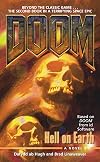
(Originally posted in my blog on March 28th 2010)
I'm not arrogant enough to believe that anyone reading this has actually been actively following me from blog-space to blog-space, fandom to fandom in my time on the internet (Except for that House of Fail guy, what is up with him?). So I don't expect anyone to know about, let alone remember, my review of DooM – Knee Deep In the Dead back when I was with the Splurd Crew. Long story short: I enjoyed not liking the book. I liked it the way show more people like Battlefield Earth.
For Christmas, Kippurbird of The Eragon Sporkings got me book two, Hell on Earth and I have to say I actually enjoyed this one.
The characters actually became a little more in depth, particularly Arlene who was a one dimentional Mary-Sue Ripley Knock-off in the first book.
We also delve into cults and religion and a whole whack of stuff and to be honest I think one of the strong points in this book was the fact that there were very few monsters and it was mostly character development. It made me feel a little dirty to come to that realization because it's a DooM book, it's all about the one note wanton violence! I’m not supposed to want character development.
Having said that, we do get appearances from more familiar monsters. Revenant and Mancubus show up, as does my beloved Arch-Vile.
We also get two new side-kicks. One is Jill the tom-boy hacker. I like Jill, which probably means she's going to get killed by the end of the series. The other is Albert, a former Marine turned Mormon with the hots for Arlene. Lucky for them Talking is a Free Action and discuss glory holes and marriage while trying to un-couple a train car from a speeding locomotive. Yes, really.
Unfortunately the writer still had an annoying habit of making characters stupid for plot reasons. For example, Fly says they need "tech" to build a ship. Arlene replies with "Tech?". Of course you need tech to build a freaking rocket ship! She could have said "What sort of tech?" or something, but no, Arlene was clueless.
Also continued was the out of place vocabulary. If you've taken the time to read my other review, or This FRIENDS 4 EVER!!!! strip, you know that one of my biggest problems with the book was that the character Fly had a vocabulary bigger than his education should allow for. One word that caught my attention in Knee Deep… was nomenclature. They use that word again in this book no less than twice. Also, I counted at least eight punctuation and spelling errors in the book. Eight. They miss-typed "The" as "eht". Almost every page had at least two exclamation points.
Finally, just like at the end of the last novel, Fly and Arlene are confronted with a huge problem and the last sentence is basically Arlene saying "Fly! I know how to _______ us to _______!"
At any rate I found it much more enjoyable for what it was then the first book and really want to finish the series but I can't find the other two books anywhere but online. My life is hard. show less
I'm not arrogant enough to believe that anyone reading this has actually been actively following me from blog-space to blog-space, fandom to fandom in my time on the internet (Except for that House of Fail guy, what is up with him?). So I don't expect anyone to know about, let alone remember, my review of DooM – Knee Deep In the Dead back when I was with the Splurd Crew. Long story short: I enjoyed not liking the book. I liked it the way show more people like Battlefield Earth.
For Christmas, Kippurbird of The Eragon Sporkings got me book two, Hell on Earth and I have to say I actually enjoyed this one.
The characters actually became a little more in depth, particularly Arlene who was a one dimentional Mary-Sue Ripley Knock-off in the first book.
We also delve into cults and religion and a whole whack of stuff and to be honest I think one of the strong points in this book was the fact that there were very few monsters and it was mostly character development. It made me feel a little dirty to come to that realization because it's a DooM book, it's all about the one note wanton violence! I’m not supposed to want character development.
Having said that, we do get appearances from more familiar monsters. Revenant and Mancubus show up, as does my beloved Arch-Vile.
We also get two new side-kicks. One is Jill the tom-boy hacker. I like Jill, which probably means she's going to get killed by the end of the series. The other is Albert, a former Marine turned Mormon with the hots for Arlene. Lucky for them Talking is a Free Action and discuss glory holes and marriage while trying to un-couple a train car from a speeding locomotive. Yes, really.
Unfortunately the writer still had an annoying habit of making characters stupid for plot reasons. For example, Fly says they need "tech" to build a ship. Arlene replies with "Tech?". Of course you need tech to build a freaking rocket ship! She could have said "What sort of tech?" or something, but no, Arlene was clueless.
Also continued was the out of place vocabulary. If you've taken the time to read my other review, or This FRIENDS 4 EVER!!!! strip, you know that one of my biggest problems with the book was that the character Fly had a vocabulary bigger than his education should allow for. One word that caught my attention in Knee Deep… was nomenclature. They use that word again in this book no less than twice. Also, I counted at least eight punctuation and spelling errors in the book. Eight. They miss-typed "The" as "eht". Almost every page had at least two exclamation points.
Finally, just like at the end of the last novel, Fly and Arlene are confronted with a huge problem and the last sentence is basically Arlene saying "Fly! I know how to _______ us to _______!"
At any rate I found it much more enjoyable for what it was then the first book and really want to finish the series but I can't find the other two books anywhere but online. My life is hard. show less
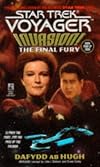
Ugh. Getting into this was like trying to get into a pair of skinny jeans. And, once I did there was wayy too much that was just wrong. Uh, Neelix as some sort of 'Swashbuckler' space pirate? Puleeze... I don't think so. B-Elanna, please, really, she's not insecure like that, not by a long shot. Ugh.
Not to mention Janeway's a scientist, NOT an engineer on the show. And in the Star Trek Universe there's a big difference between the scientists and the engineers. They even wear different show more division colors on their uniforms.
And, of course, there was the most often occurring mistake that's happened in more than one Star Trek Voyager novels. The Ops consoles are at the back of the bridge, not the front. Harry Kim's station is NOwhere near Tom Paris' station. Ack.
Add to all that the fact that none of them sounded right either. Or, a very trippy experience, ab Hugh didn't seem to be able to choose whether he wanted The Doctor to be able to turn himself on and off or let the crew do it. Agh.
A thoroughly horrendously written and plotted book and the only reason I plowed through it was because I wanted to finish the Invasion! series. I did have a story thought though. Maybe, since the book was about all these hellish furies, maybe the whole book was --supposed-- to be hell for the reader to read. But, I've tried to read other ab Hugh books which were just as bad. So I'm gonna stick with the simple answer. The author can't write good Star Trek Novels. show less
Not to mention Janeway's a scientist, NOT an engineer on the show. And in the Star Trek Universe there's a big difference between the scientists and the engineers. They even wear different show more division colors on their uniforms.
And, of course, there was the most often occurring mistake that's happened in more than one Star Trek Voyager novels. The Ops consoles are at the back of the bridge, not the front. Harry Kim's station is NOwhere near Tom Paris' station. Ack.
Add to all that the fact that none of them sounded right either. Or, a very trippy experience, ab Hugh didn't seem to be able to choose whether he wanted The Doctor to be able to turn himself on and off or let the crew do it. Agh.
A thoroughly horrendously written and plotted book and the only reason I plowed through it was because I wanted to finish the Invasion! series. I did have a story thought though. Maybe, since the book was about all these hellish furies, maybe the whole book was --supposed-- to be hell for the reader to read. But, I've tried to read other ab Hugh books which were just as bad. So I'm gonna stick with the simple answer. The author can't write good Star Trek Novels. show less
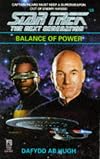
Well.... funny!
I remembered bits and pieces of this book from back in the day when I first read it - it's definitely a Hitchhiker's Guide kind of vibe, with multiple in-joke SF references. The best thing in the beginning is all the commiseration offered Geordi over the death of his beloved (not!) professor.
Sometimes the jokes go on too long, but there is a lot to like in this jolly Trek romp. I'm glad to find where the line about "a broken chronometer is right twice a day" discussion was, show more one I've remembered for years. show less
I remembered bits and pieces of this book from back in the day when I first read it - it's definitely a Hitchhiker's Guide kind of vibe, with multiple in-joke SF references. The best thing in the beginning is all the commiseration offered Geordi over the death of his beloved (not!) professor.
Sometimes the jokes go on too long, but there is a lot to like in this jolly Trek romp. I'm glad to find where the line about "a broken chronometer is right twice a day" discussion was, show more one I've remembered for years. show less
Lists
Awards


You May Also Like


Associated Authors
Statistics
- Works
- 24
- Also by
- 10
- Members
- 3,608
- Popularity
- #7,015
- Rating
- 3.3
- Reviews
- 37
- ISBNs
- 67
- Languages
- 4
- Favorited
- 2