
Charles Ives (1874–1954)
Author of Essays before a Sonata, and Other Writings
About the Author
Charles Ives is lecturer at the University of Washington.
Image credit: Charles Edward Ives, around 1913 This photo from around 1913 shows Ives in his "day job": he was the director of a successful insurance agency. (Public domain; Wikipedia)
Works by Charles Ives
Charles Ives: Variations on "America" (1891) for Organ; Adeste Fidelis In an Organ Prelude (1897) (Mercury Music Corp.) (1949) 8 copies
String Quartet No. 2 (Parts) 7 copies
Symphony no. 10 ; New England triptych ; American festival overture [sound recording] (1992) — Composer — 5 copies
Piano Sonata No. 1 (1902-1910) 4 copies
Nineteen Songs (New Music Edition) 3 copies
Symphonies Nos. 2 and 4/Serebrier, Ormandy, London Philharmonic, Philadelphia Orchestra (1999) 3 copies
Symphony No. 4 3 copies
Ives: The Unanswered Question; Holidays; Central Park in the Dark / Carter: Concerto for Orchestra (1998) 3 copies
Charles Ives's America 3 copies
Sunrise. Voice, violin and piano. < Text by Ives. > Edited by John Kirkpatrick. [Score. With a facsimile.] (1977) 3 copies, 1 review
The Orchestral Music of Charles Ives 2 copies
Fourteen songs for voice and piano 2 copies
Symphony no. 2 ; The Fourth of July 2 copies
Music for Chorus 2 copies
Piano Sonata 2 " Concord " 2 copies
Songs Vol. 2 2 copies
Ives: Symphony no.2 1 copy
Charles Ives - Gebundeld 1 copy
Moment Musical No. 2 in A-flat to Ives, Orchestral Set No. 2, II, "The Rockstrewn Hills Join in the People's outdoor meeting" 1 copy, 1 review
Ives: Songs, Vol. 3 1 copy
Complete symphonies 1 copy
"Country Band" March 1 copy
Track 37. Orchestral Set No. 2, II "The Rockstrewn Hills Join in The People's OUtdoor Meeting" 1 copy, 1 review
Three Harvest Home Chorales 1 copy
Study no. 23 : for piano 1 copy
Track 36. Orchestral Set No. 2, II "The Rockstrewn Hills Join in The People's OUtdoor Meeting" 1 copy, 1 review
Piano Works 1 copy
Elgar : Variations on an original theme 'Enigma', Op.36 + Ives : Symphony no.1 [sound recording] — Composer — 1 copy
BBC Proms 2021 : Prom 11 : Dvořák’s ‘New World’ Symphony [sound recording] (2021) — Composer — 1 copy
Variations On America: Organ Spectacular [sound recording] — Composer — 1 copy
Complete works for piano. 1 copy
Vocal Music 1 copy
The 100th Anniversary 1 copy
String Quartet No.2 1 copy
String quartets 1 copy
Songs. Volume 1 1 copy
Ives: Piano Sonata No. 2 Concord / Varied Air and Variations / The Celestial Railroad / Transcriptions from Emerson, No. 1 (2004) 1 copy
Charles Ives Symphony No. 2 1 copy
Ives;Symphonies 3 4 1 copy
Charles Ives - 5 Sonatas For Violin And Piano / Heleen Hulst - Violin, Gerard Bouwhuis - Piano 1 copy
Lieder 1 copy
17 Lieder / Klaviersonate Nr. 2 "Concord, Mass. 1840-1860" // Susan Graham, Pierre-Laurent Aimard 1 copy
The unknown Ives 1 copy
Easter Carol 1 copy
Turn Ye, Turn Ye 1 copy
Ives Symphony No 3 1 copy
Songs. 1 copy
Songs 1 copy
They are there! The Gregg Smith Singers; The American Symphony Orchersta; Leopold Stokowski, cond. (#46-48) Disk 4 of 4. 1 copy, 1 review
The Concord Sonata 1 copy
Violin Sonatas 2, 3, 4 1 copy
The Sixty-Seventh Song 1 copy
Associated Works
Barber : Adagio for strings + Copland : Quiet city + Cowell : Hymn and fuguing tune no.10 + Creston : A rumor + Ives : Symphony no.3 [sound recording] (1992) — Composer — 6 copies
Quiet City [sound recording] — Composer — 1 copy
Tagged
Common Knowledge
- Legal name
- Ives, Charles Edward
- Birthdate
- 1874-10-20
- Date of death
- 1954-05-19
- Gender
- male
- Occupations
- composer
organist
insurance executive - Awards and honors
- American Academy of Arts and Letters (Music ∙ 1946)
- Relationships
- Parker, Horatio (teacher)
Carter, Elliott (student) - Nationality
- USA
- Birthplace
- Danbury, Connecticut, USA
- Place of death
- New York, New York, USA
- Associated Place (for map)
- USA
Members
Reviews
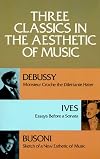
One of the joys of reading about aesthetics, particular as the field applies to music, is that there is such a variance of thought about what is beautiful. For all three of the authors included in this collection, beauty is not solely defined by consonance and dissonance. These composer-authors grapple with the role of inspiration, philosophical contexts, and music itself.
Claude Debussy, "Monsieur Croche the Dilettante Hater" (1927)
Debussy does not mince words and offers invective toward show more everything from opera to arts administration. It is more music criticism than a specific treatise on aesthetics. It is impossible, however, to read this group of essays without tasting the clear flavor of Debussy's own aesthetic agenda. For example, the Paris Opera, for Debussy, "...continue[s] to produce curious noises which the people who pay call music, but there is no need to believe them implicitly." (24)
Ferruccio Busoni, "Sketch of a New Esthetic of Music "(1911)
Busoni gives the reader a more straightforward offering complete with footnotes and musical examples. However, even Busoni likes to wax poetic: "Tradition is a plaster mask taken from life..." (n.1, p. 7). In another footnote, Busoni makes the case for microtonality, attacking the idea of musical "purity":
"But what is "pure," and what "impure?" We hear a piano "gone out of tune," and whose intervals may thus have become "pure, but unserviceable," and it sounds impure to us. The diplomatic "Twelve-semitone system" is an invention mothered by necessity yet none the less do we sedulously guard its imperfections." (89)
Charles Ives, "Essays before a Sonata" (1920)
It is Ives' contribution that is the most beautiful read. He offers an essay that is one part program note (for the Concord Sonata (1915, rev. 1947)) to two parts philosophical and aesthetic treatise. Writing with all the passion and transcendental fervor he can muster, Ives presents various New England literary figureheads as aesthetes, blurring the line between the artistry of literature and that of music. show less
Claude Debussy, "Monsieur Croche the Dilettante Hater" (1927)
Debussy does not mince words and offers invective toward show more everything from opera to arts administration. It is more music criticism than a specific treatise on aesthetics. It is impossible, however, to read this group of essays without tasting the clear flavor of Debussy's own aesthetic agenda. For example, the Paris Opera, for Debussy, "...continue[s] to produce curious noises which the people who pay call music, but there is no need to believe them implicitly." (24)
Ferruccio Busoni, "Sketch of a New Esthetic of Music "(1911)
Busoni gives the reader a more straightforward offering complete with footnotes and musical examples. However, even Busoni likes to wax poetic: "Tradition is a plaster mask taken from life..." (n.1, p. 7). In another footnote, Busoni makes the case for microtonality, attacking the idea of musical "purity":
"But what is "pure," and what "impure?" We hear a piano "gone out of tune," and whose intervals may thus have become "pure, but unserviceable," and it sounds impure to us. The diplomatic "Twelve-semitone system" is an invention mothered by necessity yet none the less do we sedulously guard its imperfections." (89)
Charles Ives, "Essays before a Sonata" (1920)
It is Ives' contribution that is the most beautiful read. He offers an essay that is one part program note (for the Concord Sonata (1915, rev. 1947)) to two parts philosophical and aesthetic treatise. Writing with all the passion and transcendental fervor he can muster, Ives presents various New England literary figureheads as aesthetes, blurring the line between the artistry of literature and that of music. show less

The classic Bernstein premiere recording of the great Second Symphony by Ives. This performance captures the sheer rugged charm of the symphony.
This is not my favorite Third Symphony performance, however. It seems more ungainly than it needs be. Indeed, it may be the worst recording of it I’ve ever heard.
The performance of the greatest concept art piece of the last century, The Unanswered Question, is fine.
This is the first CD of these performances by Bernstein and his usual orchestra. A show more later issue included a lecture by Bernstein not on this record. show less
This is not my favorite Third Symphony performance, however. It seems more ungainly than it needs be. Indeed, it may be the worst recording of it I’ve ever heard.
The performance of the greatest concept art piece of the last century, The Unanswered Question, is fine.
This is the first CD of these performances by Bernstein and his usual orchestra. A show more later issue included a lecture by Bernstein not on this record. show less
Busoni is one of my favorite composers. He possessed a complex style that combined the height of the Romantic era with a Modernism based on new ideas. In compositions like his operas (Doktor Faust, Turandot, and Arlecchino) he was on the leading edge of the twentieth century. Yet, he looked backward to Bach with a stylistic approach steeped in the soul of Liszt. Born in Italy but German in his approach to music he was also a theorist of Music and this volume is his exploration of absolute show more music and the nature of modern tonal music. show less
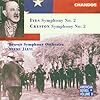
Tracklist
Charles Ives Symphony No. 2 For Large Orchestra (34:33)
1 – I. Andante Moderato 5:50
2 – II. Allegro 10:53
3 – III. Adagio Cantabile 7:23
4 – IV. Lento Maestoso 2:15
5 – V. Allegro Molto Vivace 8:05
Paul Creston Symphony No. 2, Op.35 (21:55)
6 – I. Introduction And Song: Slow, With Deep Emotion 11:44
7 – II. Interlude And Dance: Moderately Slow 10:08
Charles Ives Symphony No. 2 For Large Orchestra (34:33)
1 – I. Andante Moderato 5:50
2 – II. Allegro 10:53
3 – III. Adagio Cantabile 7:23
4 – IV. Lento Maestoso 2:15
5 – V. Allegro Molto Vivace 8:05
Paul Creston Symphony No. 2, Op.35 (21:55)
6 – I. Introduction And Song: Slow, With Deep Emotion 11:44
7 – II. Interlude And Dance: Moderately Slow 10:08
Awards

You May Also Like


Associated Authors
Statistics
- Works
- 311
- Also by
- 10
- Members
- 941
- Popularity
- #27,308
- Rating
- 4.2
- Reviews
- 178
- ISBNs
- 37
- Languages
- 4
- Favorited
- 1
