
Nicolas Slonimsky (1894–1995)
Author of Schirmer Pronouncing Pocket Manual of Musical Terms
About the Author
Nicolas Slonimsky, writer, lexicographer, pianist, composer, conductor, teacher. He died in 1995 at the age of 101
Works by Nicolas Slonimsky
Lexicon of Musical Invective: Critical Assaults on Composers Since Beethoven's Time (1990) 229 copies, 5 reviews
Tagged
Common Knowledge
- Birthdate
- 1894-04-27
- Date of death
- 1995-12-25
- Gender
- male
- Education
- St. Petersburg Conservatory
- Occupations
- professor
musicologist
conductor
pianist
composer
lexicographer (show all 7)
music writer - Organizations
- American Academy of Arts and Letters (American Honorary ∙ 1991)
Boston Chamber Orchestra (founder) - Relationships
- Wengeroff, Pauline (grandmother)
Sazonova, Yulia Slonimskaya (sister)
Slonimsky, Mikhail (brother)
Adlow, Dorothy (wife) - Short biography
- http://en.wikipedia.org/wiki/Nicholas...
Nicolas Slonimsky was born Nikolai Leonidovich Slonimskiy to a family of the intelligentsia in St. Petersburg, Russia. His maternal aunt, Isabelle Vengerova, later a founder of the Curtis Institute of Music in Philadelphia, was his first piano teacher. After studying at the St. Petersburg Conservatory, he fled the Bolshevik Revolution of 1917 first to Kyiv, then ultimately to Paris, where his sister Yulia Slonimskaya Sazonova was already living. He settled in Rochester, New York, in 1923. After two years, he moved to Boston, where he taught music theory at the Boston Conservatory and the Malkin Conservatory, and began to write music articles for The Boston Evening Transcript, The Christian Science Monitor, and The Etude magazine. In 1927, he formed the Boston Chamber Orchestra, and championed contemporary music, which he conducted around the world. In 1931, he married Dorothy Adlow, art critic of The Christian Science Monitor, with whom he had a daughter Electra, who later edited his letters and collected works. Throughout his life, Slonimsky wrote extensively for periodicals and newspapers, produced program and liner notes, and contributed to numerous reference works. When his active conducting career slowed, he spent more time writing about music. In 1947, he published the Thesaurus of Scales and Melodic Patterns, one of his most influential works for composers and performers. Two books for children followed, The Road to Music and A Thing or Two About Music. In 1952, Slonimsky brought out the Lexicon of Musical Invective, a collection of insulting contemporary critiques of musical greats in their time. In 1958, he became editor of Baker's Biographical Dictionary of Musicians, and remained its chief editor until 1992. In 1964, Slonimsky's wife died, and he moved to Los Angeles. He taught at the University of California at Los Angeles for three years, and lectured and spoke about music. In 1988, he published his autobiography, Perfect Pitch, filled with anecdotes about musical figures of the 20th century. - Nationality
- USA
Russia (birth) - Birthplace
- St. Petersburg, Russia
- Places of residence
- Paris, France
Rochester, New York, USA
Boston, Massachusetts, USA
Los Angeles, California, USA - Place of death
- Los Angeles, California, USA
- Associated Place (for map)
- USA
Members
Reviews
Lexicon of musical invective: critical assaults on composers since Beethoven's time by Nicolas Slonimsky

A classic compilation of negative and insulting — and therefore often very funny — reviews of new music. Slonimsky starts with Beethoven — partly because it’s intrinsically funny to see people saying rude things about a composer who now has such an elevated status in our understanding of music history, but also partly for the very practical reason that he coincides with the beginning of the era of public concerts, before which there was no real raison d’être for music critics. The show more book was originally compiled in the early 1950s, with a supplement added about ten years later, but Slonimsky only looks at composers who came on the musical scene up to about the early 1930s. Shostakovich is in, but there’s no sign of people like Britten, Boulez, or Stockhausen. (Although Peter Maxwell Davies sneaks in with a passing mention in a 1960s criticism that is really included because of what it says about Schoenberg.)
Almost all the music that is being slagged off here by people who ought to know better has since made it firmly into the western canon. I suppose it wouldn’t be as funny, or as interesting, to see negative reviews of deservedly forgotten music. There are a few less familiar names — Roy Harris, Edgar Varèse, and Carl Ruggles, for example, don’t often make it onto present-day concert programmes, but they were composers whose music Slonimsky supported and premiered himself in the 20s and 30s, so it makes sense that they appear here.
It’s probably no surprise to see how long the entries for Wagner, Stravinsky and Schoenberg are — they were composers who wrote music that was intended to be new and shocking, after all — but it’s fascinating to see how much invective people like Brahms, Debussy, and Berlioz attracted. Novelty of any kind is clearly considered dangerous in the musical world. Fun to see that Sibelius and Bizet were both attacked for tunelessness in their time, and Verdi‘s Rigoletto was said to “lack melody”. Occasionally we see a critic taking the opposite approach: “sad to see that the composer of the daring and innovative work A has come along twenty years later with something as dull and conservative as B”. Which is particularly amusing if Slonimsky has just shown us the same critic lambasting A, twenty years earlier…
One of the joys of the book is that composers are arranged alphabetically, not chronologically, so that we can see how the pattern of critical response to the unfamiliar in music has not really changed much between the 1800s and the 1930s. Slonimsky reinforces this with a thematic index (“Invecticon”), where we can see how many critics chose to accuse composers of absence of melody, or a score so confusing no-one could tell which notes were played wrong, or animal noises (cats, cattle, frogs, zoo animals, cat-walking-on-the-keyboard), and so on. Another very common rhetorical device is to express sympathy for the audience, the instruments, or the players. Any composer foolish enough to put something nautical into the title of a work (Debussy, Wagner, …) is evidently opening the door to accusations of causing seasickness. It’s also interesting to see how acceptable ad hominem attacks were in the rough-and-tumble of 19th and early 20th century journalism. It seemed to be no problem at all to attack a composer for being ugly (Debussy), Jewish (Schoenberg, Bruch), Russian (Shostakovich, Tchaikovsky), or mentally ill (Wagner).
Not a particularly useful book, unless you are a music critic looking for examples of clichés to avoid, but great fun to dip into. show less
Almost all the music that is being slagged off here by people who ought to know better has since made it firmly into the western canon. I suppose it wouldn’t be as funny, or as interesting, to see negative reviews of deservedly forgotten music. There are a few less familiar names — Roy Harris, Edgar Varèse, and Carl Ruggles, for example, don’t often make it onto present-day concert programmes, but they were composers whose music Slonimsky supported and premiered himself in the 20s and 30s, so it makes sense that they appear here.
It’s probably no surprise to see how long the entries for Wagner, Stravinsky and Schoenberg are — they were composers who wrote music that was intended to be new and shocking, after all — but it’s fascinating to see how much invective people like Brahms, Debussy, and Berlioz attracted. Novelty of any kind is clearly considered dangerous in the musical world. Fun to see that Sibelius and Bizet were both attacked for tunelessness in their time, and Verdi‘s Rigoletto was said to “lack melody”. Occasionally we see a critic taking the opposite approach: “sad to see that the composer of the daring and innovative work A has come along twenty years later with something as dull and conservative as B”. Which is particularly amusing if Slonimsky has just shown us the same critic lambasting A, twenty years earlier…
One of the joys of the book is that composers are arranged alphabetically, not chronologically, so that we can see how the pattern of critical response to the unfamiliar in music has not really changed much between the 1800s and the 1930s. Slonimsky reinforces this with a thematic index (“Invecticon”), where we can see how many critics chose to accuse composers of absence of melody, or a score so confusing no-one could tell which notes were played wrong, or animal noises (cats, cattle, frogs, zoo animals, cat-walking-on-the-keyboard), and so on. Another very common rhetorical device is to express sympathy for the audience, the instruments, or the players. Any composer foolish enough to put something nautical into the title of a work (Debussy, Wagner, …) is evidently opening the door to accusations of causing seasickness. It’s also interesting to see how acceptable ad hominem attacks were in the rough-and-tumble of 19th and early 20th century journalism. It seemed to be no problem at all to attack a composer for being ugly (Debussy), Jewish (Schoenberg, Bruch), Russian (Shostakovich, Tchaikovsky), or mentally ill (Wagner).
Not a particularly useful book, unless you are a music critic looking for examples of clichés to avoid, but great fun to dip into. show less
Lexicon of Musical Invective: Critical Assaults on Composers Since Beethoven's Time (Washington Paperbacks) by Nicolas Slonimsky

Critics are so awesome in the creative critiques of music they don't like, especially from the early 1800s, before political correctness. The whole scholarly introduction is quite wonderful, basically saying "Music tastes change" when in reality, the whole point of this book is to put together horrible reviews for the amusement of readers.
My favourite review goes something like this "This piece of music sounds like a bunch of nails, and occasionally the hammer dropping". I don't remember who show more said it of which composer, but the quote is awesome. And strangely, I can totally imagine this piece of music. show less
My favourite review goes something like this "This piece of music sounds like a bunch of nails, and occasionally the hammer dropping". I don't remember who show more said it of which composer, but the quote is awesome. And strangely, I can totally imagine this piece of music. show less
This has to be my favourite dictionary. Its witty, lively and sometimes a bit subversive. Its a book to take to bed and to wonder at the amazing lives and phenomena of the most elusive of the arts.
Lexicon of Musical Invective: Critical Assaults on Composers Since Beethoven's Time by Nicolas Slonimsky
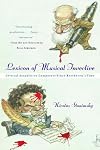
So, so amusing! And it's useful for reception history research! (Well, sometimes.) A fascinating look at the most colorful critical insults on various famous (and some not-so-famous) composers throughout history. Notes available for further research.
Awards

You May Also Like


Associated Authors
Statistics
- Works
- 41
- Members
- 1,131
- Popularity
- #22,700
- Rating
- 4.1
- Reviews
- 10
- ISBNs
- 89
- Languages
- 2