
Harold C. Schonberg (1915–2003)
Author of The Lives of the Great Composers
About the Author
Works by Harold C. Schonberg
The Great Pianists 1 copy
The Virtuosi 1 copy
Associated Works
Great Tours and Detours: The Sophisticated Traveler Series (1985) — Contributor — 35 copies, 1 review
Tagged
Common Knowledge
- Legal name
- Schonberg, Harold Charles
- Birthdate
- 1915-11-29
- Date of death
- 2003-07-26
- Gender
- male
- Education
- Brooklyn College (BA|1937)
New York University - Occupations
- journalist
music critic - Organizations
- The New York Times
United States Army Signal Corps - Awards and honors
- Pulitzer Prize (Criticism, 1971)
- Nationality
- USA
- Birthplace
- New York, New York, USA
- Places of residence
- New York, New York, USA
- Place of death
- New York, New York, USA
- Associated Place (for map)
- New York, New York, USA
Members
Discussions
The Rest is Noise #1 in Le Salon Littéraire du Peuple pour le Peuple (June 2012)
Reviews

First published in 1971, this magisterial one-volume book contains brief but erudite commentaries on the bulk of composers anyone would really want to know about.
In a 'Postlude', Schonberg comments on classical music post-World War II and says that none of the post-war composers have made any impact on the bulk of the classical repertoire, or the consciousness of the public. He declines to offer a view as to whether some musical form or other will capture that imagination, though he hints show more that the film composer might well fill part of that void. But overall, he says that there has been "a hiatus" in the stream of great composers which stretched unbroken from the time of Bach.
Hindsight is a wonderful thing. Shostakovich was still alive and composing in 1971; and there have been a few contemporary superstars that have arisen since then - Tippett, Williamson, Maxwell Davies, Lutoslawski, Stockhausen, Rorem and Turnage are just a few that come to mind. Oddly, Benjamin Britten is relegated to a virtual footnote on opera since Puccini. The Minimalists - Glass, Adams, Reich and Nyman - were a few years in the future and still brash young students when Schonberg was writing. And it's always possible to argue for re-discovered composers - Alkan, Brian and Lloyd are my candidates.
But these are minor quibbles. By the time anyone gets round to enthusing over the names I've mentioned, they're already well-immersed in the world of classical music. But this book should be the back-stop on their shelves as it is on mine. show less
In a 'Postlude', Schonberg comments on classical music post-World War II and says that none of the post-war composers have made any impact on the bulk of the classical repertoire, or the consciousness of the public. He declines to offer a view as to whether some musical form or other will capture that imagination, though he hints show more that the film composer might well fill part of that void. But overall, he says that there has been "a hiatus" in the stream of great composers which stretched unbroken from the time of Bach.
Hindsight is a wonderful thing. Shostakovich was still alive and composing in 1971; and there have been a few contemporary superstars that have arisen since then - Tippett, Williamson, Maxwell Davies, Lutoslawski, Stockhausen, Rorem and Turnage are just a few that come to mind. Oddly, Benjamin Britten is relegated to a virtual footnote on opera since Puccini. The Minimalists - Glass, Adams, Reich and Nyman - were a few years in the future and still brash young students when Schonberg was writing. And it's always possible to argue for re-discovered composers - Alkan, Brian and Lloyd are my candidates.
But these are minor quibbles. By the time anyone gets round to enthusing over the names I've mentioned, they're already well-immersed in the world of classical music. But this book should be the back-stop on their shelves as it is on mine. show less

This book, though quite compelling and full of great anecdotes, falls short of his Great Composers, Great Pianists, and Great Conductors books. Nevertheless, no one has written about music and its artists of all types with more love and insight then Schonberg, and this book will have you searching for archival recordings of Caruso, Hofmann, and lots of others. If only they existed for Liszt and Paganini! Quoting from eyewitnesses, Schonberg tries to give us a feeling for what made each show more performer, whether a singer or an instrumentalist special. He is diligent to seek out both strengths and weaknesses, though he has to look pretty hard for weaknesses in a few cases. Throughout, he writes in his standard compelling but opinionated mode. There is a great deal of regret that contemporary performers (i.e., 1985) lack the power, insight, or spontaneity of prior generations. He would definitely jump in a time machine to 1920 if he had the chance. Many of his readers will want to do the same. show less
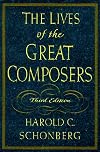
It's rare for a writer to express strong opinions without running off the rails with the facts. Schonberg's biographies of composers (I have the 1981 edition) is strongly opinionated and yet (as far as I can tell) factually accurate. You may disagree with him, even be infuriated with him, but you'll get a lot of information about the composers and their connections with each other. I hadn't previously known that Debussy liked cats better than people (clearly a wise man). The descriptions of show more how composers were received in their own time are especially interesting. There were rivalries and alliances, just as there are today. The book should be findable in used bookstores or on eBay. show less
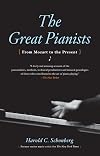
I found this book fascinating. It doesn't concentrate on biographical details of the great pianists, but rather on their personalities, idiosyncracies and their piano playing style as described by those who heard (and saw) them.
There's some delightful titbits in there, such as the fact that Liszt was a handsome man with long hair, who would throw his hands around, and toss his hair over his face, make dramatic gestures and fierce grimaces while playing. Ladies would swoon and scream and show more throw their jewellery on the stage while he played. The first rock star?
As well as anecdotes like that, the book is also a history of piano playing, from the piano's invention in Bach's day, until the time of writing, which was the 1980s. It gives a clear picture of the changes from baroque to classical to romantic to modernist. As a piano player, I found some fascinating insights there too, such as that it's a relatively new idea that the performer should slavishly adhere to what's written on the score - it was the norm for over a century to embellish and enforce one's own personality onto the music.
My only complaint is that the book finishes too soon - reading it now, I feel like I'm missing out on the rest of the story - it was written squarely in the modernist period, which I'm sure is over now. What are we at now? Post-modernist? Neo-romantic? Eclectic? I'd love someone to tell me. show less
There's some delightful titbits in there, such as the fact that Liszt was a handsome man with long hair, who would throw his hands around, and toss his hair over his face, make dramatic gestures and fierce grimaces while playing. Ladies would swoon and scream and show more throw their jewellery on the stage while he played. The first rock star?
As well as anecdotes like that, the book is also a history of piano playing, from the piano's invention in Bach's day, until the time of writing, which was the 1980s. It gives a clear picture of the changes from baroque to classical to romantic to modernist. As a piano player, I found some fascinating insights there too, such as that it's a relatively new idea that the performer should slavishly adhere to what's written on the score - it was the norm for over a century to embellish and enforce one's own personality onto the music.
My only complaint is that the book finishes too soon - reading it now, I feel like I'm missing out on the rest of the story - it was written squarely in the modernist period, which I'm sure is over now. What are we at now? Post-modernist? Neo-romantic? Eclectic? I'd love someone to tell me. show less
Lists
You May Also Like


Associated Authors
Statistics
- Works
- 27
- Also by
- 1
- Members
- 1,638
- Popularity
- #15,683
- Rating
- 4.1
- Reviews
- 16
- ISBNs
- 58
- Languages
- 8
- Favorited
- 6