
Elizabeth Stuart Phelps (1844–1911)
Author of The Story of Avis
About the Author
Disambiguation Notice:
Please do not delete CK content again unless it is in error! Do not combine or confuse this author with her mother, Elizabeth Wooster Stuart Phelps (1815-1852).
Image credit: See below.
Series
Works by Elizabeth Stuart Phelps
Our Famous Women : An Authorized Record of The Lives and Deeds of Distinguished American Women of Our Times (1975) 6 copies
Friends: a duet 3 copies
The Man in the Case 3 copies
Though life us do part 2 copies
Come forth 2 copies
Since I died 2 copies
Hedged in 2 copies
Donald Marcy 2 copies
Fourteen to One [and other stories]. 2 copies
Tiny's Sunday Nights 1 copy
A Chariot of Fire 1 copy
Through Life Us Do Part 1 copy
Madonna of the Tubs 1 copy
Old maid's paradise 1 copy
Our Famous Women 1 copy
The True Story of Guenever 1 copy
The boys of Brimstone Court 1 copy
Associated Works
The Camelot Chronicles: Heroic Adventures from the Age of Legend (1992) — Contributor — 137 copies, 1 review
What Did Miss Darrington See? An Anthology of Feminist Supernatural Fiction (1989) — Contributor — 126 copies
Weird Women: Classic Supernatural Fiction by Groundbreaking Female Writers: 1852-1923 (2020) — Contributor — 108 copies, 2 reviews
Two Friends and Other 19th-century American Lesbian Stories (1994) — Contributor — 107 copies, 1 review
The Darker Sex: Tales of the Supernatural and Macabre by Victorian Women Writers (2009) — Contributor — 55 copies, 2 reviews
The Lifted Veil: The Book of Fantastic Literature by Women 1800-World War II (1806) — Contributor — 45 copies
Women in the Trees: U.S. Women's Short Stories About Battering and Resistance, 1839-1994 (1996) — Contributor — 45 copies
Daring to Dream: Utopian Fiction by Nineteenth Century Women Writers (1984) — Contributor — 39 copies
Ghostly Gentlewomen: Two Centuries of Spectral Stories by the Gentle Sex (1977) — Contributor — 26 copies
The Wimbourne Book of Victorian Ghost Stories (Annotated): Volume 11 (2022) — Contributor — 3 copies
The Wimbourne Book of Victorian Ghost Stories (Annotated): Volume 22 — Contributor — 1 copy
Tagged
Common Knowledge
- Other names
- Phelps, Mary Gray (birth name)
Phelps, Lily
Adams, Mary
Ward, Elizabeth Stuart Phelps - Birthdate
- 1844-08-31
- Date of death
- 1911-01-28
- Gender
- female
- Education
- Abbot Academy
Mrs. Edwards' School for Young Ladies - Occupations
- novelist
essayist
social reformer
feminist - Relationships
- Phelps, Austin (father)
Trusta, H. (mother) - Short biography
- Elizabeth Stuart Phelps, later Ward, was born Mary Gray Phelps in Andover, Massachusetts. Her parents were Austin Phelps, a Congregational minister and educator, and his wife Elizabeth Wooster Stuart Phelps, author of the Kitty Brown series of books for girls under the pen name H. Trusta. After her mother died when she was eight years old, she asked to be renamed in her honor. Elizabeth received an excellent education, attending the Abbot Academy and Mrs. Edwards' School for Young Ladies. She began writing as a child and published a story in the magazine Youth's Companion at age 13. A couple of years later, she won recognition from prominent literary figures such as John Greenleaf Whittier when her story "The Tenth of January" appeared in The Atlantic Monthly. In 1868, she published The Gates Ajar, a bestselling fantasy novel about the afterlife that won her national fame and popularity. It was followed by Beyond the Gates (1883) and The Gates Between (1887). During her lifetime, she published 57 volumes of fiction, poetry and essays, all of which challenged the conventional view that a woman's place was in the home and often portrayed women in careers. She also wrote several poems and three short stories on Arthurian themes. In 1888, she married Herbert D. Ward, a journalist 17 years her junior, in another break with the norms of the time. She became an advocate through her writing, lectures and other work for social reform, temperance, and the women's emancipation. She was also involved in clothing reform for women, and in 1874 urged them to burn their corsets.
- Nationality
- USA
- Birthplace
- Andover, Massachusetts, USA
- Place of death
- Newton Center, Massachusetts, USA
- Burial location
- Newton Cemetery, Newton, Massachusetts, USA
- Disambiguation notice
- Please do not delete CK content again unless it is in error! Do not combine or confuse this author with her mother, Elizabeth Wooster Stuart Phelps (1815-1852).
- Associated Place (for map)
- Massachusetts, USA
Members
Reviews

Originally published in 1904, Trixy is an antivivisection novel by the activist Elizabeth Stuart Phelps. Aside from print-on-demand editions, this is the first publication of the novel since 1905. In a 2019 edition from Northwestern University Press, editor Emily E. VanDette reprints the complete text with a forty-page introduction, seven pages of endnotes, and contextual materials.
Trixy is of a piece with other antivivisection novels of the era, pitting a sympathetic female protagonist show more against a harsh male vivisector and strongly emphasizing dogs in particular as a victim of vivisection. In this case, the sympathetic Miriam Lauriat is wooed by the accomplished young doctor Olin Steele, who, unbeknownst to her, is a vivisector. At the same time, Miriam makes the acquaintance of a young man named Dan and his performing dog, Trixy, who is snatched in order to be made an experimental subject in Steele's laboratory.
Like many other antivivisection novels Trixy associates the danger of vivisection with a danger to women. The threat Steele poses to Miriam is not physical danger but, rather, his possessive attitude toward women. Although as a young trainee he could not bear to see an animal experimented upon, he has by the novel's present time dissected the brains of fifty dogs in his search for the physiological cause of love and concluded that love doesn't exist. He believes that the weak must be sacrificed to the strong and that women must therefore be gained by force. Steele loves Miriam, but his clinical training has destroyed his capacity to understand his feelings. Phelps's novel thus argues that vivisection is dangerous because of the harm it causes not only to innocent animals but also to the vivisector. While this argument is not uncommon, Phelps's emphasis on misogyny and her exploration of the continuity between the animal and the human distinguish her approach within the convention. As a result, the republication of Trixy will be of interest to scholars of feminist activism as well as scientific ethics.
You can read the rest of this review at Legacy: A Journal of American Woman Writers, though only if you have access to Project MUSE, alas. show less
Trixy is of a piece with other antivivisection novels of the era, pitting a sympathetic female protagonist show more against a harsh male vivisector and strongly emphasizing dogs in particular as a victim of vivisection. In this case, the sympathetic Miriam Lauriat is wooed by the accomplished young doctor Olin Steele, who, unbeknownst to her, is a vivisector. At the same time, Miriam makes the acquaintance of a young man named Dan and his performing dog, Trixy, who is snatched in order to be made an experimental subject in Steele's laboratory.
Like many other antivivisection novels Trixy associates the danger of vivisection with a danger to women. The threat Steele poses to Miriam is not physical danger but, rather, his possessive attitude toward women. Although as a young trainee he could not bear to see an animal experimented upon, he has by the novel's present time dissected the brains of fifty dogs in his search for the physiological cause of love and concluded that love doesn't exist. He believes that the weak must be sacrificed to the strong and that women must therefore be gained by force. Steele loves Miriam, but his clinical training has destroyed his capacity to understand his feelings. Phelps's novel thus argues that vivisection is dangerous because of the harm it causes not only to innocent animals but also to the vivisector. While this argument is not uncommon, Phelps's emphasis on misogyny and her exploration of the continuity between the animal and the human distinguish her approach within the convention. As a result, the republication of Trixy will be of interest to scholars of feminist activism as well as scientific ethics.
You can read the rest of this review at Legacy: A Journal of American Woman Writers, though only if you have access to Project MUSE, alas. show less
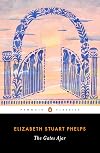
There are reasons that its popularity did not continue. And some are valid.
But Phelps gives a startlingly legitimate portrait of grief and questioning. I remembered something I had read regarding the post-Civil War life: That there were literally towns full of women because towns full of men had been killed (because of the way that they composed their companies). These seemed to be her audience.
I liked the book, in perspective. I liked it, especially with the ties to Stowe and mourning. I show more also thought the conclusions (based on her reading of The Bible and life) that Winifred reaches regarding heaven were interesting*.
*see [b:The Book of Mormon: Another Testament of Jesus Christ|323355|The Book of Mormon Another Testament of Jesus Christ|Anonymous|https://images.gr-assets.com/books/1327389004s/323355.jpg|2139868], particularly the book of Alma. show less
But Phelps gives a startlingly legitimate portrait of grief and questioning. I remembered something I had read regarding the post-Civil War life: That there were literally towns full of women because towns full of men had been killed (because of the way that they composed their companies). These seemed to be her audience.
I liked the book, in perspective. I liked it, especially with the ties to Stowe and mourning. I show more also thought the conclusions (based on her reading of The Bible and life) that Winifred reaches regarding heaven were interesting*.
*see [b:The Book of Mormon: Another Testament of Jesus Christ|323355|The Book of Mormon Another Testament of Jesus Christ|Anonymous|https://images.gr-assets.com/books/1327389004s/323355.jpg|2139868], particularly the book of Alma. show less
A stressed and unfulfilled housewife and mother is asked by her husband to try an experiment; she's to have an hour or so each day just to do things for herself. The woman agrees and tries the experiment but everytime she goes into her room for a little 'me' time she is interrupted.
Unfulfilled and highly stressed out, the woman moans about how meaningless and mundane her life is until she gets a wake-up call and new lease on life by two Guardian Angels. This is a short story that can be show more read in one sitting. I truly enjoyed this inspirational book and identified with the main character. I thought the title ought to be 'A Woman's work is never done' until I read the ending. show less
Unfulfilled and highly stressed out, the woman moans about how meaningless and mundane her life is until she gets a wake-up call and new lease on life by two Guardian Angels. This is a short story that can be show more read in one sitting. I truly enjoyed this inspirational book and identified with the main character. I thought the title ought to be 'A Woman's work is never done' until I read the ending. show less

3771. The Gates Ajar, by Elizabeth Stuart Phelps (read 20 July 2003) I believe this book was mentioned in one of Vera Brittain's letters (read 26 June 2003) and finding it in a local college library--it was published in 1869 and the copy I read was put out that year--I read it. I guess it is a novel, but it is more an "inspirational" book, talking much about what heaven will be like, and may well be comforting for some who grieve. Not my usual fare, but I don't mind having read it.
Lists
Must-Read Maine (1)
Awards


You May Also Like


Associated Authors
Statistics
- Works
- 67
- Also by
- 32
- Members
- 483
- Popularity
- #51,117
- Rating
- 3.6
- Reviews
- 7
- ISBNs
- 147
- Languages
- 1
- Favorited
- 1


