

Tim Heald (1944–2016)
Author of The Best After-Dinner Stories
About the Author
Image credit: Tim Heald
Series
Works by Tim Heald
Great Stories of Crime and Detection, Volumes I-IV: Beginnings to the Present (2002) — Editor — 73 copies
The best after-dinner stories 13 copies
Man Who Will Be King H R H 1 copy
Red Herrings : A Novel 1 copy
It's A Dog's Life 1 copy
Associated Works
The Year's 25 Finest Crime and Mystery Stories: Third Annual Edition (1994) — Contributor — 10 copies
Fingerprints : A Collection of Stories by the Crime Writers of Canada (1984) — Contributor — 2 copies
Tagged
Common Knowledge
- Legal name
- Heald, Timothy Villiers
- Other names
- Lancaster, David
- Birthdate
- 1944-01-28
- Date of death
- 2016-11-20
- Gender
- male
- Education
- Connaught House, Somerset, England, UK
Sherborne School, Dorset, England, UK
University of Oxford (Balliol College) - Occupations
- biographer
columnist
journalist
public speaker
novelist - Organizations
- Daily Express
- Nationality
- UK
- Birthplace
- Dorchester, Dorset, England, UK
- Places of residence
- Fowey, Cornwall, England, UK
Somerset, England, UK
Oxford, Oxfordshire, England, UK
Dorset, England, UK
Tasmania, Australia
South Australia, Australia - Associated Place (for map)
- England, UK
Members
Reviews

I chose the second story To Be Taken With a Grain of Salt by Charles Dickens. Don’t ask me why, because, with the exception of A Christmas Carol I can’t tolerate Dickens’ paid-by-the-word writing style. Maybe I felt the need to torture myself with mind-numbing prose?
If I did, I failed, because this story was delightful! Written with an economy of style I can hardly credit to Dickens, but fully fleshed out and wonderfully creepy. At 10 pages long it’s a compact ghost story about a man show more who sits on the jury of a murder trial, and how the victim sees to it that justice is done. It’s an unconventional follow-up to the conventional starter, and it makes me eager to find out what’s to follow. I doubt I’ll follow them in strict order, but I have high hopes that they’ll all be wroth reading, and I look forward to filling up my index card.
It has left me feeling completely flummoxed by Charles Dickens though. show less
If I did, I failed, because this story was delightful! Written with an economy of style I can hardly credit to Dickens, but fully fleshed out and wonderfully creepy. At 10 pages long it’s a compact ghost story about a man show more who sits on the jury of a murder trial, and how the victim sees to it that justice is done. It’s an unconventional follow-up to the conventional starter, and it makes me eager to find out what’s to follow. I doubt I’ll follow them in strict order, but I have high hopes that they’ll all be wroth reading, and I look forward to filling up my index card.
It has left me feeling completely flummoxed by Charles Dickens though. show less

I'm calling this finished, even though technically I haven't read it cover to cover. In part because it's really not meant to be read cover to cover, but dipped into now and again more or less randomly and in part because it's making me itch to see it squatting on my Currently Reading list.
The Best of the Raconteurs is a rather large collection of anecdotes, bits from speeches and other odds and ends - some seem almost to be snippets of conversation - collected from an incredibly varied show more cast of wits including Nora Ephron, William Churchill, Oscar Wilde, and David Niven, to touch upon just a very few.
The quality of the entries is all over the place; as some of them aren't more than a paragraph, while others are 2 or 3 pages long, odds were always long that every entry was going to be a winner. Nora Ephron's entry had me laughing out loud, while Ogden Nash's poem charmed me until the very end, where it promptly made my hair stand on end (which is exactly the effect Nash would have wanted). Those that fell flat were the definition of unmemorable.
Generally, a good collection, if you like anecdotes, and very likely to have something for everyone. show less
The Best of the Raconteurs is a rather large collection of anecdotes, bits from speeches and other odds and ends - some seem almost to be snippets of conversation - collected from an incredibly varied show more cast of wits including Nora Ephron, William Churchill, Oscar Wilde, and David Niven, to touch upon just a very few.
The quality of the entries is all over the place; as some of them aren't more than a paragraph, while others are 2 or 3 pages long, odds were always long that every entry was going to be a winner. Nora Ephron's entry had me laughing out loud, while Ogden Nash's poem charmed me until the very end, where it promptly made my hair stand on end (which is exactly the effect Nash would have wanted). Those that fell flat were the definition of unmemorable.
Generally, a good collection, if you like anecdotes, and very likely to have something for everyone. show less
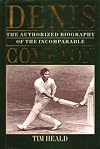
Anecdotally, Denis Compton gave more pleasure to the spectators than any other cricketer. He was the hero and idol of almost every fan who was young in the 1940s and 1950s. He wrote several autobiographical works but Heald's 'authorised' biography was one of the first of its kind when originally published in 1994 when Compton was still alive. This edition is an updated one that came out a decade after Compton's death.
It is a fairly simple, straightforward biography of a person who Heald show more reckons to be a simple, straightforward person. It follows two parallel threads - of Compton's career on the cricket field in parallel with the memories of those who he knew him and those who he inspired and entertained. Both threads are fairly superficial. Heald knew and was close to Compton for many years. His view, that is probably shared by most who knew Compton, either personally or as a cricketer, is that he was an overgrown schoolboy. Heald doesn't try to overanalyze this premise and try to fit his behaviour in all circumstances to this. This is not always satisfactory, as when Compton sided with South African government and pro-apartheid lobby in the several clashes through the 1960s to 1980s. The excuse of naivety is also a little disingenuous because Compton held several important positions including the Presidency of Middlesex CCC for many years.
The remembrances of those who were young when Compton was his best is scattered around the book and are some of the best parts. Many of these people have since died. What they said will provide some explanations for why Compton was as important as he was.
The cricketing side of Compton involves many match descriptions and scores but comes up short. One need lots of prior knowledge and imagination to get enthused even by 1947. Describing Compton satisfactorily is not an easy task and this is not the book to get inspired about Compton's batting.
Considering the personal nature of parts of the book, one will probably learn things that are not found elsewhere. But one interesting what if, that is probably documented by others, involved John Arlott and Compton's fastest triple hundred. While Compton was blazing away in Benoni, Arlott was in (iirc) Bloemfontein. While idling on the streets, he saw a black man walking along, minding his business. A white man who came in the opposite direction, for no reason, kicked the black man into a roadside gutter. The black man climbed up and instead of retaliating, apologised and stuttered along. This incident was Arlott's first encounter with apartheid and profoundly influenced his later actions. Had Arlott watched Compton's triple hundred, it is conceivable that Basil D'Oliveira (the black South African cricketer who Arlott helped to move to England) stayed home and South Africa played Tests well into the 1970s and possibly never expelled. show less
It is a fairly simple, straightforward biography of a person who Heald show more reckons to be a simple, straightforward person. It follows two parallel threads - of Compton's career on the cricket field in parallel with the memories of those who he knew him and those who he inspired and entertained. Both threads are fairly superficial. Heald knew and was close to Compton for many years. His view, that is probably shared by most who knew Compton, either personally or as a cricketer, is that he was an overgrown schoolboy. Heald doesn't try to overanalyze this premise and try to fit his behaviour in all circumstances to this. This is not always satisfactory, as when Compton sided with South African government and pro-apartheid lobby in the several clashes through the 1960s to 1980s. The excuse of naivety is also a little disingenuous because Compton held several important positions including the Presidency of Middlesex CCC for many years.
The remembrances of those who were young when Compton was his best is scattered around the book and are some of the best parts. Many of these people have since died. What they said will provide some explanations for why Compton was as important as he was.
The cricketing side of Compton involves many match descriptions and scores but comes up short. One need lots of prior knowledge and imagination to get enthused even by 1947. Describing Compton satisfactorily is not an easy task and this is not the book to get inspired about Compton's batting.
Considering the personal nature of parts of the book, one will probably learn things that are not found elsewhere. But one interesting what if, that is probably documented by others, involved John Arlott and Compton's fastest triple hundred. While Compton was blazing away in Benoni, Arlott was in (iirc) Bloemfontein. While idling on the streets, he saw a black man walking along, minding his business. A white man who came in the opposite direction, for no reason, kicked the black man into a roadside gutter. The black man climbed up and instead of retaliating, apologised and stuttered along. This incident was Arlott's first encounter with apartheid and profoundly influenced his later actions. Had Arlott watched Compton's triple hundred, it is conceivable that Basil D'Oliveira (the black South African cricketer who Arlott helped to move to England) stayed home and South Africa played Tests well into the 1970s and possibly never expelled. show less

This biography doesn't work. I spent some considerable time trying to work out the reason and, the best with which I can come up, follows;
Brian Johnston was one of those chaps who were bigger than his achievements. To hear him broadcast was to discover a lost but much loved uncle. This book suffers from being rather too rosy a picture but, at the same time, if it had gainsaid the legend, I shouldn't have enjoyed that!
The second problem with this work is linked to the first, the author was show more not aquainted with Johnston and so, relies heavily upon other people's stories. They too did not wish to 'dish the dirt' upon a national institution and so, there was little but a eulogy and very little that one did not know before starting the book.
Having bben so negative, it was still pleasant to revel in the remembered joy of a Brian Johnston commentary. show less
Brian Johnston was one of those chaps who were bigger than his achievements. To hear him broadcast was to discover a lost but much loved uncle. This book suffers from being rather too rosy a picture but, at the same time, if it had gainsaid the legend, I shouldn't have enjoyed that!
The second problem with this work is linked to the first, the author was show more not aquainted with Johnston and so, relies heavily upon other people's stories. They too did not wish to 'dish the dirt' upon a national institution and so, there was little but a eulogy and very little that one did not know before starting the book.
Having bben so negative, it was still pleasant to revel in the remembered joy of a Brian Johnston commentary. show less
Lists
Awards


You May Also Like


Associated Authors
Statistics
- Works
- 60
- Also by
- 12
- Members
- 1,534
- Popularity
- #16,773
- Rating
- 3.5
- Reviews
- 15
- ISBNs
- 196
- Languages
- 3