
Hans-Hermann Hoppe
Author of Democracy, the God That Failed: The Economics and Politics of Monarchy, Democracy, and Natural Order
About the Author
Hans-Hermann Hoppe is currently professor of economics at the University of Nevada Las Vegas, senior fellow of the Ludwig von Mises Institute, Auburn, AL, and editor of the Journal of Libertarian Studies: An Interdisciplinary Quarterly Review.
Image credit: Hans-Hermann Hoppe (1949-)
photograph by bartvs, Antwerpen, May 25th, 2005.
Works by Hans-Hermann Hoppe
Democracy, the God That Failed: The Economics and Politics of Monarchy, Democracy, and Natural Order (2001) 374 copies, 3 reviews
The Economics and Ethics of Private Property: Studies in Political Economy and Philosophy (1993) 94 copies
The Myth of National Defense: Essays on the Theory and History of Security Production (2003) 84 copies
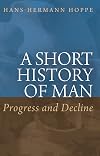
A Short History of Man : Progress and Decline, an Austro-Libertarian Reconstruction (2015) 42 copies, 2 reviews
From Aristocracy to Monarchy to Democracy: A Tale of Moral and Economic Folly and Decay (2014) 38 copies, 2 reviews
Der Wettbewerb der Gauner: Über das Unwesen der Demokratie und den Ausweg in die Privatrechtsgesellschaft (2012) 7 copies, 1 review
Praxeology and economic science 5 copies
Libertad o Socialismo 2 copies
Eigentum, Anarchie und Staat: Studien zur Theorie des Kapitalismus (Studien zur Sozialwissenschaft) (German Edition) (1987) 2 copies
Mänsklighetens historia i korthet : framsteg och förfall - en austrolibertariansk rekonstruktion (2018) 2 copies
O que deve ser feito 1 copy
Monarquía, democracia y orden natural: Una visión austriaca de la era americana (Anarkhos) (2013) 1 copy
الديمقراطية: الإله الذي فشل 1 copy
Kritik der kausalwissenschaftlichen Sozialforschung. Untersuchungen zur Grundlegung von Soziologie und Ökonomie (1983) 1 copy
Social Democracy 1 copy
Tagged
Common Knowledge
- Birthdate
- 1949-09-02
- Gender
- male
- Education
- Goethe University, Frankfurt-am-Main, Germany (PhD|Philosophy|1974)
Goethe University, Frankfurt-am-Main, Germany (PhD|Economics|1981) - Occupations
- libertarian
Austrian school economist - Organizations
- University of Nevada, Las Vegas
Ludwig von Mises Institute - Awards and honors
- Gary G. Schlarbaum Liberty Prize (2006)
- Nationality
- Germany (birth)
USA (naturalized) - Birthplace
- Peine, Germany
- Associated Place (for map)
- Peine, Germany
Members
Reviews
There are major positions where I align with Hoppe and the anarcho-capitalists, but present here as with similar thinkers is the (I think erroneous and detestable) view that--well, put explicitly and suddenly by Hoppe in section 2: "the rich and poor are usually rich or poor for a reason. The rich are characteristically bright and industrious, and the poor typically dull, lazy, or both. It is not very likely that dullards, even if they make up a majority, will systematically outsmart and show more enrich themselves at the expensive of a minority of bright and energetic individuals."
Who is satisfied by this argument? Aside from being graceless, lazy, and a bit creepy, is it just not a bit oversimplistic to explain it all away with an appeal to meritocracy?
Hoppe despises the 'amoral demagogues' that float to the top of popular democracy by virtue of their charisma and strategy/manipulations but has no issues at all with these apparently bright and amazing millionaires and billionaires who according to Hoppe, are at the top because they are just so darn smart and impressive! That was a disappointing and bizarre assertion (supported by nothing) in the midst of what I thought was otherwise educational material.
Also, Mr. Hoppe prefers the idea of supreme eternal law that is placed above even our highest rulers (in his preferences, an aristocracy or feudal king). He thinks legislation--the progressive modification of law that renders malleable the previously absolute or transcendental--is a major cause of our long-term downfall. He argues that there was in fact more freedom and justice in the European Middle Ages but admits imperfections existed then too. My potential specific objections fade away as I write this, so let me just think out loud. It is important to be guided by ancient principles, many that have always proved valuable, but I have the impression that some legislation was necessary to, for example, achieve many of the civil rights and to end the brutalities that had existed before modernity. Admittedly I am historically ignorant on the specifics and maybe Mr. Hoppe would say that the State has no business in legislating any rights or restrictions other than what violates the autonomy and property of an individual. I don't know. Was it not an sovereign 'eternal' law that a slave was valid property? Did we not need legislation at that point?
I am impressed by some of the heterodox theories but then suspicious of how sweeping and seemingly bigoted the underlying beliefs are. At a few points he can't help but just blurt it out...I am with him when he goes after corrupt politicians and plutocrats...not when he is spitting on the poor and justifying their material conditions on the basis of what he describes as their natural inferiority. show less
Who is satisfied by this argument? Aside from being graceless, lazy, and a bit creepy, is it just not a bit oversimplistic to explain it all away with an appeal to meritocracy?
Hoppe despises the 'amoral demagogues' that float to the top of popular democracy by virtue of their charisma and strategy/manipulations but has no issues at all with these apparently bright and amazing millionaires and billionaires who according to Hoppe, are at the top because they are just so darn smart and impressive! That was a disappointing and bizarre assertion (supported by nothing) in the midst of what I thought was otherwise educational material.
Also, Mr. Hoppe prefers the idea of supreme eternal law that is placed above even our highest rulers (in his preferences, an aristocracy or feudal king). He thinks legislation--the progressive modification of law that renders malleable the previously absolute or transcendental--is a major cause of our long-term downfall. He argues that there was in fact more freedom and justice in the European Middle Ages but admits imperfections existed then too. My potential specific objections fade away as I write this, so let me just think out loud. It is important to be guided by ancient principles, many that have always proved valuable, but I have the impression that some legislation was necessary to, for example, achieve many of the civil rights and to end the brutalities that had existed before modernity. Admittedly I am historically ignorant on the specifics and maybe Mr. Hoppe would say that the State has no business in legislating any rights or restrictions other than what violates the autonomy and property of an individual. I don't know. Was it not an sovereign 'eternal' law that a slave was valid property? Did we not need legislation at that point?
I am impressed by some of the heterodox theories but then suspicious of how sweeping and seemingly bigoted the underlying beliefs are. At a few points he can't help but just blurt it out...I am with him when he goes after corrupt politicians and plutocrats...not when he is spitting on the poor and justifying their material conditions on the basis of what he describes as their natural inferiority. show less
From Aristocracy to Monarchy to Democracy: A Tale of Moral and Economic Folly and Decay by Hans-Hermann Hoppe

This is a fitting essay (70 pages) to read during an election year. In his essay, Hoppe argues that democracy was really a bad idea and things were much better under feudalism with the aristocrats in charge. He feels that "the entire history we are told and taught in schools and standard textbooks, which presents democracy as the crowning achievement of human civilization, is just about the opposite of the truth." Hans-Hermann Hoppe is "an Austrian school economist and libertarian/ show more anarcho-capitalist philosopher" As an Autrian/libertarian, Hoppe's libertarian hammer makes every problem seem to stem from the Austrian nails of anti-statism and the sacredness of private property. .
His views are overly simplistic in many ways since he sees the dark ages representing the natural order to things since "everyone is bound by ONE law, (b) there is no law-making power, and (c) there was no monopoly on who people could choose to judge disputes. His view of the dark ages ignores the fact that people in villages could not travel to other villages due to the difficulties of transportation resulting in a very limited choice of judges being actually available. Hoppe also simplistically feels that AL disputes will be about property ignoring the fact that two people in a dispute might have a dispute about who they want to choose for a judge.
Kings eventually seized power and started creating laws and imposing taxes. Because the King's legitimacy stemmed from an appeal to the people, this evolved later towards democracy. Hoppe does not like Democracy as a system that allows anyone to create laws which he feels leads an elite to define laws that benefit the elite. Hoppe feels that this is worse than democracy.
Although the book and its thesis is entertaining, the whole thesis seems rather shallow - it all sounds more like a theory out of the ivory tower than a thesis developed from historical evidence. The theories of taxation, as explained in David Graeber's "Debt: The First 5000 Years" are better grounded with evidence when he explains that property taxes were valuable because it regularly confirmed the property owner's right to the title.
the book is published by the Libertarian Mises Institute and has the major advantage of being inexpensive. show less
His views are overly simplistic in many ways since he sees the dark ages representing the natural order to things since "everyone is bound by ONE law, (b) there is no law-making power, and (c) there was no monopoly on who people could choose to judge disputes. His view of the dark ages ignores the fact that people in villages could not travel to other villages due to the difficulties of transportation resulting in a very limited choice of judges being actually available. Hoppe also simplistically feels that AL disputes will be about property ignoring the fact that two people in a dispute might have a dispute about who they want to choose for a judge.
Kings eventually seized power and started creating laws and imposing taxes. Because the King's legitimacy stemmed from an appeal to the people, this evolved later towards democracy. Hoppe does not like Democracy as a system that allows anyone to create laws which he feels leads an elite to define laws that benefit the elite. Hoppe feels that this is worse than democracy.
Although the book and its thesis is entertaining, the whole thesis seems rather shallow - it all sounds more like a theory out of the ivory tower than a thesis developed from historical evidence. The theories of taxation, as explained in David Graeber's "Debt: The First 5000 Years" are better grounded with evidence when he explains that property taxes were valuable because it regularly confirmed the property owner's right to the title.
the book is published by the Libertarian Mises Institute and has the major advantage of being inexpensive. show less
Democracy – The God That Failed: The Economics and Politics of Monarchy, Democracy and Natural Order (Perspectives on Democratic Practice) by Hans-Hermann Hoppe
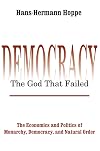
This book makes the case that 1) democracy, in the sense of mob rule, is a bad social order, as it inevitably leads to socialism 2) monarchy, particularly of the feudal and highly localized/informal model, is superior 3) a theoretical libertarian/anarcho-capitalist social order would be superior to even monarchy. These are pretty shocking conclusions for most Americans today (and westerners in general), but the argument, from some basic and acceptable premises, seems sound -- in particular, show more the argument for monarchy of the circa 1215 ad English kind being superior to modern "democratic socialism" of the form found in most of the world to varying degrees (including the US).
(I originally heard of Hoppe as "a racist guy who gave intellectual support to the far right", and then later as "someone so extreme as to call Hayek and Mises and Friedman leftists". Eventually, after seeing enough other references (and the popular "Hoppean Snek" series of memes ... the snake from the Gadsden flag crossed with Augusto Pinochet, engaged in "physical removal, so to speak"), I decided to read Hoppe's greatest book. )
I think the case for monarchy or some kind of limited franchise republicanism is well made. The case for anarcho-capitalist utopia seems a bit weaker (essentially, that everything is done by contract, and there are insurance companies with a non-monopoly of force which take a lot of the protective functions of the state). The main weakness of the anarcho-capitalist argument is Hoppe repeatedly says "X is bad", which it is, but it's entirely possible X is less-bad than the alternatives.
Another problem Hoppe finds with "mainstream libertarianism" and modern culture is essentially moral -- he argues that true liberalism/anarcho-capitalist libertarianism must be highly morally upright, and that a wide array of things would be sufficiently injurious to life that they would be banned (not by monopolistic law, but by covenant) -- hence the famous "physical removal" arguments, the proposal that some property could be posted "no beggars, bums, or homeless, but also no homosexuals, drug users, Jews, Moslems, Germans, or Zulus" as an example, etc. I think it's important here to separate out his deliberately provocative "to ban" list, from his idea that private property owners should have the ultimate right to ban anyone for any arbitrary reason. However, he does repeatedly reinforce the value of the traditional heterosexual/nuclear/etc. family and a lot of very conventional beliefs as ultimately best, and I think that's debatable -- it's possible something was never the best, or was the best in a certain setting but not the current setting, etc. -- but I do agree on the fundamental premise of private property owners being unrestricted in their use of property (provided it doesn't interfere with the property rights of others.)
The weakest part of his argument is localized secession as a route to achieving this anarcho-capitalist utopia; as we've seen, this just doesn't happen in the modern world, in that the only people who tend to do so are just as statist as those they're separating from. States also violently suppress any true secession from their system. I'm a firm believer in technology as the only route to achieving any kind of durable and lasting property protection (through computing, cryptography, and at some point, the conquest of new physical frontiers), and I don't think Hoppe has particularly considered that.
The book is very accessible -- it's a collection of 13 essays, each of which can stand alone. There are extensive footnotes, including quotes from other works and references to those works. This probably isn't the ideal introduction to libertarian thought, but it, along with Murray Rothbard, define one extreme. show less
(I originally heard of Hoppe as "a racist guy who gave intellectual support to the far right", and then later as "someone so extreme as to call Hayek and Mises and Friedman leftists". Eventually, after seeing enough other references (and the popular "Hoppean Snek" series of memes ... the snake from the Gadsden flag crossed with Augusto Pinochet, engaged in "physical removal, so to speak"), I decided to read Hoppe's greatest book. )
I think the case for monarchy or some kind of limited franchise republicanism is well made. The case for anarcho-capitalist utopia seems a bit weaker (essentially, that everything is done by contract, and there are insurance companies with a non-monopoly of force which take a lot of the protective functions of the state). The main weakness of the anarcho-capitalist argument is Hoppe repeatedly says "X is bad", which it is, but it's entirely possible X is less-bad than the alternatives.
Another problem Hoppe finds with "mainstream libertarianism" and modern culture is essentially moral -- he argues that true liberalism/anarcho-capitalist libertarianism must be highly morally upright, and that a wide array of things would be sufficiently injurious to life that they would be banned (not by monopolistic law, but by covenant) -- hence the famous "physical removal" arguments, the proposal that some property could be posted "no beggars, bums, or homeless, but also no homosexuals, drug users, Jews, Moslems, Germans, or Zulus" as an example, etc. I think it's important here to separate out his deliberately provocative "to ban" list, from his idea that private property owners should have the ultimate right to ban anyone for any arbitrary reason. However, he does repeatedly reinforce the value of the traditional heterosexual/nuclear/etc. family and a lot of very conventional beliefs as ultimately best, and I think that's debatable -- it's possible something was never the best, or was the best in a certain setting but not the current setting, etc. -- but I do agree on the fundamental premise of private property owners being unrestricted in their use of property (provided it doesn't interfere with the property rights of others.)
The weakest part of his argument is localized secession as a route to achieving this anarcho-capitalist utopia; as we've seen, this just doesn't happen in the modern world, in that the only people who tend to do so are just as statist as those they're separating from. States also violently suppress any true secession from their system. I'm a firm believer in technology as the only route to achieving any kind of durable and lasting property protection (through computing, cryptography, and at some point, the conquest of new physical frontiers), and I don't think Hoppe has particularly considered that.
The book is very accessible -- it's a collection of 13 essays, each of which can stand alone. There are extensive footnotes, including quotes from other works and references to those works. This probably isn't the ideal introduction to libertarian thought, but it, along with Murray Rothbard, define one extreme. show less
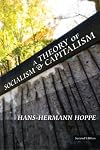
So I will be grateful to Hans for his first chapter which set out the core social issues which drive socialism and capitalism. Unfortunately his pompous pedantic style takes 8 chapters re-iteratively to prove socialism doesn't work then skates over in two chapters why capitalism is the right answer..Pretty clear where his loyalties lies. Nevertheless his so careful 'flawed' analytical style, does, if you ignore the repetitive cumbersome inclusion/exclusion, so as to not leave a stone show more unturned, terminology, reveal tangentially different ways of thinking about these core social structures. But it is a painful slog. The problem is it leaves the mind fogged with irrelevances so you cannot reason against the painfully slow development of his argument.
Hans would have us to reverentially accept that his analytical logic propels us to the only one outcome. Any other answer has, by his definition, to contravene this solid logic. Whilst accepting his core premise of sic 'aggressive' ownership, my real world experiences of all the dynamics of subtlety cannot not just be brushed aside and dismissed. Left with reading fatigue but also a quest to find alternative views for other social states and outcomes. show less
Hans would have us to reverentially accept that his analytical logic propels us to the only one outcome. Any other answer has, by his definition, to contravene this solid logic. Whilst accepting his core premise of sic 'aggressive' ownership, my real world experiences of all the dynamics of subtlety cannot not just be brushed aside and dismissed. Left with reading fatigue but also a quest to find alternative views for other social states and outcomes. show less
Lists
You May Also Like


Statistics
- Works
- 43
- Members
- 935
- Popularity
- #27,473
- Rating
- 3.5
- Reviews
- 15
- ISBNs
- 61
- Languages
- 8
- Favorited
- 6