

Gerald R. Ford (1913–2006)
Author of Write It When I'm Gone: Remarkable Off-the-Record Conversations with Gerald R. Ford
About the Author
Gerald R. Ford was born Leslie Lynch King Jr. on July 19, 1914, in Omaha, Nebraska. His parents divorced and his mother moved them back to Grand Rapids to be near her parents. Two years later, Ford's mother remarried Gerald R. Ford and the couple renamed the baby after Ford's new stepfather. His show more name was officially changed on December 3, 1935. Ford attended South High School in Grand Rapids, Michigan where he was named to the honor society, as well as to the "All City" and "All State" football teams. He achieved the rank of Eagle Scout in 1927 and earned money by working for the family paint store and at a local restaurant. Ford attended the University of Michigan at Ann Arbor from 1931 till 1935. he majored in economics and political science and played on the school football team, being voted MVP in 1934. He graduated with a Bachelor of Arts Degree in 1935. Ford received two offers from professional football teams when he graduated college. Both the Detroit Lions and the Green Bay Packers offered him a position on their respective teams, but he turned both offers down. Instead, Ford chose to go to Yale and take the position of boxing coach and assistant varsity football coach, hoping to get into the law school there. He was admitted into Yale in 1938 and managed to graduate in 1941 in the top 25 percent of the class despite his full time coaching positions. He also worked for Wendell Wilkins presidential campaign in 1940, giving him his first taste of politics. Ford returned to Michigan, passed his bar exam and opened up a law firm with Philip A Buchen in Grand Rapids. He also taught a course in business law at the University of Grand Rapids, served as line coach for the University's football team and became active in a republican group called the Home Front. In 1942, as World War II began, Ford entered the U.S. Naval reserves as an ensign. He rose to fitness instructor at a pre-flight school in Chapel Hill before beginning service on the USS Monterey in 1943. On board the ship, Ford worked as the athletic director and a gunnery division officer, and finally as the assistant navigator. He was discharged in 1946 as a lieutenant commander. Ford went back to Grand Rapids and joined a prestigious law firm there. He also ran for the Republican nomination for the U. S. House of Representatives in the 1948 election and won the seat. He served the House from January 3, 1949 till December 6, 1973, after having been reelected 12 times. He became a member of the House Appropriations Board in 1951. He was the ranking minority member of the Defense Appropriations Subcommittee in 1961, but his ambition was to become Speaker of the House. In 1963, Ford was appointed to the Warner Commission by President Johnson, to help investigate the assassination of President Kennedy. He co-authored "Portrait of the Assassin" with John R. Stiles, and the book was published in 1965. Ford then won the position of minority leader of the House in 1965, a position he held for eight years, never reaching his ambition of Speaker because the Republicans never gained the majority in his term. He also became President of the Senate, but never Speaker. Ford was appointed Vice President to Nixon after Spiro Agnew resigned the post in 1973. He became President when Nixon resigned as well in the aftermath of the Watergate scandal. In 1975, Ford was the target of two assassination attempts, both by women. He lost the 1976 Presidential election to Jimmy Carter after a term filled with political chaos and mistrust. He retired and wrote his memoirs, "A Time to Heal: The Autobiography of Gerald R. Ford," which was published in 1979. In 1981, both the Gerald R, Ford Library in Ann Arbor, Michigan and the Gerald R. Ford Museum in Grand Rapids, Michigan were dedicated. Ford published "Humor and the Presidency" in 1987. He died on December 26, 2006 of heart failure at the age of 93. (Bowker Author Biography) show less
Works by Gerald R. Ford
Write It When I'm Gone: Remarkable Off-the-Record Conversations with Gerald R. Ford (2007) 394 copies, 11 reviews
American Agenda: Report to the Forty-first President of the United States of America (1990) — Editor — 14 copies
Public papers of the Presidents of the United States : Gerald R. Ford : containing the public messages, speeches, a (1975) 3 copies, 1 review
Energy: Today's Choices, Tomorrow's Opportunities: Essential Dimensions in Thinking for Energy Policy (1974) 1 copy
Gerald R. Ford Late a President of the United States:Memorial Tributes Delivered In Congress (2012) 1 copy
Associated Works
On the Firing Line: The Public Life of Our Public Figures (1989) — Contributor — 126 copies, 1 review
Rediscovering American Values: The Foundations of our Freedom for the 21st Century (1997) — Foreword, some editions — 97 copies, 1 review
NAE, Prayer for the Nation 2 copies
Tagged
Common Knowledge
- Legal name
- Ford, Gerald Rudolph, Jr.
- Other names
- King, Leslie Lynch, Jr. (birth name)
Ford, Jerry - Birthdate
- 1913-07-14
- Date of death
- 2006-12-26
- Gender
- male
- Education
- University of Michigan
- Occupations
- Vice President of the United States (1973-1974, Republican)
President of the United States (1974-1977, Republican) - Organizations
- United States Navy
United States House of Representatives - Awards and honors
- Congressional Gold Medal (1998)
Presidential Medal of Freedom (1999)
Francis Boyer Award (1977) - Relationships
- Ford, Betty (wife)
Ford, Susan (daughter) - Nationality
- USA
- Birthplace
- Omaha, Nebraska, USA
- Place of death
- Rancho Mirage, California, USA
- Associated Place (for map)
- USA
Members
Discussions
38- Gerald R Ford in US Presidents Challenge (USPC) (July 2021)
(Presidential) Proclamation 4311 may come back to haunt us in Pro and Con (October 2016)
Reviews
Write It When I'm Gone: Remarkable Off-the-Record Conversations With Gerald R. Ford by Thomas M. DeFrank
Quite an interesting, well written and effective book. I learned a lot that I didn't know about an era in which I grew up. I was roughly 15-17 during the Watergate scandal and already a political junkie. Even though I am liberal politically I was about the only one in Scarsdale High School who supported Ford's pardon of Nixon.
My only quibble with the book is that Defrank spends far too much time on the excruciating details of Ford's fatal illness. I think that is best left as a private show more matter, and adds little to public edification. show less
My only quibble with the book is that Defrank spends far too much time on the excruciating details of Ford's fatal illness. I think that is best left as a private show more matter, and adds little to public edification. show less
Best I can figure, the unholy combination of the discovery of political satire, a teacher’s ability to make our country’s history and the workings of our republic exciting (Thanks, Mrs. Henderson!), and the unceasing desire of a semi-literate adolescent boy to be a smartass, converged to give me my admiration of President Gerald R. Ford. “Write it when I’m Gone: Remarkable Off-the-Record Conversations with Gerald R. Ford by Thomas Defrank only confirmed and deepened that show more esteem.
Regardless of any political disagreement one might have with President Ford, his decency as a human being is unquestionable. Knowing what the country needed, as well as knowing that by answering that need he was all but certainly destroying any hope he might have of winning re-election, President Ford stepped in from of America and the world to say “our long national nightmare is over.”
In an age when finding a politician who actually believes in something is about as likely as Bill Clinton becoming a Jesuit, President Ford’s words and deeds demonstrated what belief in a principle, an ideal – no matter the cost – looks like.
The most poignant moments, when the ability of Michigan All-American Center begins to falter, are described by Mr. Defrank with such compassion and earnestness that rather than feel sorrow for President Ford, I began to share Defrank’s grief for such a mentor and great man. Defrank did this by subtly repeating Ford’s comments, and reflecting the slight loss of memory experienced as one ages.
Ford’s concern and compassion for others is easily seen in two examples from late in his life. As the war in Vietnam came to it’s conclusion, Ford kept the American embassy open as long as possible. The iconic image of that time became the thousands who climbed the ladder on top of the embassy and onto helicopters that offered freedom and safety. Today that ladder is the center piece of President Ford’s library and is something Ford took great pride in. The other example is his treatment of Ronald Reagan. Ford was no fan of Ronald Reagan, and to his dying day believed that Reagan ultimately cost Ford re-election. If ever Ford had an enemy, it was Reagan. That all changed when President Reagan’s Alzheimer’s was made public in 1994. From that moment until his death, President Ford stood by his rival in every way possible. President Ford knew that the most important aspect of leadership, regardless of all other variables, is the care, empathy and genuine love of one’s fellow man. show less
Regardless of any political disagreement one might have with President Ford, his decency as a human being is unquestionable. Knowing what the country needed, as well as knowing that by answering that need he was all but certainly destroying any hope he might have of winning re-election, President Ford stepped in from of America and the world to say “our long national nightmare is over.”
In an age when finding a politician who actually believes in something is about as likely as Bill Clinton becoming a Jesuit, President Ford’s words and deeds demonstrated what belief in a principle, an ideal – no matter the cost – looks like.
The most poignant moments, when the ability of Michigan All-American Center begins to falter, are described by Mr. Defrank with such compassion and earnestness that rather than feel sorrow for President Ford, I began to share Defrank’s grief for such a mentor and great man. Defrank did this by subtly repeating Ford’s comments, and reflecting the slight loss of memory experienced as one ages.
Ford’s concern and compassion for others is easily seen in two examples from late in his life. As the war in Vietnam came to it’s conclusion, Ford kept the American embassy open as long as possible. The iconic image of that time became the thousands who climbed the ladder on top of the embassy and onto helicopters that offered freedom and safety. Today that ladder is the center piece of President Ford’s library and is something Ford took great pride in. The other example is his treatment of Ronald Reagan. Ford was no fan of Ronald Reagan, and to his dying day believed that Reagan ultimately cost Ford re-election. If ever Ford had an enemy, it was Reagan. That all changed when President Reagan’s Alzheimer’s was made public in 1994. From that moment until his death, President Ford stood by his rival in every way possible. President Ford knew that the most important aspect of leadership, regardless of all other variables, is the care, empathy and genuine love of one’s fellow man. show less
An interesting collection of interviews and reflections on the former president with excellent narration from Scott Brick, one of my favorite narrators. DeFrank was a friendly associate from the veep days, so nothing controversial there. Here, Ford sticks by the Warren Commission findings and was too far out of Nixon circle to know of any crimes ordered by the president, though he faults Nixon for letting a sloppy cover-up appear out of inaction. In 2004 Ford openly loathed Dick Cheney and show more although this ardent supported of his Republican Party changed that opinion to one of respect he never stopped being a critic of the WMD premise for invading Iraq. He felt Saddam was premised himself. Ford is the only person to have served as both vice president and president without being elected to either office. Add to this being defeated by Carter in the election and not given another opportunity to try and you have the biggest regret documented here. show less
Write It When I'm Gone: Remarkable Off-the-Record Conversations With Gerald R. Ford by Thomas M. DeFrank
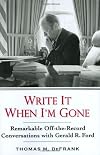
Write It When I'm Gone is pleasant, if a little scattered. In 1974, a then Vice President Ford was finishing up an interview with 28 year old Tom DeFrank, a reporter with Newsweek, when Ford said "When I'm President...", and then swore DeFrank to silence. With the Watergate Investigations ongoing, and Nixon wounded by not defeated, his Vice President had to be a company man, 110%. The gaffe lead to an enduring friendship and a series of candid interviews, to be published after Ford's death show more in 2006.
The book is best when it talks about Ford the person. He seems to have been one of the better people to inhabit the Oval Office, an unprepossing midwesterner who genuinely cared about the people around him, who didn't let the position go to his head, and had good relationships with the press and other politicians. Ford's long and happy post-Presidency retirement, golf, swimming, corporate boards, family, charity, was a well deserved second act.
There also a lot of gossip. Ford, the consummate party man, never cared much for Ronald Reagan, who he saw as intellectually incurious, and who he resented for challenging him in the 1976 primary and not doing enough in the campaign against Carter. Ford also personally liked Bill Clinton, but thought the Lewinsky scandal was a blot on the Presidency. Cheney and Rumsfeld had their first taste of Presidential authority under Ford, and he supported both of his former staffers, but was skeptical of how they had handled the War in Iraq. Of course, by then he was approaching the end of his life.
Beyond the platitudes and light gossip, there's not much there about the Presidency, or Ford's role in history, particularly pardoning Nixon. Pleasant, and helped me some at a hard point in my life, but not a must-read. show less
The book is best when it talks about Ford the person. He seems to have been one of the better people to inhabit the Oval Office, an unprepossing midwesterner who genuinely cared about the people around him, who didn't let the position go to his head, and had good relationships with the press and other politicians. Ford's long and happy post-Presidency retirement, golf, swimming, corporate boards, family, charity, was a well deserved second act.
There also a lot of gossip. Ford, the consummate party man, never cared much for Ronald Reagan, who he saw as intellectually incurious, and who he resented for challenging him in the 1976 primary and not doing enough in the campaign against Carter. Ford also personally liked Bill Clinton, but thought the Lewinsky scandal was a blot on the Presidency. Cheney and Rumsfeld had their first taste of Presidential authority under Ford, and he supported both of his former staffers, but was skeptical of how they had handled the War in Iraq. Of course, by then he was approaching the end of his life.
Beyond the platitudes and light gossip, there's not much there about the Presidency, or Ford's role in history, particularly pardoning Nixon. Pleasant, and helped me some at a hard point in my life, but not a must-read. show less
Lists
Awards


You May Also Like


Associated Authors
Statistics
- Works
- 27
- Also by
- 8
- Members
- 750
- Popularity
- #33,912
- Rating
- 4.0
- Reviews
- 15
- ISBNs
- 24


