

Dipesh Chakrabarty
Author of Provincializing Europe: Postcolonial Thought and Historical Difference
About the Author
Dipesh Chakrabarty is the Lawrence A. Kimpton Distingished Service Professor of History and South Asian Languages and Civilizations at the University of Chicago, He is the author of several books, including Habitations of Modernity: Essays in the Wake of Subultern Studies, also published by the show more University of Chicago Press. show less
Image credit: Photo courtesy the University of Chicago Experts Exchange (link)
Works by Dipesh Chakrabarty
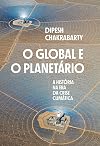
O global e o planetário: a história na era da crise climática (Portuguese Edition) 2 copies, 1 review
l'humanisme en una era global 2 copies
Dipesh Chakrabarty Reader 1 copy
Associated Works
Medievalisms in the Postcolonial World: The Idea of "the Middle Ages" Outside Europe (2010) — Contributor — 4 copies
Tagged
Common Knowledge
- Birthdate
- 20th Century
- Gender
- male
- Organizations
- University of Chicago
Members
Reviews
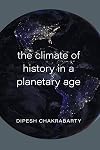
Public conversation about global warming/climate change tends to focus on scientific and environmental topics, such as temperature, drought, air quality, oceanic acidification, and mass extinction, etc. Dipesh Chakrabarty argues that what we need is a humanistic understanding of the effect that this is having on our species. The Climate of History in a Planetary Age is an attempt to offer a philosophical/intellectual/humanistic framework to the public discourse on global warming. A couple of show more key points. First, Chakrabarty wants to re-orient focus to the planet, not the globe. This is more than semantics. The latter conjures up globalism and the human-manufactured world, while the latter, according to Chakrabarty, should be associated with looking more broadly at the planet, as an independent entity in something of James Lovelock Gaia way, that de-centers humankind. In fact, according to his argument, we are not the dominant species and thus the barrier between humans and the natural world is a relic of the Enlightenment that should be discarded altogether. Second, since we are on this point, the Enlightenment created another false belief regarding our relationship with nature, which is that it is full of economic resources that will always provide for or sustain us. Industrialization has completely blown this concept to smithereens. Yet, it is still an essential canon of modern thought. Third, he finds discussions that emphasize capitalism or that claim that the problem of climate change cannot be addressed until capitalism is first dismantled are distracting, if not useless. Why? Because, as Chakrabarty writes, socialism doesn’t have a better track record, and, also, while he genuinely decries economic inequality, it is, in his deep history approach, a very recent issue. I think this is to say that the issue is not poverty, but wealth, which is, again, human-centered, global thinking, not one fitting the impending planetary age. We need to emphasize the non-human inhabitants of earth. Of course, there are enormous challenges when everyone wants an air conditioner (a whole chapter is dedicated to this topic) to cool themselves, which is only making the problem worse, and our local, national, and international governments and organizations have no solutions either. I admit that I am not really doing Chakrabarty’s argument anything like justice. This book really speaks to me. I was drawn to it in the first place because it was referenced numerous times in a workshop for scholars working on environmental historians and humanities that I attended in 2022 and frankly I felt embarrassed that was totally unfamiliar with it. Connecting his comments about the Enlightenment to my own observations collected outside this work, really leaves me concerned that we are on the cusp of, or in the midst of, a major paradigm shift. Finally, I understand that others might not be as impressed with this book as I am or might not find his points (and there are so many more than what I enumerated above) convincing or actionable. But I found it thought invoking, and I think that is the best outcome any reader or author can aspire to. show less
Provincializing Europe: Postcolonial Thought and Historical Difference (New Edition) (Princeton Studies in Culture/Power/History) by Dipesh Chakrabarty
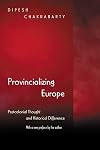
Dipesh Chakrabarty argues that all history has had Europe as its subject because the intellectual contributions of Europe (Marxism, enlightenment rationality, secular humanism) have been taken as universals. While recognizing that these intellectual theories have relevance outside of Europe (he is himself a committed Marxist), he argues against the idea that all Modernity must be European bourgeois modernity. He argues against a historicism that posits that all history must be show more progressive,and against the idea that developing nations who manifest capitalism differently should be seen as 'in the waiting room of history or representing an incomplete transition to capitalist modernity. Instead he seeks to demonstrate, through examples from Bengali history, the myriad ways in which indigenous intellectual traditions and cultural values interact with European intellectual traditions to create unique modernities that should be seen as no less whole for all their differences. show less
Provincializing Europe: Postcolonial Thought and Historical Difference - New Edition (Princeton Studies in Culture/Power/History) by Dipesh Chakrabarty
This book had been on my reading list for a very long time: it is practically the starting point of “subaltern studies,” the postcolonial view of history, as a resistance against the Eurocentric view that still dominates historiography, even in many non-Western countries. But, to be honest, I am a bit disappointed. In the first place, because the book is more of a collection of articles. The subaltern or postcolonial naturally forms the common thread, but the book is not very show more homogeneous. And secondly, because Chakrabarty’s references are very heavily focused on India and South Asia. Of course, it is the author’s prerogative to focus on that region; it is not for nothing that it is almost a continent in itself, both geographically and culturally. But for a layperson, and certainly for a historian trained in Europe like myself, it is quite a hurdle. A third obstacle is the very theoretical content of this book, a typical characteristic of a way of thinking that finds its origins in Marxism. And that brings me to the fourth obstacle: I understand and follow Chakrabarty’s criticism of Eurocentrism, but despite everything, I don’t quite understand where he is actually going, what the alternative is that he proposes (but that could, of course, be my fault). More on that in my History account on Goodreads: https://www.goodreads.com/review/show/1912216076. show less
Circuito Ubu - Abril de 2025
Apr 30, 2025Portuguese (Brazil)
Lists
Awards


You May Also Like


Associated Authors
Statistics
- Works
- 25
- Also by
- 2
- Members
- 621
- Popularity
- #40,535
- Rating
- 4.0
- Reviews
- 4
- ISBNs
- 49
- Languages
- 9
- Favorited
- 1