

Paul Bloom
Author of Against Empathy: The Case for Rational Compassion
About the Author
Paul Bloom is the Brooks and Suzanne Ragen Professor of Psychology at Yale University and the author or editor of six books, including the acclaimed How Pleasure Works. He lives in New Haven with his wife and two sons.
Works by Paul Bloom
Descartes' Baby: How the Science of Child Development Explains What Makes Us Human (2004) 202 copies, 3 reviews
Psychological Science Under Scrutiny: Recent Challenges and Proposed Solutions (2017) — Contributor — 9 copies
Is God an Accident? 1 copy
Associated Works
What Is Your Dangerous Idea? Today's Leading Thinkers on the Unthinkable (2007) — Contributor — 668 copies, 8 reviews
The Next Fifty Years: Science in the First Half of the Twenty-first Century (2002) — Contributor — 411 copies, 10 reviews
The Believing Primate: Scientific, Philosophical, and Theological Reflections on the Origin of Religion (2009) — Contributor — 45 copies
Tagged
Common Knowledge
- Birthdate
- 1963-12-24
- Gender
- male
- Education
- McGill University, Montreal, Canada
Massachusetts Institute of Technology - Occupations
- professor of psychology
author - Organizations
- Yale University
University of Arizona - Relationships
- Wynn, Karen (wife)
- Short biography
- PAUL BLOOM is the Brooks and Suzanne Ragen Professor of Psychology at Yale University. His research explores how children and adults understand the physical and social world, with special focus on morality, religion, fiction, and art. He has won numerous awards for his research and teaching. He is past-president of the Society for Philosophy and Psychology, and co-editor of Behavioral and Brain Sciences, one of the major journals in the field.
Dr. Bloom has written for scientific journals such as Nature and Science, and for popular outlets such as The New York Times, The Guardian, The New Yorker, and The Atlantic Monthly. He is the author or editor of six books, including Just Babies: The Origins of Good and Evil.
http://pantheon.yale.edu/~pb85/Paul_B... - Nationality
- Canada
- Birthplace
- Montréal, Québec, Canada
- Places of residence
- Montréal, Québec, Canada
Massachusetts, USA
Arizona, USA - Associated Place (for map)
- Montréal, Québec, Canada
Members
Reviews
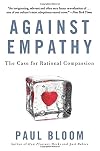
Imagine an entire book written critiquing empathy--written by a psychologist, no less--that doesn't once mention attachment theory or the importance of that close atunement by a caregiver during a child's formative years for psychological development.
This will give you an idea of the considerable gaps in reasoning in this book that purports to demonstrate how importance reasoning (paired with compassion rather than empathy) is to proper moral decision making.
A selection of other, similar show more gaps:
p. 106: argument that it doesn't matter to a starving child if they are given food by a smiling face or if the food is dropped by a drone. Of course it matters. Raise your hand if you see no difference between birthday presents dropped off by drone rather than delivered by the smiling faces of your friends and family. People, particularly children, need to know that they are important and that they matter to people *as people*, and this is hardly communicated by a drone drop.
The entire bit just before that about the kid who got a job on wall street so he could make large donations to the poor. While this is obviously an improvement over getting a job on wall street so you can buy a yacht, it does--contrary to Bloom's conclusion-without-support--makes things worse for the global poor. The investment machine that Wall Street powers is directly, intimately and daily linked to the actions of global companies who deprive people of land, food, and their lives. He can't possibly be ignorant of this; it smacks of cherry-picking.
p. 107: He dismisses the claim that literature increases empathy, completely ignoring the scientific research that demonstrate that it does.
p. 126: He argues that working on climate changes has nothing to do with empathy, as there are no identifiable Others with which to empathize. This book was written in America in 2016. At that time, California was experiencing the worst drought of its history, fueled by climate change. The Syrian refugee crisis, spurred in large part by a climate-change drought in the north of the country, was raging at that time. Both crises dominated the news with pictures of drowned toddlers, boats full of desperate people with nowhere to go, etc. No identifiable others? What planet was Bloom living on?
I work in climate change. This is not a "pale statistical abstraction" for me, but is daily fueled by the impacts I know this is having on people, animals and landscapes.
p. 154: Parenting. Here is where you would think attachment theory would make an appearance. Nope! Instead he makes a curious argument (repeated throughout the book) that empathy uniquely enslaves people and makes it impossible to consider how to respond using reason. I'll come back to this.
p. 183-185: Psychopaths! Here, Bloom argues by aphorism. That is, he includes quotes by famous people asserting that a thing must be so, without providing evidence, and then concludes that indeed it is so. Eg. a quote from Steven Pinker about how crimes and violence committed in the name of morality "would surely outnumber the fatalities from amoral conquest and predation," and accepts this statement as fact. Oh? Give us a statistic, Bloom. Give us some numbers with a source.
You might think he'd have something to say here about the legendary lack of empathy in psychopaths. Nope!
p. 232: IQ tests! "A long time ago people said things like 'IQ tests just measure how good you are at doing IQ tests,' but nobody takes this seriously anymore." (This in an argument about how IQ tests measure the potential for life success, as some kind of corollary argument for reason or reasoning ability--he never clarifies the connection he tries to draw here.) So I typed that phrase--IQ tests just measure how good you are at taking IQ tests--into google, and found this article from 2017 https://theconversation.com/the-iq-test-wars-why-screening-for-intelligence-is-s... and this from 2014 https://blogs.scientificamerican.com/beautiful-minds/what-do-iq-tests-test-inter... . Seems like the conversation over the utility of IQ tests continues to rage on, Paul.
Not to mention that describing IQ tests as good arbiters of reasoning ability, and claiming that no one questions this anymore, without discussing the differing results between different demographic groups and how completely obvious it is that privilege and material well-being factor into higher IQ scores--is racist and sexist.
p. 234: "I said that if you were curious about what sort of person a child would grow up to be, an intelligence test would be a great measure." Fun! So, I was in a gifted program from grade 4-grade 13/OAC, said program based on the results of universally administered aptitude/IQ tests within the schools. Everyone I went to school with did extremely well on IQ tests, within the top 1-2 percentile.
Yes, there are neurosurgeons and professors and lawyers within that group of people.
There are also highschool and university drop-outs who have spent their entire adult lives bewailing how unfairly life has treated them because they are GENIUSES goddammit and they DESERVE better.
So.
Later on he talks about the importance of self-control and how well this was demonstrated in the infamous Marshmallow Test.
Which has now been debunked as a measure of affluence rather than willpower. https://www.theatlantic.com/family/archive/2018/06/marshmallow-test/561779/
p. 238: Here he talks about how good people are at reasoning in every day matters such as whether to buy a house or local politics such as zoning regulations. "My own experience is that the level of rational discourse here is high," he says.
Dear Lord. Apparently Paul Bloom, alone among North American adults, has never heard of NIMBYism. As an environmental professional now for a few decades, let me state categorically that the level of rational discourse in local political and planning matter is abysmal, and emotion plays an enormous role in the conclusions people draw. I used to work in wind energy and read a study at that time showing that people who claimed negative health impacts from a local wind farm were almost certain to be able to see it from a window in their house; didn't matter how far away it was or whether they could hear it or not.
And keep in mind that Mr. Bloom wrote the sentences defending the rationality of everyday Americans in whether or not to purchase a house in 2016, a mere 8 years after the mortgage crisis.
So this is a small collection of my "Oh my god you have got to be kidding me" moments from reading this book, but you might be wondering about the overall argument.
I picked up the book on the strength of Kate Manne's mentioning of it in her book Down Girl, where she writes of his claim that empathy is "biased and innumerate": that is, that the empathy we feel reflects our own biases, and favours the one over the many. Manne then expands on this to discuss how empathy flows up the social hierarchy, and our society's tendency to, for example, express empathy towards perpetrators ("this allegation will destroy his career!") over victims.
That was the best part of Against Empathy, and having read it, you can probably skip the rest of the book. On the strength of it, I gave it two stars rather than one.
But its weaknesses are many. A short list:
1. The definition of empathy changes on every page to be whatever Bloom needs it to be in order to dismiss it. At the beginning of the book, empathy can be directed towards groups at a distance: he uses the example of the Sandy Hook massacre. At the end of the book, empathy can only be triggered in direct proximity to one or a small group of people who are directly emoting in your presence. At the beginning, again as with the Sandy Hook example, the empathy inspired isn't directly feeling exactly what the other person is feeling--he wouldn't and doesn't claim he feels the same rage and grief as the children's parents do--but at the end it is direct and exact mirroring, and only this mirroring, that counts as empathy. I could go on.
2. Of course, any emotion or capacity joined to Reason is going to be superior to any emotion or capacity specifically entirely unconnected to Reason, so saying Compassion Reason is a better guide to moral decision making than Empathy Alone is ... obvious. Let's experiment: Anger Reason is better than Love Alone (think: people stalking the object of their romantic obsession, people using anger plus critical reasoning to advance social causes). Shame Reason is better than Happiness Alone (research showing that the single-minded pursuit of happiness is linked with selfishness and moral deterioration; the capacity of reasoning one's way out of shame to restore social bonds and inspire moral improvement). Hate Reason is better than Joy Alone (I have to admit that this is a tricky one, but I think a person who can reason about their hate can identify bridges that needed burning and separate themselves from destructive people and relationships much better than people who think any sign of hate is a moral failing; and Joy, if it comes at another's expense and is expressed without consideration of that fact, could be hurtful).
We should simply assume and act as if all of our capacities are better when we can reason them through.
3. He never explains why empathy is so impossible to reason through; he simply states that he himself can't do it, and then seems to assume that no one else can either. But of course empathy can join with Reason; an effective parent will do so as a matter of daily course. He brings up an example of how empathy would make a parent unable to subject their child to vaccinations because of the pain from the needle, but this is nonsense. Empathy simply makes it easier for the parent to understand and respond to the child's pain and confusion afterwards. Compassion wouldn't cut it.
My daughter has a genetic syndrome that was only diagnosed when she was nearly 14. She had many, many tests beginning in infancy to try to diagnose it. I will never forget the first, when she was a tiny baby, about 5 lbs at the time, and it took me and two nurses to pin her down while they drew blood from her little arms. And I wept while she screamed, in her confusion and pain and fear. It did not stop me from getting her tested. It did provide a break of balancing the pain of any given test from the benefit of whatever knowledge we expected to gain from it, which is what happens when empathy is joined with reason.
4. All feelings have a purpose. We are creatures who evolved, and we share these feelings with many of our non-human relatives; they have adaptive and survival value or they wouldn't exist. Any argument that tries to do away with any particular feeling must, I believe, acknowledge and understand the value that exists before a coherent and convincing argument can be made against it. This goes for the Dalai Lama's incessant harping against anger, Brene Brown's wholly unconvincing dismissal of shame, and it goes here for Paul Bloom's devaluation of empathy.
5. He repeatedly insists that the idea that people are incapable of truly reasoning is baseless, without providing any convincing argument against the vast evidence--never mentioned--that human reasoning ability is inextricably connected with emotion. That neurologically people are incapable of reaching conclusions without emotions. His argument reflects an unearned faith in the existence of One True Reasonable Conclusion for any argument; of course, there isn't one. This isn't, as he claims, a dismissal of Reason; it's an admission of its limitations and its inherent dependency on our emotional responses. We reason using thoughts and feelings, and any reasoned conclusions is partially dependent on feelings which must be admitted to and explored as part of a reasoned exploration. There are plenty of people out there who claim that there beliefs that the earth is flat, that climate change is a hoax, that vaccines cause autism, etc. are reasoned arguments based on evidence, which they clearly are not. His own book would have been better if he himself had done so.
On page 10, Bloom lists his main influences for his argument against empathy and for reason:
Richard Davidson
Sam Harris (article about his assertion that black americans score lower on IQ tests because they are less intelligent here: https://www.vox.com/2018/4/9/17210248/sam-harris-ezra-klein-charles-murray-trans...
Jesse Prinz
Peter Singer (disabled humans not persons; adult gorillas are persons; apparently supports the rights of parents to kill their disabled children? http://web.archive.org/web/20170307001948/http:/www.martlet.ca/protesters-crash-...
Michael Lynch
Michael Shermer (multiple accusations of sexual assault: https://www.buzzfeed.com/markoppenheimer/will-misogyny-bring-down-the-atheist-mo...
Hrm.
What kinds of conclusions do you think a person is going to reach with influences like these?
Let's ignore the fact that they are all white, able-bodied, male, and with the exception of one, straight.
Let's consider that this list is 50% known unrepentant asshole.
Essentially, Paul Bloom sets up a straw man of unconstrained empathy without the benefit of any reasoning counterbalance and spends about 240 pages pummeling it with half-facts and anecdotes. show less
This will give you an idea of the considerable gaps in reasoning in this book that purports to demonstrate how importance reasoning (paired with compassion rather than empathy) is to proper moral decision making.
A selection of other, similar show more gaps:
p. 106: argument that it doesn't matter to a starving child if they are given food by a smiling face or if the food is dropped by a drone. Of course it matters. Raise your hand if you see no difference between birthday presents dropped off by drone rather than delivered by the smiling faces of your friends and family. People, particularly children, need to know that they are important and that they matter to people *as people*, and this is hardly communicated by a drone drop.
The entire bit just before that about the kid who got a job on wall street so he could make large donations to the poor. While this is obviously an improvement over getting a job on wall street so you can buy a yacht, it does--contrary to Bloom's conclusion-without-support--makes things worse for the global poor. The investment machine that Wall Street powers is directly, intimately and daily linked to the actions of global companies who deprive people of land, food, and their lives. He can't possibly be ignorant of this; it smacks of cherry-picking.
p. 107: He dismisses the claim that literature increases empathy, completely ignoring the scientific research that demonstrate that it does.
p. 126: He argues that working on climate changes has nothing to do with empathy, as there are no identifiable Others with which to empathize. This book was written in America in 2016. At that time, California was experiencing the worst drought of its history, fueled by climate change. The Syrian refugee crisis, spurred in large part by a climate-change drought in the north of the country, was raging at that time. Both crises dominated the news with pictures of drowned toddlers, boats full of desperate people with nowhere to go, etc. No identifiable others? What planet was Bloom living on?
I work in climate change. This is not a "pale statistical abstraction" for me, but is daily fueled by the impacts I know this is having on people, animals and landscapes.
p. 154: Parenting. Here is where you would think attachment theory would make an appearance. Nope! Instead he makes a curious argument (repeated throughout the book) that empathy uniquely enslaves people and makes it impossible to consider how to respond using reason. I'll come back to this.
p. 183-185: Psychopaths! Here, Bloom argues by aphorism. That is, he includes quotes by famous people asserting that a thing must be so, without providing evidence, and then concludes that indeed it is so. Eg. a quote from Steven Pinker about how crimes and violence committed in the name of morality "would surely outnumber the fatalities from amoral conquest and predation," and accepts this statement as fact. Oh? Give us a statistic, Bloom. Give us some numbers with a source.
You might think he'd have something to say here about the legendary lack of empathy in psychopaths. Nope!
p. 232: IQ tests! "A long time ago people said things like 'IQ tests just measure how good you are at doing IQ tests,' but nobody takes this seriously anymore." (This in an argument about how IQ tests measure the potential for life success, as some kind of corollary argument for reason or reasoning ability--he never clarifies the connection he tries to draw here.) So I typed that phrase--IQ tests just measure how good you are at taking IQ tests--into google, and found this article from 2017 https://theconversation.com/the-iq-test-wars-why-screening-for-intelligence-is-s... and this from 2014 https://blogs.scientificamerican.com/beautiful-minds/what-do-iq-tests-test-inter... . Seems like the conversation over the utility of IQ tests continues to rage on, Paul.
Not to mention that describing IQ tests as good arbiters of reasoning ability, and claiming that no one questions this anymore, without discussing the differing results between different demographic groups and how completely obvious it is that privilege and material well-being factor into higher IQ scores--is racist and sexist.
p. 234: "I said that if you were curious about what sort of person a child would grow up to be, an intelligence test would be a great measure." Fun! So, I was in a gifted program from grade 4-grade 13/OAC, said program based on the results of universally administered aptitude/IQ tests within the schools. Everyone I went to school with did extremely well on IQ tests, within the top 1-2 percentile.
Yes, there are neurosurgeons and professors and lawyers within that group of people.
There are also highschool and university drop-outs who have spent their entire adult lives bewailing how unfairly life has treated them because they are GENIUSES goddammit and they DESERVE better.
So.
Later on he talks about the importance of self-control and how well this was demonstrated in the infamous Marshmallow Test.
Which has now been debunked as a measure of affluence rather than willpower. https://www.theatlantic.com/family/archive/2018/06/marshmallow-test/561779/
p. 238: Here he talks about how good people are at reasoning in every day matters such as whether to buy a house or local politics such as zoning regulations. "My own experience is that the level of rational discourse here is high," he says.
Dear Lord. Apparently Paul Bloom, alone among North American adults, has never heard of NIMBYism. As an environmental professional now for a few decades, let me state categorically that the level of rational discourse in local political and planning matter is abysmal, and emotion plays an enormous role in the conclusions people draw. I used to work in wind energy and read a study at that time showing that people who claimed negative health impacts from a local wind farm were almost certain to be able to see it from a window in their house; didn't matter how far away it was or whether they could hear it or not.
And keep in mind that Mr. Bloom wrote the sentences defending the rationality of everyday Americans in whether or not to purchase a house in 2016, a mere 8 years after the mortgage crisis.
So this is a small collection of my "Oh my god you have got to be kidding me" moments from reading this book, but you might be wondering about the overall argument.
I picked up the book on the strength of Kate Manne's mentioning of it in her book Down Girl, where she writes of his claim that empathy is "biased and innumerate": that is, that the empathy we feel reflects our own biases, and favours the one over the many. Manne then expands on this to discuss how empathy flows up the social hierarchy, and our society's tendency to, for example, express empathy towards perpetrators ("this allegation will destroy his career!") over victims.
That was the best part of Against Empathy, and having read it, you can probably skip the rest of the book. On the strength of it, I gave it two stars rather than one.
But its weaknesses are many. A short list:
1. The definition of empathy changes on every page to be whatever Bloom needs it to be in order to dismiss it. At the beginning of the book, empathy can be directed towards groups at a distance: he uses the example of the Sandy Hook massacre. At the end of the book, empathy can only be triggered in direct proximity to one or a small group of people who are directly emoting in your presence. At the beginning, again as with the Sandy Hook example, the empathy inspired isn't directly feeling exactly what the other person is feeling--he wouldn't and doesn't claim he feels the same rage and grief as the children's parents do--but at the end it is direct and exact mirroring, and only this mirroring, that counts as empathy. I could go on.
2. Of course, any emotion or capacity joined to Reason is going to be superior to any emotion or capacity specifically entirely unconnected to Reason, so saying Compassion Reason is a better guide to moral decision making than Empathy Alone is ... obvious. Let's experiment: Anger Reason is better than Love Alone (think: people stalking the object of their romantic obsession, people using anger plus critical reasoning to advance social causes). Shame Reason is better than Happiness Alone (research showing that the single-minded pursuit of happiness is linked with selfishness and moral deterioration; the capacity of reasoning one's way out of shame to restore social bonds and inspire moral improvement). Hate Reason is better than Joy Alone (I have to admit that this is a tricky one, but I think a person who can reason about their hate can identify bridges that needed burning and separate themselves from destructive people and relationships much better than people who think any sign of hate is a moral failing; and Joy, if it comes at another's expense and is expressed without consideration of that fact, could be hurtful).
We should simply assume and act as if all of our capacities are better when we can reason them through.
3. He never explains why empathy is so impossible to reason through; he simply states that he himself can't do it, and then seems to assume that no one else can either. But of course empathy can join with Reason; an effective parent will do so as a matter of daily course. He brings up an example of how empathy would make a parent unable to subject their child to vaccinations because of the pain from the needle, but this is nonsense. Empathy simply makes it easier for the parent to understand and respond to the child's pain and confusion afterwards. Compassion wouldn't cut it.
My daughter has a genetic syndrome that was only diagnosed when she was nearly 14. She had many, many tests beginning in infancy to try to diagnose it. I will never forget the first, when she was a tiny baby, about 5 lbs at the time, and it took me and two nurses to pin her down while they drew blood from her little arms. And I wept while she screamed, in her confusion and pain and fear. It did not stop me from getting her tested. It did provide a break of balancing the pain of any given test from the benefit of whatever knowledge we expected to gain from it, which is what happens when empathy is joined with reason.
4. All feelings have a purpose. We are creatures who evolved, and we share these feelings with many of our non-human relatives; they have adaptive and survival value or they wouldn't exist. Any argument that tries to do away with any particular feeling must, I believe, acknowledge and understand the value that exists before a coherent and convincing argument can be made against it. This goes for the Dalai Lama's incessant harping against anger, Brene Brown's wholly unconvincing dismissal of shame, and it goes here for Paul Bloom's devaluation of empathy.
5. He repeatedly insists that the idea that people are incapable of truly reasoning is baseless, without providing any convincing argument against the vast evidence--never mentioned--that human reasoning ability is inextricably connected with emotion. That neurologically people are incapable of reaching conclusions without emotions. His argument reflects an unearned faith in the existence of One True Reasonable Conclusion for any argument; of course, there isn't one. This isn't, as he claims, a dismissal of Reason; it's an admission of its limitations and its inherent dependency on our emotional responses. We reason using thoughts and feelings, and any reasoned conclusions is partially dependent on feelings which must be admitted to and explored as part of a reasoned exploration. There are plenty of people out there who claim that there beliefs that the earth is flat, that climate change is a hoax, that vaccines cause autism, etc. are reasoned arguments based on evidence, which they clearly are not. His own book would have been better if he himself had done so.
On page 10, Bloom lists his main influences for his argument against empathy and for reason:
Richard Davidson
Sam Harris (article about his assertion that black americans score lower on IQ tests because they are less intelligent here: https://www.vox.com/2018/4/9/17210248/sam-harris-ezra-klein-charles-murray-trans...
Jesse Prinz
Peter Singer (disabled humans not persons; adult gorillas are persons; apparently supports the rights of parents to kill their disabled children? http://web.archive.org/web/20170307001948/http:/www.martlet.ca/protesters-crash-...
Michael Lynch
Michael Shermer (multiple accusations of sexual assault: https://www.buzzfeed.com/markoppenheimer/will-misogyny-bring-down-the-atheist-mo...
Hrm.
What kinds of conclusions do you think a person is going to reach with influences like these?
Let's ignore the fact that they are all white, able-bodied, male, and with the exception of one, straight.
Let's consider that this list is 50% known unrepentant asshole.
Essentially, Paul Bloom sets up a straw man of unconstrained empathy without the benefit of any reasoning counterbalance and spends about 240 pages pummeling it with half-facts and anecdotes. show less
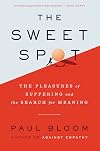
The Sweet Spot from Paul Bloom is an enlightening read that draws as many points from the reader's own mind as from any theory. I'll explain momentarily, but what Bloom excels at is explaining his ideas through analogy and anecdotes such that we gain quite a bit of knowledge without realizing it.
I'll start by admitting I like Bloom's work. I am not always in complete agreement but I can count on him to make me think about and reconsider many of my own ideas. In addition to several of his show more books I also took a couple of his online MOOCs, and his books are a lot like listening to his lectures. Before you think that is a negative, let me explain. His lectures are almost conversational in tone, so the book is also almost conversational in tone.
As humans we have an amazing ability to state unequivocally that we believe two things that are not only incompatible but contradictory. An area where we do this quite a bit is when we discuss the purpose of life or, another way, how we live our lives. Are we pleasure seeking animals, plain and simple? Are we selfish and only think of our own best interests? And so on. Bloom doesn't so much counter all of the ways we think about this as make us think about all of them with more nuance and less certitude.
Like so many things, how we define a term makes a big difference. Pain or suffering defined using a broad spectrum allows for more variation in how we will answer the question about whether suffering (sometimes and certain types) is good and even desirable.
This book entertains while it educates, and many of Bloom's points seem to be drawn from our own experiences. His examples of ways of thinking or acting will resonate with us and from these he illustrates the value, and necessity, of suffering. In particular when it serves to give our lives some meaning.
My convoluted commentary does not do the book justice, but hopefully it shows how Bloom engages his readers to consider old ideas with a bit more nuance.
Reviewed from a copy made available by the publisher via NetGalley. show less
I'll start by admitting I like Bloom's work. I am not always in complete agreement but I can count on him to make me think about and reconsider many of my own ideas. In addition to several of his show more books I also took a couple of his online MOOCs, and his books are a lot like listening to his lectures. Before you think that is a negative, let me explain. His lectures are almost conversational in tone, so the book is also almost conversational in tone.
As humans we have an amazing ability to state unequivocally that we believe two things that are not only incompatible but contradictory. An area where we do this quite a bit is when we discuss the purpose of life or, another way, how we live our lives. Are we pleasure seeking animals, plain and simple? Are we selfish and only think of our own best interests? And so on. Bloom doesn't so much counter all of the ways we think about this as make us think about all of them with more nuance and less certitude.
Like so many things, how we define a term makes a big difference. Pain or suffering defined using a broad spectrum allows for more variation in how we will answer the question about whether suffering (sometimes and certain types) is good and even desirable.
This book entertains while it educates, and many of Bloom's points seem to be drawn from our own experiences. His examples of ways of thinking or acting will resonate with us and from these he illustrates the value, and necessity, of suffering. In particular when it serves to give our lives some meaning.
My convoluted commentary does not do the book justice, but hopefully it shows how Bloom engages his readers to consider old ideas with a bit more nuance.
Reviewed from a copy made available by the publisher via NetGalley. show less
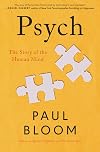
Psych by Paul Bloom is an excellent overview of the history of and current ideas in the field of psychology. Based partly on his teaching outline for his Intro to Psychology course, this offers a very accessible tour with enough depth to generate even more curiosity.
I first heard of Bloom when I took one of his MOOCs back in 2014 (or so) and have since taken another one as well as read several of his books. One of the strong aspects of his other books has been his voice, you can almost hear show more him (if you have taken one of his courses). Coupled with the almost conversational tone you learn so much without realizing it, like when you're talking with a friend who is knowledgeable, and you suddenly realize how much you now understand. I was actually surprised, quite pleasantly, by how much of that delivery made it into this book.
This is not a textbook but offers the reader a similar type of tour. Just far more interesting and less sleep-inducing. An ideal book to build a course around, basically doing the opposite of what Bloom did. I don't, however, want to emphasize that. This is a wonderful book for those who simply want a better understanding of what psychology is and, as a result, who we as human beings are. Don't be put off by talk of formal courses, this is that rare book that easily serves both formal learning and informal self-education.
Highly recommended for anyone with an interest in how we think and feel, and why. Whether you have previous education in the field or just coming to it, this will reward you.
Reviewed from a copy made available by the publisher via NetGalley. show less
I first heard of Bloom when I took one of his MOOCs back in 2014 (or so) and have since taken another one as well as read several of his books. One of the strong aspects of his other books has been his voice, you can almost hear show more him (if you have taken one of his courses). Coupled with the almost conversational tone you learn so much without realizing it, like when you're talking with a friend who is knowledgeable, and you suddenly realize how much you now understand. I was actually surprised, quite pleasantly, by how much of that delivery made it into this book.
This is not a textbook but offers the reader a similar type of tour. Just far more interesting and less sleep-inducing. An ideal book to build a course around, basically doing the opposite of what Bloom did. I don't, however, want to emphasize that. This is a wonderful book for those who simply want a better understanding of what psychology is and, as a result, who we as human beings are. Don't be put off by talk of formal courses, this is that rare book that easily serves both formal learning and informal self-education.
Highly recommended for anyone with an interest in how we think and feel, and why. Whether you have previous education in the field or just coming to it, this will reward you.
Reviewed from a copy made available by the publisher via NetGalley. show less
***NO SPOILERS***
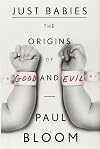
Is a sense of right and wrong programmed into the human psyche at birth, or is the psyche blank and pliable, able to be fashioned just as easily into that of a conscionable being as into that of a psychopath? Just Babies seeks to answer this question. Author Paul Bloom refers to the sense of right and wrong as "morality" while at the same time acknowledging that that word can be hard to define: "Even moral philosophers don't agree about what morality really is, and many non show more philosophers don't like to use the word at all. When I tell people what this book is about, more than one has responded with "I don’t believe in morality." Someone once told me—and I'm not sure that she was joking—that morality is nothing more than rules about whom you can and can't have sex with." Just Babies grapples with the nature versus nurture question but presents lots of proof favoring nature's role.
The book is divided into seven chapters, with the first explaining the technical aspects of testing babies, along with the results of these various experiments. This first chapter is fascinating not only because of the results but also because of the experiments themselves; the researchers' ingenuity in devising ways to test babies is impressive.
The chapters following explore whether, and to what degree, people are born with a sense of empathy, fairness, disgust (possibly the most intriguing chapter), a desire to punish and seek revenge, and exactly why people are naturally kinder to kin than to strangers. As with the first chapter, the answers to these questions and the examples proving them (via elaborate experiments) are riveting. Just one of a great many that stand out: "Children are sensitive to inequity, then, but it seems to upset them only when they themselves are the ones getting less [...] The psychologists Peter Blake and Katherine McAuliffe paired up four- and eight-year-olds who had never met, placing them in front of a special apparatus that was set up to distribute two trays of candy. One of the children had access to a lever that gave her the choice either to tilt both trays toward the children (so that each got whatever amount of candy was on the nearest tray) or to dump both trays (so that nobody got any candy.)
When there was an equal amount of candy in each tray, the children almost never dumped. They also almost never dumped when the distribution favored themselves—say, four candies on their tray, and one candy on the other child’s tray—though some of the eight-year-olds did reject this choice. But when this distribution was reversed to favor the other child, children at every age group frequently chose to dump both trays. They would rather get nothing than have another child, a stranger, get more than them."
Just Babies is well-organized and written in clear, straightforward language ideal for the everyday reader; Bloom didn't use any specialized science or psychology jargon, so a background in these fields isn't necessary to understand the book. The writing, however, could be better. Certain word choices are jarring and detract from Just Babies's otherwise scholarly tone. The use of "pissed" is one such example: "The researchers find that the dog offered a lesser treat will sometimes act, well, pissed, and refuse it." Along the same lines: "And so, while there might remain some stalwart contributors, the situation gradually goes to hell."
Fortunately the book's strengths—its biggest being that it effectively backs up each of its many claims with compelling experimental evidence—outweigh weaknesses. Bloom took care to convince, leaving little room for doubt or dismissal. show less
Is a sense of right and wrong programmed into the human psyche at birth, or is the psyche blank and pliable, able to be fashioned just as easily into that of a conscionable being as into that of a psychopath? Just Babies seeks to answer this question. Author Paul Bloom refers to the sense of right and wrong as "morality" while at the same time acknowledging that that word can be hard to define: "Even moral philosophers don't agree about what morality really is, and many non show more philosophers don't like to use the word at all. When I tell people what this book is about, more than one has responded with "I don’t believe in morality." Someone once told me—and I'm not sure that she was joking—that morality is nothing more than rules about whom you can and can't have sex with." Just Babies grapples with the nature versus nurture question but presents lots of proof favoring nature's role.
The book is divided into seven chapters, with the first explaining the technical aspects of testing babies, along with the results of these various experiments. This first chapter is fascinating not only because of the results but also because of the experiments themselves; the researchers' ingenuity in devising ways to test babies is impressive.
The chapters following explore whether, and to what degree, people are born with a sense of empathy, fairness, disgust (possibly the most intriguing chapter), a desire to punish and seek revenge, and exactly why people are naturally kinder to kin than to strangers. As with the first chapter, the answers to these questions and the examples proving them (via elaborate experiments) are riveting. Just one of a great many that stand out: "Children are sensitive to inequity, then, but it seems to upset them only when they themselves are the ones getting less [...] The psychologists Peter Blake and Katherine McAuliffe paired up four- and eight-year-olds who had never met, placing them in front of a special apparatus that was set up to distribute two trays of candy. One of the children had access to a lever that gave her the choice either to tilt both trays toward the children (so that each got whatever amount of candy was on the nearest tray) or to dump both trays (so that nobody got any candy.)
When there was an equal amount of candy in each tray, the children almost never dumped. They also almost never dumped when the distribution favored themselves—say, four candies on their tray, and one candy on the other child’s tray—though some of the eight-year-olds did reject this choice. But when this distribution was reversed to favor the other child, children at every age group frequently chose to dump both trays. They would rather get nothing than have another child, a stranger, get more than them."
Just Babies is well-organized and written in clear, straightforward language ideal for the everyday reader; Bloom didn't use any specialized science or psychology jargon, so a background in these fields isn't necessary to understand the book. The writing, however, could be better. Certain word choices are jarring and detract from Just Babies's otherwise scholarly tone. The use of "pissed" is one such example: "The researchers find that the dog offered a lesser treat will sometimes act, well, pissed, and refuse it." Along the same lines: "And so, while there might remain some stalwart contributors, the situation gradually goes to hell."
Fortunately the book's strengths—its biggest being that it effectively backs up each of its many claims with compelling experimental evidence—outweigh weaknesses. Bloom took care to convince, leaving little room for doubt or dismissal. show less
 This review was written for LibraryThing Early Reviewers.
Lists
Awards


You May Also Like


Associated Authors
Statistics
- Works
- 25
- Also by
- 6
- Members
- 2,131
- Popularity
- #12,080
- Rating
- 3.5
- Reviews
- 54
- ISBNs
- 119
- Languages
- 10
- Favorited
- 2

