

Terence Rattigan (1911–1977)
Author of The Winslow Boy
About the Author
Rattigan, who had been a playwright since leaving Oxford University at the age of 22, boasted of his workmanship---"I believe sloppy construction, untidy technique, and lack of craftsmanship to be great faults"---and of his ability to please the British playgoer, the archetypical "Aunt Edna," a show more "middle-class, middle-aged maiden lady with time on her hands." Not surprisingly, he fell out of favor in the Britain of the 1960s. (He had never been particularly popular in the United States, which looked on his work as inspirationally lacking.) At the time of his death, criticism, still taking him at his word, faintly praised Rattigan's expositions, his management of interleaving characters (as in Separate Tables, 1954), and his artful episodic development in Ross (1960). But Darlow and Hodson's revelations of Rattigan's tormented personal life have helped readers acknowledge that, despite imposed or sentimental endings, his plays are often full of genuine anguish---in the relations of parents and children (Man and Boy, 1963) and obsessed lovers (The Deep Blue Sea, 1952), and in recognition of weakness that vitiates heroism (Ross, 1960, which is based on the life of T. E. Lawrence. And revivals of the 1948 play The Browning Version (at the National Theatre) and of The Winslow Boy (1946) moved the critic Harold Hobson to concede that "there are many things in Rattigan that have not yet been properly perceived." (Bowker Author Biography) show less
Works by Terence Rattigan
The Deep Blue Sea With Three Other Plays: Harlequinade; Adventure Story; The Browning Version (1955) 18 copies
Heart To Heart 1 copy
Table Number Seven 1 copy
Table by the Window 1 copy
Associated Works
The World of Law, Volumes I-II: The Law in Literature, The Law as Literature (1960) — Contributor — 54 copies
Twenty One-Act Plays: An Anthology for Amateur Performing Groups (1978) — Contributor — 41 copies, 1 review
Tagged
Common Knowledge
- Canonical name
- Rattigan, Terence
- Legal name
- Rattigan, Sir Terence Mervyn
- Birthdate
- 1911-06-10
- Date of death
- 1977-11-30
- Gender
- male
- Education
- Harrow School
University of Oxford (Trinity College) - Occupations
- playwright
screenwriter - Awards and honors
- Order of the British Empire (Commander, 1958)
knighthood (1971) - Nationality
- UK
- Birthplace
- London, England, UK
- Place of death
- Hamilton, Bermuda
- Burial location
- Kensal Green Cemetery, London, England
- Associated Place (for map)
- UK
Members
Discussions
Drama on 3 in All the World's a Stage (June 2015)
Drama in BBC Radio 3 Listeners (May 2013)
Reviews
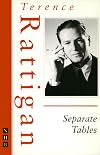
An interesting set of what is actually two plays, though it reads more like two acts of one play, connected only by the same characters and setting. The stories could be told independently, and no one would ever know they were connected. I found both of them somewhat disturbing, but particularly the second. They are steeped in the ideas and morals of their time, and that means that the characters fuss about things no one would likely notice today. The dialogue is often quotidian, but I think show more that is the direct intention of the author. He intends this to be about people in their usual mode of interaction, thrown into a new situation. I didn't find the stories particularly compelling, but perhaps onstage they would play better than they read. The edition included some alternate scenes for the second act, which were never performed because they were too...problematic...for the time, I suppose. I must say, I preferred the alternate scenes. The original act as written was difficult to deal with because it depicted actions that were then and remain criminal, and violated the rights of various women, and we are expected to forgive the act. In the alternate scenes, the ones where the actions were too troubling for audiences, most of us would probably say, so what? But at the time this play came out, those were criminal actions that got much more serious penalty than the much more disturbing (to modern minds, especially women) scenes that were deemed more acceptable for stage. So this was an interesting exercise in trying to view a work through the eyes of its own time. At the very least, it made me glad I live in this time, warts and all. show less

This play is based on the real-life story of Alma Rattenbury, on trial for murdering her husband in concert with her lover, who (shock horror!) was 20 years younger than she was. The play shifts between the circumstances leading up to the murder, the trial, and the family dynamics of the jury forewoman, Edith Davenport.
I found the play a bit messy when shifting between these timelines, and I’m not sure how much the staging would have helped, especially if the sitting-room setting is show more supposed to be both the Davenports’ living room and the Rattenburys’. This play is almost better conceptually as a TV adaptation, where the shifts in time and place can be much more clearly defined. (The existence of the TV adaptation, featuring a young David Morrissey as the lover, Stoner in real life but Wood in the play, is the reason I read this play in the first place.)
This was Rattigan’s last play, and it kind of shows, with the messy chronology and the somewhat samey-sounding characters. I ended up looking up the original case and found the circumstances more interesting than the play. The murder victim, Francis Rattenbury, practised architecture in Canada and designed the British Columbia provincial legislature, as well as the Empress Hotel in Victoria and the former provincial courthouse, which is now home to the Vancouver Art Gallery. And it was his affair with Alma, who later became the wife who murdered him, that caused a scandal in the Canadian society he lived in, stopping the flow of work and precipitating his return to England.
If you are at all interested in this play, hunt down the TV adaptation. Don’t bother reading it. show less
I found the play a bit messy when shifting between these timelines, and I’m not sure how much the staging would have helped, especially if the sitting-room setting is show more supposed to be both the Davenports’ living room and the Rattenburys’. This play is almost better conceptually as a TV adaptation, where the shifts in time and place can be much more clearly defined. (The existence of the TV adaptation, featuring a young David Morrissey as the lover, Stoner in real life but Wood in the play, is the reason I read this play in the first place.)
This was Rattigan’s last play, and it kind of shows, with the messy chronology and the somewhat samey-sounding characters. I ended up looking up the original case and found the circumstances more interesting than the play. The murder victim, Francis Rattenbury, practised architecture in Canada and designed the British Columbia provincial legislature, as well as the Empress Hotel in Victoria and the former provincial courthouse, which is now home to the Vancouver Art Gallery. And it was his affair with Alma, who later became the wife who murdered him, that caused a scandal in the Canadian society he lived in, stopping the flow of work and precipitating his return to England.
If you are at all interested in this play, hunt down the TV adaptation. Don’t bother reading it. show less

I read this first, on my own, not as an assignment, as a teenager. I think it was an old battered pupils edition of the play, from my parents bookshelves. Hard work, but an intriguing story even back then (I must have been 13 or 14).
I find that I did not understand very much back then. Back then, for me the story was about the boy, about the fight to find justice for him. Re-reading it now, I see that it is about everyone *but* the boy. There is the parents, specifically the father, putting show more everything (money, reputation, health) into the task of getting their boy exonerated from the accusation of being a thief. The siblings suffer for this, the older brother loses his place at Oxford because the parents cannot pay for it anymore, the older sister loses her fiancé due to the publicity. Even the barrister whose help they enlisted, gets himself deeply involved in a tangle of political mudfights, legal battles and last but not least his unacknowledged attraction to a lady. There is a number of subplots going on, and the end does not only see the boy exonerated but nicely ties a few of these subplots as well. There is an open ending that is just lovely and unexpected --or not, if you have been reading attentively!
There is a 1999 film version of this play by David Mamet, which is worth watching. show less
I find that I did not understand very much back then. Back then, for me the story was about the boy, about the fight to find justice for him. Re-reading it now, I see that it is about everyone *but* the boy. There is the parents, specifically the father, putting show more everything (money, reputation, health) into the task of getting their boy exonerated from the accusation of being a thief. The siblings suffer for this, the older brother loses his place at Oxford because the parents cannot pay for it anymore, the older sister loses her fiancé due to the publicity. Even the barrister whose help they enlisted, gets himself deeply involved in a tangle of political mudfights, legal battles and last but not least his unacknowledged attraction to a lady. There is a number of subplots going on, and the end does not only see the boy exonerated but nicely ties a few of these subplots as well. There is an open ending that is just lovely and unexpected --or not, if you have been reading attentively!
There is a 1999 film version of this play by David Mamet, which is worth watching. show less
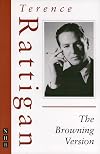
An excellent one-act. The outcome surprised me in that the main character appeared to be doomed to a hellish existence with his whorish wife, but Rattigan suggests that that may not be so. He leaves one with a feeling of hope after all.
Lists
Awards


You May Also Like


Associated Authors
Statistics
- Works
- 53
- Also by
- 8
- Members
- 1,169
- Popularity
- #22,001
- Rating
- 3.8
- Reviews
- 23
- ISBNs
- 125
- Languages
- 4
- Favorited
- 3