

Paul Fleischman
Author of Seedfolks
About the Author
Paul Fleischman was born in Monterey, California on September 5, 1952. His father is fellow children's author, Sid Fleischman. He attended the University of California at Berkeley for two years, from 1970 to 1972. He dropped out to go on a cross-country train/bicycle trip and along the way took show more care of a 200-year-old house in New Hampshire. He eventually earned a Bachelor of Arts Degree from the University of New Mexico in 1977. Fleischman has written over 25 books for children and young adults including award winners such as Joyful Noise: Poems for Two Voices, Newberry Medal in 1989; Graven Images, Newberry Honor; Bull Run, Scott O'Dell Award for Historical Fiction; Breakout, Finalist for the National Book Award in 2003; Saturnalia, Boston Globe-Horn Book Fiction Honor. He has also garnered numerous awards and recognitions from the American Library Association, School Library Journal, Publisher's Weekly, Booklist, and NCTE. He founded the grammar watchdog groups ColonWatch and The Society for the Prevention of Cruelty to English. (Bowker Author Biography) show less
Image credit: Copyright © 2006 by Dana Fleischman
Series
Works by Paul Fleischman
Copier Creations: Using Copy Machines to Make Decals, Silhouettes, Flip Books, Films, and Much More! (1993) 36 copies
Fearsome Giant, Fearless Child: A Worldwide Jack and the Beanstalk Story (Worldwide Stories) (2019) 33 copies, 5 reviews
Pappskallene 1 copy
Associated Works
When I Was Your Age, Volume Two: Original Stories About Growing Up (1999) — Contributor — 93 copies, 2 reviews
A Newbery Zoo: A dozen animal stories by Newbery Award-winning authors (1995) — Contributor — 39 copies, 2 reviews
Tagged
Common Knowledge
- Birthdate
- 1952-09-05
- Gender
- male
- Relationships
- Fleischman, Sid (father)
- Nationality
- USA
- Birthplace
- Monterey, California, USA
- Places of residence
- Santa Monica, California, USA
New Hampshire, USA
Berkeley, California, USA - Associated Place (for map)
- California, USA
Members
Discussions
Found: Fiction book about a community garden, Switching POVs in Name that Book (November 2024)
Reviews

Newbery Medal-winning author Paul Fleischman highlights the diverse Cinderella traditions of the world in this flawed retelling of the famous tale, cobbling together elements from seventeen variants of the story in his global version. Opening with a depiction of a young girl sitting on her mother's lap, being read the story from a book, a globe on the table beside them, the narrative includes details from various tellings—Cinderella urging her father to remarry (Mexico), being sent to work show more in the rice fields (Korea), vowing not to tell her father of her mistreatment (Iraq)—and sometimes features multiple variants for the same part of the story. For instance, when Cinderella is hungry, panels on the same page describe and depict her being given honey by the cattle (Russia), figs and apricots by a fairy (Iran) and rice by Godfather Snake (India). So the story proceeds, cobbling together various elements to tell the tale, with the variants included coming from: Mexico, Appalachia, West Indies, Ireland, France, Germany, Poland, Russia, Zimbabwe, Iraq, Iran, India, China, Korea, Laos, Japan and Indonesia...
Given my love for fairy-tales and folklore, and the fact that I have read variants of this specific tale from many corners of the globe, I expected to enjoy Glass Slipper, Gold Sandal: A Worldwide Cinderella far more than I did. I should start by saying that it did have some very good qualities, chief amongst them the idea of the book itself. I liked the notion of combining various different tellings of this tale, highlighting the diversity of the folk cultures and traditions of the world, while also demonstrating, through the stories these cultures tell, the common concerns they share. This is part of why I enjoy folklore, and why I like to read many variants of the same tale type. I also greatly appreciated the beautiful gouache artwork of illustrator Julie Paschkis, which had a gorgeous and colorful folk-art style entirely appropriate to the text. All this being said, despite appreciating the idea of the book, unfortunately I didn't feel that it worked, in the end. The story felt fractured, both overall, and in those places where multiple elements of the same episode were used together. I felt I could appreciate what Fleischman was doing, but I have read so many variants of this tale that I could identify each element being used. Would younger children who have not had that exposure be able to do the same? Or would the story just feel confusing, jumping around and back in a discordant way? To make matters worse, there is no back matter, giving information on each country's telling of this tale, and where those specific variants can be found (most have been published in picture book form), which is a real missed opportunity.
In addition to this central flaw, I also found myself immensely annoyed by the brief author's note at the beginning, which once again shares the false information that the Chinese variant of this story is the oldest one recorded, in the 9th century AD. I have seen this incorrect information shared in a number of places, and am at a loss to explain its ubiquity, when a quick search should alert authors and editors to the fact that the ancient Egyptian variant predates the Chinese one by many centuries. The tale of Rhodopis—a picture book retelling can be found in Shirley Climo's The Egyptian Cinderella—was recorded in the work of the Greek geographer Strabo some time in the late first century BC, or early first century AD. Another retelling can be found in the work of Roman author Aelian (ca. 175–235 AD). I feel that this information had to have been available in 2007, when this book was published (the Climo was published in 1989), so the error feels particularly egregious and misleading.
In any case, while in the end I'm glad to have read this one, given my interest in comparative folklore in general and this tale in particular, I don't know that I strongly recommend it, save to those who likewise have an interest in Cinderella retellings. My three stars are largely for the idea and artwork. show less
Given my love for fairy-tales and folklore, and the fact that I have read variants of this specific tale from many corners of the globe, I expected to enjoy Glass Slipper, Gold Sandal: A Worldwide Cinderella far more than I did. I should start by saying that it did have some very good qualities, chief amongst them the idea of the book itself. I liked the notion of combining various different tellings of this tale, highlighting the diversity of the folk cultures and traditions of the world, while also demonstrating, through the stories these cultures tell, the common concerns they share. This is part of why I enjoy folklore, and why I like to read many variants of the same tale type. I also greatly appreciated the beautiful gouache artwork of illustrator Julie Paschkis, which had a gorgeous and colorful folk-art style entirely appropriate to the text. All this being said, despite appreciating the idea of the book, unfortunately I didn't feel that it worked, in the end. The story felt fractured, both overall, and in those places where multiple elements of the same episode were used together. I felt I could appreciate what Fleischman was doing, but I have read so many variants of this tale that I could identify each element being used. Would younger children who have not had that exposure be able to do the same? Or would the story just feel confusing, jumping around and back in a discordant way? To make matters worse, there is no back matter, giving information on each country's telling of this tale, and where those specific variants can be found (most have been published in picture book form), which is a real missed opportunity.
In addition to this central flaw, I also found myself immensely annoyed by the brief author's note at the beginning, which once again shares the false information that the Chinese variant of this story is the oldest one recorded, in the 9th century AD. I have seen this incorrect information shared in a number of places, and am at a loss to explain its ubiquity, when a quick search should alert authors and editors to the fact that the ancient Egyptian variant predates the Chinese one by many centuries. The tale of Rhodopis—a picture book retelling can be found in Shirley Climo's The Egyptian Cinderella—was recorded in the work of the Greek geographer Strabo some time in the late first century BC, or early first century AD. Another retelling can be found in the work of Roman author Aelian (ca. 175–235 AD). I feel that this information had to have been available in 2007, when this book was published (the Climo was published in 1989), so the error feels particularly egregious and misleading.
In any case, while in the end I'm glad to have read this one, given my interest in comparative folklore in general and this tale in particular, I don't know that I strongly recommend it, save to those who likewise have an interest in Cinderella retellings. My three stars are largely for the idea and artwork. show less

A group of fourth graders in a Wisconsin classroom are encouraged to imagine themselves as migrating veery birds by their teacher Mrs. Lee in this thoughtful picture book from Newbery Medal-winning author Paul Fleischman and up-and-coming illustrator Hannah Salyer. Every afternoon, in the last half-an-hour of the school day, their teacher closes the window blinds and the children close their eyes and rest their heads on their desks, experiencing through their imagination, and the narration show more and sound effects provided by Ms. Lee, the long journey from Brazil to Wisconsin. The voyage from the Amazon to the Caribbean, across that great body of water to Cuba, and thence to Louisiana and further northward are imagines, as each child identifies with the veery in different ways, and comes to consider their lives and needs in a deeper way. The book concludes with a class field trip to a local state park, where the children see actual veery birds, and a final section giving more information, and resources and tips for the child reader on watching and tracking birds...
Full disclosure: I am friends with illustrator Hannah Salyer, and am a great admirer of her work. Published last year (2024), The Class with Wings is a book I tracked down in order to peruse and experience Hannah's artwork, created using gouache, colored pencil and digital elements. I was certainly not disappointed on that score, finding the visuals here absolutely stunning. I particularly loved those scenes in which the children are paired with birds visually, the latter done in a striking golden hue, the former in darker blue and purplish colors. There is one scene in which a bird partially obscures a girl's face that has the beauty and power of a surrealist painting. Another scene, much lighter in hue, shows a girl with a bird's wing. These illustrations perfectly depicts that liminal space between nature and imagination, that is also wonderfully captured in the text. Fleischman's text is a creative and thought-provoking way to highlight this bird species (about which I knew little, going in), while also exploring the power of the imagination in building knowledge and empathy. The fictional Ms. Lee should get an award for her teaching! I also liked the final section, for the additional information it provided, and for the tips it gave in how to get involving in watching and documenting migratory birds, "one of the world's largest citizen-science projects." Recommended to young bird and animal lovers, to anyone seeking children's stories about the imagination, and to those who appreciate beautiful illustrations. show less
Full disclosure: I am friends with illustrator Hannah Salyer, and am a great admirer of her work. Published last year (2024), The Class with Wings is a book I tracked down in order to peruse and experience Hannah's artwork, created using gouache, colored pencil and digital elements. I was certainly not disappointed on that score, finding the visuals here absolutely stunning. I particularly loved those scenes in which the children are paired with birds visually, the latter done in a striking golden hue, the former in darker blue and purplish colors. There is one scene in which a bird partially obscures a girl's face that has the beauty and power of a surrealist painting. Another scene, much lighter in hue, shows a girl with a bird's wing. These illustrations perfectly depicts that liminal space between nature and imagination, that is also wonderfully captured in the text. Fleischman's text is a creative and thought-provoking way to highlight this bird species (about which I knew little, going in), while also exploring the power of the imagination in building knowledge and empathy. The fictional Ms. Lee should get an award for her teaching! I also liked the final section, for the additional information it provided, and for the tips it gave in how to get involving in watching and documenting migratory birds, "one of the world's largest citizen-science projects." Recommended to young bird and animal lovers, to anyone seeking children's stories about the imagination, and to those who appreciate beautiful illustrations. show less
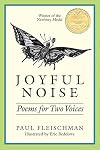
This slim volume of poetry is dedicated entirely to insects. Sounds like it could be gross, but it’s not. Various insects take on different roles, but nearly all are sympathetically portrayed. In fact, some even seem to take the role of the tragic hero. All are accompanied with black-and-white illustrations, which are realistic but also somehow make the insects look inviting. The poems are all written “for two voices” with each page having a right column for the first reader and a left show more column for the second reader. These columns sometimes contain contrasting lines, complementing lines, or even on occasion the same line. This method of poetry serves better for some poems than others. For instance, the book lice poem is the story of a couple, while the honeybees poem contrasts a worker bee’s life with a queen bee’s life, so the choral reading style works well for both of these. On the other hand, the digger wasp poem is clearly narrated by one being, so having two voices does not make sense here. Of course, another downside with the poems for two voices is that they do not make for the best reading material when waiting in a doctor’s office by yourself (which is when I read this book), so this book works better if you have a partner and are able to read aloud. Overall though, I would recommend this as a short and sweet volume extolling the virtues of nature that can be enjoyed at any age. show less
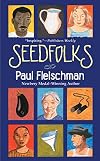
Maybe the author had good intentions with this story of a multicultural community coming together to grow a garden. But the racial insensitivity it traffics in was painful - each chapter is written in a different characters voice, but only the Asian character is written with an obvious accent. The political and economic assumption is that all these people could build a better community if they just worked a little harder. One of the final chapters includes a line “ It had been such a show more wonderful change to see people making something for themselves instead of waiting for a welfare check.”
There’s so much to unpack in these 70 pages, and I don’t think this novella deserves that much work. show less
There’s so much to unpack in these 70 pages, and I don’t think this novella deserves that much work. show less
Lists
Awards


You May Also Like


Associated Authors
Statistics
- Works
- 53
- Also by
- 6
- Members
- 15,864
- Popularity
- #1,429
- Rating
- 4.0
- Reviews
- 739
- ISBNs
- 393
- Languages
- 9
- Favorited
- 2