
H.E. Bates (1905–1974)
Author of Fair Stood the Wind for France
About the Author
Disambiguation Notice:
H.E. Bates wrote his wartime propaganda stories for the RAF under the pseudonym "Flying Officer X"
Series
Works by H.E. Bates
The Tinkers of Elstow: The story of the Royal Ordnance Factory managed by J. Lyons & Company Limited for the Ministry of (1946) 3 copies
The Greater Omnibus of Private Books — Contributor — 2 copies
A German Idyll 2 copies
Thirty Tales 2 copies
Majs ljuva knoppar 2 copies
The Lily 2 copies
Bíbor sivatag regény 1 copy
L'AVIATEUR ANGLAIS 1 copy
Time (Still Life) 1 copy
In the heart of the country 1 copy
Colonel Julian 1 copy
The Darling Buds of May 1 copy
Never 1 copy
The Station 1 copy
A Funny Thing 1 copy
The Waterfall [short story] 1 copy
De minnaar 1 copy
The Larkin Saga 1 copy
Flying Officer X 1 copy
Associated Works
Escape-or die: authentic stories of the R.A.F. Escaping Society (1952) — Introduction, some editions — 146 copies, 1 review
Gentle Like a Cyclone: Stories of Horses and Their Riders (1974) — Contributor — 22 copies, 1 review
Reader's Digest Condensed Books: Night over Water • Loves Music, Loves to Dance • Stormchild • The Darling Buds of May (1965) 7 copies
Story in America, 1933-1934: Thirty-Four Selections from the American Issues of "Story," the Magazine Devoted Solely to the Short Story (1934) — Contributor — 3 copies
Then and Now. A Selection of Articles, Stories & Poems, Taken from the First Fifty Numbers of ‘Now & Then’, 1921–35. Together with Some Illustrations, etc. (1935) — Contributor — 2 copies
The Best British Short Stories of 1933 — Contributor, some editions — 2 copies
American Aphrodite: A Quarterly for the Fancy-Free (Volume 4, Number 13) (1954) — Contributor — 2 copies
American Aphrodite: A Quarterly for the Fancy Free (Volume 5, Number 19) (1955) — Contributor — 2 copies
Great tales of adventure: A selection of condensed novels and full-length short stories (1982) — Contributor — 2 copies
Twelve Great Modern Stories, A New Collection — Contributor — 1 copy
Contemporary British Short Stories II. George Orwell, Dylan Thomas, D. H. Lawrence, Virginia Woolf, H. E. Bates. (1998) — Author — 1 copy
Missing From Their Homes — Contributor — 1 copy
Stories for girls — Contributor — 1 copy
Argosy (UK) [Vol. IV No. 5, June 1943] — Contributor — 1 copy
New English short stories — Contributor — 1 copy
Tagged
Common Knowledge
- Legal name
- Bates, Herbert Ernest
- Other names
- Flying Officer X
- Birthdate
- 1905-05-16
- Date of death
- 1974-01-29
- Gender
- male
- Education
- Kettering Grammar School, Northamptonshire, England, UK
- Occupations
- reporter
clerk
RAF propagandist
writer - Organizations
- Royal Air Force (WWII)
- Awards and honors
- Order of the British Empire (Commander, 1973)
- Nationality
- UK
- Birthplace
- Rushden, Northamptonshire, England, UK
- Places of residence
- Rushden, Northamptonshire, England, UK
Little Chart, Kent, England, UK - Place of death
- Canterbury, Kent, England, UK
- Burial location
- Kent County Crematorium, Charing, Ashford Borough, Kent, England, UK
- Map Location
- England, UK
- Disambiguation notice
- H.E. Bates wrote his wartime propaganda stories for the RAF under the pseudonym "Flying Officer X"
Members
Reviews

Yet another book that I've always thought of as a classic bit of timeless Englishness, but which turns out on closer inspection to be tied to a very specific moment in British history. This is 1958, Harold Macmillan's "never had it so good" era, when a minor economic boom coupled with the effects of a labour shortage, inflation, and taxes to create a kind of social "inversion layer", where many middle-class people on fixed salaries or pensions struggled to make ends meet whilst agricultural show more and factory workers were raking in the cash and drowning in consumer luxuries. English lit was awash with grim, grey novels about angry young working-class men from Nottingham, whilst the shock troops of the aristocracy (Nancy Mitford and Evelyn Waugh) were fighting a brave rearguard action to defend their culture.
H.E. Bates (previously known for sentimental tales of World War II airmen falling in love with heroines of the French Resistance) took a completely different course with this affectionate comic portrait of a working-class family that simply revels in all the things that set middle-class teeth on edge (tomato ketchup, television, large rolls of banknotes, fish and chips, butter, open displays of sexuality, implausible numbers of children, ice cream, cocktail cabinets, pelmets, flaunting of the tax laws, ...). We have to love the Larkins because of the uninhibited pleasure they take in all these things, and their urge to share that pleasure with all their friends. Of course, it helps that Pop Larkin is always ready to help out his impoverished but deserving middle-class neighbours, the Brigadier and Miss Pilchester.
Bates is mocking his middle-class readers, but in the nicest possible way. Although the cultural references are very 1958, the style recalls the humour of Pickwick Papers: in many ways, the Larkins's farm is just an updated version of Mr Wardle's Manor Farm at Dingley Dell. Come to think of it, Mr Pickwick wasn't averse to a bit of tomato sauce, either, was he? show less
H.E. Bates (previously known for sentimental tales of World War II airmen falling in love with heroines of the French Resistance) took a completely different course with this affectionate comic portrait of a working-class family that simply revels in all the things that set middle-class teeth on edge (tomato ketchup, television, large rolls of banknotes, fish and chips, butter, open displays of sexuality, implausible numbers of children, ice cream, cocktail cabinets, pelmets, flaunting of the tax laws, ...). We have to love the Larkins because of the uninhibited pleasure they take in all these things, and their urge to share that pleasure with all their friends. Of course, it helps that Pop Larkin is always ready to help out his impoverished but deserving middle-class neighbours, the Brigadier and Miss Pilchester.
Bates is mocking his middle-class readers, but in the nicest possible way. Although the cultural references are very 1958, the style recalls the humour of Pickwick Papers: in many ways, the Larkins's farm is just an updated version of Mr Wardle's Manor Farm at Dingley Dell. Come to think of it, Mr Pickwick wasn't averse to a bit of tomato sauce, either, was he? show less

Treacherous mud clutched at the wheels and the Wellington up-ended. End of mission. The great bomber had been giving the crew trouble since leaving Italy. Finally over occupied France, it settles like a weary, wounded edge on what seemed to Franklin a hard, smooth field. The five members of the crew, already closely bound together that even conversation was seldom necessary, were welded by the crash into a single whole, one tiny forged weapon in the vast territory of the enemy-weak and show more ineffectual yet confident as only men can be whose minds are free. show less

Bates at his most tense and immediate'
By sally tarbox on 29 May 2013
Format: Paperback
Ten wonderful evocative short stories - I particularly liked 'Love Me Little, Love Me long' which in only seven pages totally creates the mood and passion of a man visiting his former love, now-married and out of his grasp forever.
Also the marvellous title story where we meet 45 year old Mrs Boorman, living a totally unglamorous life on a pig farm:
'Every morning, as she slopped out of the house into the show more mouldering filth of the pig-yard...she looked in fact less like a pig than a shabby, straddling scarecrow. Big, mud-caked gumboots concealed whatever shape her legs had. A long sackcloth apron shrouded her body into a flatness that might have been masculine...And as if she were actually afraid of revealing any part of herself that might have given away the fact that she was a woman she wore, winter and summer, a vast pair of old leather driving gloves, so dark with dirt and use that they might have been perennially soaked in pig dung.'
But Mrs Boorman has a secret - every spare penny goes on a fabulous collection of clothes...
Once I'd got past the rather lackluster first tale in this collection, I was hooked. show less
By sally tarbox on 29 May 2013
Format: Paperback
Ten wonderful evocative short stories - I particularly liked 'Love Me Little, Love Me long' which in only seven pages totally creates the mood and passion of a man visiting his former love, now-married and out of his grasp forever.
Also the marvellous title story where we meet 45 year old Mrs Boorman, living a totally unglamorous life on a pig farm:
'Every morning, as she slopped out of the house into the show more mouldering filth of the pig-yard...she looked in fact less like a pig than a shabby, straddling scarecrow. Big, mud-caked gumboots concealed whatever shape her legs had. A long sackcloth apron shrouded her body into a flatness that might have been masculine...And as if she were actually afraid of revealing any part of herself that might have given away the fact that she was a woman she wore, winter and summer, a vast pair of old leather driving gloves, so dark with dirt and use that they might have been perennially soaked in pig dung.'
But Mrs Boorman has a secret - every spare penny goes on a fabulous collection of clothes...
Once I'd got past the rather lackluster first tale in this collection, I was hooked. show less
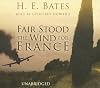
It's an unlikely word to describe a WWII novel, but this book is really beautiful. It is, on the whole, comparatively slow paced and the romance gently unfolds while not a lot actually happens, but then, suddenly, the violence of war interveens and these episodes are genuinely shocking. A wellington bomber crashlands in France after a bombing raid to italy. The crew survive, but the pilot suffers a serious injury to on arm, losing a lot of blood. They proceed on foot and discover a show more farmhouse, whose occupants take them in. they are distinctly segregated from the inhabitants initially, but slowly the crew leave to try and escape to Blighty, leaving just the pilot in the farmhouse. He begins to integrate into the family, and they spend considerable effort trying to protect him from the truth of events in the village. the ending is, in one sense, a culmination of events that you can see building from a distance off, however, the final chapter is utterly shocking and completely unexpected. It is moving and could be profoundly depressing, but it isn't, and you remain sure that love will come through. show less
Lists
Awards


You May Also Like


Associated Authors
Statistics
- Works
- 167
- Also by
- 56
- Members
- 5,616
- Popularity
- #4,418
- Rating
- 3.9
- Reviews
- 103
- ISBNs
- 489
- Languages
- 8
- Favorited
- 13
