
Robert E. Goodin
Author of A Companion to Contemporary Political Philosophy
About the Author
Robert E. Goodin is Distinguished Professor of Social and Political Theory and Philosophy at the Research School of Social Sciences, Australian National University, and Professor of Government at the University of Essex.
Works by Robert E. Goodin
Innovating Democracy: Democratic Theory and Practice After the Deliberative Turn (2008) 21 copies, 1 review
Reasons for Welfare: The Political Theory of the Welfare State (Studies in Moral, Political, and Legal Philosophy) (1988) 16 copies, 1 review
Free Movement: Ethical Issues in the Transnational Migration of People and of Money (1992) — Editor — 11 copies
Associated Works
The Cambridge History of Twentieth-Century Political Thought (2003) — Contributor — 55 copies, 1 review
Tagged
Common Knowledge
- Birthdate
- 1950-11-30
- Gender
- male
- Education
- University of Oxford (D.Phil., Politics, 1975)
- Occupations
- Editor, Jounal of Political Philosophy
Members
Reviews
Innovating Democracy: Democratic Theory and Practice After the Deliberative Turn by Robert E. Goodin
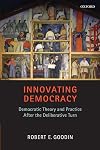
I didn't think very highly of deliberative democratic theory prior to reading this book. That's probably because Dryzek's Foundations and Frontiers of Deliberative Governance was my first book on the subject. But this book was the exact opposite of Dryzek's confusing work. Why do these two collaborators, Goodin and Dryzek, differ so much in their deliberative theorizing? I think Goodin answers the question in the concluding chapter of this book where he respectfully criticizes Habermas' (and show more thereby indirectly Dryzek's) penchant for trying to treat "questions of which it is hard to say anything much in any interestingly general terms" (p.258-261). This book excels precisely in asking the right questions through deliberative democratic theory.
Goodin approaches the subject from a multitude of interesting and general angles. His chapters on micro-deliberation (in small groups) soon convinced me of the usefulness of deliberation. They also taught me a lot about its limitations and the variety of procedural choices that could alter the outcome of a micro-debate. The chapters on macro-publics are even better. The all-affected-interests principle, democratic parties and societal diversity are all discussed with reference to democratic deliberation. Even democratic representation, which often seems to be disregarded in theories that focus on deliberation, is given suitable room in this book.
All in all I strongly recommend this book to all students of democratic theory. It rewards concentrated study. If you're just getting started, this book will save you a great deal of time as it sets you on the right track from the beginning. It shows that some aspects of democratic deliberation can be discussed in theoretical terms with a clearly defined meaning. It's Goodin's best book to date and I can't wait to read the next one. show less
Goodin approaches the subject from a multitude of interesting and general angles. His chapters on micro-deliberation (in small groups) soon convinced me of the usefulness of deliberation. They also taught me a lot about its limitations and the variety of procedural choices that could alter the outcome of a micro-debate. The chapters on macro-publics are even better. The all-affected-interests principle, democratic parties and societal diversity are all discussed with reference to democratic deliberation. Even democratic representation, which often seems to be disregarded in theories that focus on deliberation, is given suitable room in this book.
All in all I strongly recommend this book to all students of democratic theory. It rewards concentrated study. If you're just getting started, this book will save you a great deal of time as it sets you on the right track from the beginning. It shows that some aspects of democratic deliberation can be discussed in theoretical terms with a clearly defined meaning. It's Goodin's best book to date and I can't wait to read the next one. show less
I've enjoyed many of Robert Goodin's books in political theory, but the arguments in this one don't compare favorably to his previous work. The chapters have been put together from research papers. As usual the separate origin of each chapter is reflected in the argument, which becomes excessively detailed in some places and is insufficiently integrated on the whole. I was particularly annoyed by a section on the Condorcet jury theorem and Bayesian probability. These topics are clearly show more peripheral to the main argument. After 50 pages of elaborate but completely pointless formalism the author finally comes to the obvious conclusion: political decisions don't have an objectively correct yes/no answer.
As for the main argument, "democratic deliberation within", I have to say that I found this idea unworthy of publication. The point is simply that democratic decisions would be improved if most voters would imaginatively put themselves in other shoes before voting. The interests of disadvantaged and disenfranchised people, and even those of future generations and the natural world, could supposedly be democratically protected in this way. The author does not say much about how this paradisiacal ideal could be reached in practice, but apparently it would be helpful if people read more novels and broadened their spheres of social intercourse. Frankly, a professional political theorist should come up with better ideas than this. I would direct prospective readers towards Goodin's other books, such as Reasons for Welfare, before this one. show less
As for the main argument, "democratic deliberation within", I have to say that I found this idea unworthy of publication. The point is simply that democratic decisions would be improved if most voters would imaginatively put themselves in other shoes before voting. The interests of disadvantaged and disenfranchised people, and even those of future generations and the natural world, could supposedly be democratically protected in this way. The author does not say much about how this paradisiacal ideal could be reached in practice, but apparently it would be helpful if people read more novels and broadened their spheres of social intercourse. Frankly, a professional political theorist should come up with better ideas than this. I would direct prospective readers towards Goodin's other books, such as Reasons for Welfare, before this one. show less
The author of this book has an enviable knack for clear and cogent argumentation, but I still didn't like it very much. The first part on green theories of value was the most interesting. The author argues that if natural things have value, they do so on account of their history. The argument is abstract, but in a good and useful way. Unfortunately the book turns sour after that. In the second part the author posits that the green political program cannot be adopted piecemeal by other show more parties - it's always an all-or-nothing affair. This argument seemed to beg the question. You agree with it if you've already adopted the green theory of value, but there's no independent reason for agreement if you happen to prioritize other values.
The third part on the green theory of agency suffers from other problems. The theories of agency (with regard to direct democracy, political decentralization, politics without parties etc.) are so rudimentary and opaque that I wouldn't even call them political theory. The author often distills these "theories" from the programs of various green political parties from the 1980s. The book seems a bit outdated on that account. I think he drifts too far away from political theory as he rehashes green ideology instead of arguing philosophically. Perhaps there have been real developments in green political theory after this book was written, but as it stands this is clearly a lightweight contribution which I cannot recommend. show less
The third part on the green theory of agency suffers from other problems. The theories of agency (with regard to direct democracy, political decentralization, politics without parties etc.) are so rudimentary and opaque that I wouldn't even call them political theory. The author often distills these "theories" from the programs of various green political parties from the 1980s. The book seems a bit outdated on that account. I think he drifts too far away from political theory as he rehashes green ideology instead of arguing philosophically. Perhaps there have been real developments in green political theory after this book was written, but as it stands this is clearly a lightweight contribution which I cannot recommend. show less
Reasons for Welfare: The Political Theory of the Welfare State (Studies in Moral, Political, & Legal Philosophy) by Robert E. Goodin
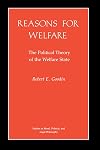
Robert Goodin's books are always worth reading and I liked this one although it was a bit too long. Part I is called "Against the old left" and this was in my opinion the least interesting part of this book. The author discusses traditional philosophical defenses of welfare provisions, but much of his analysis shrinks to tedious conceptual analysis. In part II he finally releases his own theory, which is much more interesting. He finds the justification of the welfare state in rendering show more dependent people less dependent on the actions of particular others (p.125), so that they can participate on fair terms in the market sectors of their society (p.183). This is a very illuminating and convincing argument and I have not seen the same issues discussed anywhere else with this degree of clarity.
Part III consists of a set of counter-arguments against traditional objections to welfare provision. This is also an interesting analysis, although I think it would have benefited from a slight reduction in length. In a particularly interesting section (p.312-331) the author recounts the effects of the welfare state on freedom. This might be the most philosophical of Goodin's books, as nearly every argument is rooted in moral principles. It's also a very comprehensive literature review on the 20th century debates on the welfare state, so I can recommend it to everyone who has ever speculated upon how the welfare provisions of modern states can be justified. show less
Part III consists of a set of counter-arguments against traditional objections to welfare provision. This is also an interesting analysis, although I think it would have benefited from a slight reduction in length. In a particularly interesting section (p.312-331) the author recounts the effects of the welfare state on freedom. This might be the most philosophical of Goodin's books, as nearly every argument is rooted in moral principles. It's also a very comprehensive literature review on the 20th century debates on the welfare state, so I can recommend it to everyone who has ever speculated upon how the welfare provisions of modern states can be justified. show less
Lists
You May Also Like


Associated Authors
Statistics
- Works
- 32
- Also by
- 2
- Members
- 813
- Popularity
- #31,388
- Rating
- 3.7
- Reviews
- 14
- ISBNs
- 119
- Languages
- 2