
David Held
Author of Models of Democracy
About the Author
David Held is Graham Wallas Professor of Political Science at the London School of Economics and Political Science
Image credit: David Held
Works by David Held
Democracy and the Global Order: From the Modern State to Cosmopolitan Governance (1995) 56 copies, 1 review
Μοντέλα Δημοκρατίας 1 copy
Tagged
Common Knowledge
- Canonical name
- Held, David
- Birthdate
- 1951-08-27
- Gender
- male
- Education
- Massachusetts Institute of Technology
Manchester University - Occupations
- political theorist
college master - Organizations
- University College, Durham
Durham University
Polity Press
Civitatis International
London School of Economics and Political Science
Open University (show all 7)
University of York - Nationality
- UK
- Associated Place (for map)
- UK
Members
Reviews

This book about models of democracy is itself a model of clarity. The author presents about a dozen historical and contemporary models and strives to articulate the justification principle and the required institutional framework for each model and to add something general about what kind of society could implement it. So this book will definitely teach you how to theorize democracy. It's mainly an introductory book but it's written so well that more seasoned travelers can also profit from show more reading it. show less
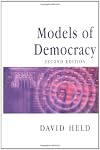
I found this a hard, but worthwhile read. David Held writes well, but this is clearly designed as a text for an educational course and there were stages at which I would have welcomed a co-reader with whom to discuss what was being reported.
The book takes a look at democracy from its inception, at the hands of the Greek people, to the beginning of the 21st century. I expect that, if you are less mean than myself and bought a new edition from a book store, it would be even more up to show more date.
The first, perhaps unsurprising point, is that the perfect democratic system has yet to be created but, that democracy is the only system that even offers the prospect of a halcyon state. The book looks at both right leaning and leftward attempts at the perfect state. As one would expect of a serious tome, neither is favoured: both get a chance to show their strengths and both reveal their weaknesses.
In the final section of the book, Held offers an insight into the problems to come and, as I have already said, my edition was written in 2002, some 13 years before my ingesting thereof: this means that the predicted trials have started to appear. It is impressive to note how accurately Mr Held has been in spotting them. The final issue brought up, is the question of the need for some form of World Government. We see, at the moment, that the USA is taking the role of the world's policeman; it is time that a multinational alternative was considered. show less
The book takes a look at democracy from its inception, at the hands of the Greek people, to the beginning of the 21st century. I expect that, if you are less mean than myself and bought a new edition from a book store, it would be even more up to show more date.
The first, perhaps unsurprising point, is that the perfect democratic system has yet to be created but, that democracy is the only system that even offers the prospect of a halcyon state. The book looks at both right leaning and leftward attempts at the perfect state. As one would expect of a serious tome, neither is favoured: both get a chance to show their strengths and both reveal their weaknesses.
In the final section of the book, Held offers an insight into the problems to come and, as I have already said, my edition was written in 2002, some 13 years before my ingesting thereof: this means that the predicted trials have started to appear. It is impressive to note how accurately Mr Held has been in spotting them. The final issue brought up, is the question of the need for some form of World Government. We see, at the moment, that the USA is taking the role of the world's policeman; it is time that a multinational alternative was considered. show less
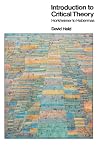
I believe there's a 1990 edition where, presumably, Held takes account of the relations between poststructuralism (and its iterations) and critical theory. But I'd say that this edition (1980) may be stronger for not having this material in it, as it becomes all the more astonishing how much poststructuralism--including its feminist versions--owes to critical theory. There are differences, of course (see Held's (approving?) account of Marcuse on mastering 'nature'); but the differences are show more not of the nature of a radical break. Apart from being a reference, the book's value may lie in its preventing students of theory--me, for instance--from thinking that because Derrida et al. surprised us, that they emerged ex nihilo rather than from an already thriving intellectual tradition. In our arrogance, I think we too often mistake our own astonishment, and the astonishment of an uneducated press, for the astonishment of intellectuals who may not have been astonished at all.
The book's final third is on Habermas. After seeing that we were about the enter into a discussion of unrestricted rational discussions in the public sphere, I skipped it, since Habermas's unreconstructed humanism is of no value to my work on animals. So I can't rightly be said to have finished this book. show less
The book's final third is on Habermas. After seeing that we were about the enter into a discussion of unrestricted rational discussions in the public sphere, I skipped it, since Habermas's unreconstructed humanism is of no value to my work on animals. So I can't rightly be said to have finished this book. show less
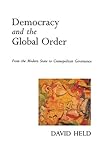
I was disappointed with this book because the author is slow in getting to the main topic. The total length of the book is 287 pages and the discussion on global democracy doesn't begin until page 219.
After an introductory part I the author gets to part II, which actually constitutes half of the entire book. It's a presentation of the history of the modern state and modern political systems. Not bad as a broad outline, but it's also obvious that the author is no historian. He merely skims show more the surface of state history with a detached theoretical perspective. Frankly, I don't see any reason why half the book should be used on a historical presentation which isn't of any relevance for the theoretical arguments at the end.
In Part III we finally get to democratic theory. But once again the author exhibits poor judgment. He spends a lot of pages on the principle of autonomy and on democratic thought experiments. These are quite abstract questions in democratic theory, and the author fails to explain their relevance for cosmopolitan governance. Spending another 70 pages on them seemed a bit pointless.
The author performs better in part IV when he at last gets to cosmopolitan democracy. This part was worth reading, but I was still mystified by the author's emphasis on "autonomy". His basic argument is quite simple: personal autonomy should be enforced on a global scale by international democratic law. If we can implement global democracy, we can effectively protect human rights, freedom and justice. This isn't exactly a deep insight. Constructing an abstract "principle of autonomy" and saying that it would be good if everyone could respect it, isn't an interesting argument. The author does offer some ideas for institutional change in international politics as well, but they don't amount to much more than pure fantasy. Perhaps he could have argued his case more convincingly if he had extended his central argument to 200 pages instead of 60.
In conclusion, I think this book is poorly structured: the preliminary parts are too long and the argument is much too short. But if you're looking for good books in democratic theory, you might want to consult this book just for its bibliography, which is quite comprehensive (up to 1995). show less
After an introductory part I the author gets to part II, which actually constitutes half of the entire book. It's a presentation of the history of the modern state and modern political systems. Not bad as a broad outline, but it's also obvious that the author is no historian. He merely skims show more the surface of state history with a detached theoretical perspective. Frankly, I don't see any reason why half the book should be used on a historical presentation which isn't of any relevance for the theoretical arguments at the end.
In Part III we finally get to democratic theory. But once again the author exhibits poor judgment. He spends a lot of pages on the principle of autonomy and on democratic thought experiments. These are quite abstract questions in democratic theory, and the author fails to explain their relevance for cosmopolitan governance. Spending another 70 pages on them seemed a bit pointless.
The author performs better in part IV when he at last gets to cosmopolitan democracy. This part was worth reading, but I was still mystified by the author's emphasis on "autonomy". His basic argument is quite simple: personal autonomy should be enforced on a global scale by international democratic law. If we can implement global democracy, we can effectively protect human rights, freedom and justice. This isn't exactly a deep insight. Constructing an abstract "principle of autonomy" and saying that it would be good if everyone could respect it, isn't an interesting argument. The author does offer some ideas for institutional change in international politics as well, but they don't amount to much more than pure fantasy. Perhaps he could have argued his case more convincingly if he had extended his central argument to 200 pages instead of 60.
In conclusion, I think this book is poorly structured: the preliminary parts are too long and the argument is much too short. But if you're looking for good books in democratic theory, you might want to consult this book just for its bibliography, which is quite comprehensive (up to 1995). show less
You May Also Like


Associated Authors
Statistics
- Works
- 41
- Members
- 1,404
- Popularity
- #18,294
- Rating
- 3.7
- Reviews
- 8
- ISBNs
- 146
- Languages
- 8