
Judith Orloff
Author of The Empath's Survival Guide: Life Strategies for Sensitive People
About the Author
Judith Orloff is an American psychiatrist and author, specializing in treating empaths and sensitive people. She is an assistant clinical professor of psychiatry at UCLA. She has written and spoken widely about her work, reaching out to doctors, patients, and everyday people. She is the author of show more Emotional Freedom, Positive Energy, Dr. Judith Orloff's Guide to Intuitive Healing, Second Sight, and The Empath's Survival Guide. Her work has appeared in a variety of magazines and newspaper including O Magazine, Forbes, Newsweek, USA Today, the Wall Street Journal, and more. Her television appearances include The Today Show, The Dr. Oz Show, CBS Early Show, CNN, PBS, and other networks. She is a blogger on Elephant Journal, Huffington Post and Psychology Today. (Bowker Author Biography) show less
Image credit: Photo courtesy of Hay House, Inc.
Works by Judith Orloff
Positive Energy: 10 Extraordinary Prescriptions for Transforming Fatigue, Stress, and Fear into Vibrance, Strength, and Love (2004) 293 copies, 2 reviews
Emotional Freedom: Liberate Yourself from Negative Emotions and Transform Your Life (2009) 256 copies, 5 reviews
Dr. Judith Orloff's Guide to Intuitive Healing: 5 Steps to Physical, Emotional, and Sexual Wellness (2000) 133 copies
The Ecstasy of Surrender: 12 Surprising Ways Letting Go Can Empower Your Life (2014) 47 copies, 2 reviews
The Power of Surrender: Let Go and Energize Your Relationships, Success, and Well-Being (2015) 23 copies
The Genius of Empathy: Practical Skills to Heal Your Sensitive Self, Your Relationships, and the World (2024) 18 copies, 1 review
Positive Energy Practices: How to Attract Uplifting People and Combat Energy Vampires (2006) 13 copies
The Power of Surrender Cards: A 52-Card Deck to Transform Your Life by Letting Go (2015) 13 copies, 1 review
Emotional Freedom Practices: How to Transform Difficult Emotions into Positive Energy (2009) 9 copies
Liberté émotionnelle : Libérez-vous de vos émotions négatives et retrouvez un parcours hors de la souffrance (2009) 2 copies, 1 review
Becoming an Intuitive Healer: A Professional Development Course for Health Practitioners (2007) 1 copy
Die Kraft in mir. Fünf Schritte zu körperlicher, emotionaler und sexueller Gesundheit. (Livre en allemand) (2003) 1 copy
Wenn dir alles unter die Haut geht: Das Überlebenshandbuch für Empathen und Hochsensible (2018) 1 copy
Tagged
Common Knowledge
- Canonical name
- Orloff, Judith
- Birthdate
- 1951-06-25
- Gender
- female
- Education
- University of Southern California
- Occupations
- psychiatrist
- Nationality
- USA
- Places of residence
- Beverly Hills, California, USA
- Associated Place (for map)
- California, USA
Members
Reviews
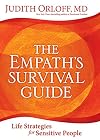
"Sensitive" here in the same sense as in Highly Sensitive People (HSPs), that is folks who are more sensitive than some to stimuli. HSPs (I am one) get overloaded easily in environments with harsh or excessive stimuli--so, crowds might bother them, or intense smells and sounds, or irritating fabrics and so on. According to Orloff, empaths are similar to HSPs (a person can be one but not the other, or both) but the sensitivity in the case of empaths is to do with picking up on other people's show more emotions and reacting to them, sometimes as if they were your own. If you find embarrassing scenes on TV excruciating or get anxious if you walk into a room where someone is angry or get choked up when an entire basketball stadium leaps to its feet in joy at a buzzer beater, you might be an empath.
Orloff explains what empaths are, offers some techniques for embracing and managing this sensitivity, and gives advice geared for general situations (how to thrive as an empathic parent, how to raise an empathic child, how to thrive at work as an empath, and so on). The worth of this book for me was two-fold: 1) the "it's you; it's real; it's okay" bit--it's always nice to get confirmation that you aren't imagining things and that you aren't alone and that there's nothing wrong with you--and 2) the exercises and meditations for embracing and managing empathic tendencies. She provides some meditations that I think will be really helpful. Some of Orloff's suggestions are a bit "new age" (do we still say that? crystals and premonitions and the like), and I don't personally find that sort of thing helpful. If you do, that aspect is here for you along with the rest. If you don't, but you want some help putting a barrier between other people's emotions and your own, there is definitely a core of non-crystalline advice here. show less
Orloff explains what empaths are, offers some techniques for embracing and managing this sensitivity, and gives advice geared for general situations (how to thrive as an empathic parent, how to raise an empathic child, how to thrive at work as an empath, and so on). The worth of this book for me was two-fold: 1) the "it's you; it's real; it's okay" bit--it's always nice to get confirmation that you aren't imagining things and that you aren't alone and that there's nothing wrong with you--and 2) the exercises and meditations for embracing and managing empathic tendencies. She provides some meditations that I think will be really helpful. Some of Orloff's suggestions are a bit "new age" (do we still say that? crystals and premonitions and the like), and I don't personally find that sort of thing helpful. If you do, that aspect is here for you along with the rest. If you don't, but you want some help putting a barrier between other people's emotions and your own, there is definitely a core of non-crystalline advice here. show less
Emotional Freedom: Liberate Yourself from Negative Emotions and Transform Your Life by Judith Orloff
Let me start by saying, I'm not a big fan of self help books. I've read a few in my life that had interesting and helpful points, but wading through the unrealistically positive twaddle is hard to take. This book was very different. She gets right to the heart of human nature and paints a beautiful picture of the path to recovery from the human condition.
If you are introspective and want to grow, read this and you'll be glad you did. If you aren't introspective, you probably need to read it show more even more, and your life will be significantly enhanced. :-)
The scientific foundation of the book could have easily stood on its own, but I really appreciated her including intuition. Some times the reading went a little slow, seeming to belabor a point, but I appreciated this on the segments covering what I most needed to improve. It got the point across. show less
If you are introspective and want to grow, read this and you'll be glad you did. If you aren't introspective, you probably need to read it show more even more, and your life will be significantly enhanced. :-)
The scientific foundation of the book could have easily stood on its own, but I really appreciated her including intuition. Some times the reading went a little slow, seeming to belabor a point, but I appreciated this on the segments covering what I most needed to improve. It got the point across. show less
After reading this I am even further convienced that I am not sensitive. However, I had a better understanding of what an empath actually is. It is not NECESSARILY a bunch of tree-hugging-hippie crap, but some of it is, the idea that a black crystal held close to you will help you makes it so far out there that I really wanted to through out the baby with the bath water.
I hae had a number of relationships that have claimed to be empaths, including my wife. Based on Dr. Orioff's description show more I may well be an "energy vampire" making it even more struggling that I would be attracted to ladies like this. I know it is part of the whole opposites attract. I suspect that if Judith were our consular she would recommend we divorce. Luck for me my wife is even more committed to the sacrament of matrimony than I am.
This book is certainly aimed at the sensitive. But there is some value in the loved one of HSPs reading this as well. It isn't easy reading, it is hard not to just dismiss Orioff as a whack-job, but ya do what ya can. show less
I hae had a number of relationships that have claimed to be empaths, including my wife. Based on Dr. Orioff's description show more I may well be an "energy vampire" making it even more struggling that I would be attracted to ladies like this. I know it is part of the whole opposites attract. I suspect that if Judith were our consular she would recommend we divorce. Luck for me my wife is even more committed to the sacrament of matrimony than I am.
This book is certainly aimed at the sensitive. But there is some value in the loved one of HSPs reading this as well. It isn't easy reading, it is hard not to just dismiss Orioff as a whack-job, but ya do what ya can. show less
Emotional Freedom: Liberate Yourself from Negative Emotions and Transform Your Life by Judith Orloff
Let me start by saying, I'm not a big fan of self help books. I've read a few in my life that had interesting and helpful points, but wading through the unrealistically positive twaddle is hard to take. This book was very different. She gets right to the heart of human nature and paints a beautiful picture of the path to recovery from the human condition.
If you are introspective and want to grow, read this and you'll be glad you did. If you aren't introspective, you probably need to read it show more even more, and your life will be significantly enhanced. :-)
The scientific foundation of the book could have easily stood on its own, but I really appreciated her including intuition. Some times the reading went a little slow, seeming to belabor a point, but I appreciated this on the segments covering what I most needed to improve. It got the point across. show less
If you are introspective and want to grow, read this and you'll be glad you did. If you aren't introspective, you probably need to read it show more even more, and your life will be significantly enhanced. :-)
The scientific foundation of the book could have easily stood on its own, but I really appreciated her including intuition. Some times the reading went a little slow, seeming to belabor a point, but I appreciated this on the segments covering what I most needed to improve. It got the point across. show less
Lists
Awards

You May Also Like


Statistics
- Works
- 46
- Members
- 1,735
- Popularity
- #14,819
- Rating
- 3.5
- Reviews
- 26
- ISBNs
- 116
- Languages
- 11
- Favorited
- 1