
Don McGregor
Author of Black Panther (Penguin Classics Marvel Collection)
About the Author
Image credit: Don McGregor. Photographed July 1974, Commodore Hotel, New York Comic Art Convention. By Tenebrae at English Wikipedia, CC BY-SA 3.0, https://commons.wikimedia.org/w/index.php?curid=18840374
Series
Works by Don McGregor
Tales from the Crypt #1: Ghouls Gone Wild (Tales from the Crypt Graphic Novels) (2007) 41 copies, 2 reviews
Marvel Masterworks, Volume 141: Black Panther Volume 1 [Jungle Action #6-24] (2010) 31 copies, 2 reviews
Marvel Masterworks, Volume 265: Killraven Volume 1 [Amazing Adventures #18-39 + Marvel Graphic Novel #7] (2018) — Author — 21 copies
Marvel Masterworks, Volume 303: Black Panther Volume 3 [#1-4 + parts of Marvel Comics Presents #13-37] (2021) 9 copies
Amazing Adventures, Vol. 2 #39 4 copies
Amazing Adventures, Vol. 2 #34 4 copies
Amazing Adventures, Vol. 2 #36 4 copies
Amazing Adventures, Vol. 2 #37 4 copies
Murder By Crowquill 4 copies
Amazing Adventures, Vol. 2 #31 4 copies
Amazing Adventures, Vol. 2 #30 3 copies
Amazing Adventures, Vol. 2 #28 3 copies
Amazing Adventures, Vol. 2 #23 3 copies
Amazing Adventures, Vol. 2 #26 3 copies
Amazing Adventures, Vol. 2 #25 3 copies
Amazing Adventures, Vol. 2 #27 3 copies
Amazing Adventures, Vol. 2 #35 3 copies
Amazing Adventures, Vol. 2 #21 3 copies
Blade (1998) #2 2 copies
Monsters Unleashed! — Editor — 2 copies
Blade (1998) #1 2 copies
Blade (1998) #3 2 copies
Morbius: Blood Tide! 2 copies
Doctor Strange (1974-1987) #31 — Author — 2 copies
Zorro (1993 series) No. 1 1 copy
Zorro (1993 series) No. 0 1 copy
Zorro (1993 series) No. 3 1 copy
Zorro (1993 series) No. 2 1 copy
Zorro (1993 series) No. 4 1 copy
Zorro (1993 series) No. 5 1 copy
Zorro (1993 series) No. 6 1 copy
Zorro (1993 series) No. 7 1 copy
Zorro (1993 series) No. 8 1 copy
Zorro #s 8,10 1 copy
Vampire Tales (1973-1975) #5 1 copy
Fantasy Illustrated #1 — Author — 1 copy
Marvel Comics, la collection de référence Tome CR-26 XXVI La Panthère noire-la colère de la panthère 1 copy
Detective Comics (1937) #388 1 copy
Zorro (1993 series) No. 9 1 copy
Sabre #03 1 copy
Power Man 31 1 copy
Zorro (1993 series) No. 11 1 copy
Zorro (1993 series) No. 10 1 copy
Amazing Adventures, #21-30 1 copy
Dracula versus Zorro 1 copy
Morbius: Demon Fire! 1 copy
Marvel Classics Comics No. 23 — Author — 1 copy
An Editorial Felled 1 copy
Spider-Man (Vol. 1) #28 1 copy
Spider-Man (Vol. 1) #27 1 copy
Marvel Classics Comics No. 31 — Author — 1 copy
Nathaniel Dusk #3 1 copy
Nathaniel Dusk #1 1 copy
Killraven. Tomos I y II 1 copy
Nathaniel Dusk II 1 copy
Zorro Matanzas #1 1 copy
Zorro Matanzas #4 1 copy
Zorro Matanzas #3 1 copy
Associated Works
9-11: The World's Finest Comic Book Writers & Artists Tell Stories to Remember (2002) — Author — 256 copies, 1 review
Tagged
Common Knowledge
- Legal name
- McGregor, Donald Francis
- Birthdate
- 1945-06-15
- Gender
- male
- Occupations
- comic book writer
- Organizations
- Marvel Comics
- Nationality
- USA
- Birthplace
- Providence, Rhode Island, USA
- Associated Place (for map)
- Rhode Island, USA
Members
Reviews

Access a version of the below that includes illustrations on my blog.
After Don McGregor's Black Panther run from Jungle Action was cancelled back in 1976, he actually got invited back two more times: he did a story called Panther's Quest published in Marvel Comics Presents in 1989 and a four-issue prestige miniseries called Panther's Prey in 1991. This "Epic Collection" collects both of them, along with five short Black Panther tales by other creators from the same era.
Panther's Quest sends show more the Black Panther into South Africa in order to find his mother, missing since childhood. Sure, we did apartheid in a thinly fictionalized version of South Africa in the immediate previous Black Panther storyline, but why not do it again in the real place? This story ran twenty-five biweekly installments of (usually) eight pages... and it is interminable. Like, eight pages will go by and all that's happened is Black Panther has punched a guy. One thing I liked about McGregor's Panther's Rage was how it really made you feel the difficulty of what the Black Panther did, but this goes too far with it, because everything is immensely difficult, everything is enormously slowed down, it never feels like we're getting anywhere, being crushed under the weight of McGregor's enormously wordy style. Being set in South Africa means we again lose the worldbuilding that made Panther's Rage so interesting, too. It has it moments, including some nice side characters in South Africa, but ultimately, a tedious slog with little to say.
Panther's Prey almost has the opposite problem: this is made up of four forty-page installments and is all over the place. Wakanda is modernizing, connecting with the outside world more—this is nicely demonstrated by the appearance of a food court selling pizza. But with the benefits of connecting to the outside world also come the downsides, and someone is smuggling crack into Wakanda and vibranium out... using an army of cyborg pterodactyls, of course! The story follows this main storyline, but also T'Challa's mother acclimating to life in Wakanda, what Monica Lynne's been up to in the U.S. since we last saw her in Jungle Action (McGregor ignores her later appearances), the guy organizing the drug smuggling operation, and updates to various members of Black Panther's Wakandan supporting cast. There's a lot of nice moments here but overall not much actually seems to happen despite the fact the story runs over one hundred and fifty pages. Black Panther doesn't even meet the villain until about ten pages from the end, and beats him by luck in about six seconds. And in the end, crack is still a problem in Wakanda! Way to cheer me up, McGregor.
The other stories here are nice to have for completism's sake, but not very memorable.
What's interesting to me reading Black Panther in terms of publication chronology is to see the development of the character I know from the movies. His mother, Raimonda, debuted in this volume, but she's not the imperious ruler of screen, but a South African woman romanced by T'Challa's father who returned to her homeland after her husband died. Many elements of the mythos have yet to appear at all. There's also still no sense of cohesion: McGregor doesn't really acknowledge that anyone used the character other than him since 1976. (Can't imagine why the "Black Musketeers" don't come up in discussions of T'Challa's family!) show less
After Don McGregor's Black Panther run from Jungle Action was cancelled back in 1976, he actually got invited back two more times: he did a story called Panther's Quest published in Marvel Comics Presents in 1989 and a four-issue prestige miniseries called Panther's Prey in 1991. This "Epic Collection" collects both of them, along with five short Black Panther tales by other creators from the same era.
Panther's Quest sends show more the Black Panther into South Africa in order to find his mother, missing since childhood. Sure, we did apartheid in a thinly fictionalized version of South Africa in the immediate previous Black Panther storyline, but why not do it again in the real place? This story ran twenty-five biweekly installments of (usually) eight pages... and it is interminable. Like, eight pages will go by and all that's happened is Black Panther has punched a guy. One thing I liked about McGregor's Panther's Rage was how it really made you feel the difficulty of what the Black Panther did, but this goes too far with it, because everything is immensely difficult, everything is enormously slowed down, it never feels like we're getting anywhere, being crushed under the weight of McGregor's enormously wordy style. Being set in South Africa means we again lose the worldbuilding that made Panther's Rage so interesting, too. It has it moments, including some nice side characters in South Africa, but ultimately, a tedious slog with little to say.
Panther's Prey almost has the opposite problem: this is made up of four forty-page installments and is all over the place. Wakanda is modernizing, connecting with the outside world more—this is nicely demonstrated by the appearance of a food court selling pizza. But with the benefits of connecting to the outside world also come the downsides, and someone is smuggling crack into Wakanda and vibranium out... using an army of cyborg pterodactyls, of course! The story follows this main storyline, but also T'Challa's mother acclimating to life in Wakanda, what Monica Lynne's been up to in the U.S. since we last saw her in Jungle Action (McGregor ignores her later appearances), the guy organizing the drug smuggling operation, and updates to various members of Black Panther's Wakandan supporting cast. There's a lot of nice moments here but overall not much actually seems to happen despite the fact the story runs over one hundred and fifty pages. Black Panther doesn't even meet the villain until about ten pages from the end, and beats him by luck in about six seconds. And in the end, crack is still a problem in Wakanda! Way to cheer me up, McGregor.
The other stories here are nice to have for completism's sake, but not very memorable.
What's interesting to me reading Black Panther in terms of publication chronology is to see the development of the character I know from the movies. His mother, Raimonda, debuted in this volume, but she's not the imperious ruler of screen, but a South African woman romanced by T'Challa's father who returned to her homeland after her husband died. Many elements of the mythos have yet to appear at all. There's also still no sense of cohesion: McGregor doesn't really acknowledge that anyone used the character other than him since 1976. (Can't imagine why the "Black Musketeers" don't come up in discussions of T'Challa's family!) show less
Marvel Masterworks Presents The Black Panther, Volume 1: Collecting Jungle Action Nos. 6-24 by Don McGregor

Access a version of the below that includes illustrations on my blog.
This is the Black Panther's first ongoing series, a run in Jungle Action by Don McGregor, which is made up of two stories: Panther's Rage and The Panther vs. the Klan! The first story takes T'Challa back to Wakanda after his sojourn to America, along with his girlfriend Monica, who I guess must be from some Avengers stories I haven't read. Panther's Rage inspired the Black Panther movie, as it's about an attempt by Erik show more Killmonger to depose T'Challa from the throne of Wakanda.
At the same time he wrote this, Don McGregor was also writing Killraven, of which I am a big fan, and this is very similar: wordy and portentous, perhaps verging into pretentious, with a large emphasis on character and theme. Like Killraven, it has a lot of the trappings of superhero comics, but it is not one. Panther's Rage is a war comic, a war in a nation, a war in a people, and a war in one man. He fights grotesque villains working for Killmonger, but it's more like a fever dream at times, surreal battles that are really there to illuminate what's happening inside T'Challa
I can't say I always liked it. It gets a bit repetitive at times, and the ongoing plot doesn't move very quickly. Sometimes there were just so many words. The series had eleven different letterers across its eighteen issues, and I can see why: why do more than two issues of this when you can go letter some Captain America comic with half the dialogue and none of the narration? But Billy Graham and Rich Buckler capture power in their layouts and art, and sometimes the thing whole rises to poetry.
McGregor builds up a recurring cast around T'Challa, and I look forward to seeing if future writers keep these people's lives going. Indeed, if the story has a single success, it's in convincing you that though Wakanda is a strange place, it is a real place. It is a country with people and history and geography and conflict. I suspect that will be its legacy.
This makes it all the more inexplicable that for its second arc, McGregor had T'Challa go to the American South with Monica to investigate the apparent suicide of her sister. The Ku Klux Klan plays a big role, as does a not-the-KKK organization, the Dragon Clan. Gone are all the characters and history he had so painstakingly built up; T'Challa himself suddenly feels less plausible as he for some reason never takes off his Black Panther outfit. There are still fun parts—Monica's solitaire-obsessed father—and interesting imagery, but the investigation moves at a crawl, and nothing has really happened at the point where the story suddenly ends because the book was cancelled for low sales.
Don McGregor and his collaborators would be soon replaced by Jack Kirby. (Somewhat weirdly, Marvel would actually get another writer and artist to finish the Klan storyline in three issues of Marvel Premiere, over three years after Jungle Action was cancelled. Like, why? If it wasn't worth doing at the time, why was it worth doing years later? I cannot imagine a comics publisher nicely capping off a mediocre run like this now. Those issues of Marvel Premiere are in another Marvel Masterworks Presents The Black Panther volume, but alas that one is not on Hoopla.) show less
This is the Black Panther's first ongoing series, a run in Jungle Action by Don McGregor, which is made up of two stories: Panther's Rage and The Panther vs. the Klan! The first story takes T'Challa back to Wakanda after his sojourn to America, along with his girlfriend Monica, who I guess must be from some Avengers stories I haven't read. Panther's Rage inspired the Black Panther movie, as it's about an attempt by Erik show more Killmonger to depose T'Challa from the throne of Wakanda.
At the same time he wrote this, Don McGregor was also writing Killraven, of which I am a big fan, and this is very similar: wordy and portentous, perhaps verging into pretentious, with a large emphasis on character and theme. Like Killraven, it has a lot of the trappings of superhero comics, but it is not one. Panther's Rage is a war comic, a war in a nation, a war in a people, and a war in one man. He fights grotesque villains working for Killmonger, but it's more like a fever dream at times, surreal battles that are really there to illuminate what's happening inside T'Challa
I can't say I always liked it. It gets a bit repetitive at times, and the ongoing plot doesn't move very quickly. Sometimes there were just so many words. The series had eleven different letterers across its eighteen issues, and I can see why: why do more than two issues of this when you can go letter some Captain America comic with half the dialogue and none of the narration? But Billy Graham and Rich Buckler capture power in their layouts and art, and sometimes the thing whole rises to poetry.
McGregor builds up a recurring cast around T'Challa, and I look forward to seeing if future writers keep these people's lives going. Indeed, if the story has a single success, it's in convincing you that though Wakanda is a strange place, it is a real place. It is a country with people and history and geography and conflict. I suspect that will be its legacy.
This makes it all the more inexplicable that for its second arc, McGregor had T'Challa go to the American South with Monica to investigate the apparent suicide of her sister. The Ku Klux Klan plays a big role, as does a not-the-KKK organization, the Dragon Clan. Gone are all the characters and history he had so painstakingly built up; T'Challa himself suddenly feels less plausible as he for some reason never takes off his Black Panther outfit. There are still fun parts—Monica's solitaire-obsessed father—and interesting imagery, but the investigation moves at a crawl, and nothing has really happened at the point where the story suddenly ends because the book was cancelled for low sales.
Don McGregor and his collaborators would be soon replaced by Jack Kirby. (Somewhat weirdly, Marvel would actually get another writer and artist to finish the Klan storyline in three issues of Marvel Premiere, over three years after Jungle Action was cancelled. Like, why? If it wasn't worth doing at the time, why was it worth doing years later? I cannot imagine a comics publisher nicely capping off a mediocre run like this now. Those issues of Marvel Premiere are in another Marvel Masterworks Presents The Black Panther volume, but alas that one is not on Hoopla.) show less
THE AMAZING SPIDER-MAN #101-102
I didn’t realize that the whole “Spidey has 6 arms” plot being connected with Morbius’s emergence was actually a thing in the comics! But yeah, this is pretty straightforward stuff. And Morbius’s origin story as told in the flashback in the second issue is a bit more expansive than it is in the cartoon, actually kind of a bare bones version of what we end up seeing in the movie! Lizard’s involvement also spices things up a bit. The three-way fight show more at the beginning of #102 and Spidey and Lizard teaming up against Morbius at the end of the same issue were both pretty enjoyable, and to no one’s great shock I enjoyed Morbius’s stock villain dialogue about his superiority and everyone else being beneath him etc etc quite a bit.
MARVEL TEAM UP #3-4
This was also kind of true of the two previous comics, but: seeing Spider-Man using 70s slang was kind of adorably weird.
#3 was arguably a bit better since it had Morbius making another vampire to be friends with, which I really wish would happen more often!, but he’s a black guy in a 70s comic book with a speaking role so of course he isn’t long for this world. But also Spidey’s titular team-up in this one is Johnny from the Fantastic 4, so… eh. #4 starts out more Spidey vs. X-Men than Spidey teaming up with the X-Men, and then becomes X-Men vs. Morbius. The X-Men vs. Morbius parts were pretty good, Spidey stealing a kiss from Jean at the end for no particular reason was not.
GIANT-SIZE SUPERHEROES #1
This is probably my favorite story in the first collection! Morbius basically enslaves Man-Wolf and the pair of them just whale on Spidey, true I Want This Twink Destroyed style. This is pretty much exactly what I would want out of a movie with Morbius as the villain rather than an antihero.
ADVENTURE INTO FEAR #20-26
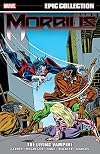
In a lot of ways this is the real meat of this collection. These issues of the Adventure Into Fear ongoing series were effectively Morbius solo comics, with all of their titles being stylized “Adventure Into Fear with Morbius The Living Vampire.”
The adventures Morbius gets up to in these are weird as fuck, and while the writing wasn’t always top notch I remained thoroughly entertained throughout. #20 sees Morbius escaping from the X-Men and enslaved by a hypno dommy Satanic cultist guy. He isn’t hot, sorry. But the dialog kinda is, as usual.
Oh, it’s worth noting that there’s a… kind of awkward depiction of a rabbi here? It’s not your usual brand of antisemitism, just… kinda weird? Like, they have him say “Isiaha’s beard” the way you’d have a wizard say “Merlin’s beard”? And I just don’t know what that’s about. Also his dying thoughts are that Morbius’s first name (Michael) is a Hebrew name, which is definitely what I’d be thinking as a vampire finished sucking the life out of my veins.
#21 finds our antiheroic vampire given the hard sell by a group of technologically advanced aliens called the Caretakers who are, I believe, approximately the zillionth powerful, mysterious force revealed to have influenced humanity’s evolution by Marvel comics. Morbius is loath to take part in their very eugenics-sounding scheme to “save” humanity not because of the principled opposition to eugenics you might expect from a scientist who accidentally turned himself into a vampire while doing genetic research, but because of some Social Darwinist Lite philosophy that he proclaims in a single throwaway line every time the subject comes up here and in future issues. I super hate it?
Anyway, Morbius goes to try to fight the Satanist hypnodom guy only to find out that he’s dating his ex or something, and then the hypnodom summons a catboy to fight Morbius because sure, why not. #22 finds that catboy trying to kill Morbius by just keeping him pinned to the ground until the sun comes up (the art is very horny), which won’t work because Morbius is a science vampire or whatever. Anyway, the catboy ends up getting summoned back to his world of catboys and the king makes up some bullshit about wanting Morbius around to thin the herd due to overpopulation when clearly he should just admit that all the subby catboys are horny for vampires.
#23 finds Morbius on a planet populated by humans, androids, and mutant aliens and it gets super eugenics-y and I kind of just don’t even want to dwell on it because ugh. #24 pits Morbius against Blade, and its coverart is actually used for the first volume of the Epic Collection even though it’s a super short confrontation, like it’s one of the least consequential things that happens in the entire collection. Personally I would’ve gone with the Morbius and Man-Wolf vs. Spidey cover from Giant-Size Superheroes #1 (which they did actually use on the back cover), especially considering that cover art would set the tone for how unbelievably horny a lot of the comics in this collection are.
#25 and #26 finish off this arc by having everyone (except for the actually-interesting catboys) come back and fight each other and switch sides a bunch of times. Probably my least favorite part of the entire arc tbh, but it gets the job done.
So, yeah! These are oftentimes terribly written, but the concepts in them are just so silly that I’m entertained wondering what will happen next. But the main thing that keeps me coming back is they are just super horny, with the lurid details of Morbius sinking his teeth into so many necks being lovingly presented both with vivid art and lovingly lingering narration. “Razor-sharp fangs part the smooth fur on the catwoman’s neck and plunge deep into her soft, warm flesh!” “The irresistible drive to feel teeth sinking into soft flesh, to feel steaming liquid on his tongue…” This is just vampire porn. Y’all wrote vampire porn. I’m not judging, it rules.
VAMPIRE TALES #1-8
The Epic Collection only includes the Morbius stories from these comics, which is a shame because a lot of the other stories sound rad as fuck ngl.
These were in black and white, which was usually fine (and even kinda fit the tone) but the last page of issue 7 had one really weird panel where they had black text on a dark background that was just kinda impossible to read and I don’t really get how that happened? (The best I can guess is the thing was originally done in full color and then printed in black and white, but like… why would you do it that way???) Issue 8’s first page is a literal reprint of that page with white text boxes around the offending narration, which seemed like the printing equivalent of an “oops, our bad.”
But, yeah. These stories vacillate between being wonderfully pulpy and being… kinda plodding and boring? I do enjoy the more indulgent elements when they come up, and honestly just when I was starting to lose patience with this series the aforementioned issue 7 has a scene where a demonic skeleton that is on fire who wears a cloak and rides a horse that is also a skeleton and on fire catches Morbius with a barbed-wire noose and drags him around for a minute, so like… consider me bought back in, obviously???
There’s also plenty of horny bloodsucking in these, which like, you know I’m totally onboard with.
GIANT-SIZE WEREWOLF #4
The Epic Collection closes out with this pretty straightforward issue pitting the very originally-named werewolf *checks notes* Werewolf against Morbius. Both Morbius and Werewolf are portrayed pretty sympathetically, and their fights are pretty decent. This also picks back up the storyline of Morbius’s ex-fiancee Martine from his arc in Adventure Into Fear, I’d actually say that their interactions take up the vast majority of the pages of this issue. show less
I didn’t realize that the whole “Spidey has 6 arms” plot being connected with Morbius’s emergence was actually a thing in the comics! But yeah, this is pretty straightforward stuff. And Morbius’s origin story as told in the flashback in the second issue is a bit more expansive than it is in the cartoon, actually kind of a bare bones version of what we end up seeing in the movie! Lizard’s involvement also spices things up a bit. The three-way fight show more at the beginning of #102 and Spidey and Lizard teaming up against Morbius at the end of the same issue were both pretty enjoyable, and to no one’s great shock I enjoyed Morbius’s stock villain dialogue about his superiority and everyone else being beneath him etc etc quite a bit.
MARVEL TEAM UP #3-4
This was also kind of true of the two previous comics, but: seeing Spider-Man using 70s slang was kind of adorably weird.
#3 was arguably a bit better since it had Morbius making another vampire to be friends with, which I really wish would happen more often!, but he’s a black guy in a 70s comic book with a speaking role so of course he isn’t long for this world. But also Spidey’s titular team-up in this one is Johnny from the Fantastic 4, so… eh. #4 starts out more Spidey vs. X-Men than Spidey teaming up with the X-Men, and then becomes X-Men vs. Morbius. The X-Men vs. Morbius parts were pretty good, Spidey stealing a kiss from Jean at the end for no particular reason was not.
GIANT-SIZE SUPERHEROES #1
This is probably my favorite story in the first collection! Morbius basically enslaves Man-Wolf and the pair of them just whale on Spidey, true I Want This Twink Destroyed style. This is pretty much exactly what I would want out of a movie with Morbius as the villain rather than an antihero.
ADVENTURE INTO FEAR #20-26
In a lot of ways this is the real meat of this collection. These issues of the Adventure Into Fear ongoing series were effectively Morbius solo comics, with all of their titles being stylized “Adventure Into Fear with Morbius The Living Vampire.”
The adventures Morbius gets up to in these are weird as fuck, and while the writing wasn’t always top notch I remained thoroughly entertained throughout. #20 sees Morbius escaping from the X-Men and enslaved by a hypno dommy Satanic cultist guy. He isn’t hot, sorry. But the dialog kinda is, as usual.
Oh, it’s worth noting that there’s a… kind of awkward depiction of a rabbi here? It’s not your usual brand of antisemitism, just… kinda weird? Like, they have him say “Isiaha’s beard” the way you’d have a wizard say “Merlin’s beard”? And I just don’t know what that’s about. Also his dying thoughts are that Morbius’s first name (Michael) is a Hebrew name, which is definitely what I’d be thinking as a vampire finished sucking the life out of my veins.
#21 finds our antiheroic vampire given the hard sell by a group of technologically advanced aliens called the Caretakers who are, I believe, approximately the zillionth powerful, mysterious force revealed to have influenced humanity’s evolution by Marvel comics. Morbius is loath to take part in their very eugenics-sounding scheme to “save” humanity not because of the principled opposition to eugenics you might expect from a scientist who accidentally turned himself into a vampire while doing genetic research, but because of some Social Darwinist Lite philosophy that he proclaims in a single throwaway line every time the subject comes up here and in future issues. I super hate it?
Anyway, Morbius goes to try to fight the Satanist hypnodom guy only to find out that he’s dating his ex or something, and then the hypnodom summons a catboy to fight Morbius because sure, why not. #22 finds that catboy trying to kill Morbius by just keeping him pinned to the ground until the sun comes up (the art is very horny), which won’t work because Morbius is a science vampire or whatever. Anyway, the catboy ends up getting summoned back to his world of catboys and the king makes up some bullshit about wanting Morbius around to thin the herd due to overpopulation when clearly he should just admit that all the subby catboys are horny for vampires.
#23 finds Morbius on a planet populated by humans, androids, and mutant aliens and it gets super eugenics-y and I kind of just don’t even want to dwell on it because ugh. #24 pits Morbius against Blade, and its coverart is actually used for the first volume of the Epic Collection even though it’s a super short confrontation, like it’s one of the least consequential things that happens in the entire collection. Personally I would’ve gone with the Morbius and Man-Wolf vs. Spidey cover from Giant-Size Superheroes #1 (which they did actually use on the back cover), especially considering that cover art would set the tone for how unbelievably horny a lot of the comics in this collection are.
#25 and #26 finish off this arc by having everyone (except for the actually-interesting catboys) come back and fight each other and switch sides a bunch of times. Probably my least favorite part of the entire arc tbh, but it gets the job done.
So, yeah! These are oftentimes terribly written, but the concepts in them are just so silly that I’m entertained wondering what will happen next. But the main thing that keeps me coming back is they are just super horny, with the lurid details of Morbius sinking his teeth into so many necks being lovingly presented both with vivid art and lovingly lingering narration. “Razor-sharp fangs part the smooth fur on the catwoman’s neck and plunge deep into her soft, warm flesh!” “The irresistible drive to feel teeth sinking into soft flesh, to feel steaming liquid on his tongue…” This is just vampire porn. Y’all wrote vampire porn. I’m not judging, it rules.
VAMPIRE TALES #1-8
The Epic Collection only includes the Morbius stories from these comics, which is a shame because a lot of the other stories sound rad as fuck ngl.
These were in black and white, which was usually fine (and even kinda fit the tone) but the last page of issue 7 had one really weird panel where they had black text on a dark background that was just kinda impossible to read and I don’t really get how that happened? (The best I can guess is the thing was originally done in full color and then printed in black and white, but like… why would you do it that way???) Issue 8’s first page is a literal reprint of that page with white text boxes around the offending narration, which seemed like the printing equivalent of an “oops, our bad.”
But, yeah. These stories vacillate between being wonderfully pulpy and being… kinda plodding and boring? I do enjoy the more indulgent elements when they come up, and honestly just when I was starting to lose patience with this series the aforementioned issue 7 has a scene where a demonic skeleton that is on fire who wears a cloak and rides a horse that is also a skeleton and on fire catches Morbius with a barbed-wire noose and drags him around for a minute, so like… consider me bought back in, obviously???
There’s also plenty of horny bloodsucking in these, which like, you know I’m totally onboard with.
GIANT-SIZE WEREWOLF #4
The Epic Collection closes out with this pretty straightforward issue pitting the very originally-named werewolf *checks notes* Werewolf against Morbius. Both Morbius and Werewolf are portrayed pretty sympathetically, and their fights are pretty decent. This also picks back up the storyline of Morbius’s ex-fiancee Martine from his arc in Adventure Into Fear, I’d actually say that their interactions take up the vast majority of the pages of this issue. show less

For about three years in the 1970s, Marvel ran a War of the Worlds series about an alternate reality where The War of the Worlds happened exactly as depicted by Wells in 1901... but then the Martians returned in 2001. The series takes place in 2018, following the adventures of the escaped gladiator Killraven and his band of freedom-fighters, as they work to escape Martian oppression. It was based on the ideas in the artilleryman chapter of the original novel, and it's a decent idea. It's a show more pretty fun adventure story, too, but I don't know how much it has to do with The War of the Worlds, aside from the occasional tripod. Don McGregor, who wrote the majority of the series, seemed to enjoy coming up with a new mutant for Killraven to battle every week more than anything else; we get a squid/man, a rat/man, a cyclops, a horse/serpent, a crab/man, a werewolf, and so on.
My other big problem is that the series feels pretty aimless. Since the goal of bringing down the Martian occupation is bit too big for four guys and a girl in a bikini, McGregor has them focus on rescuing Killraven's brother, who's in Yellowstone National Park. Yet he seems to think that he can't have this plotline come to fruition too quickly, so the characters spend most of the series lost and randomly ambling throughout the United States, visiting Indiana, Tennessee, West Virginia, and Flordia on their way to Wyoming. And then the series gets canceled (though McGregor got to wrap it up in 1983 with a one-shot graphic novel, and Joe Linser later added on a bit as well). The characters are fun, especially Killraven's faithful righthand man M'Shulla. McGregor could work on his depiction of mental retardation, on the other hand; I alternated between loving the gentle giant Old Skull and wanting to bash him over the head with a spanner. And as I said, there is a lot of mutant-fighting in this series, but there's little flashes of something greater from time to time, too-- points where McGregor meditates on the ephemerality of our 20th-century culture. He's also obviously trying to do some interesting things with the comic book medium in terms of how he uses text/narration, and sometimes it even works. And I've come this far without mentioning P. Craig Russell, who penciled the majority of the series: sure, his boobs all defy gravity, but most everything he draws looks fantastic. Who else could draw a crab/man like that?
Nothing ever makes you appreciate good writing like bad writing, however, and I'm convinced that Bill Mantlo's three fill-in issues must have been commissioned solely to make McGregor look good. Because they're pretty freaking dreadful. Between this and Alpha Flight, Mantlo clearly has a unique inability to understand what makes other people's creations work. show less
My other big problem is that the series feels pretty aimless. Since the goal of bringing down the Martian occupation is bit too big for four guys and a girl in a bikini, McGregor has them focus on rescuing Killraven's brother, who's in Yellowstone National Park. Yet he seems to think that he can't have this plotline come to fruition too quickly, so the characters spend most of the series lost and randomly ambling throughout the United States, visiting Indiana, Tennessee, West Virginia, and Flordia on their way to Wyoming. And then the series gets canceled (though McGregor got to wrap it up in 1983 with a one-shot graphic novel, and Joe Linser later added on a bit as well). The characters are fun, especially Killraven's faithful righthand man M'Shulla. McGregor could work on his depiction of mental retardation, on the other hand; I alternated between loving the gentle giant Old Skull and wanting to bash him over the head with a spanner. And as I said, there is a lot of mutant-fighting in this series, but there's little flashes of something greater from time to time, too-- points where McGregor meditates on the ephemerality of our 20th-century culture. He's also obviously trying to do some interesting things with the comic book medium in terms of how he uses text/narration, and sometimes it even works. And I've come this far without mentioning P. Craig Russell, who penciled the majority of the series: sure, his boobs all defy gravity, but most everything he draws looks fantastic. Who else could draw a crab/man like that?
Nothing ever makes you appreciate good writing like bad writing, however, and I'm convinced that Bill Mantlo's three fill-in issues must have been commissioned solely to make McGregor look good. Because they're pretty freaking dreadful. Between this and Alpha Flight, Mantlo clearly has a unique inability to understand what makes other people's creations work. show less
Lists
Awards

You May Also Like


Associated Authors
Statistics
- Works
- 139
- Also by
- 9
- Members
- 955
- Popularity
- #26,972
- Rating
- 3.6
- Reviews
- 19
- ISBNs
- 73
- Languages
- 3
- Favorited
- 1
