
Jonathan Gash
Author of The Judas Pair
About the Author
Jonathan Gash, best known as the creator of the character Lovejoy, is the pseudonym of John Grant. Grant was born on September 30, 1933 in Bolton, Lancashire, England. He was educated at the University of London and the Royal College of Surgeons and Physics. In the mid-1970s, Gash began writing to show more relieve some of the stress of his career as a physician. The first Lovejoy novel, The Judas Pair, won the Creasey Award for the Crime Writer's Association of Great Britain for best first crime novel. A number of other novels, Lovejoy's and otherwise, have followed. (Bowker Author Biography) Jonathan Gash was born John Grant on September 30, 1933 in Bolton, Lancashire, England. He was received an M.B. and a B.S. at the University of London, a M.R.C.S. and a L.R.C.P. at the Royal College of Surgeons and Physicians and has also earned D.Path., D.Bact., D.H.M., M.D. and D.T.M.H. He achieved the rank of Major in the British Army Medical Corps and was posted to Germany. In 1955, he married Pamela Richard, and they had three daughters. Grant had served as a general practitioner in London, a pathologist in London and Essex, a clinical pathologist in Hanover and Berlin, a lecturer in clinical pathology and head of division at the University of Hong Kong, and a microbiologist in Hong Kong and London. He was also the head of the bacteriology unit at the School of Hygiene and Tropical Medicine, University of London, from 1971 to 1988. He is a fellow of the International College of Surgeons and of the Royal Society of Tropical Medicine. Jonathan Gash is the author of The Lovejoy Novels, whose first was "The Judas Pair" (1977). It won the Creasey Award from the Crime Writer's Association of Great Britain for the best first crime novel of the year. Some of the other titles in the Lovejoy series are "The Vatican Rip" (1981), "The Gondola Scam" (1983), "Jade Woman" (1988), "Lies of Fair Ladies" (1991), "The Grace in Older Women" (1995), and "A Rag, a Bone and a Hank of Hair" (1999). He also has a series that features Dr. Clare Burtonall with the first being "Different Women Dancing" (1997). He has also written "The Incomer" (1982) under the pseudonym Graham Gaunt and "Mehala, Lady of Sealandings" (1993) under the pseudonym Jonathan Grant. (Bowker Author Biography) show less
Disambiguation Notice:
Jonathan Gash is the pen-name of John Grant, an English doctor and author of medical thrillers as well as the Lovejoy novels. He wrote the novel The Incomer under the pen name Graham Gaunt.
Image credit:
www.vjbooks.com
Series
Works by Jonathan Gash
Associated Works
Malice Domestic 08: An Anthology of Original Traditional Mystery Stories (1999) — Contributor — 52 copies
A Taste of Murder: Diabolically Delicious Recipes from Contemporary Mystery Writers (1999) — Contributor — 48 copies, 1 review
The Year's 25 Finest Crime and Mystery Stories: Third Annual Edition (1994) — Contributor — 10 copies
The Curse of the Pharoahs | Spend Game | Murder on Martha's Vineyard (1981) — Contributor — 5 copies
Tagged
Common Knowledge
- Legal name
- Grant, John
- Other names
- Gaunt, Graham (pseudonym)
- Birthdate
- 1933-09-30
- Gender
- male
- Education
- University of London (MB and BS)
Royal College of Surgeons and Physicians (MRCS and LRCP)
Thornleigh College - Occupations
- general practitioner
pathologist
microbiologist - Organizations
- University of London
International College of Surgeons (Fellow)
Royal Society of Tropical Medicine (Fellow)
Royal Army Medical Corps - Nationality
- England
- Birthplace
- Bolton, Lancashire, England, UK
- Places of residence
- Colchester, Essex, England, UK
Bolton, Lancashire, England (birth)
Germany - Map Location
- UK
- Disambiguation notice
- Jonathan Gash is the pen-name of John Grant, an English doctor and author of medical thrillers as well as the Lovejoy novels. He wrote the novel The Incomer under the pen name Graham Gaunt.
Members
Reviews
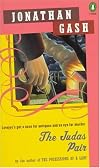
The Judas Pair is the name of a set of flintlock dueling weapons that are like the holy grail of the antique gun world. Lovejoy, a somewhat shady antiques dealer with a penchant for the ladies, is hired to find them by the brother of a man who claimed he owned the Judas Pair, but then was murdered. When the police went to examine the crime scene, the guns were nowhere to be found. Lovejoy sets out to find the weapons (if they exist), but it soon becomes obvious that someone else is show more interested as well, and will use any means possible to have the entire set.
Lovejoy may not be a perfect human being, but he's witty and philosophizes throughout the novel, often to the point of making me laugh out loud. Considering that this is the first installment of a rather lengthy series, Gash has done a really nice job of fleshing out his character and making him real enough for people to either really like or really hate, which is really rare in a series opener. As far as the story, the mystery isn't all that hard to guess, but I think it's really secondary here to the character of Lovejoy himself.
There have been several reviews that speak against Lovejoy's treatment of women, and I agree that this is definitely a downside to his character, but actually you'll probably find more domestic abuse in one of Oprah's book club selections.
Not a cozy, not a police procedural, The Judas Pair is still a really good read. I'd recommend it to readers of British crime fiction, or to those who've seen the series on television and want to read the original source. show less
Lovejoy may not be a perfect human being, but he's witty and philosophizes throughout the novel, often to the point of making me laugh out loud. Considering that this is the first installment of a rather lengthy series, Gash has done a really nice job of fleshing out his character and making him real enough for people to either really like or really hate, which is really rare in a series opener. As far as the story, the mystery isn't all that hard to guess, but I think it's really secondary here to the character of Lovejoy himself.
There have been several reviews that speak against Lovejoy's treatment of women, and I agree that this is definitely a downside to his character, but actually you'll probably find more domestic abuse in one of Oprah's book club selections.
Not a cozy, not a police procedural, The Judas Pair is still a really good read. I'd recommend it to readers of British crime fiction, or to those who've seen the series on television and want to read the original source. show less

I find it hard to believe that this is the first Lovejoy novel that I have read: I came across, and enjoyed, the TV series many moons ago. So, how does the written word compare? firstly, one has to accept that Lovejoy is a somewhat different character to that portrayed by Ian McShane; then, one has to come to terms with some variations in the other characters - Tinker is a smelly tramp! - but, when that falls into place, after some fifty pages, or so, then one finds a cracking little story. show more Mr. Gash clearly has a talent for creating tension and when Lovejoy finds himself in an old WW II gun emplacement, love nor money would have tempted me to put the book down (if anyone wishes to challenge this statement, please send your cheques, or scantily clad female body's to ....).
If I were to be uncharitable (how unlike me) I would have liked a little more work upon the ending: it did feel just a little like my son's early writing attempts - a whodunnit that suddenly said,"then the cops came and arrested them all. The end." In fact, if memory serves, that was the entire opus.
I shall certainly try a few more of Mr Gash's works. show less
If I were to be uncharitable (how unlike me) I would have liked a little more work upon the ending: it did feel just a little like my son's early writing attempts - a whodunnit that suddenly said,"then the cops came and arrested them all. The end." In fact, if memory serves, that was the entire opus.
I shall certainly try a few more of Mr Gash's works. show less

https://fromtheheartofeurope.eu/the-grail-tree-by-jonathan-gash/
This is the Lovejoy of Gash’s original conception, fanatically obsessed with antiques and fatally attractive to women, who he treats badly. In fact he hits one of his girlfriends on page 2 (though in fairness she hits him first). If you pick this up expecting the gentle humour of Ian Le Frenais’ writing and Ian McShane’s acting, well, you’ll be surprised.
At the same time, I think the writer is fully aware of Lovejoy’s show more flaws and shows us what a monster he is, through his own lack of self-perception. And the actual plot of the book is a murder mystery, where Lovejoy is motivated by righteous rage when a friend is killed and the police write it off as an accident. I found the actual mystery resolution a bit opaque, but there is a fantastically well written climactic scene in Colchester Castle, where Lovejoy and his charming newly hired apprentice Lydia take on the villain, Lydia making her first of many appearances here.
There’s also a fair bit of lore about the Holy Grail – this book was published in 1979, three years before The Holy Blood and the Holy Grail, but after at least two of the three BBC documentaries that it drew on (from 1972, 1974 and 1979). Not to go into details, but it had me checking Wikipedia for the career of Hester Bateman, one woman for whom Lovejoy has the highest respect.
Anyway, the protagonist’s extreme sexism means that the book has aged very badly. show less
This is the Lovejoy of Gash’s original conception, fanatically obsessed with antiques and fatally attractive to women, who he treats badly. In fact he hits one of his girlfriends on page 2 (though in fairness she hits him first). If you pick this up expecting the gentle humour of Ian Le Frenais’ writing and Ian McShane’s acting, well, you’ll be surprised.
At the same time, I think the writer is fully aware of Lovejoy’s show more flaws and shows us what a monster he is, through his own lack of self-perception. And the actual plot of the book is a murder mystery, where Lovejoy is motivated by righteous rage when a friend is killed and the police write it off as an accident. I found the actual mystery resolution a bit opaque, but there is a fantastically well written climactic scene in Colchester Castle, where Lovejoy and his charming newly hired apprentice Lydia take on the villain, Lydia making her first of many appearances here.
There’s also a fair bit of lore about the Holy Grail – this book was published in 1979, three years before The Holy Blood and the Holy Grail, but after at least two of the three BBC documentaries that it drew on (from 1972, 1974 and 1979). Not to go into details, but it had me checking Wikipedia for the career of Hester Bateman, one woman for whom Lovejoy has the highest respect.
Anyway, the protagonist’s extreme sexism means that the book has aged very badly. show less
Lovejoy always provides a chaotic, fun romp through the world of antique dealers in East Anglia, England. Those flat, sea dominated landscapes are the backdrop for all the scheming. The most delectable part of this series is the Lovejoy stream of consciousness which throws up arcane after arcane tidbit from the world of fine arts, craftsmanship and, of course the 'fiddles' of those completely untrustworthy dealers. It's a wonder to contemplate where Gash finds all this in the pre-internet show more world. Lovejoy' friends fill out a stable of diverse, humorous characters. Gash also delivers a fine sense of locale as these villains and heroes dash about. If you need a break from the noir Gash and his Lovejoy may offer a chuckle filled interlude. show less
Lists
Awards

You May Also Like


Associated Authors
Statistics
- Works
- 46
- Also by
- 14
- Members
- 4,295
- Popularity
- #5,845
- Rating
- 3.6
- Reviews
- 62
- ISBNs
- 295
- Languages
- 2
- Favorited
- 7