
Jason Latour
Author of Southern Bastards, Vol. 1: Here Was a Man
About the Author
Image credit: From Wikipedia
Series
Works by Jason Latour
Spider-Gwen Vol. 6: The Life and Times of Gwen Stacy (Spider-Gwen (2015)) (2018) 59 copies, 2 reviews
Wolverine & the X-Men Volume 1: Tomorrow Never Learns (Wolverine and the X-Men) (2014) 43 copies, 1 review
Southern Bastards #5 — Illustrator — 4 copies
Southern Bastards #6 — Illustrator — 3 copies
Southern Bastards #7 — Illustrator — 3 copies
Spider-Gwen, Vol. 2 #4 3 copies
Southern Bastards #8 — Illustrator — 2 copies
Spider-Gwen, Vol. 2 #19 2 copies
Spider-Gwen, Vol. 2 #16 2 copies
Spider-Gwen, Vol. 2 #15 2 copies
Spider-Gwen, Vol. 2 #14 2 copies
Spider-Gwen, Vol. 2 #17 2 copies
Spider-Gwen, Vol. 2 #28 1 copy
Spider-Gwen, Vol. 2 #27 1 copy
Spider-Gwen, Vol. 2 #10 1 copy
Infinity: Against The Tide 1 copy
Spider-Gwen, Vol. 2 #20 1 copy
Spider-Gwen, Vol. 2 #21 1 copy
Spider-Gwen, Vol. 2 #26 1 copy
Spider-Gwen, Vol. 2 #22 1 copy
Spider-Gwen, Vol. 2 #23 1 copy
Elige tu arma 1 copy
Depredadores 1 copy
La vida de Gwen Stacy 1 copy
Spider-Gwen, Vol. 2 #24 1 copy
Spider-Gwen, Vol. 2 #25 1 copy
Associated Works
Peter Porker, the Spectacular Spider-Ham: The Complete Collection, Vol. 2 (2022) — Illustrator — 7 copies
Tagged
Common Knowledge
- Canonical name
- Latour, Jason
- Legal name
- Latour, David Jason
- Birthdate
- 1977-08-29
- Gender
- male
- Nationality
- USA
- Birthplace
- Charlotte, North Carolina, USA
- Associated Place (for map)
- North Carolina, USA
Members
Reviews

Kingpin Matt Murdock uses his leverage over Gwen to send her to take down Harry Osbourn's Lizard with a serum that will cause the Lizard contaminant to leave Harry's system but in the process create a sentient, parasitic goo that only Gwen can survive. As Gwen grapples with whether giving Harry the serum will actually save him from completely turning into the Lizard or if Murdock has some other plans up his sleeve, she must also protect Harry from SHIELD assassins Wolverine and Kitty Pryde.
A show more really solid story arc for Gwen and I enjoyed every second of it. Watching her grapple with which choice is the lesser of two evils is compelling stuff, seeing an alternate backstory for Wolverine is fun, and trying to figure out just what malevolent plan Murdock is orchestrating is fun reading. Plus the threat of Venom! show less
A show more really solid story arc for Gwen and I enjoyed every second of it. Watching her grapple with which choice is the lesser of two evils is compelling stuff, seeing an alternate backstory for Wolverine is fun, and trying to figure out just what malevolent plan Murdock is orchestrating is fun reading. Plus the threat of Venom! show less
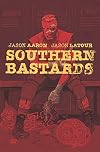
The ending of volume one of Southern Bastards came as something of a shock - not quite as much of a shock in a post-Game Of Thrones world, but still. The story built to it, foreshadowed it, earned it, and still it was a punch to the gut. Almost as shocking, in a quieter way, is what comes next - a volume devoted to the life and character of the villain, the guy who may epitomise the book's title, though in fact there's no shortage of the type in these pages.
So, four issues humanising the show more biggest bastard of the book, who starts out as a lonely, bullied, abused boy with only one way out and no-one to get it but himself. We end up knowing way more than we want to abut him, feeling way too much for his suffering, empathise too much with his need to make something of himself - too much because he's still a murdering bastard, even more of a murdering bastard than we already knew, though we may have suspected. As a piece of work it's a brilliant achievement by Aaron and Latour - relentless, unflinching, but also as funny as is it is savage. Southern Bastards is probably the best crime comic being currently produced.
By the way, read the introduction if you can. I had no idea who Ryan Kalil is, but about a third of the way in it takes off into a whole strange and indecipherable language that becomes a kind of poetry. He's a football player, and football is central to Southern Bastards, but if someone like me, who has a knowledge of sport that's in negative figures, can enjoy the hell out of it anyway, so can anyone. show less
So, four issues humanising the show more biggest bastard of the book, who starts out as a lonely, bullied, abused boy with only one way out and no-one to get it but himself. We end up knowing way more than we want to abut him, feeling way too much for his suffering, empathise too much with his need to make something of himself - too much because he's still a murdering bastard, even more of a murdering bastard than we already knew, though we may have suspected. As a piece of work it's a brilliant achievement by Aaron and Latour - relentless, unflinching, but also as funny as is it is savage. Southern Bastards is probably the best crime comic being currently produced.
By the way, read the introduction if you can. I had no idea who Ryan Kalil is, but about a third of the way in it takes off into a whole strange and indecipherable language that becomes a kind of poetry. He's a football player, and football is central to Southern Bastards, but if someone like me, who has a knowledge of sport that's in negative figures, can enjoy the hell out of it anyway, so can anyone. show less
So, I'm an old, white Canadian boy who hates football with a burning passion.
I really should have hated this volume. But Aaron and Latour wrote a very compelling story about Euless Boss that hooked me pretty much right from the get-go.
Aaron can, like he did in the excellent Scalped series, get inside his characters' heads and make the reader hurt for them...no matter how nasty that person is.
And Latour's art? Yeah, it's awful. And yet, somehow, for this series? It's perfect. It's show more gritty.
Loving this series. Now, I just need Bert to show up! show less
I really should have hated this volume. But Aaron and Latour wrote a very compelling story about Euless Boss that hooked me pretty much right from the get-go.
Aaron can, like he did in the excellent Scalped series, get inside his characters' heads and make the reader hurt for them...no matter how nasty that person is.
And Latour's art? Yeah, it's awful. And yet, somehow, for this series? It's perfect. It's show more gritty.
Loving this series. Now, I just need Bert to show up! show less
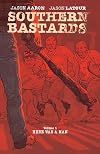
Southern Bastards – Here Lies a Man, by Jason Aaron and Jason Latour, invites us to dive deep in the South of the United States. Mixing fiction and even the authors' memoirs, the criminal series was nominated for several Eisner awards and won a Harvey for Best New Series.
The colour palette is filled with dark reds, browns and yellows, which give us the feeling that we are catching a glimpse of hell on Earth. The first page shocks the reader with the image of a dog defecating in front of show more several signs advertising roadside churches. And the premise is quite simple. In a city that feels powerless, a man decides, against another, that it is time to assert himself, although the chances of winning are few or even non-existent.
Earl Tubb is the protagonist who returns to a small town in Alabama to empty his old uncle Buhl's house. But, unfortunately, he gets into trouble with Boss, the local football coach, turning his (initially brief) stay into a descent into hell.
In his speech, Earl is rational, even soft, and he had sworn he would stay away from the city and the fame of his late father, who had been a sheriff there 40 years ago. But, eventually, he starts to walk around with a baseball bat. After the death of an acquaintance at the hands of the Boss Coach team, leaving is no longer an option.
While facing the coach and, consequently, an entire baseball team, Earl tries to communicate with someone whose identity is only revealed in the epilogue. Right up to the end, the reader is treated to as much authenticity as clichés. Craw County presents itself, in a rural, ultra-violent, southern setting, with lots of barbecues and lots of football.
This first volume doesn't unfold any further, focusing on introducing the characters and backstory, allowing the reader to settle in and see enough curiosity aroused in them to look forward to the next chapter.
The South is known for a past of corruption in small towns. Both authors are southern boys with a love-hate relationship with their origins. Aaron, who promises never to return to the South, describes it as the most peaceful place he's ever been. But also as "a place we can miss and love and hate and be afraid of, all at the same time." As for Latour, he has returned to the South, because he realized that he loves its nonsense. show less
The colour palette is filled with dark reds, browns and yellows, which give us the feeling that we are catching a glimpse of hell on Earth. The first page shocks the reader with the image of a dog defecating in front of show more several signs advertising roadside churches. And the premise is quite simple. In a city that feels powerless, a man decides, against another, that it is time to assert himself, although the chances of winning are few or even non-existent.
Earl Tubb is the protagonist who returns to a small town in Alabama to empty his old uncle Buhl's house. But, unfortunately, he gets into trouble with Boss, the local football coach, turning his (initially brief) stay into a descent into hell.
In his speech, Earl is rational, even soft, and he had sworn he would stay away from the city and the fame of his late father, who had been a sheriff there 40 years ago. But, eventually, he starts to walk around with a baseball bat. After the death of an acquaintance at the hands of the Boss Coach team, leaving is no longer an option.
While facing the coach and, consequently, an entire baseball team, Earl tries to communicate with someone whose identity is only revealed in the epilogue. Right up to the end, the reader is treated to as much authenticity as clichés. Craw County presents itself, in a rural, ultra-violent, southern setting, with lots of barbecues and lots of football.
This first volume doesn't unfold any further, focusing on introducing the characters and backstory, allowing the reader to settle in and see enough curiosity aroused in them to look forward to the next chapter.
The South is known for a past of corruption in small towns. Both authors are southern boys with a love-hate relationship with their origins. Aaron, who promises never to return to the South, describes it as the most peaceful place he's ever been. But also as "a place we can miss and love and hate and be afraid of, all at the same time." As for Latour, he has returned to the South, because he realized that he loves its nonsense. show less
Lists
Awards

You May Also Like


Associated Authors
Statistics
- Works
- 123
- Also by
- 6
- Members
- 2,860
- Popularity
- #8,971
- Rating
- 3.7
- Reviews
- 112
- ISBNs
- 125
- Languages
- 6
- Favorited
- 1