
Stephen Wyatt
Author of Doctor Who: Paradise Towers
About the Author
Image credit: www.stephenwyatt.co.uk/
Works by Stephen Wyatt
Associated Works
Tagged
Common Knowledge
- Birthdate
- 1948-02-04
- Gender
- male
- Education
- University of Cambridge (Clare College)
- Occupations
- playwright
scriptwriter - Organizations
- BBC Radio
- Nationality
- UK
- Birthplace
- Beckenham, Kent, England, UK
- Places of residence
- Ealing, West London, England, UK
- Associated Place (for map)
- England, UK
Members
Reviews

In Doctor Who: The Greatest Show in the Galaxy, Stephen Wyatt adapts his storyline featuring the Seventh Doctor and his companion, Ace, who find themselves fighting for survival in the nightmarish Psychic Circus. The episode was the final story of classic Doctor Who’s twenty-fifth season. Though Ace always found circuses, and specifically clowns, somewhat frightening, she did not anticipate finding one where the spectators were forced to perform or die. The Doctor, however, always has show more something up his sleeve, be it a plan or a magic trick. Wyatt faithfully adapts his own story, though he uses the novel format to include some added dialogue or extend scenes that weren’t as long due to production costs.
Some, like Paul Cornell, Martin Day, and Keith Topping (authors of The Discontinuity Guide) or David J. Howe and Stephen James Walker (authors of Doctor Who: The Television Companion) interpret the story as a metaphor for Doctor Who, with Captain Cook representing Star Trek, the Gods of Ragnarok who demand entertainment taking the place of BBC executives, the Chief Clown standing in for BBC Controller Michael Grade, and Whizz Kid parodying obsessive fans. Whether or not Wyatt intended this, the story is sure to entertain fans of Sylvester McCoy’s Seventh Doctor and Sophie Aldred’s Ace. show less
Some, like Paul Cornell, Martin Day, and Keith Topping (authors of The Discontinuity Guide) or David J. Howe and Stephen James Walker (authors of Doctor Who: The Television Companion) interpret the story as a metaphor for Doctor Who, with Captain Cook representing Star Trek, the Gods of Ragnarok who demand entertainment taking the place of BBC executives, the Chief Clown standing in for BBC Controller Michael Grade, and Whizz Kid parodying obsessive fans. Whether or not Wyatt intended this, the story is sure to entertain fans of Sylvester McCoy’s Seventh Doctor and Sophie Aldred’s Ace. show less
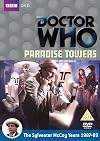
Not a bad story line. However it was spoilt by Richard Briers over acting as the caretaker meaning the comedy side of this story did not work.

Something is killing people in a dystopian apartment building.
Silly, but a completely wrong type of silly for Doctor Who. It's like the writer had never seen Doctor Who, heard it was a children's show, and then... just didn't give any more fucks. Poor Sylvester McCoy - between this and "Time and the Rani," he really got a horrible start to his Doctor. If I'd been watching at the time, I might even have thought he was worse than Colin Baker.
Concept: D
Story: D
Characters: D
Dialog: D
Pacing: show more C
Cinematography: C
Special effects/design: D
Acting: D
Music: F
Enjoyment: D
GPA: 1.1/4 show less
Silly, but a completely wrong type of silly for Doctor Who. It's like the writer had never seen Doctor Who, heard it was a children's show, and then... just didn't give any more fucks. Poor Sylvester McCoy - between this and "Time and the Rani," he really got a horrible start to his Doctor. If I'd been watching at the time, I might even have thought he was worse than Colin Baker.
Concept: D
Story: D
Characters: D
Dialog: D
Pacing: show more C
Cinematography: C
Special effects/design: D
Acting: D
Music: F
Enjoyment: D
GPA: 1.1/4 show less

http://nhw.livejournal.com/1079514.html?#cutid5
Wyatt's book is not really an improvement on the TV original. Shorn of (for once) decent production values and the compelling performances of the actors, the holes in the plot and clunky scene-setting are more apparent, and Wyatt, having written a TV script, is reduced to reporting what we saw on screen without being able to add much to it. Fails the Bechdel test - each female character is rigidly paired off with a male, and on the rare show more occasions that they converse it is always about one of the men (usually the Doctor). show less
Wyatt's book is not really an improvement on the TV original. Shorn of (for once) decent production values and the compelling performances of the actors, the holes in the plot and clunky scene-setting are more apparent, and Wyatt, having written a TV script, is reduced to reporting what we saw on screen without being able to add much to it. Fails the Bechdel test - each female character is rigidly paired off with a male, and on the rare show more occasions that they converse it is always about one of the men (usually the Doctor). show less
Lists
You May Also Like


Associated Authors
Statistics
- Works
- 12
- Also by
- 1
- Members
- 432
- Popularity
- #56,590
- Rating
- 3.2
- Reviews
- 7
- ISBNs
- 20