
Terrance Dicks (1935–2019)
Author of Doctor Who and the Day of the Daleks
About the Author
Series
Works by Terrance Dicks
Doctor Who: The Scripts, Tom Baker 1974/5 (2001) — Author "Introduction" and "Robot" — 64 copies, 1 review
Mindgame Saga 2 copies
Deadly Assasain 1 copy
Abominable Snowman 1 copy
Auton Invasion 1 copy
Terror of the Autons 1 copy
Monsters of Peladon 1 copy
An Earthly Child 1 copy
Time Warriors 1 copy
Dalek Special 1 copy
double detection 1 copy
The case of the crooked kids 1 copy
Os mêts, mêts 1 copy
Introducing Doctor Who 1 copy
DOCTOR WHO (THE THIRD GIFT SET) (4 BOOKS-FOUR TO DOOMSDAY,TERMINUS,EARTHSHOCK,CASTROVALVA) (1983) 1 copy
Doctor Who - Catastrophe 1 copy
Zemsta Cyborgów 1 copy
Władcy czasu 1 copy
Loch-Ness Monster 1 copy
Associated Works
Doctor Who : A Celebration—Two Decades Through Time and Space (1983) — "Who and I" — 284 copies, 2 reviews
The Target Book: A History of the Target Doctor Who Books (2007) — Introduction — 54 copies, 3 reviews
Who and Me: The Memoir of Barry Letts, Doctor Who Producer 1969-1974 (2008) — Foreword — 21 copies, 2 reviews
Doctor Who: The Krotons (BBC Audio Collection) (2008) — Script editor, some editions — 6 copies, 2 reviews
In●Vision: The Five Doctors (1997) — Contributor "The Eight Doctors" and "Perfect Dicks-ion" — 2 copies
Roger Delgado ~ A Tribute (1987) — "You could almost say that the part of the Master was created for him" — 1 copy
Doctor Who — An Adventure in Space & Time: The Krotons (1984) — Contributor "Holmes for Hire" — 1 copy
Tagged
Common Knowledge
- Legal name
- Dicks, Terrance William
- Other names
- Bland, Robin
- Birthdate
- 1935-04-10
- Date of death
- 2019-09-02
- Gender
- male
- Education
- Downing College, Cambridge
- Occupations
- advertising copywriter
playwright
script editor
screenwriter - Organizations
- BBC
British Army - Awards and honors
- Scribe Award (Grandmaster, Faust Award, 2015)
- Relationships
- Germaney, Elsa (wife)
- Nationality
- UK
- Birthplace
- East Ham, London, Middlesex, England, UK
- Places of residence
- London, Middlesex, England, UK
- Place of death
- Hampstead, London, Middlesex, England, UK
- Map Location
- England, UK
Members
Reviews
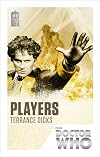
When his companion Peri demands elegance for their next destination, the Doctor sets the coordinates for London in 1900 to enjoy the season there. Instead the TARDIS arrives in South Africa, just in time to witness a Boer ambush of a train containing British soldiers accompanied by a young war correspondent named Winston Churchill — whose life the Doctor saves after he is nearly assassinated by a mysterious man with a rifle. Captured along with Churchill by the Boers, the Doctor and Peri show more soon discover a second unknown individual, this one working to aid in Churchill's escape. Realizing that there are people involved whom he encountered when he met Churchill during his second incarnation, the Doctor travels to London in 1936 to get to the bottom of the mystery, one that soon involves stopping a plot that threatens the course of all of human history!
I must confess that I approached this novel with a degree of ambivalence, given that the Sixth Doctor is by far my least favorite version of the character and a storyline involving Winston Churchill was one primed to fail. This was a mistake on my part, as I should have taken into consideration that the author was Terrance Dicks, arguably the most prolific writer of Doctor Who media in the history of the franchise. In his experienced hands what could have been a name-checking tale involving an off-putting central character is instead a rollicking adventure spanning across four decades of one of the most adventurous lives in human history. In this it represents everything that a first-rate Doctor Who novel should be, and one that other authors in the franchise should turn to when dealing with some of the more awkward elements in the long-running series. show less
I must confess that I approached this novel with a degree of ambivalence, given that the Sixth Doctor is by far my least favorite version of the character and a storyline involving Winston Churchill was one primed to fail. This was a mistake on my part, as I should have taken into consideration that the author was Terrance Dicks, arguably the most prolific writer of Doctor Who media in the history of the franchise. In his experienced hands what could have been a name-checking tale involving an off-putting central character is instead a rollicking adventure spanning across four decades of one of the most adventurous lives in human history. In this it represents everything that a first-rate Doctor Who novel should be, and one that other authors in the franchise should turn to when dealing with some of the more awkward elements in the long-running series. show less

Doctor Who and the Genesis of the Daleks (1976) / Doctor Who and the Pyramids of Mars (1976)
Back when I read my way through the first Doctor novelisations, I noted how the very idea of a "Doctor Who book" was emerging. Doctor Who in an exciting adventure with the Daleks (1964) was literally the only Doctor Who book in the universe when it came out; Doctor Who and the Zarbi (1965) was the second.
But by the time the first two books collected in The Essential Terrance Dicks, Volume Two were show more published, things were very different. Doctor Who and the Genesis of the Daleks and Doctor Who and the Pyramids of Mars were the fourth and fifth novelisations to feature the fourth Doctor—and the 23rd and 27th Target novelisations overall. By this time, there was no need of the novels to stand alone, to work for people who hadn't seen the television programme, or even the stories being novelised. The function of these books are very different to those earlier ones, part of a project to pump out the books to meet the demands of an enthusiastic child readership. And of course, no one was better at meeting that demand than former script editor Terrance Dicks.
When I read Dicks's Doctor Who and the Dalek Invasion of Earth (1977), I observed that the novel's unfortunate weak spot was the Daleks themselves:
Pyramids of Mars, on the other hand, seemed to have lit up Terrance's imagination. This might be an unambitious novelisation of a story I've seen several times, but I found there were a lot of nice little touches here. While The Genesis of the Daleks seemed to go from dialogue sequence to dialogue sequence, faithfully recapitulating the script, The Pyramids of Mars has an original prologue about the Osirans, an original epilogue about Sarah Jane after her travels with the Doctor, and a number of long bits of dialogue-less prose that set the scene atmospherically or provide backstory. I suspect, based on all the original Dicks novels I've read, that the historical setting did more for him than the science fictional one of Genesis. This is pretty straightforward stuff (though Dicks carefully removes all references to "1980"), but it works on its own to a degree that Genesis did not. My current litmus test is to imagine my six-year-old reading these (I haven't actually tried to foist one on them yet, though), and I felt like I could imagine them getting a complete novelistic experience out of Pyramids that I don't think they would Genesis.
I think it also helps that this is the first of the books I've read in this sequence where Tom Baker comes through. Doctor Who and the Loch Ness Monster (1976) was too early for Dicks to have a sense of how Baker plays it, and Nation always writes a pretty generic Doctor, but here Dicks captures the moody, capricious nature of Tom Baker on the page pretty effectively. I look forward to seeing how this is handled in future novelisations.
Doctor Who and the Talons of Weng-Chiang (1977) / Doctor Who and the Horror of Fang Rock (1978)
People tend to lump Terrance Dicks novelisations into three periods, is my understanding: his early period, where the idea of a Doctor Who novelisation was relatively brand new and he was still going all out; his middle period, where he was cranking them out, but they were solid renditions that expanded on their screen counterparts; and his late period, where they were just the scripts with "said the Doctor" stuck in occasionally.
I haven't read enough of them to know if this is a fair characterization, to be honest, but it does seem to me that if it is, Doctor Who and the Talons of Weng-Chiang and Doctor Who and the Horror of Fang Rock clearly belong to the middle period. I don't think either of these will set your world alight, but it did seem to me that both stories must have engaged Dicks's imagination enough that, like The Pyramids of Mars, he gives the stories enough embellishment and energy to bring it all to life for a reader whether you've seen these stories or not. (I've seen The Talons of Weng-Chiang a number of times over the years, Horror of Fang Rock just the once almost two decades ago.)
I am of the camp that considers Talons one of Doctor Who's best stories, and Dicks captures it on the page well, especially its characters: Tom Baker's moody Doctor and Leela's directness are both on the page, and Dicks does particularly well, I thought, by Jago, Litefoot, and Li H'sen Chang, each of whom gets some nice moments of internal characterization that complements and expands on his screen performance. I imagine there are times cramming a six-parter into (in this edition, anyway) just over one hundred pages could backfire, but it works well here, as we fairly rocket through an engaging story. Dicks clearly enjoyed Robert Holmes's script and brings it to life.
He also does well by his own script in The Horror of Fang Rock, another pseudo-historical of an alien trapped on Earth. There's good period details here, and he (of course, I suppose) captures the complications of the script well. I did find the guest cast somewhat thinner, though. The lighthouse crew are strong enough, actually, but the survivors of the yacht crash don't feel very lively; I'm guessing (it's been a long time since I saw the tv serial) that skilled performers brought them to life more. Still, this is good stuff, especially the early parts where Dicks is setting the scene.
Doctor Who: The Five Doctors (1983)
This is the one book in this volume that's a reread, because I own the individual book (though I don't have an entry for it on my reading log, meaning I must have read it before September 2007, when I started tracking). As novelisations go, this is one of those ones that doesn't really add much to the televised story; it's pretty much the script put on the page. There's no extra bits, no added depth. You could imagine a writer adding more continuity references, or working in stuff that wasn't feasible to do on screen—Dicks, after all, wrote the script, and must have been keenly aware of its limitations!—like giving us more Tom Baker, but he doesn't. Unfortunately, that means it doesn't have much to offer a reader, a modern reader anyway. To be honest, The Five Doctors isn't a very exciting story... but it is a deeply pleasurable one to watch, it's just fun to see all these characters on screen doing their thing in the same story. I enjoyed it even when I was a neophyte Doctor Who fan and had never seen Jon Pertwee or Patrick Troughton in a story before; in fact, I remember even my kid sister (not a classic Who fan by any stretch of the imagination) getting drawn in when I watched the DVD.
But take out Patrick Troughton and Jon Pertwee (and Lis Sladen and Nicholas Courtney and...), and frankly, this story doesn't have a lot going for it. Which is fine for the script, it was meant as a vehicle for seeing old friends again, and it accomplishes that perfectly. But that means on the page, the story has little to recommend it beyond reminding you of a tv story you'd rather be watching. I can see how this would be helpful in 1983, when you had no way to watch the story again, but in 2025, I can just stick in my DVD.
Overall Notes
As of this writing, I've read six novelisations reprinted in the Essential Terrance Dicks range, the five in this volume plus The Dalek Invasion of Earth from volume one; I don't know what happened, but Talons and only Talons contains a large number of typos—missing quotation marks, incorrect words, line breaks in the wrong position. (See the last page of ch. 12 on p. 268 for an example of the latter.) Not having access to the original book, I don't know if this faithfully reproduces an original copyedit that was not careful enough, or if it's a product of whatever OCR process converted these twentieth-century books for a twenty-first-century reprinting.
The volume has, by the way, has a foreword by Robert Webb of Mitchell and Webb fame, and it's a good one. "If I told you that Terrance Dicks taught me to read, I would be exaggerating. But not much." show less
Back when I read my way through the first Doctor novelisations, I noted how the very idea of a "Doctor Who book" was emerging. Doctor Who in an exciting adventure with the Daleks (1964) was literally the only Doctor Who book in the universe when it came out; Doctor Who and the Zarbi (1965) was the second.
But by the time the first two books collected in The Essential Terrance Dicks, Volume Two were show more published, things were very different. Doctor Who and the Genesis of the Daleks and Doctor Who and the Pyramids of Mars were the fourth and fifth novelisations to feature the fourth Doctor—and the 23rd and 27th Target novelisations overall. By this time, there was no need of the novels to stand alone, to work for people who hadn't seen the television programme, or even the stories being novelised. The function of these books are very different to those earlier ones, part of a project to pump out the books to meet the demands of an enthusiastic child readership. And of course, no one was better at meeting that demand than former script editor Terrance Dicks.
When I read Dicks's Doctor Who and the Dalek Invasion of Earth (1977), I observed that the novel's unfortunate weak spot was the Daleks themselves:
I think probably the Daleks are a bit tricky to capture on the page, but I don't know that Dicks even really tries; [...] I don't think the book really sells you on their alien nature or their monstrousness. It seems to reckon (perhaps accurately) that you'll already know and care what a Dalek is because you've seen one on tv!I felt the same way here, and I would extend that observation to Davros, the Daleks' creator. Maybe something about the Daleks doesn't capture Terrance Dicks's fancy (I haven't read any of his third Doctor Dalek novelisations yet), maybe he more broadly just can't vibe with a Terry Nation script, I don't know. But I felt like The Genesis of the Daleks had all of the to-ing and fro-ing of its tv counterpart, but little of the atmosphere or intensity. I know the inclusions in The Essential Terrance Dicks were determined by fan vote, but I kind of suspect fans were more voting on the quality of the original stories than that of the books in question per se. Of course, I can see how this book would be invaluable in 1976, when there was little chance you were going to see Genesis of the Daleks again, but while this book was of course an effortless glide to read, I found it had little to recommend the 2024 reader.
Pyramids of Mars, on the other hand, seemed to have lit up Terrance's imagination. This might be an unambitious novelisation of a story I've seen several times, but I found there were a lot of nice little touches here. While The Genesis of the Daleks seemed to go from dialogue sequence to dialogue sequence, faithfully recapitulating the script, The Pyramids of Mars has an original prologue about the Osirans, an original epilogue about Sarah Jane after her travels with the Doctor, and a number of long bits of dialogue-less prose that set the scene atmospherically or provide backstory. I suspect, based on all the original Dicks novels I've read, that the historical setting did more for him than the science fictional one of Genesis. This is pretty straightforward stuff (though Dicks carefully removes all references to "1980"), but it works on its own to a degree that Genesis did not. My current litmus test is to imagine my six-year-old reading these (I haven't actually tried to foist one on them yet, though), and I felt like I could imagine them getting a complete novelistic experience out of Pyramids that I don't think they would Genesis.
I think it also helps that this is the first of the books I've read in this sequence where Tom Baker comes through. Doctor Who and the Loch Ness Monster (1976) was too early for Dicks to have a sense of how Baker plays it, and Nation always writes a pretty generic Doctor, but here Dicks captures the moody, capricious nature of Tom Baker on the page pretty effectively. I look forward to seeing how this is handled in future novelisations.
Doctor Who and the Talons of Weng-Chiang (1977) / Doctor Who and the Horror of Fang Rock (1978)
People tend to lump Terrance Dicks novelisations into three periods, is my understanding: his early period, where the idea of a Doctor Who novelisation was relatively brand new and he was still going all out; his middle period, where he was cranking them out, but they were solid renditions that expanded on their screen counterparts; and his late period, where they were just the scripts with "said the Doctor" stuck in occasionally.
I haven't read enough of them to know if this is a fair characterization, to be honest, but it does seem to me that if it is, Doctor Who and the Talons of Weng-Chiang and Doctor Who and the Horror of Fang Rock clearly belong to the middle period. I don't think either of these will set your world alight, but it did seem to me that both stories must have engaged Dicks's imagination enough that, like The Pyramids of Mars, he gives the stories enough embellishment and energy to bring it all to life for a reader whether you've seen these stories or not. (I've seen The Talons of Weng-Chiang a number of times over the years, Horror of Fang Rock just the once almost two decades ago.)
I am of the camp that considers Talons one of Doctor Who's best stories, and Dicks captures it on the page well, especially its characters: Tom Baker's moody Doctor and Leela's directness are both on the page, and Dicks does particularly well, I thought, by Jago, Litefoot, and Li H'sen Chang, each of whom gets some nice moments of internal characterization that complements and expands on his screen performance. I imagine there are times cramming a six-parter into (in this edition, anyway) just over one hundred pages could backfire, but it works well here, as we fairly rocket through an engaging story. Dicks clearly enjoyed Robert Holmes's script and brings it to life.
He also does well by his own script in The Horror of Fang Rock, another pseudo-historical of an alien trapped on Earth. There's good period details here, and he (of course, I suppose) captures the complications of the script well. I did find the guest cast somewhat thinner, though. The lighthouse crew are strong enough, actually, but the survivors of the yacht crash don't feel very lively; I'm guessing (it's been a long time since I saw the tv serial) that skilled performers brought them to life more. Still, this is good stuff, especially the early parts where Dicks is setting the scene.
Doctor Who: The Five Doctors (1983)
This is the one book in this volume that's a reread, because I own the individual book (though I don't have an entry for it on my reading log, meaning I must have read it before September 2007, when I started tracking). As novelisations go, this is one of those ones that doesn't really add much to the televised story; it's pretty much the script put on the page. There's no extra bits, no added depth. You could imagine a writer adding more continuity references, or working in stuff that wasn't feasible to do on screen—Dicks, after all, wrote the script, and must have been keenly aware of its limitations!—like giving us more Tom Baker, but he doesn't. Unfortunately, that means it doesn't have much to offer a reader, a modern reader anyway. To be honest, The Five Doctors isn't a very exciting story... but it is a deeply pleasurable one to watch, it's just fun to see all these characters on screen doing their thing in the same story. I enjoyed it even when I was a neophyte Doctor Who fan and had never seen Jon Pertwee or Patrick Troughton in a story before; in fact, I remember even my kid sister (not a classic Who fan by any stretch of the imagination) getting drawn in when I watched the DVD.
But take out Patrick Troughton and Jon Pertwee (and Lis Sladen and Nicholas Courtney and...), and frankly, this story doesn't have a lot going for it. Which is fine for the script, it was meant as a vehicle for seeing old friends again, and it accomplishes that perfectly. But that means on the page, the story has little to recommend it beyond reminding you of a tv story you'd rather be watching. I can see how this would be helpful in 1983, when you had no way to watch the story again, but in 2025, I can just stick in my DVD.
Overall Notes
As of this writing, I've read six novelisations reprinted in the Essential Terrance Dicks range, the five in this volume plus The Dalek Invasion of Earth from volume one; I don't know what happened, but Talons and only Talons contains a large number of typos—missing quotation marks, incorrect words, line breaks in the wrong position. (See the last page of ch. 12 on p. 268 for an example of the latter.) Not having access to the original book, I don't know if this faithfully reproduces an original copyedit that was not careful enough, or if it's a product of whatever OCR process converted these twentieth-century books for a twenty-first-century reprinting.
The volume has, by the way, has a foreword by Robert Webb of Mitchell and Webb fame, and it's a good one. "If I told you that Terrance Dicks taught me to read, I would be exaggerating. But not much." show less

Given the lack of quality both in Timewyrm: Genesys and in Terrance Dicks's later writing, I wasn't expecting much out of this... but it turns out that in 1991, Uncle Terrance could still write a cracking Doctor Who adventure like none other. He gloms right onto what makes the seventh Doctor and Ace work, and sends them through a fun adventure: Doctor Who on television probably could never have done the Nazis during its original run, but this takes a lot of those classic tropes of the Doctor show more infiltrating and bamboozling an occupying force, and inserts them right into the Third Reich. The whole thing is just a blast, as this is the Doctor at his most cunning and also his most clownish, pulling one over on the ultimate bad guys, but also being fairly direct about what makes Nazis the ultimate bad guys. I wouldn't have thought that making Hitler the pawns of two different aliens would work, but Dicks pulls it off, and with style. Trad, but with just enough rad to delight, basically the most you could want out of any New Adventure not written by any of the actual "rad" authors. show less

An eminently readable, but also very ordinary, Target adventure. I don't want to besmirch Terrance Dicks' name in any way, or the excellent legacy he left of inspiring a generation of children to read - indeed, I would still very gladly put this book in a ten year old's hand. However, I also know that Dicks wrote other, far more exciting Target novels. This one is starting to indicate the direction of his books in the late '70s, which he wrote at too great a speed for a lot of the more show more interesting detail he had worked into earlier volumes. In particular, it suffers in comparison to its "prequel," the earlier Doctor Who and the Abominable Snowmen, which is a wonderfully atmospheric book.
Having said that, there are still some nice little touches and tweaks to this one, including an extended meeting between the Doctor and Col. Lethbridge-Stewart that never happened on screen, and the quiet rewriting of an anti-Semitic stereotype and muffling of a Welsh one. Pound for pound the TV serial is simply better, especially as there's no real way for Dicks to replicate Douglas Camfield's well-directed action sequences (and he doesn't really try) - but it's still a very likeable book, and as I said, one I'd be happy to hand to a budding Doctor Who fan. show less
Having said that, there are still some nice little touches and tweaks to this one, including an extended meeting between the Doctor and Col. Lethbridge-Stewart that never happened on screen, and the quiet rewriting of an anti-Semitic stereotype and muffling of a Welsh one. Pound for pound the TV serial is simply better, especially as there's no real way for Dicks to replicate Douglas Camfield's well-directed action sequences (and he doesn't really try) - but it's still a very likeable book, and as I said, one I'd be happy to hand to a budding Doctor Who fan. show less
Lists
Awards


You May Also Like


Associated Authors
Statistics
- Works
- 292
- Also by
- 30
- Members
- 23,376
- Popularity
- #901
- Rating
- 3.2
- Reviews
- 282
- ISBNs
- 717
- Languages
- 12
- Favorited
- 6
