
Hershel Parker
Author of Moby-Dick [Norton Critical Edition]
About the Author
Image credit: via Alchetron
Works by Hershel Parker
The Confidence-Man: His Masquerade [Norton Critical Edition, 2nd ed.] (2006) — Editor; Contributor — 195 copies, 2 reviews
The Confidence-Man: His Masquerade [Norton Critical Edition, 1st ed.] (1971) — Editor — 158 copies, 1 review
Walt Whitman and Emily Dickinson: Selections from The Norton Anthology of American Literature, Fourth Edition (1994) 16 copies
Associated Works
Pierre, or the Ambiguities: The Kraken Edition (1995) — Editor, some editions — 152 copies, 2 reviews
The Norton Anthology of American Literature, Volume 2: 1865 to Present (1979) — Editor, some editions — 135 copies
Billy Budd, Sailor and Other Uncompleted Writings: The Writings of Herman Melville, Volume 13 (2017) — Editor — 8 copies
Tagged
Common Knowledge
- Birthdate
- 1935-11-26
- Gender
- male
Members
Reviews

Hershel Parker is the greatest biographer and scholar of Melville ever. His two-volumed, weighty bricks of a biography are unmatched (though not everyone's cup of tea, for sure). Here is a sort of memoir of a scholar's pursuit of his biographical subject, a memoir of the writing process, and a memoir of the jagged world of academe. On that last, the back-biting, the sniping, the hoarding of hoards of documents, the sometimes bitter professional duels. Parker can sometimes come off as show more prickly, but, if so, it is only because fellow scholars have been prickly, rude, or spiteful first. Take, for instance, Melville's "lost works": The Isle of the Cross and Poems (pp. 190-192). Several authors on Melville lambasted Parker for helping to unearth the existence of these lost books in Melville's biography (alas, the works themselves are still, mostly, lost), some even accusing him of error, but these same authors then make use of Parker's info in their own works. Dastardly.
Parker is often excoriated, though, because he is not a postmodernist. English lit types these days take any text they want and make what they want of it. In Melville's case, lit-crit theorists take scraps of text and scraps of bio and spin tales of Melville-the-wife-beater, or Melville-the-homosexual. When Parker points out lack of any real evidence for these suppositions, in fact, evidence AGAINST these very things, he's disparaged as an old fogey, a varorium-loving textual antiquarian who has had no new ideas since Ike was president. That is a shame and a calumny. Parker's biographies are monuments to the historical art. His work on the Collected Works of Melville are monuments to the art of textual criticism. His commentaries are monuments to true exegesis. This memoir is a monument to Parker's life and tenacity.
Will we ever see "The New Melville Log" though?
If Parker didn't hate tobacco, I'd like to sit down and have a long talk and "segar" with him (as Melville was wont to do). show less
Parker is often excoriated, though, because he is not a postmodernist. English lit types these days take any text they want and make what they want of it. In Melville's case, lit-crit theorists take scraps of text and scraps of bio and spin tales of Melville-the-wife-beater, or Melville-the-homosexual. When Parker points out lack of any real evidence for these suppositions, in fact, evidence AGAINST these very things, he's disparaged as an old fogey, a varorium-loving textual antiquarian who has had no new ideas since Ike was president. That is a shame and a calumny. Parker's biographies are monuments to the historical art. His work on the Collected Works of Melville are monuments to the art of textual criticism. His commentaries are monuments to true exegesis. This memoir is a monument to Parker's life and tenacity.
Will we ever see "The New Melville Log" though?
If Parker didn't hate tobacco, I'd like to sit down and have a long talk and "segar" with him (as Melville was wont to do). show less

Ishmael wanders through a whale skeleton in Chapter 102, "A Bower in Arsacides" in an echo of the Theseus/Cretan labyrinth/Minotaur Greek myth (thanks footnote).
"To and fro I paced before this skeleton---brushed the vines aside---broke through the ribs---and with a ball of Arsacidean twine, wandered, eddied long amid its many winding, shaded colonnades and arbors. But soon my line was out; and following it back, I emerged from the opening where I entered. I saw no living thing within; naught show more was there but bones." show less
"To and fro I paced before this skeleton---brushed the vines aside---broke through the ribs---and with a ball of Arsacidean twine, wandered, eddied long amid its many winding, shaded colonnades and arbors. But soon my line was out; and following it back, I emerged from the opening where I entered. I saw no living thing within; naught show more was there but bones." show less

Moby Dick is a massive, messy, maniacal masterpiece. Everyone knows the plot -- a whaling captain is obsessed with killing the Great White Whale that bit off his leg, and chases the whale across the world’s oceans. Beast and man meet in climactic battle.
But the plot really isn’t the reason to read the novel. If you’re interested in a tale of pure whaling drama (and there is nothing wrong with that!), try In the Heart of the Sea: The Tragedy of the Whaleship Essex by Nathaniel show more Philbrick, which tells the true story of the events that inspired Melville’s work.
Melville’s novel is a chaotic (but controlled) navigation of every writing style one could imagine: poetry, play writing, scientific treatise, technical whaling manual, surreal nightmarish vision, an anthropology of exotic cultures, and plain old “thrill of the chase” narrative. It can give you vertigo (or is that sea sickness?) until you get your literary sea legs. The Norton 50th Anniversary Critical Edition features a series of essays that help make sense of this stunning, bravado pageant. I found the section that deconstructed Melville’s writing process to be particularly interesting.
According to many scholars, Melville set out to write a truly American tragedy, with the crew of a whaling vessel -- rather than kings and their armies -- as the players. He proves there can be as much majesty in those “ordinary” people as in royalty and as much drama on a small boat as in the halls of princes.
Reading Moby Dick requires patience and persistence, and a willingness to let yourself go and take the work on its own terms. If you’re open to it, you’ll experience what I'd dub (with apologies to Twain, Faulkner, and many LibraryThingers) the bona fide Great American Novel. show less
But the plot really isn’t the reason to read the novel. If you’re interested in a tale of pure whaling drama (and there is nothing wrong with that!), try In the Heart of the Sea: The Tragedy of the Whaleship Essex by Nathaniel show more Philbrick, which tells the true story of the events that inspired Melville’s work.
Melville’s novel is a chaotic (but controlled) navigation of every writing style one could imagine: poetry, play writing, scientific treatise, technical whaling manual, surreal nightmarish vision, an anthropology of exotic cultures, and plain old “thrill of the chase” narrative. It can give you vertigo (or is that sea sickness?) until you get your literary sea legs. The Norton 50th Anniversary Critical Edition features a series of essays that help make sense of this stunning, bravado pageant. I found the section that deconstructed Melville’s writing process to be particularly interesting.
According to many scholars, Melville set out to write a truly American tragedy, with the crew of a whaling vessel -- rather than kings and their armies -- as the players. He proves there can be as much majesty in those “ordinary” people as in royalty and as much drama on a small boat as in the halls of princes.
Reading Moby Dick requires patience and persistence, and a willingness to let yourself go and take the work on its own terms. If you’re open to it, you’ll experience what I'd dub (with apologies to Twain, Faulkner, and many LibraryThingers) the bona fide Great American Novel. show less
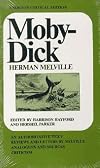
I wasn't sure what I was going to think of this book going into it because some people had told me it was really boring--it was one of my "I'm *obligated* as a person educated about literature to read this book" additions to my library. But I turned out to really enjoy it. Parts of it were very exciting, the symbolism was intriguing, and even the "whaling manual" stretches I found interesting because I like it when books teach me about things I don't know anything about. The only times it show more lost me were when it went off on total tangents like "And now I'm gonna describe paintings people have made of whales!" Ishmael/Queequeg are my OTP, and I related just a bit too much to Ahab. show less
Lists
Awards


You May Also Like


Associated Authors
Statistics
- Works
- 19
- Also by
- 6
- Members
- 2,099
- Popularity
- #12,261
- Rating
- 3.9
- Reviews
- 17
- ISBNs
- 27