
Tavis Smiley
Author of The Covenant with Black America
About the Author
"Tavis Smiley's efforts to create a positive movement toward a better life for all Americans and in particular to develop a new process of hope for African Americans is an historic undertaking which will profoundly improve America's future." -Newt Gingrich, former Speaker, U.S. House of show more Representatives show less
Image credit: Photo courtesy of Hay House, Inc.
Works by Tavis Smiley
Death of a King: The Real Story of Dr. Martin Luther King Jr.'s Final Year (2014) 156 copies, 2 reviews
Before You Judge Me: The Triumph and Tragedy of Michael Jackson's Last Days (2016) 30 copies, 2 reviews
Associated Works
The Other Wes Moore: One Name, Two Fates (2010) — Afterword, some editions — 2,551 copies, 86 reviews
The Unfinished Agenda of Brown v. Board of Education (Landmarks in Civil Rights History) (2004) — Introduction, some editions — 24 copies
Tagged
Common Knowledge
- Birthdate
- 1964-09-13
- Gender
- male
- Education
- Indiana University
- Occupations
- radio producer
television producer
publisher
philanthropist - Organizations
- The Smiley Group, Inc.
Tavis Smiley Foundation
Public Broadcasting Service
Public Radio International - Nationality
- USA
- Associated Place (for map)
- USA
Members
Reviews

This is a sad book. That final year of King's life almost exactly begins with the speech in which he strongly and unequivocally condemned the Vietnam War and the Johnson administration's execution of that war. King was strongly condemned both within and without of the Civil Rights movement for this action. He was told by whites, conservatives and liberals alike, that he should stick to civil rights and leave politics and the war in particular to the people who knew what they were talking show more about. From within the movement, many of his closest advisors felt strongly that King was basically taking his eye off the ball and, worse, risking alienating the liberal whites who had been the movements allies up until then. The FBI stepped up their campaign of hounding King and executing their disinformation campaign against him. And at the same time, more radical Blacks in the Panthers and SNCC criticized King from the left, accusing him and his insistence on non-violence of becoming increasingly irrelevant. King came up with the idea of a Poor Person's March on Washington, as he began identifying a 3-pronged system of oppression in America: racism, poverty and militarism. Even within his own Southern Christian Leadership Conference, King faced growing discontent with this idea. One of the most bitter blows to King was longtime friend and ally Bayard Rustin's spurning of the Poor Person's March idea. Rustin thought this was a waste of time and money. He thought the time for mass demonstrations of this sort had passed, and wanted to focus on getting more legislators elected who would help them pursue their policy goals in Congress. In all, Smiley portrays King's final year as harrowing and disheartening. King began to muse ever more frequently on his own death, which he assumed was coming soon. And yet King never did fully lose heart, according to Smiley. He continued pushing for his March plan, and insisted on going to Memphis to help out with the long and bitter strike being waged by the garbage men's union there.
There were a couple of small irritations with the book for me. Smiley insisted on continually referring to MLK as "Doc," which was his nickname among his friends and advisors. I didn't feel that was necessarily appropriate here and it irked me from time to time, though not seriously. Also, Smiley relatively frequently writes as if he knows King's thoughts. He explains this in his introduction, saying he only does this when his interviews with King's close advisors reveal what these people felt sure King was thinking, or sometimes what he said to them. I was willing to give Smiley the benefit of the doubt on this effect, basically trusting that he had the ideas and emotions correct. Somebody who knew King might have a different idea.
All in all, I thought this book was very much worth reading, though frequently depressing. I had tended to think of King's live as mostly single-toned, if that makes sense. King was just King, the great man who sometimes had his missteps but was consistent in the long run. Understanding the that the enormous pressures of the times--the discord, hatred and doubt--had on King during his last year only adds to my esteem for his life and what he was able to accomplish. show less
There were a couple of small irritations with the book for me. Smiley insisted on continually referring to MLK as "Doc," which was his nickname among his friends and advisors. I didn't feel that was necessarily appropriate here and it irked me from time to time, though not seriously. Also, Smiley relatively frequently writes as if he knows King's thoughts. He explains this in his introduction, saying he only does this when his interviews with King's close advisors reveal what these people felt sure King was thinking, or sometimes what he said to them. I was willing to give Smiley the benefit of the doubt on this effect, basically trusting that he had the ideas and emotions correct. Somebody who knew King might have a different idea.
All in all, I thought this book was very much worth reading, though frequently depressing. I had tended to think of King's live as mostly single-toned, if that makes sense. King was just King, the great man who sometimes had his missteps but was consistent in the long run. Understanding the that the enormous pressures of the times--the discord, hatred and doubt--had on King during his last year only adds to my esteem for his life and what he was able to accomplish. show less
An excellent account of Martin Luther King Jr.'s last year. The Baptist preacher from Georgia takes on an insane schedule to fight for his beliefs and he feels increasingly misunderstood and rejected by his own people. Before I read this book, I was not aware how strongly Martin Luther King opposed the Vietnam war - he saw the bigger connection between poverty, war and race. Many others criticized him saying he was taking on too much - and how could he oppose President Lyndon Johnson, after show more he had made concessions toward civil rights. MLK even considers a fast like Gandhi to show that he is firm in his conviction - he disregards politics, popularity, but sometimes also his own safety. "I am not a consensus leader", he says, "a genuine leader is not a searcher for consensus, but a molder of consensus." He wanted to substitute courage for caution. An impressive testimony to one of America's greatest democratic public intellectuals. show less
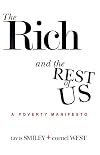
Finally finished this book, and I certainly was moved. At the end of the day, I do have some mixed feelings about the book. This is not due to the content. It is just that it is the kind of book that the choir will pretty much pick up, nod in agreement, and then move on, and the clueless will just completely miss. I get the feeling that the people who really should be reading this book will either miss it or ignore it. After all, pointing out that poverty exists and calling out those show more actually responsible for it is just not done in polite company. Smiley and West are saying a lot that needs to be said, but how many out there will listen? More importantly, how many of those who listen will be moved to substantial action? That is my question.
Having said that, this book is a must-read. The book is a follow-up of the authors' 2011 Poverty Tour, a tour that went to 18 cities in the U.S. to highlight issues of poverty. The book combines personal stories, commentary, historical overviews and statistics to show how poverty is not just a significant issue in the U.S. It is a national security threat, not to mention a shame upon the nation since it is something that can be solved, but Americans as a whole choose not to solve it. It is not a new problem. What is new is that white suburbanites, who always saw themselves as solid middle class are suddenly falling into poverty. That is what makes the news now, but poverty has been around long before the recent Recession. At any rate, there is an opportunity for substantial change, but it is going to take a lot of will, courage, and compassion. This is what the authors argue. Unlike other books, the authors also offer a full plan for a solution that is worth a look, and one that politicians, if they actually cared for their constituents, could work toward implementing.
I took some notes, so I will probably do a longer write-up of the book in my blog, but I wanted to jot down some thoughts here and to note that I did finish it. Now, don't just sit there. Go find and read this book. show less
Having said that, this book is a must-read. The book is a follow-up of the authors' 2011 Poverty Tour, a tour that went to 18 cities in the U.S. to highlight issues of poverty. The book combines personal stories, commentary, historical overviews and statistics to show how poverty is not just a significant issue in the U.S. It is a national security threat, not to mention a shame upon the nation since it is something that can be solved, but Americans as a whole choose not to solve it. It is not a new problem. What is new is that white suburbanites, who always saw themselves as solid middle class are suddenly falling into poverty. That is what makes the news now, but poverty has been around long before the recent Recession. At any rate, there is an opportunity for substantial change, but it is going to take a lot of will, courage, and compassion. This is what the authors argue. Unlike other books, the authors also offer a full plan for a solution that is worth a look, and one that politicians, if they actually cared for their constituents, could work toward implementing.
I took some notes, so I will probably do a longer write-up of the book in my blog, but I wanted to jot down some thoughts here and to note that I did finish it. Now, don't just sit there. Go find and read this book. show less
If you are familiar with the work of West and Smiley, nothing in this book will surprise you. It is an impassioned, sincere call to action, nothing less than the eradication of poverty in America. The profiles of some of the desperately poor people they met on their poverty tour are heartbreaking, and the historical analysis of how government has gradually abandoned anti-poverty programs over the past few decades is deeply troubling. West and Smiley call for a new society of compassion, show more fairness, and equality. Nothing the authors propose is beyond doing but it will require radical systemic and paradigmatic change. show less
Lists
Best Biographies (1)
Awards


You May Also Like


Associated Authors
Statistics
- Works
- 21
- Also by
- 3
- Members
- 1,257
- Popularity
- #20,409
- Rating
- 3.7
- Reviews
- 11
- ISBNs
- 73
- Languages
- 1
- Favorited
- 1