
Denis Diderot (1713–1784)
Author of Jacques the Fatalist
About the Author
Denis Diderot was a French philosopher and critic during the Age of Enlightenment. Born in 1713 in Langres, France, Diderot was educated at the University of Paris. From 1745 to 1772 he served as editor of L'Encyclopedie, which he fashioned as a journal of radical revolutionary opinion. He was a show more leader in the movement to challenge both church and state by furthering knowledge. Diderot also wrote several critical and philosophical works including Pensees sur l'interpretation de la nature (Thoughts on the Interpretation of Nature, 1754). In addition, he published essays based on personal experience, as well as several plays. As a philosopher, Diderot speculated on free will and held a completely materialistic view of the universe; he suggested all human behavior is determined by heredity. He is recognized now as an art critic of the first rank. His Essai sur la peinture (Essay on Painting, 1796) won him posthumous praise as a critic of painting technique and aesthetics. He died in Paris in 1784 and was buried in the city's Église Saint-Roch. His heirs sent his vast library to Catherine II, who had it deposited at the National Library of Russia. (Bowker Author Biography) show less
Image credit: Denis Diderot, écrivain, 1767, Louis Michel Van Loo
Series
Works by Denis Diderot
Supplément au voyage de Bougainville : "Pensées philosophiques", "Lettre sur les aveugles" (1972) 54 copies
Diderot on Art, Volume I: The Salon of 1765 and Notes on Painting (Salon of 1765 & Notes on Painting) (1995) 34 copies
Entretien entre D'Alembert et Diderot / Le rêve de d'Alembert / Suite de l'entretien (1965) 33 copies
Le Neveu de Rameau, suivi de "La Satire première", "L'Entretien d'un père avec ses enfants", "L'Entretien avec la maréchale de" (1966) 26 copies, 1 review
L'uccello bianco 18 copies
Encyclopedic Liberty: Political Articles in the Dictionary of Diderot and D’Alembert (2016) 11 copies
Pensamientos filosóficos ; Investigaciones filosóficas sobre el origen y la naturaleza de lo bello (1984) 11 copies, 1 review
Pensées philosophiques ; Lettre sur les aveugles ; Entretien entre d'Alembert et Diderot ; Supplément au Voyage de Bougainville (2008) 9 copies
Thoughts on the Interpretation of Nature and Other Philosophical Works (Enlightenment source texts) (2000) 9 copies
Le Fils Naturel: Ou, Les Epreuves De La Vertu; Comédie En Cinq Actes Et En Prose (French Edition) (1991) 8 copies
L' Encyclopedie ou Dictionnaire Raisonne Des Sciences Des Arts et des metiers (5 volume Readex Compact Edition) (1969) 8 copies
Oeuvres Choisies 8 copies
Coleção Grandes Obras do Pensamento Universal (diderot - Cartas Sobre os Cegos / Cartas Sobre os Sur (Em Portuguese do Brasil) (2006) 8 copies
Selected writings 8 copies
SERRURIER - FERRONNIER Recueil de Planches, sur les sciences, les arts libéraux et les arts méchaniques aves leur explication (2002) 7 copies
Enciclopédia. Discurso Preliminar e Outros Textos - Volume 1 (Em Portuguese do Brasil) (2015) 7 copies
Encyclopédie, ... Recueil de planches, sur les sciences, les arts libéraux, et les arts méchaniques, avec leur explication (1988) — Editor; Editor — 7 copies
Oeuvres 6 copies
L'Encyclopédie Diderot et d'Alembert. Recueil de Planches - L'art de l'écriture, Caractères et Alphabets (1986) 6 copies
ENCICLOPaDIA - VOLUME 5 6 copies
ENCICLOPaDIA - VOLUME 3 6 copies
Tratado de la barbarie de los pueblos civilizados (Historia (pasado)) (Spanish Edition) (2011) 5 copies
La filosofia dell' Encyclopédie 5 copies
Encyclopedie ou dictionnaire raisonné des sciences, des arts et des métiers. Textes vol. 16 5 copies
Enciclopédia, ou Dicionário Razoado das Ciências, das Artes e dos Ofícios - Volume 6 (2017) 5 copies
L'ART DU TOURNEUR. L'Encyclopédie: recueil de planches sur les sciences, les arts libéraux et les arts méchaniques, avec leur explication (1996) 4 copies
Sur l'Art et les Artistes 4 copies
De droom van d'Alembert en andere wijsgerige geschriften: en andere wijsgerige geschriften (2021) 3 copies
Oeuvres, Esthétique - Théâtre 3 copies
La religieuse - Le neveu de rameau 2 copies
DIDEROT: Supplement Au Voyage De Bougainville, Pensées Philosophiques, Lettre Sur Les Aveugles (1972) 2 copies
El autor y su obra. 2 copies
Ramo Ka Bhatija 2 copies
Diderot Rameau's Nephew and Other Works in New Translations By Jacques Barzun and Ralph H. Bowen (1956) (1956) 2 copies
Teatro 2 copies
Carta Sobre o Comércio dos Livros 2 copies
Vida de Séneca 2 copies
The paradox of the actor: Reflexions sur le paradoxe (Humanities Collections) (Volume 21) (2015) 2 copies
Der Hausvater : ein Schauspiel in fünf Aufzügen — Author — 2 copies
Salons De 1759 1761 1763 2 copies
Synonymes Français, par Diderot, d'Alembert, et de Jaucourt, suivis d'une Table Alphabétique 2 copies
Diderots udødelige tanker 2 copies
Éloge de Richardson 2 copies
Die Rache einer Frau : eine Erzählung aus dem Roman "Jacques le fataliste et son maître" (2000) 2 copies
Selections From the Encyclopedia By Diderot, D/alembert and a Society of Men of Letters (1965) 2 copies
La Enciclopedia 2 copies
To nie bajka 1 copy
Jóias Indiscretas 1 copy
Vida de Seneca 1 copy
Oeuvres De Théatre De M. Diderot : Avec Un Discours Sur La Poesie Dramatique Tome Premier [...] 1 copy
Da interpretação da natureza 1 copy
Opere filosofiche 1 copy
O divadle 1 copy
Dos autores e dos críticos 1 copy
Miscelanea Philosophiques 1 copy
Entretien Entre D'Alembert et Diderot - Le Reve De D'Alembert - Suite De L'entretien de Diderot 1 copy
L'oiseau blanc : conte 1 copy
Th©♭r©·se Philosophe 1 copy
La religiosa No es un cuento 1 copy
Frændi Rameaus 1 copy
Cháu ông Rameau 1 copy
Oeuvres De Théatre De M. Diderot : Avec Un Discours Sur La Poesie Dramatique Tome Second [...] 1 copy
Mémoires pour Catherine II 1 copy
Romans 1 copy
Diderot Oeuvres romanesques - éditions Garnier frères 1966 - texte établi, avec présentation et notes par Henri Bénac (1966) 1 copy
Oeuvres philosophiques 1 copy
Diderot's Selected Writings 1 copy
Euvres esthetiques 1 copy
LA ENCICLOPEDIA 1 copy
OBRAS FILOSÓFICAS 1 copy
SOPHIE VOLLAND'A MEKTUPLAR 1 copy
Diderot Obras VIII 1 copy
Paradosso sull'attore,uno dei testi piu'celebri e brillanti dell'estetica illuminista. 1996 (1900) 1 copy
A filosofia de Diderot 1 copy
L'ecyclopedie, Agriculture 1 copy
Supplément aux Oeuvres de Diderot contenant: Voyage de Hollande (Litterature) (French Edition) (2015) 1 copy
Kubuś Fatalista 1 copy
Spreuken 1 copy
Diderot Os Pensadores 1 copy
Tous les chefs d'oeuvre de la litterature Francaise. Les chefs-d'oeuvre de Diderot. Tome Deuxieme. 1 copy
D116 - O Sobrinho de Rameau 1 copy
L'encyclopedie, Astronomie 1 copy
L'antro di Platone 1 copy
Lettres à Sophie Volland, II 1 copy
Lettres à Sophie Volland, I 1 copy
Œuvres politiques 1 copy
Diderot [Opere di] 1 copy
Progetto di una università per il governo di Russia, 1775-1776, ovvero Di una educazione pubblica in tutte le scienze (2004) 1 copy
Das erzählerische Werk (I-IV). Die geschätzigen Kleinode, Die Nonne, Jacques der Fatalist und sein Herr, Rameaus Neffe. (1984) 1 copy
Házasság és hűség 1 copy
Sur Deux Mémoires de d'Alembert : L'un concernant le Calcul des Probabilités, l'autre l'Inoculation (2015) 1 copy
Oeuvres Choisies II 1 copy
Donna Alba 1 copy
To ni zgodba in druge zgodbe 1 copy
Oeuvres Choisies I 1 copy
Œuvres politiques. [Textes établis avec introductions, bibliographies, notes et relevé de variantes 1 copy
Encyclopédie méthodique 1 copy
Réflexions sur une difficulté proposée contre la manière dont les Newtoniens expliquent la cohésion (2015) 1 copy
O poreklu i prirodi lepoga 1 copy
The Paradox of the actor (annotated): Le paradoxe sur le comédien (Humanities Collections Book 21) (2014) 1 copy
Pensées détachées sur la Peinture, la Sculpture, l'Architecture et la poésie pour servir de suite aux Salons (2015) 1 copy
Beaux-Arts, première partie - Art du dessin : L'Histoire et le secret de la peinture en cire (2015) 1 copy
O svojstvima 1 copy
O umetnosti 1 copy
Lettre historique et politique adressée à un magistrat sur le commerce de la librairie (2013) 1 copy
L'oiseau blanc : Conte bleu 1 copy
Principes De La Philosophie Morale: Ou Essai De M. S. Sur Le Merite Et La Vertu (1745) (2010) 1 copy
Sogno di D'Alembert 1 copy
Ironie morali 1 copy
Le neveu de Rameau 1 copy
Oeuvres romanesque 1 copy
Ο ανεψιός του Ραμώ 1 copy
Pensées détachées ou Fragments politiques échappés du portefeuille d'un philosophe (HR.SAVOIR LETTR) (French Edition) (2011) 1 copy
Filozofické dialógy a state 1 copy
As joias indiscretas 1 copy
Redovnica 1 copy
Sogno di D'Alembert 1 copy
ENCYCLOPÉDIE: ou Dictionnaire raisonné des sciences, des arts et des métiers (26) (Molière & Co.) (French Edition) (2020) 1 copy
From Their Lips to His Ear : Tasteful Extract from Les Bijoux Indiscrets (Pocket Erotica) (2020) 1 copy
Pensamiento filosóficos 1 copy
Associated Works
The Libertine Reader: Eroticism and Enlightenment in Eighteenth-Century France (1997) — Contributor — 71 copies
Neoclassicism and Romanticism, 1750-1850, Vol. 1: Enlightenment/Revolution (1970) — Contributor — 28 copies
Oogst Der Tijden. keur uit de werken van schrijvers en dichters aller volken en eeuwen (1940) — Contributor — 12 copies
The Nun [1966 film] — Original book — 10 copies
The Masterpiece Library of Short Stories Vol. III: French — Contributor — 4 copies
Tagged
Common Knowledge
- Canonical name
- Diderot, Denis
- Legal name
- Diderot, Denis
- Birthdate
- 1713-10-15
- Date of death
- 1784-07-31
- Gender
- male
- Education
- University of Paris (MA)
College d'Harcourt
Lycée Louis-le-Grand, Paris, France - Occupations
- philosopher
polymath - Relationships
- d'Epinay, Madame (friend)
Rousseau, Jean-Jacques (friend)
d'Alembert, Jean le Rond (co-author)
Catherine the Great (patron)
Grimm, Friedrich-Melchior (friend)
Vandeul, Marie Angélique de (daughter) - Short biography
- Denis Diderot was a prominent philosopher, art critic, polymath, and writer of the French Enlightenment, best known today as co-founder and chief editor of the Encyclopédie. Diderot was educated by the Jesuits in Langres and earned a master of arts degree in philosophy in Paris. He considered entering the clergy and studying law. However, by 1734 Diderot had decided to become a writer. Because of his refusal to enter one of the learned professions, he was disowned by his father, and for the next 10 years he lived a Bohemian existence, in near-poverty, dodging the censors. He befriended Jean-Jacques Rousseau, Madame d'Epinay, and other writers and thinkers (philosophes). In 1743, he married Antoinette Champion, daughter of a linen draper, a match his father considered inappropriate; the couple had one surviving child. Diderot had affairs with the writer Madeleine de Puisieux and Sophie Volland; his letters to them contain some of the most vivid insights that historians have into his personality and the daily life of the French philosophes of the period. Diderot was elected to the Académie française, but still had financial troubles, especially when it came time for his daughter Marie-Angelique to marry, and was about to sell his library. Jacob Grimm appealed on his behalf in 1765 to Catherine the Great of Russia, who commissioned an agent in Paris to buy the library; she then requested that Diderot retain the books and act as her librarian with an annual salary that she paid in advance. In 1773, Diderot went to visit the Empress in Saint Petersburg to thank her, and spent some months at court. After his death, his library was deposited at the National Library of Russia. Diderot's last words were said to be, "Le premier pas vers la philosophie, c'est l'incrédulité" ("The first step toward philosophy is incredulity").
- Nationality
- France
- Birthplace
- Langres, France
- Place of death
- Paris, France
- Burial location
- Saint-Roch, Paris, France
- Associated Place (for map)
- Paris, France
Members
Discussions
Diderot - Dialogues & Minor Works in Literary Centennials (October 2013)
Diderot - The Indiscreet Jewels in Literary Centennials (October 2013)
Diderot - The Nun in Literary Centennials (March 2013)
Reviews

I read Diderot's The Dream of D'Alembert 20 years ago (written in 1769, but published much later), and that was quite difficult reading, because it dealt with a number of philosophical-scientific issues of that time (mid-18th century). It wasn't the form that was the problem, because Diderot had wrapped it in dialogue form, which is always more pleasant to read than a dry argument. It wasn't the 18th century French either (I read this in the original version), because that differs relatively show more little from modern French, which I understand well (although it is not my mother tongue). I think it rather was the dry, topic-based treatment that did me in.
This book, Jacques the Fatalist (1785), actually also is a philosophical story in dialogue form. But Diderot wrote it in a much lighter style, with a clear ironic-picaresque slant, and that makes it much more digestible. The dialogue takes place between the servant Jacques and his unnamed boss (the master). Jacques is an inveterate chatterbox who loves to talk about his time in the army and his amorous adventures. His boss is particularly interested in the latter, but he remains dissatisfied because Jacques jumps from topic to topic, is interrupted by the master and other people. The broken storyline leads to irritation and frustration with the master, but also with the reader. And that is apparently deliberately intended by Diderot, who regularly interrupts the novel to address the reader directly and to comment on the events himself, which of course only makes matters worse. In this Diderot was inspired by Tristam Shandy, the voluminous novel by the English writer Laurence Sterne, the first parts of which had been published a few years earlier. And that of course explains a few things. Because if there is one novel that tests the patience of the reader, with constant interruptions and digressions, it is this one. But Diderot was also clearly inspired by the ironic and picaresque nature of Sterne's novel. Jacques Le Fataliste also excels in his laconic, satirical and often simply absurd nature. And the entertaining stories within the story (such as the delightful one about the Marquis des Arcis and the Marquise de Pommeraye) certainly compensate for the reading difficulties.
Okay, fine, but what about the philosophy? That is certainly there, even on almost every page. Because chatterbox Jacques turns out to be a fatalist, who attributes everything he experiences to Providence, "everything good and bad that happens to us here below was written up there”. In the dialogue with the master, that providence is constantly being sounded out, and with it inevitably the question of man's free will, one of the most fundamental philosophical issues. Every adventure, every prank, every bit of luck or misfortune is weighed up and discussed in this light, by each of the three main characters (Jacques, the master ànd the writer). Not with weighty philosophical arguments, no, on the contrary, light-heartedly and with a wink, and therefore also constantly undermining (false) certainties: “It is because, for lack of knowing what is written up there, we know neither what we want nor what we do, and we follow our fantasy which we call reason, or our reason which often just is a dangerous fantasy that sometimes turns out well, sometimes badly.” (what a great quote”!). I enjoyed this delicious, mischievous novel immensely. For me, this is the best thing Diderot ever put to paper. show less
This book, Jacques the Fatalist (1785), actually also is a philosophical story in dialogue form. But Diderot wrote it in a much lighter style, with a clear ironic-picaresque slant, and that makes it much more digestible. The dialogue takes place between the servant Jacques and his unnamed boss (the master). Jacques is an inveterate chatterbox who loves to talk about his time in the army and his amorous adventures. His boss is particularly interested in the latter, but he remains dissatisfied because Jacques jumps from topic to topic, is interrupted by the master and other people. The broken storyline leads to irritation and frustration with the master, but also with the reader. And that is apparently deliberately intended by Diderot, who regularly interrupts the novel to address the reader directly and to comment on the events himself, which of course only makes matters worse. In this Diderot was inspired by Tristam Shandy, the voluminous novel by the English writer Laurence Sterne, the first parts of which had been published a few years earlier. And that of course explains a few things. Because if there is one novel that tests the patience of the reader, with constant interruptions and digressions, it is this one. But Diderot was also clearly inspired by the ironic and picaresque nature of Sterne's novel. Jacques Le Fataliste also excels in his laconic, satirical and often simply absurd nature. And the entertaining stories within the story (such as the delightful one about the Marquis des Arcis and the Marquise de Pommeraye) certainly compensate for the reading difficulties.
Okay, fine, but what about the philosophy? That is certainly there, even on almost every page. Because chatterbox Jacques turns out to be a fatalist, who attributes everything he experiences to Providence, "everything good and bad that happens to us here below was written up there”. In the dialogue with the master, that providence is constantly being sounded out, and with it inevitably the question of man's free will, one of the most fundamental philosophical issues. Every adventure, every prank, every bit of luck or misfortune is weighed up and discussed in this light, by each of the three main characters (Jacques, the master ànd the writer). Not with weighty philosophical arguments, no, on the contrary, light-heartedly and with a wink, and therefore also constantly undermining (false) certainties: “It is because, for lack of knowing what is written up there, we know neither what we want nor what we do, and we follow our fantasy which we call reason, or our reason which often just is a dangerous fantasy that sometimes turns out well, sometimes badly.” (what a great quote”!). I enjoyed this delicious, mischievous novel immensely. For me, this is the best thing Diderot ever put to paper. show less

A wonderful "anti-novel", obviously inspired in part by Tristram Shandy, teasing the reader with all sorts of ideas about how narrative works in an endless and constantly-interrupted discussion between the valet Jacques and his employer as they make their way from somewhere unspecified to somewhere else. We get humour both subtle and coarse; the odd bit of good old-fashioned slapstick; high-flying philosophical discussions; love stories high and low; all manner of knavery; discourses on show more medicine, law, religion, finance and cart-making; and more than a bit of down-to-earth common sense. At one point we even get an authorial aside of a couple of pages defending the use of the French "F-word" in print with arguments that are still just as valid today as they were 200 years ago.
Between the lines, Diderot has a go at putting us right about social relations in France shortly before the revolution: even if Jacques' peasant bolshieness is an exaggeration, there's no way we can fit his nameless "Maître" into the traditional category of big-wigged aristocrats with absolute power over their peasants. This is a world where the minor gentry, at least, are all in debt to middle-class tradesmen or crooked moneylenders and can't go around offending people at will. Philosophers, on the other hand, seem to be quite happy to offend everyone...
Like so many light, effortlessly discursive books, it seems to have had a difficult birth: Diderot tinkered with it and expanded it over a period of some twenty years. There's obviously more to it than fun and paradox. Diderot's trying to make us think, evidently, and pushing his belief that the world is not as ordered and straightforward as we might think. An alarmingly modern way of looking at things. Obviously, part of it is the recurrent theme of determinism implied by Jacques and his catch-phrase "il est écrit là-haut". We don't get a Candide-style rubbishing of an over-simplified philosophical idea - while Jacques' fatalism is clearly ridiculous, and his behaviour isn't consistent with a belief that everything is predetermined, Diderot also takes care to remind us how difficult it is to demonstrate free will. In the interpolated stories, we're often forced into paradoxical moral positions. Against our best instincts, we are led to admire the tricksters and look down on their dupes, except in the case of Mme de La Pommeraye, who ought by rights to have our sympathy, but loses it because her revenge is so out of proportion with the offence that provokes it. show less
Between the lines, Diderot has a go at putting us right about social relations in France shortly before the revolution: even if Jacques' peasant bolshieness is an exaggeration, there's no way we can fit his nameless "Maître" into the traditional category of big-wigged aristocrats with absolute power over their peasants. This is a world where the minor gentry, at least, are all in debt to middle-class tradesmen or crooked moneylenders and can't go around offending people at will. Philosophers, on the other hand, seem to be quite happy to offend everyone...
Like so many light, effortlessly discursive books, it seems to have had a difficult birth: Diderot tinkered with it and expanded it over a period of some twenty years. There's obviously more to it than fun and paradox. Diderot's trying to make us think, evidently, and pushing his belief that the world is not as ordered and straightforward as we might think. An alarmingly modern way of looking at things. Obviously, part of it is the recurrent theme of determinism implied by Jacques and his catch-phrase "il est écrit là-haut". We don't get a Candide-style rubbishing of an over-simplified philosophical idea - while Jacques' fatalism is clearly ridiculous, and his behaviour isn't consistent with a belief that everything is predetermined, Diderot also takes care to remind us how difficult it is to demonstrate free will. In the interpolated stories, we're often forced into paradoxical moral positions. Against our best instincts, we are led to admire the tricksters and look down on their dupes, except in the case of Mme de La Pommeraye, who ought by rights to have our sympathy, but loses it because her revenge is so out of proportion with the offence that provokes it. show less

Hilarious. I didn’t know how funny, when I bought this in Quebec City, Libraire Generale Française, over two decades ago. Nor did I know how metaliterary, like its contemporary, Sterne’s Tristram Shandy, but here, Diderot notes all the fictional clichés he refuses to write, telling only the truth. Ignorant of its humor, I chose this book because of a couple passages in the middle: one, "Never pay in advance, unless you want to be badly served"(112); the other directly opposed my show more Puritan upbringing, where I/ one must work to get ahead, but one must act morally, or be wracked with guilt. Here? Not at all. All is pre-determined on high, “ecrit en haut” (236).
Such rollicking humor. The surgeon who must repair Jacques’ knee broken by a fall from his horse, tells the housewife to go down “à la cave,” to the wine-cellar, “boirons un coup, cela rends la main sûre.” I’ll have a drink, it’ll make my hand more steady (56). Benefits of wine: Jacques says it helps his memory, "refraîchit la memoire"(182). The surgeon sets up his host holding one leg, the wife holding another, turning patient on his side, then sends the wife back down to the cellar for another bottle. (Why only wives to the wine-cellar? Maybe the ceiling height, maybe her pacing her supply.)
Meanwhile, the patient, Jacques quizzes the chirurgeon, “Will I boiter/limp?” The doctor says, You should be glad I didn’t amputate like that other doctor suggested. “Je vous aie vous sauvé votre jambe” I’ve saved your leg. Do you like dancing? You may walk a little worse, but “danserez que mieux …Commère, le vin chaud.” You will dance better…Ma’am, some warm wine? (58)
Mostly a play, with two main speakers, Jacques and Le Maître / Master (no given or family name). Meta-literary, writing about writing, Jacques / the writer again and again rejects interruption to fulfill narrative clichés. But he does employ one common 18th Century novel device, direct address of the reader: “Vous concevez, lecteur…”(26), “Où? lecteur, vous êtes d’une curiosité bien incommode!” Where? What does it matter if the road’s going to Pontoise or Saint-Germain? Your curiosity’s inconvenient.(44) “Je vous supplie, lecteur…”(48). “Ma, si vous m’interrompez, lecteur…”(61).
This book contrasts the speakers (Jacques, Mme La Pommeraye) versus the non-speakers, though sometimes it's merely a situation, as when the Marquis is silent from worry, afraid to tell Mme La P that he did what she told hi not to. He walks around the room, stops in front of her, goes to the windo, then back to the door, all silent. "il se promener...sans mot dire: il allait au fenêtres, il regardait le ciel"(188).
Again and again, Diderot tells us what he will surely not tell us, the expected stories of fiction. For instance, Master and Jacques debate women, one saying “qu’elles étaient bonnes, l’autres méchantes,” and they were both right, one saying they were “sottes, l’autre pleines d’esprit” and they were both right. The one said miserly, the other, generous; the one, they were liars, the other, honest…and again , both were right (44).
After the surgery when the couple learn of the months of recovery, they suggest the “soeurs gris,” the nuns of St Vincent de Paul— who, by the way, had a home for wayward boys (to avoid jail time) down the street from us, at the end of Cornell Road, Westport. (Now they’ve torn down all the bunk rooms, turned the land over to a grandiose Land Trust property, with spindly acceptable maples replacing the century old Norway maples along the road. Invasive Norwegians. But so are Rosa Rugosa, and I don’t see anyone pulling beach roses up.)
One of several times Jacques falls from his horse, he's rescued by a well-dressed man who even gives him a horse--though a badly behaved one which eventually throws him. Later Jacques sees a man with braided hat, well clothed with gold braid, with two big dogs; he runs up to him and embraes him, thanking him. The man is impassive, hardly acknowledges, though he admits he did help him (103). (BTW, Jacques newly-given horse had run straight for the scaffold.) When Jacques askes his Maître who the man is, he is shocked to find he's "Le Bourreau'/ the undertaker. (No wonder the man is unused to gratitude.)
BTW, Diderot wrote this at the end of his life—he a central philosophe whose Enlightenment Encyclopédie suggested the future could be better, a founding idea of the United States. Previously, in the Renaissance, authors like Ben Jonson looked backward to the Golden Age.
Jacques says many things which draw universal agreement, like Long live Dogs (146):
"Vivent les chiens! il n'y a rien de plus parfait sous le ciel."
Read in 1989 edition, Pocket, 1989. ISBN 2-266-8322-8 show less
Such rollicking humor. The surgeon who must repair Jacques’ knee broken by a fall from his horse, tells the housewife to go down “à la cave,” to the wine-cellar, “boirons un coup, cela rends la main sûre.” I’ll have a drink, it’ll make my hand more steady (56). Benefits of wine: Jacques says it helps his memory, "refraîchit la memoire"(182). The surgeon sets up his host holding one leg, the wife holding another, turning patient on his side, then sends the wife back down to the cellar for another bottle. (Why only wives to the wine-cellar? Maybe the ceiling height, maybe her pacing her supply.)
Meanwhile, the patient, Jacques quizzes the chirurgeon, “Will I boiter/limp?” The doctor says, You should be glad I didn’t amputate like that other doctor suggested. “Je vous aie vous sauvé votre jambe” I’ve saved your leg. Do you like dancing? You may walk a little worse, but “danserez que mieux …Commère, le vin chaud.” You will dance better…Ma’am, some warm wine? (58)
Mostly a play, with two main speakers, Jacques and Le Maître / Master (no given or family name). Meta-literary, writing about writing, Jacques / the writer again and again rejects interruption to fulfill narrative clichés. But he does employ one common 18th Century novel device, direct address of the reader: “Vous concevez, lecteur…”(26), “Où? lecteur, vous êtes d’une curiosité bien incommode!” Where? What does it matter if the road’s going to Pontoise or Saint-Germain? Your curiosity’s inconvenient.(44) “Je vous supplie, lecteur…”(48). “Ma, si vous m’interrompez, lecteur…”(61).
This book contrasts the speakers (Jacques, Mme La Pommeraye) versus the non-speakers, though sometimes it's merely a situation, as when the Marquis is silent from worry, afraid to tell Mme La P that he did what she told hi not to. He walks around the room, stops in front of her, goes to the windo, then back to the door, all silent. "il se promener...sans mot dire: il allait au fenêtres, il regardait le ciel"(188).
Again and again, Diderot tells us what he will surely not tell us, the expected stories of fiction. For instance, Master and Jacques debate women, one saying “qu’elles étaient bonnes, l’autres méchantes,” and they were both right, one saying they were “sottes, l’autre pleines d’esprit” and they were both right. The one said miserly, the other, generous; the one, they were liars, the other, honest…and again , both were right (44).
After the surgery when the couple learn of the months of recovery, they suggest the “soeurs gris,” the nuns of St Vincent de Paul— who, by the way, had a home for wayward boys (to avoid jail time) down the street from us, at the end of Cornell Road, Westport. (Now they’ve torn down all the bunk rooms, turned the land over to a grandiose Land Trust property, with spindly acceptable maples replacing the century old Norway maples along the road. Invasive Norwegians. But so are Rosa Rugosa, and I don’t see anyone pulling beach roses up.)
One of several times Jacques falls from his horse, he's rescued by a well-dressed man who even gives him a horse--though a badly behaved one which eventually throws him. Later Jacques sees a man with braided hat, well clothed with gold braid, with two big dogs; he runs up to him and embraes him, thanking him. The man is impassive, hardly acknowledges, though he admits he did help him (103). (BTW, Jacques newly-given horse had run straight for the scaffold.) When Jacques askes his Maître who the man is, he is shocked to find he's "Le Bourreau'/ the undertaker. (No wonder the man is unused to gratitude.)
BTW, Diderot wrote this at the end of his life—he a central philosophe whose Enlightenment Encyclopédie suggested the future could be better, a founding idea of the United States. Previously, in the Renaissance, authors like Ben Jonson looked backward to the Golden Age.
Jacques says many things which draw universal agreement, like Long live Dogs (146):
"Vivent les chiens! il n'y a rien de plus parfait sous le ciel."
Read in 1989 edition, Pocket, 1989. ISBN 2-266-8322-8 show less
Man was born to live with his fellow human beings. Separate him, isolate him, his character will go bad, a thousand ridiculous affects will invade his heart, extravagant thoughts will germinate in his brain, like thorns in an uncultivated land.
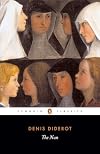
Given the untimely arrival of our Arctic Vortex, it is fitting that The Nun shudders with a frozen despair. Bone chilling mornings are well suited for such guided tours of the dark side. Abandon your preconceptions of the Enlightenment and moral show more cautionary tales, Diderot's creation is terrifying. Apparently it was a practical joke used to trick a friend to return to Paris from the countryside. The novel takes the form of an escaped nun tracing her history in a lengthy letter about a series of convents, ones where the prevailing theme is obedience. One thinks of Martin Amis, "give some someone absolute control over another and thoughts soon turn to torture." Forget Sade or Huysmans, I was scared shitless by the novel's second Mother Superior: think Martha Stewart as Torquemada. show less
Given the untimely arrival of our Arctic Vortex, it is fitting that The Nun shudders with a frozen despair. Bone chilling mornings are well suited for such guided tours of the dark side. Abandon your preconceptions of the Enlightenment and moral show more cautionary tales, Diderot's creation is terrifying. Apparently it was a practical joke used to trick a friend to return to Paris from the countryside. The novel takes the form of an escaped nun tracing her history in a lengthy letter about a series of convents, ones where the prevailing theme is obedience. One thinks of Martin Amis, "give some someone absolute control over another and thoughts soon turn to torture." Forget Sade or Huysmans, I was scared shitless by the novel's second Mother Superior: think Martha Stewart as Torquemada. show less
Lists
Favourite Books (1)
Monastic life (1)
. (1)
Erotic Fiction (1)
French Books (1)
Awards


You May Also Like


Associated Authors
Statistics
- Works
- 591
- Also by
- 21
- Members
- 9,173
- Popularity
- #2,613
- Rating
- 3.6
- Reviews
- 107
- ISBNs
- 962
- Languages
- 27
- Favorited
- 24


