

Gary Keller
Author of The ONE Thing
Works by Gary Keller
Associated Works
Unmasking Autism, How to Break Up with Your Phone, Hyperfocus, One Thing (2022) — Contributor — 1 copy
Tagged
Common Knowledge
- Birthdate
- 1957
- Gender
- male
- Education
- Baylor University
- Occupations
- real estate agent
businessman - Organizations
- Keller Williams Realty
- Nationality
- USA
- Birthplace
- Pasadena, Texas, USA
- Places of residence
- Austin, Texas, USA
- Map Location
- USA
Members
Reviews

Have you ever watched people whose careers and lives seem to be driven by one central passion and wondered how they do it? In The One Thing, entrepreneur Gary Keller explains how to make that happen in your life – if you’re willing to take the journey.
The first step is to identify what your “one thing” is. Are you a writer? Or an organizer? Or do you start businesses? What field are you interested in? At first, the answers seem obvious, but upon further introspection, many of these show more answers aren’t so clear. Deciding who you are – that is, learning self-knowledge – is a key first step to your journey.
Next, you need to learn time management. Especially at first, life is usually not amenable to big dreams. We have responsibilities and tasks to do that get in the way of pursuing our one thing. Keller recommends deliberately blocking off several hours each day to the one thing.
He cites writer Stephen King as an inspiration. He blocks off about four hours to write each day. What’s impressive is that he started this habit while working a full-time job as a young man when his schedule was not centered around writing. As he mastered his trade and his life, more freedoms came. You don’t have to quit your “day job” to pursue your one thing; you just have to structure your time enough around engaging in the task.
I also found Keller’s comments about “work-life balance” thought-provoking. He says that balance should not be the goal. Rather a “counterbalance” of pursuing both life and work ambitions should be a goal. I might describe this perspective as a work-life synergy. At times, either end of the spectrum might predominate, but we just can’t stay at one end or the other too long lest we neglect the other end.
His overall goal is to master the one thing. He cites the famous 10,000-hour challenge to master complex tasks as a guide. Mastery takes time and deliberate effort. Both have to win priority – that is, first place – in one’s life. Mastery begins as a youth, but often adult life overwhelms our attempts at mastery. Blocking off time and not letting interruptions dominate are key steps to achieving mastery over a domain.
I personally recommend the audiobook version of this book as an option for those inclined to learning by listening. Music is incorporated in the display, and the overall project displays good technical mastery itself. I enjoyed listening to it as I went about my weekend chores.
Overall, this book offers more than inspiration: it offers a plan to make your life more deliberate and more structured around what matters most to you. The “one thing” doesn’t have to be something that inspires awe. Rather, it can be any task that you want to intensify your focus to master. Maybe more mastery is only a few steps away if you’re willing to walk along the journey… show less
The first step is to identify what your “one thing” is. Are you a writer? Or an organizer? Or do you start businesses? What field are you interested in? At first, the answers seem obvious, but upon further introspection, many of these show more answers aren’t so clear. Deciding who you are – that is, learning self-knowledge – is a key first step to your journey.
Next, you need to learn time management. Especially at first, life is usually not amenable to big dreams. We have responsibilities and tasks to do that get in the way of pursuing our one thing. Keller recommends deliberately blocking off several hours each day to the one thing.
He cites writer Stephen King as an inspiration. He blocks off about four hours to write each day. What’s impressive is that he started this habit while working a full-time job as a young man when his schedule was not centered around writing. As he mastered his trade and his life, more freedoms came. You don’t have to quit your “day job” to pursue your one thing; you just have to structure your time enough around engaging in the task.
I also found Keller’s comments about “work-life balance” thought-provoking. He says that balance should not be the goal. Rather a “counterbalance” of pursuing both life and work ambitions should be a goal. I might describe this perspective as a work-life synergy. At times, either end of the spectrum might predominate, but we just can’t stay at one end or the other too long lest we neglect the other end.
His overall goal is to master the one thing. He cites the famous 10,000-hour challenge to master complex tasks as a guide. Mastery takes time and deliberate effort. Both have to win priority – that is, first place – in one’s life. Mastery begins as a youth, but often adult life overwhelms our attempts at mastery. Blocking off time and not letting interruptions dominate are key steps to achieving mastery over a domain.
I personally recommend the audiobook version of this book as an option for those inclined to learning by listening. Music is incorporated in the display, and the overall project displays good technical mastery itself. I enjoyed listening to it as I went about my weekend chores.
Overall, this book offers more than inspiration: it offers a plan to make your life more deliberate and more structured around what matters most to you. The “one thing” doesn’t have to be something that inspires awe. Rather, it can be any task that you want to intensify your focus to master. Maybe more mastery is only a few steps away if you’re willing to walk along the journey… show less
This book is a gem! Reading it gave me a much-needed altered perspective and shifted the way I approach my daily tasks. As a multipassionate creative, I frequently become scattered, overwhelmed, and confused about what I should work on next. My productivity has always been challenged by my myriad interests, scattering my focus to the winds.
This book provided an eye-opening perspective on how to cope with my overflowing plate of interests and roles. It taught me to tackle the most crucial show more tasks and projects first. Previously, trying to give equal attention to all aspects was a balancing act I was losing. Now I can concentrate my efforts, resulting in better outcomes and more satisfaction in the work I do.
I was entirely engrossed in the book. So much so, I read it in one sitting! I took notes, highlighted, and underlined frequently. Definitely one for my keeper shelf! show less
This book provided an eye-opening perspective on how to cope with my overflowing plate of interests and roles. It taught me to tackle the most crucial show more tasks and projects first. Previously, trying to give equal attention to all aspects was a balancing act I was losing. Now I can concentrate my efforts, resulting in better outcomes and more satisfaction in the work I do.
I was entirely engrossed in the book. So much so, I read it in one sitting! I took notes, highlighted, and underlined frequently. Definitely one for my keeper shelf! show less
Okay, here's something you won't see me do too often on this blog, I'm going to recommend a business productivity book. Hey! Wait! Come back here. It's a good one.
In fact, What's Your One Thing? by Gary Keller with Jay Papasan is not just a business book. (Though I've been arguing that writers do need to think like business people for ages.) It is an excellent book for life in general and for artists and creative people of all stripes.
What it boils down to is "What is the One thing you can show more do right now that will help you reach your goal?"
That question is a focus question. You have to make a very specific answer for it. You can't have a to do of 10 things. What is the One Thing that must get done right now to make your goal attainable. Of course, you also need to have a goal and actually think about and create a progression from here to there. I'm not re-capping all the steps, just the biggies. READ the BOOK.
Follow up? Why aren't you doing that thing?
Second step, after this focus question, is to make time for that one thing and to guard that time jealously. Keller and Papasan suggest a four hour block in the morning. I would adjust that to a four hour block whenever you are at your best. If you're a night owl, carve out a slice of time at night. If you're a morning person, do it in the morning.
I say, if you can't do four hours right now, carve out half-an-hour. If you can't do that, you don't actually give a shit about your goal and need to find one you *do* care about.
Make that time, that precious, precious time, and do it every day, five days a week. Your goal will get closer and closer. And once you spend 2-3 months carving out your time, it will be a habit and you'll feel *wrong* when you don't spend the time on your goal. After that, it's inertia and time to work on the next habit you want to create.
Time, repetition, habit. Train in new habits, and over-write old ones.
When I say guard that time, it means, work without distractions. Turn off the internet. Kill the phone. Do not move away from whatever your task is until it is done.
One task a day, that's not that hard right? Write 5 pages. Hell, write 5 sentences. Whatever the goal is, hammer at it every day.
But first, read the book. It's worth the time. show less
In fact, What's Your One Thing? by Gary Keller with Jay Papasan is not just a business book. (Though I've been arguing that writers do need to think like business people for ages.) It is an excellent book for life in general and for artists and creative people of all stripes.
What it boils down to is "What is the One thing you can show more do right now that will help you reach your goal?"
That question is a focus question. You have to make a very specific answer for it. You can't have a to do of 10 things. What is the One Thing that must get done right now to make your goal attainable. Of course, you also need to have a goal and actually think about and create a progression from here to there. I'm not re-capping all the steps, just the biggies. READ the BOOK.
Follow up? Why aren't you doing that thing?
Second step, after this focus question, is to make time for that one thing and to guard that time jealously. Keller and Papasan suggest a four hour block in the morning. I would adjust that to a four hour block whenever you are at your best. If you're a night owl, carve out a slice of time at night. If you're a morning person, do it in the morning.
I say, if you can't do four hours right now, carve out half-an-hour. If you can't do that, you don't actually give a shit about your goal and need to find one you *do* care about.
Make that time, that precious, precious time, and do it every day, five days a week. Your goal will get closer and closer. And once you spend 2-3 months carving out your time, it will be a habit and you'll feel *wrong* when you don't spend the time on your goal. After that, it's inertia and time to work on the next habit you want to create.
Time, repetition, habit. Train in new habits, and over-write old ones.
When I say guard that time, it means, work without distractions. Turn off the internet. Kill the phone. Do not move away from whatever your task is until it is done.
One task a day, that's not that hard right? Write 5 pages. Hell, write 5 sentences. Whatever the goal is, hammer at it every day.
But first, read the book. It's worth the time. show less
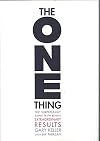
I like the premise and the main question that the book revolves around: "What's the ONE thing you can do this week, such that by doing it, everything else would be easier or unnecessary?" The emphasis on ONE is the key. What I found lacking was examples from the author's life - which I expected should/would include some failures and refinements, but there were none. The book could have easily been 50 pages or less, including such examples. Nevertheless, I'm glad I read it just for the core show more idea. What I did find incongruous was the author exhorting the reader to find that ONE thing... but then turn around and apply the ONE thing mantra to the 17 dimensions of our lives. I think it needs to be ONE thing. show less
Lists
Awards


You May Also Like


Associated Authors
Statistics
- Works
- 18
- Also by
- 1
- Members
- 2,596
- Popularity
- #9,897
- Rating
- 3.9
- Reviews
- 40
- ISBNs
- 60
- Languages
- 12