
John Francis Moore
Author of Batman & Houdini: The Devil's Workshop
About the Author
Series
Works by John Francis Moore
Doom 2099 #25 3 copies
Doom 2099 #19 2 copies
Avengers Annual 1999 2 copies
Doom 2099 #18 2 copies
Chronos 2 copies
Doom 2099 #20 2 copies
X-Men 2099 #24 1 copy
X-Men 2099 #22 1 copy
Doom 2099 #21 1 copy
X-Factor (1986-1998) #109 1 copy
X-Men 2099 #21 1 copy
X-Men 2099 #30 1 copy
X-Men 2099 (1993-1996) #24 1 copy
X-Men 2099 (1993-1996) #30 1 copy
Chronos: One Million 1 copy
Catwoman (1993) #93 1 copy
Catwoman (1993) #92 1 copy
X-Men 2099 (1993-1996) #28 1 copy
X-Men 2099 (1993-1996) #26 1 copy
X-Men 2099 (1993-1996) #25 1 copy
X-Men 2099 (1993-1996) #23 1 copy
X-Men 2099 (1993-1996) #22 1 copy
X-Men 2099 (1993-1996) #21 1 copy
X-Men 2099 (1993-1996) #20 1 copy
X-Men 2099 (1993-1996) #19 1 copy
X-Men 2099 (1993-1996) #18 1 copy
X-Men 2099 (1993-1996) #17 1 copy
X-Men 2099 (1993-1996) #16 1 copy
X-Men 2099 (1993-1996) #15 1 copy
Chronos: Revisionary 1 copy
X-Force (1991) #91 - Fallout 1 copy
Fate 1 copy
Superboy [1990] #3 1 copy
Hothouse: Part 2 1 copy
Hothouse: Part 1 1 copy
Chronos: Mad Genius 1 copy
Chronos: Time on My Hands 1 copy
Chronos: The Funeral Party 1 copy
Chronos: Legacies 1 copy
Chronos: The Killing Rain 1 copy
Chronos: Ghost Train 1 copy
X-Men 2099 (1-29, completo) 1 copy
X-Factor 1 copy
Detective Comics: The Hunt 1 copy
Associated Works
Tagged
Common Knowledge
- Birthdate
- 1964-09-05
- Gender
- male
- Occupations
- comic book writer
- Nationality
- USA
- Associated Place (for map)
- USA
Members
Reviews

Access a version of the below that includes illustrations on my blog.
Before reading it, I had thought Ironwolf: Fires of the Revolution would be a retelling of the events of Howard Chaykin's original IronWolf* story in the new context of his Twilight story. It turns out that Fires of the Revolution is largely a sequel to the 1973-74 IronWolf, albeit one that retcons it a little bit to fit it into the future history established by Twilight. The original IronWolf concerned struggles over the show more "Empire Galaktika"; Fires of the Revolution quickly establishes that this is a high-faluting name for a group of three planets. The capital of the Empire Galaktika was Earth; Fires of the Revolution clarifies that early human colonists named a ton of planets "Earth." This does require us to ignore that in the original series, IronWolf visited the Grand Canyon, but it mostly all fits together (except for the Tales of the House of IronWolf back-ups, but they weren't such a big deal anyway).
Well, I say it all fits together, but Fires of the Revolution actually opens with a retelling of an event from the first issue of IronWolf, Weird Worlds #8: Lord Ironwolf's burning down of his family's ancestral forests of anti-gravity wood, to keep them out of the hands of his brother, who's working with the Empress Erika. I complained that in the original, this moment seemed underplayed; here the writers and artists turn it into the big dramatic moment it deserved to be. From there, though, Fires of the Revolution shifts into following up rather than retelling: Ironwolf and Shebaba's fledgling revolution is cut short when one of their own betrays them. The empress is willing to cut a deal with the rebels and form a parliamentary government, but only on the condition of Ironwolf's death, so one of Ironwolf's allies betrays him.
It's a slightly different world than the original IronWolf stories of two decades prior: less sword-and-planet warlord, and more courtly intrigue. Penciller Mike Mignola follows this new approach with visuals that come right out of the French Revolution: his Empress Erika is a highly refined aristocrat, not the sultry seductress of Chaykin's originals. (Though, of course, she is no less venomous underneath.) In the highly repressed world of this Empire Galakitka, Lord Ironwolf is different from the other aristocrats: something primal and barbaric, full of energy, willing to burn the world down if it means progress might result. This resonates with the larger story of Twilight, too (to which this is a sidequel; Homer Glint puts in an appearance, and everyone in this story can live forever because of what happened over there), in that Ironwolf claims that if the Empire Galakitka is integrated into humanity's galactic civilization, it can reverse some of the stagnation that has set in.
On the whole, Fires of the Revolution is kind of pulpy just like the original IronWolf, but in a different way. Lots of fights and betrayals and fires and shadow and plotting, but the universe feels darker and less swashbuckling. But I would partially attribute that to putting the fabulously gloomy Mignola on art. I enjoyed reading it on the whole, and looking at it even more. I still do have one complaint: I get what motivates Ironwolf's personal goals. He is a simple man at heart, and he wants revenge for the various ways he's been wronged. (There's a lot of them by this point-- basically everyone who ever threw in with him was killed.) But what motivates him politically? As an "aristo" what makes him want to rid the Empire Galaktika of aristocratic control and put a democracy in place? This was a weakness in the original IronWolf and continues to be one here.
(This book was originally published as a graphic novel in hardcover in 1992, and released in paperback in 1993. DC finally collected Chaykin's Twilight in 2015; it would be cool if they also released a collection of both Fires of the Revolution and the original IronWolf stories from Weird Worlds. It would make a nice little 150ish-page space epic.)
DC Comics Space Heroes: « Previous in sequence | Next in sequence »
* As always, it's hard to tell how comic book character names ought to be capitalized. While the text pieces in the 1986 reprint special used "IronWolf," Walt Simonson's introduction to this volume goes with "Ironwolf," so I am capitalizing that way in the context of this volume. show less
Before reading it, I had thought Ironwolf: Fires of the Revolution would be a retelling of the events of Howard Chaykin's original IronWolf* story in the new context of his Twilight story. It turns out that Fires of the Revolution is largely a sequel to the 1973-74 IronWolf, albeit one that retcons it a little bit to fit it into the future history established by Twilight. The original IronWolf concerned struggles over the show more "Empire Galaktika"; Fires of the Revolution quickly establishes that this is a high-faluting name for a group of three planets. The capital of the Empire Galaktika was Earth; Fires of the Revolution clarifies that early human colonists named a ton of planets "Earth." This does require us to ignore that in the original series, IronWolf visited the Grand Canyon, but it mostly all fits together (except for the Tales of the House of IronWolf back-ups, but they weren't such a big deal anyway).
Well, I say it all fits together, but Fires of the Revolution actually opens with a retelling of an event from the first issue of IronWolf, Weird Worlds #8: Lord Ironwolf's burning down of his family's ancestral forests of anti-gravity wood, to keep them out of the hands of his brother, who's working with the Empress Erika. I complained that in the original, this moment seemed underplayed; here the writers and artists turn it into the big dramatic moment it deserved to be. From there, though, Fires of the Revolution shifts into following up rather than retelling: Ironwolf and Shebaba's fledgling revolution is cut short when one of their own betrays them. The empress is willing to cut a deal with the rebels and form a parliamentary government, but only on the condition of Ironwolf's death, so one of Ironwolf's allies betrays him.
It's a slightly different world than the original IronWolf stories of two decades prior: less sword-and-planet warlord, and more courtly intrigue. Penciller Mike Mignola follows this new approach with visuals that come right out of the French Revolution: his Empress Erika is a highly refined aristocrat, not the sultry seductress of Chaykin's originals. (Though, of course, she is no less venomous underneath.) In the highly repressed world of this Empire Galakitka, Lord Ironwolf is different from the other aristocrats: something primal and barbaric, full of energy, willing to burn the world down if it means progress might result. This resonates with the larger story of Twilight, too (to which this is a sidequel; Homer Glint puts in an appearance, and everyone in this story can live forever because of what happened over there), in that Ironwolf claims that if the Empire Galakitka is integrated into humanity's galactic civilization, it can reverse some of the stagnation that has set in.
On the whole, Fires of the Revolution is kind of pulpy just like the original IronWolf, but in a different way. Lots of fights and betrayals and fires and shadow and plotting, but the universe feels darker and less swashbuckling. But I would partially attribute that to putting the fabulously gloomy Mignola on art. I enjoyed reading it on the whole, and looking at it even more. I still do have one complaint: I get what motivates Ironwolf's personal goals. He is a simple man at heart, and he wants revenge for the various ways he's been wronged. (There's a lot of them by this point-- basically everyone who ever threw in with him was killed.) But what motivates him politically? As an "aristo" what makes him want to rid the Empire Galaktika of aristocratic control and put a democracy in place? This was a weakness in the original IronWolf and continues to be one here.
(This book was originally published as a graphic novel in hardcover in 1992, and released in paperback in 1993. DC finally collected Chaykin's Twilight in 2015; it would be cool if they also released a collection of both Fires of the Revolution and the original IronWolf stories from Weird Worlds. It would make a nice little 150ish-page space epic.)
DC Comics Space Heroes: « Previous in sequence | Next in sequence »
* As always, it's hard to tell how comic book character names ought to be capitalized. While the text pieces in the 1986 reprint special used "IronWolf," Walt Simonson's introduction to this volume goes with "Ironwolf," so I am capitalizing that way in the context of this volume. show less

While this Elseworlds has a similar feel to Gotham by Gaslight, it's set about 20 years later in 1907, and isn't related to that earlier story. This one has the huge draw for me of featuring Harry Houdini, and then the huge negative of Chaykin using racial slurs and misogyny in a way that comes across as "naughty boy saying naughty words" rather than as (unnecessary) historical accuracy. It's a disappointment, as is the plot that shoehorns in a Renfield-ish Joker and vampires. It has the show more makings of a great story, spoiled by a hamfisted execution. 3🦇 solely for the very good watercolour artwork. show less
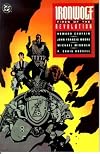
Another cynical space opera that ties in with his Twilight mini-series, Ironwolf is an aristocrat on an isolated planetary system who renounces his title to overthrow the ruling monarchy. On the eve of a hollow victory, he is betrayed and wakes up after a long convalescence to find that history has left him behind. With the help of a few outworlders looking for a stolen immortality drug, he sets out to seek revenge and justice and more equitable political system.
It's all wonderfully baroque show more with fantastically moody Mike Mignola art. show less
It's all wonderfully baroque show more with fantastically moody Mike Mignola art. show less

Access a version of the below that includes illustrations on my blog.
This is a Poison Ivy one-shot that reunites the same art team as the excellent "Poison Ivy: Year One" story included in Four of a Kind. Poison Ivy is not as good, mostly because there's just not very much Poison Ivy in it. Brian Apthorp and Stan Woch are at their best when drawing her, but they don't get a lot of opportunity to do so here, as she drops out through the middle of the story in favor of some Batman show more investigations into a perfume manufacturer.
Of course, it all turns out to be related, but one would expect a story subtitled "Poison Ivy" to be about her, not to merely include her. The "Year One" story they illustrated really played up the sexual tension between Ivy and Batman, but that's largely absent here, too: Ivy claims that Batman is in love with her, but it just comes across as a delusion on her part, as Batman never seems tempted by her. Apthorp and Woch's artwork is great, but John Francis Moore's script just doesn't give them much of interest to do.
Batman "Year One" Stories: « Previous in sequence | Next in sequence » show less
This is a Poison Ivy one-shot that reunites the same art team as the excellent "Poison Ivy: Year One" story included in Four of a Kind. Poison Ivy is not as good, mostly because there's just not very much Poison Ivy in it. Brian Apthorp and Stan Woch are at their best when drawing her, but they don't get a lot of opportunity to do so here, as she drops out through the middle of the story in favor of some Batman show more investigations into a perfume manufacturer.
Of course, it all turns out to be related, but one would expect a story subtitled "Poison Ivy" to be about her, not to merely include her. The "Year One" story they illustrated really played up the sexual tension between Ivy and Batman, but that's largely absent here, too: Ivy claims that Batman is in love with her, but it just comes across as a delusion on her part, as Batman never seems tempted by her. Apthorp and Woch's artwork is great, but John Francis Moore's script just doesn't give them much of interest to do.
Batman "Year One" Stories: « Previous in sequence | Next in sequence » show less
Lists
You May Also Like


Associated Authors
Statistics
- Works
- 209
- Also by
- 4
- Members
- 1,049
- Popularity
- #24,562
- Rating
- 3.3
- Reviews
- 10
- ISBNs
- 42
- Languages
- 5