
Christopher Benfey
Author of The Great Wave: Gilded Age Misfits, Japanese Eccentrics, and the Opening of Old Japan
About the Author
Christopher Benfey is Mellon Professor of English at Mount Holyoke College.
Works by Christopher Benfey
The Great Wave: Gilded Age Misfits, Japanese Eccentrics, and the Opening of Old Japan (2003) 242 copies, 5 reviews
A Summer of Hummingbirds: Love, Art, and Scandal in the Intersecting Worlds of Emily Dickinson, Mark Twain, Harriet Beecher Stowe, and Martin Johnson Heade (2008) 233 copies, 8 reviews
Red Brick, Black Mountain, White Clay: Reflections on Art, Family, and Survival (2012) 120 copies, 2 reviews
Degas in New Orleans: Encounters in the Creole World of Kate Chopin and George Washington Cable (1997) 88 copies, 2 reviews
Associated Works
Tagged
Common Knowledge
- Birthdate
- 1954
- Gender
- male
- Education
- The Putney School
Earlham College
Guilford College (BA)
Harvard University (PhD) - Occupations
- literary critic
English professor - Organizations
- Mount Holyoke College (Mellon Professor of English)
- Nationality
- USA
- Places of residence
- South Hadley, Massachusetts, USA
- Associated Place (for map)
- Massachusetts, USA
Members
Reviews
The great wave : gilded age misfits, Japanese eccentrics, and the opening of old Japan by Christopher Benfey
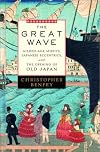
Initially, I was very excited to get into this book, as I want to specialize in Meiji-era Japanese Art. Imagine my excitement at a book that for a change wasn’t written by some dreary professor from 50 years past! Alas, that excitement waned as quickly as the quality of the chapters after the first.
The first chapter is phenomenal because it introduces two people from key years of the two countries: a Japanese drifter found by American whale hunters and the famed Herman Melville himself show more that experienced the initial wave of Japanese-Western exchange after Commodore Perry’s… *ahem*, subtle introduction of American Imperialist strength to Japan. Both of these experiences were wonderfully interwoven to give the readers a taste of how the conservative Japanese populace came to see America and its Industrialism, as well as the search for morality Western cultures yearned for in time-secluded Japan. However, I was wary of this book from the start, since Western authors are quick to discount non-western perspectives. Lo and behold, my gut instinct came through yet again— it’s getting very good at determining pompous Western biases, unfortunately.
Aside from Okakura Kakuzo and Nakahama Manjiro (if you won’t read this book, please look these people up regardless!), Japanese people’s perspectives were shunted in favor of hoity rich celebrities of the late 19th century. Some, like Lafcardio Hearn, are rightfully included because they were a part of the Western-Japanese cultural exchange. Others, like Percival Lowell and Mabel Todd were included for the shock factor, I guess? Their interest in Japan was passive at best and Japan’s culture served as a means for their goals, not vice versa. It’s just so frustrating because in a cultural exchange like this, you want to hear both sides of the story, not just how the West used Japan in its superficial search for a deeper meaning in the Orient (super racist and condescending, just so you know). I wanted to learn more about how Japan adopted Western Industrialist standards in addition to their culture and while I know some of this information from my own education, I wanted to learn more about it!
The climate of Meiji era Japan is as such, condensed for simplicity: Japan experienced heavy mood whiplashes towards the West during the Meiji period (Addendum: I am speaking from and Art Historical perspective right now). In the beginning (c.1860s), the imperial state tried to absorb as much Western educational and industrial standards as it could to catch up to the imperial powers, since it had, honestly, a great change of being colonized and cut up like its great influence, China. Then, from about 1880s and 90s, an antipathy wave towards the West surged due to overwhelming nationalism experienced by the people and encouraged by the government. Suddenly, professors imported from the West and their art forms were pushed to the side as Japan promoted their own culture in extreme nationalist tones. This movement was spurred by Japan’s desires to become a great Eastern imperial power, and was equally as propagandistic as it was a response to the superiority complex emanating from the Western Imperial powers.
If this political and cultural intrigue doesn’t pique your interest, I don’t know what will!
But hey, if you’re looking for a book about the 19th century at a passing glance, I won’t bar you from reading this book. However, if you want to learn both sides of the story in this extremely interesting time period, I would suggest skipping it. Hopefully, if I find a book with the same subject material that is better, I’ll update this review! show less
The first chapter is phenomenal because it introduces two people from key years of the two countries: a Japanese drifter found by American whale hunters and the famed Herman Melville himself show more that experienced the initial wave of Japanese-Western exchange after Commodore Perry’s… *ahem*, subtle introduction of American Imperialist strength to Japan. Both of these experiences were wonderfully interwoven to give the readers a taste of how the conservative Japanese populace came to see America and its Industrialism, as well as the search for morality Western cultures yearned for in time-secluded Japan. However, I was wary of this book from the start, since Western authors are quick to discount non-western perspectives. Lo and behold, my gut instinct came through yet again— it’s getting very good at determining pompous Western biases, unfortunately.
Aside from Okakura Kakuzo and Nakahama Manjiro (if you won’t read this book, please look these people up regardless!), Japanese people’s perspectives were shunted in favor of hoity rich celebrities of the late 19th century. Some, like Lafcardio Hearn, are rightfully included because they were a part of the Western-Japanese cultural exchange. Others, like Percival Lowell and Mabel Todd were included for the shock factor, I guess? Their interest in Japan was passive at best and Japan’s culture served as a means for their goals, not vice versa. It’s just so frustrating because in a cultural exchange like this, you want to hear both sides of the story, not just how the West used Japan in its superficial search for a deeper meaning in the Orient (super racist and condescending, just so you know). I wanted to learn more about how Japan adopted Western Industrialist standards in addition to their culture and while I know some of this information from my own education, I wanted to learn more about it!
The climate of Meiji era Japan is as such, condensed for simplicity: Japan experienced heavy mood whiplashes towards the West during the Meiji period (Addendum: I am speaking from and Art Historical perspective right now). In the beginning (c.1860s), the imperial state tried to absorb as much Western educational and industrial standards as it could to catch up to the imperial powers, since it had, honestly, a great change of being colonized and cut up like its great influence, China. Then, from about 1880s and 90s, an antipathy wave towards the West surged due to overwhelming nationalism experienced by the people and encouraged by the government. Suddenly, professors imported from the West and their art forms were pushed to the side as Japan promoted their own culture in extreme nationalist tones. This movement was spurred by Japan’s desires to become a great Eastern imperial power, and was equally as propagandistic as it was a response to the superiority complex emanating from the Western Imperial powers.
If this political and cultural intrigue doesn’t pique your interest, I don’t know what will!
But hey, if you’re looking for a book about the 19th century at a passing glance, I won’t bar you from reading this book. However, if you want to learn both sides of the story in this extremely interesting time period, I would suggest skipping it. Hopefully, if I find a book with the same subject material that is better, I’ll update this review! show less

Fascinating story of how the lives of so many important people in American literature, art, and history entwined, like vines, and how many of them shared an interest in hummingbirds.
More people are part of the story than just the four in the title; all of their families figured into the history, and not a few other celebrities. Twain does not figure as heavily as the rest, especially the Beechers and the Dickinsons; Heade was unknown to me. Mabel Loomis Todd and her husband David, as well show more as Victoria Woodhull, also figure in the affairs (literally) of the main subjects. Lord Byron and his wife are off-stage actors, but still important.
Art, passion, love, adultery, romance, poetry and everything else.
The only complaint I have is not unique to this writer: skipping around among so many people at different times, and in different places, became very confusing, especially when an episode involving some of them was described before an earlier episode involving someone else.
A timeline of important dates would have been very helpful. Also,for someone not a close student or aficionado of the period, the places the author mentions need to be located on a map.
There are some black & white illustrations taken from the works of some of the subjects. No illustrator is credited that I could see.
A good companion to "American Bloomsbury" by Susan Cheever, chronicling the lives of the Emersons, Hawthornes, Alcotts, Thoreau, and others. show less
More people are part of the story than just the four in the title; all of their families figured into the history, and not a few other celebrities. Twain does not figure as heavily as the rest, especially the Beechers and the Dickinsons; Heade was unknown to me. Mabel Loomis Todd and her husband David, as well show more as Victoria Woodhull, also figure in the affairs (literally) of the main subjects. Lord Byron and his wife are off-stage actors, but still important.
Art, passion, love, adultery, romance, poetry and everything else.
The only complaint I have is not unique to this writer: skipping around among so many people at different times, and in different places, became very confusing, especially when an episode involving some of them was described before an earlier episode involving someone else.
A timeline of important dates would have been very helpful. Also,for someone not a close student or aficionado of the period, the places the author mentions need to be located on a map.
There are some black & white illustrations taken from the works of some of the subjects. No illustrator is credited that I could see.
A good companion to "American Bloomsbury" by Susan Cheever, chronicling the lives of the Emersons, Hawthornes, Alcotts, Thoreau, and others. show less
Red Brick, Black Mountain, White Clay: Reflections on Art, Family, and Survival by Christopher Benfey
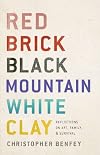
Review published @ http://epkwrsmith.blogspot.com on April 3, 2012
Benfey traces his family history through the artifacts, places, people, and stories that mean home. With his mother's Quaker beginnings and his father's German Jewish heritage, his parents, grandparents, aunts and uncles as well as great grandparents, aunts and uncles were shaped by the events leading up to, during and after WWII, his mother's family within work/internment camps of sorts for conscientious objectors and his show more father's family as victim's of Hitler's stripping even German citizens of their livelihoods because of their Jewish ancestry, all of their lives converging, moving in and out of Black Mountain from all around the world.
What I Liked
the family stories - Benfey covers his family history with artform (brick, clay, textiles, fairy tales, Greek mythology, art, pottery, poetry, collages, jewelry, literature) rather than a more expected timeline
The central setting is Black Mountain North Carolina and no matter how far away family members are or travel from Black Mountain, specifically Black Mountain College, the connection always comes full circle. Some started out there; others found their way there; and even Benfey himself returns there within a chapter aptly entitled "The Meander," the title alluding to Benfey's own shifting, zig-zagging journey, as well as those of his family members in comparison to the beloved art pattern of Benfey's great aunt and uncle.
Japan, Germany, Mexico, U.S. England, China, Russia, and Poland are just a few of the places touched by Benfey's family members and their art.
At times I was reminded of the early colonial free thinkers and their connections to one another...Walden, Thoreau, Colerige and Alcott...Benfey paints a picture of another community of intellectuals making sense of the world around them through their art in its many forms.
the appreciation of the art and a conscious resistance to defining or otherwise pigeon-holing it...an openness to interpretation but at the same time not a free for all creation or emotional, "what it means to me" response.
the search for the elusive white clay of the Cherokee nation...how the Englishman Wedgewood sought out the secrets of Chinese porcelain and early colonist potters began to throw stoneware...and the inevitable consequences for the Cherokee themselves.
Even though Benfey's book is a wealth of information, it never feels that way. I never felt bogged down, and there was enough narrative intertwined with facts to keep the flow moving swiftly and smoothly. The language is impeccable and was a joy to read.
What I Didn't Like
I honestly can't think of a thing.
Recommendations
This book is a perfect selection for those who love non-fiction, art in its many forms, family stories, early American as well as early history of marginalized groups forced to leave their homes and/or those who love reading about history without political agenda. If Benfey has one, I never noticed. show less
Benfey traces his family history through the artifacts, places, people, and stories that mean home. With his mother's Quaker beginnings and his father's German Jewish heritage, his parents, grandparents, aunts and uncles as well as great grandparents, aunts and uncles were shaped by the events leading up to, during and after WWII, his mother's family within work/internment camps of sorts for conscientious objectors and his show more father's family as victim's of Hitler's stripping even German citizens of their livelihoods because of their Jewish ancestry, all of their lives converging, moving in and out of Black Mountain from all around the world.
What I Liked
the family stories - Benfey covers his family history with artform (brick, clay, textiles, fairy tales, Greek mythology, art, pottery, poetry, collages, jewelry, literature) rather than a more expected timeline
The central setting is Black Mountain North Carolina and no matter how far away family members are or travel from Black Mountain, specifically Black Mountain College, the connection always comes full circle. Some started out there; others found their way there; and even Benfey himself returns there within a chapter aptly entitled "The Meander," the title alluding to Benfey's own shifting, zig-zagging journey, as well as those of his family members in comparison to the beloved art pattern of Benfey's great aunt and uncle.
Japan, Germany, Mexico, U.S. England, China, Russia, and Poland are just a few of the places touched by Benfey's family members and their art.
At times I was reminded of the early colonial free thinkers and their connections to one another...Walden, Thoreau, Colerige and Alcott...Benfey paints a picture of another community of intellectuals making sense of the world around them through their art in its many forms.
the appreciation of the art and a conscious resistance to defining or otherwise pigeon-holing it...an openness to interpretation but at the same time not a free for all creation or emotional, "what it means to me" response.
the search for the elusive white clay of the Cherokee nation...how the Englishman Wedgewood sought out the secrets of Chinese porcelain and early colonist potters began to throw stoneware...and the inevitable consequences for the Cherokee themselves.
Even though Benfey's book is a wealth of information, it never feels that way. I never felt bogged down, and there was enough narrative intertwined with facts to keep the flow moving swiftly and smoothly. The language is impeccable and was a joy to read.
What I Didn't Like
I honestly can't think of a thing.
Recommendations
This book is a perfect selection for those who love non-fiction, art in its many forms, family stories, early American as well as early history of marginalized groups forced to leave their homes and/or those who love reading about history without political agenda. If Benfey has one, I never noticed. show less
A Summer of Hummingbirds: Love, Art, and Scandal in the Intersecting Worlds of Emily Dickinson, Mark Twain, Harriet Beecher Stowe, and Martin Johnson Heade by Christopher Benfey
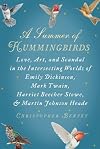
More like 3 1/2 stars. Interesting account of the connections among leading literary lights in the nineteenth-century US, but I think the hummingbird connection was a stretch.
Lists
Awards


You May Also Like


Associated Authors
Statistics
- Works
- 15
- Also by
- 3
- Members
- 866
- Popularity
- #29,560
- Rating
- 3.8
- Reviews
- 20
- ISBNs
- 33
- Languages
- 1
