
Robert K. Elder
Author of Last Words of the Executed
About the Author
Robert K. Elder's books include The Film That Changed My Life, Last Words of the Executed, and, as editor, John Woo: Interviews. He is an editor at the Chicago Sun-Times and his work has appeared in the New York Times, Los Angeles Times, Chicago Tribune, Salon, and many other publications. He lives show more in Chicago. show less
Works by Robert K. Elder
The Best Film You've Never Seen: 35 Directors Champion the Forgotten or Critically Savaged Movies They Love (2013) 37 copies
Walt Disney's Mickey and Donald: "For Whom the Doorbell Tolls" and Other Tales Inspired by Hemingway (2023) 9 copies
Christmas with Elvis: The Official Guide to the Holidays from the King of Rock ’n’ Roll (2021) 8 copies
Read Your Partner Like a Book: Everything You Should Know...But Never Thought to Ask: A Book of Questions for Couples (2019) 1 copy
Hemingway in Comics 1 copy
Associated Works
Tagged
Common Knowledge
- Birthdate
- 1976-01-20
- Gender
- male
- Education
- University of Oregon
- Occupations
- journalist
non-fiction author
columnist - Nationality
- USA
- Birthplace
- Montana, USA
- Places of residence
- Chicago, Illinois, USA
- Associated Place (for map)
- USA
Members
Reviews
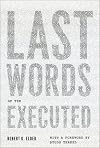
An unusual idea for a book, I suppose (yes, it literally is what the title says it is), but somehow it works, and it's more moving than you might expect. Some of the condemned use their last words to say mundane things (stuff like "Go Raiders" -- hoo boy, I'm sure posterity thanks you for that), but many of them speak eloquently as they face death, usually with more equanimity than you or I might have. Of course, as the author concedes, the transcriptions of the oral statements frequently show more aren't entirely accurate, because they're taken down by a prison official who's not only writing them in longhand, but who's probably feeling rather anxious for obvious reasons.
Although the book isn't openly an anti-capital punishment polemic, the subtext is pretty hard to miss, especially when the author talks about the often-gruesome nature of the executions, or when he notes the prisoners who were executed even though they were likely innocent. show less
Although the book isn't openly an anti-capital punishment polemic, the subtext is pretty hard to miss, especially when the author talks about the often-gruesome nature of the executions, or when he notes the prisoners who were executed even though they were likely innocent. show less
A collection like this ought to carry some kind of weight of repetition, but it needs uniformity for that, and there isn't enough of it here. Of course historical versus modern last words are going to be differently recorded and reported; that's inevitable. But some of these are "last" last words ("Are you sure you're doing that right?") and some of them are written statements; some of them are clearly more accurate than others; and of course they've all been selected out of a much larger show more pool, but there's no indication on the part of the editor how they were selected. Without that level of consistency from which to compare, this book can't be anything other than the morbid collection the author claims to want to avoid. show less
Downloaded as a free book from University of Chicago Press. I wasn't sure if I was going to find this interesting, but it sucked me in. The main character in John Green's book [book:Looking for Alaska|99561] was obsessed by last words, and since I'd read that the other day I suppose I was primed to find this one interesting.
And it is, in a morbid kind of way. Elder tries to keep a journalistic distance from the issue of whether state-inflicted murder is reasonable, but the horror of the show more whole process comes through loud and clear. For me, the biggest argument against capital punishment is the chance it gives to people to ramble on at length and inflict their last thoughts upon the rest of us: the quality of last words in recent decades was distinctly dodgy. Just lock them up and spare us, for goodness' sake. show less
And it is, in a morbid kind of way. Elder tries to keep a journalistic distance from the issue of whether state-inflicted murder is reasonable, but the horror of the show more whole process comes through loud and clear. For me, the biggest argument against capital punishment is the chance it gives to people to ramble on at length and inflict their last thoughts upon the rest of us: the quality of last words in recent decades was distinctly dodgy. Just lock them up and spare us, for goodness' sake. show less
To me the last thoughts and comments of people who know they are about to die is a profoundly interesting topic. What would I say? What would I consider so important that I would want to spend my last moments on earth discussing it? How would I want to be remembered?
The reality of this book is significantly more mundane than I anticipated. Around 3/4 of the hundreds of entries are Christian platitudes, professions of innocence (even in the face of unshakeable evidence), and apologies to show more families of victims. That said, there are also many insightful and even moving moments that give you plenty of pause before moving on to the next condemned. They range from philosophical to political to sarcastic and witty. Three of the most thought-provoking:
The reality of this book is significantly more mundane than I anticipated. Around 3/4 of the hundreds of entries are Christian platitudes, professions of innocence (even in the face of unshakeable evidence), and apologies to show more families of victims. That said, there are also many insightful and even moving moments that give you plenty of pause before moving on to the next condemned. They range from philosophical to political to sarcastic and witty. Three of the most thought-provoking:
I am against this horrible form of murder by the state, but I would rather be standing here for the crime that, so help me God, I never remember committing, than to be sitting down there eagerly waiting to see a man die. Let the state of Illinois take shame upon itself. Goodbye." Edward Brislane, 2/11/1921show less
"I have something to say, but not at this time." Grover Cleveland Redding, 6/24/1921
"You all brought me here to be executed, not to make a speech. That's it." Charles Livingston, 11/21/1997
Awards


You May Also Like


Associated Authors
Statistics
- Works
- 14
- Also by
- 2
- Members
- 218
- Popularity
- #102,473
- Rating
- 3.5
- Reviews
- 7
- ISBNs
- 23