
E. M. Delafield (1890–1943)
Author of Diary of a Provincial Lady
About the Author
Disambiguation Notice:
Please note the following distinctions, and try to keep the single-story separate from the omnibus editions which contain several "Provincial Lady" stories.
Single Story:
The Diary of a Provincial Lady (Virago, 1844085228)
Diary of a Provincial Lady (Prion, 1853753688)
The Diary of a Provincial Lady (Remploy, 0706610342)
Diary of a Provincial Lady (Chicago, 0897330536)
Omnibus Edition (contains 4 stories):
The Diary of a Provincial Lady (Virago, 0860685225)
The Provincial Lady (Macmillan, pre-ISBN)
Series
Works by E. M. Delafield
Sophy Mason Comes Back 2 copies
The Tortoise [short story] — Author — 1 copy
Reflex Action [short story] — Author — 1 copy
Holiday Group [short story] — Author — 1 copy
The Waiting Lady [short story] — Author — 1 copy
And Never the Twain Shall Meet [short story] — Author — 1 copy
Terminus [short story] 1 copy
Reparation [short story] — Author — 1 copy
The Threshold of Eternity [short work] — Author — 1 copy
The Glass Wall: A Play 1 copy
Incidental [short story] — Author — 1 copy
The Bond of Union [short story] — Author — 1 copy
As Others Hear us 1 copy
The Luggage in the Hall: An Un-moral Story [short story] — Author — 1 copy
Opportunity [short work] — Author — 1 copy
O Tempora! O Mores! [short story] — Author — 1 copy
The Girl Who Told the Truth [short story] — Author — 1 copy
Time and Tide 1 copy
The Provincial Lady: The Diary of a Provincial Lady & The Provincial Lady Goes Further, abridged (1951) 1 copy
Hukutav naine 1 copy
Love Has No Resurrection [short story] — Author — 1 copy
O.K. for Story [short work] — Author — 1 copy
It's All Too Difficult [short story] — Author — 1 copy
Bluff [short work] 1 copy
Victims [short work] 1 copy
The Other Poor Chap [short work] — Author — 1 copy
The Reason [short work] — Author — 1 copy
The Indispensable Woman [short work] — Author — 1 copy
Gwen [short story] 1 copy
The Philistine [short story] — Author — 1 copy
My Son Had Nothing on His Mind [short work] — Author — 1 copy
They Don't Wear Labels [short work] — Author — 1 copy
Associated Works
The Assassin's Cloak: An Anthology of the World's Greatest Diarists (2000) — Contributor, some editions — 624 copies, 9 reviews
Charlotte Mary Yonge: The Story of an Uneventful Life (1943) — Introduction, some editions — 13 copies
Missing From Their Homes — Contributor — 1 copy
Tagged
Common Knowledge
- Canonical name
- Delafield, E. M.
- Legal name
- Dashwood, Edmee Elizabeth Monica
- Other names
- de la Pasture, Edmee Elizabeth Monica (birth name)
- Birthdate
- 1890-06-09
- Date of death
- 1943-12-02
- Gender
- female
- Occupations
- novelist
short story writer
book reviewer - Organizations
- Voluntary Aid Detachment
Time and Tide
Women's Institute - Relationships
- de la Pasture, Elizabeth Lydia Rosabelle (mother)
Dashwood, R. M. (daughter)
Clifford, Hugh (stepfather) - Short biography
- E.M. Delafield was the pen name of Edmee Elizabeth Monica Dashwood, née de la Pasture, born in Steyning, Sussex, England, the daughter of well-known novelist Elizabeth Bonham and her husband Count Henry Philip Ducarel de la Pasture. Delafield was educated by French governesses and attended several boarding schools, followed by nine months as a postulant nun in a convent in Belgium. She worked with the Voluntary Aid Detachment (VAD) during World War I, and these experiences formed the basis of her first novel, Zella Sees Herself, published in 1917. She continued to publish one or two novels every year until her death. She is best known for the bestselling series The Diary of a Provincial Lady and its sequels. She also was an important contributor of book reviews, sketches, and short stories to Time and Tide magazine. In 1919, she married Colonel Arthur Paul Dashwood, an engineer, and they spent two years living in the Malay States before returning to live in an old house in Kentisbeare, Devonshire. The couple had two children, and Delafield served as president of the Kentisbeare Women's Institute for the the rest of her life. Her daughter Rosamund Dashwood published Provincial Daughter, a continuation of Delafield's popular series of books, in 1961.
- Nationality
- England
UK - Birthplace
- Steyning, Sussex, England, UK
- Places of residence
- Kentisbeare, Devon, England, UK
Malay States
Llandogo, Monmouthshire, Wales, UK - Place of death
- England, UK
- Burial location
- Kentisbeare churchyard, Devon, England, UK
- Map Location
- England, UK
- Disambiguation notice
- Please note the following distinctions, and try to keep the single-story separate from the omnibus editions which contain several "Provincial Lady" stories.
Single Story:
The Diary of a Provincial Lady (Virago, 1844085228)
Diary of a Provincial Lady (Prion, 1853753688)
The Diary of a Provincial Lady (Remploy, 0706610342)
Diary of a Provincial Lady (Chicago, 0897330536)
Omnibus Edition (contains 4 stories):
The Diary of a Provincial Lady (Virago, 0860685225)
The Provincial Lady (Macmillan, pre-ISBN)
Members
Discussions
British Author Challenge November 2024: E.M. Delafield & T.H. White in 75 Books Challenge for 2024 (November 2024)
Reviews
The Provincial Lady Series: Diary of a Provincial Lady, The Provincial Lady Goes Further, The Provincial Lady in America & The Provincial Lady in Wartime by E. M. Delafield
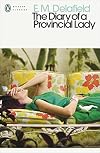
This collection of four of E. M. Delafield's Provincial Lady books in one edition was an absolute delight. If you've not heard of this writer or these books before, completely ignore the cover of this edition as it is entirely inappropriate and of the wrong era.
Written in diary form in often truncated sentences, the first book in this series was written in 1930, and although containing fictional characters the books borrow much from Delafield's own life.
This woman was, in short, an absolute show more riot. Despite the setting being close on 100 years ago, the Provincial Lady's daily concerns feel almost modern, which is no doubt down to the razor-sharp wit throughout which feels ahead of its time compared to much writing of that era. She is the Caitlin Moran or Helen Fielding of her era, a writer whose very essence exudes from her protagonist with endless witticisms, self-deprecation and withering commentary on those that cross her path.
In the first book, The Diary of a Provincial Lady, our narrator documents with dry humour her daily struggles as a woman of relatively high social standing running a household. We're never told what her husband Robert's occupation is, but they move in upper middle class circles and have a small staff to manage the domestic chores in the household. The cook is fairly useless but formidable, and our Provincial Lady spends much of her time failing to work up the courage to address her about areas that need improvement, which reminded me of friends who work full time in demanding jobs yet are scared to confront their cleaner when they do a lousy job. Our protagonist has a busy mind, and although she accepts that household management is her responsibility it's not something she enjoys or wishes to prioritise when she can help it. She sends story offerings to her favourite publication Time and Tide, but at this stage this feels like a hobby also indulged in by many of her friends and acquaintances. She enjoys trips up to London and wishes to spend more of her time there, the country life being a little too dull, but despite governesses for her youngest child, boarding school for her oldest and a small household staff, money is always tight. Despite this, her spending is only occasionally curtailed, and she regularly gets indignant over the increasingly short patience of the bank over the state of her overdraft.
I am sure that every woman will acknowledge that choosing and creating one's own rich, elegant, and costly clothes is an extremely efficient cure for any worries about money.
In the second book, The Provincial Lady Goes Further, our narrator is shocked to have earned a book deal from her Time and Tide writing which considerably changes the financial circumstances of the family (echoing how Delafield found her way to publishing). Now a woman of independent means, she delights in spontaneously buying a flat up in London to support her need to spend regular time there for her work, when in reality the writing of the second book she's received an advance for is continually pushed to the end of her to do list as she's much too busy enjoying herself. Our protagonist has little ego or airs about her, and her regular disappointment in her appearance surely strikes a chord with so many modern females reading this book, despite the passage of time.
January 22nd - Robert startles me at breakfast by asking if my cold, which he has hitherto ignored - is better. I reply that it has gone. Then why, he asks, do I look like that? Feel that life is wholly unendurable, and decide madly to get a new hat.
In the third novel, The Provincial Lady goes on a promotional tour of America for her book and delights us with her mixed emotions on being away from her family for two months whilst having a whale of a time. Every telegram she receives she's convinced brings news of her children dying in some tragic accident, which of course never happens yet taps into the preposterous ideas that many of us mothers get into our heads when we have to leave our children for any considerable length of time. She attends the Chicago World Fair, delights that the English custom for tea seems to translate to cocktails in America, and insists on a trip to the Alcott house, which is her publisher's only concession on a whirlwind tour full of engagements. Despite her somewhat new rise to the fame, everyday worries continue to keep her feet planted firmly on the ground.
Write postcards, to Rose, the children, and Robert, and after some thought send one to Cook, although entirely uncertain as to whether this will gratify her or not. Am surprised, and rather disturbed, to find that wording of Cook's postcard takes more thought than that on all the others put together.
In the final book, The Provincial Lady in Wartime, our Provincial Lady chronicles her life up in London during the initial stage of WWII, dubbed the Phoney War. During this time she, along with all her friends and acquaintances, is keen to 'do her bit', yet there's so little happening she can't get anyone to take any interest in using her skills on a voluntary basis. It's an interesting (and of course amusing) account of a period I've not read about previously in WWII accounts, this desperation to call oneself to action and feeling the social and personal disappointment of not having any role of importance to undertake, and also waiting for the action to start which never seems to come. She eventually gets a position in 'the underworld' canteen beneath the Adelphi Theatre, where volunteers for the ambulance corps, etc. are occasionally training but more often than not hanging around waiting for something to happen.
I absolutely loved this series (which absolutely didn't need such a long review, but once I got started I couldn't stop myself). She's a funny and quirky writer, and it was an absolutely delight from start to finish. If you've enjoyed reads such as Mrs Bridge I can definitely recommend this.
Diary of a Provincial Lady - 4.5 stars
The Provincial Lady Goes Further - 4.5 stars
The Provincial Lady in America - 4.5 stars
The Provincial Lady in Wartime - 4 stars (the tightening of belts and loss of socialising during this early war period made this last book a little less entertaining). show less
Written in diary form in often truncated sentences, the first book in this series was written in 1930, and although containing fictional characters the books borrow much from Delafield's own life.
This woman was, in short, an absolute show more riot. Despite the setting being close on 100 years ago, the Provincial Lady's daily concerns feel almost modern, which is no doubt down to the razor-sharp wit throughout which feels ahead of its time compared to much writing of that era. She is the Caitlin Moran or Helen Fielding of her era, a writer whose very essence exudes from her protagonist with endless witticisms, self-deprecation and withering commentary on those that cross her path.
In the first book, The Diary of a Provincial Lady, our narrator documents with dry humour her daily struggles as a woman of relatively high social standing running a household. We're never told what her husband Robert's occupation is, but they move in upper middle class circles and have a small staff to manage the domestic chores in the household. The cook is fairly useless but formidable, and our Provincial Lady spends much of her time failing to work up the courage to address her about areas that need improvement, which reminded me of friends who work full time in demanding jobs yet are scared to confront their cleaner when they do a lousy job. Our protagonist has a busy mind, and although she accepts that household management is her responsibility it's not something she enjoys or wishes to prioritise when she can help it. She sends story offerings to her favourite publication Time and Tide, but at this stage this feels like a hobby also indulged in by many of her friends and acquaintances. She enjoys trips up to London and wishes to spend more of her time there, the country life being a little too dull, but despite governesses for her youngest child, boarding school for her oldest and a small household staff, money is always tight. Despite this, her spending is only occasionally curtailed, and she regularly gets indignant over the increasingly short patience of the bank over the state of her overdraft.
I am sure that every woman will acknowledge that choosing and creating one's own rich, elegant, and costly clothes is an extremely efficient cure for any worries about money.
In the second book, The Provincial Lady Goes Further, our narrator is shocked to have earned a book deal from her Time and Tide writing which considerably changes the financial circumstances of the family (echoing how Delafield found her way to publishing). Now a woman of independent means, she delights in spontaneously buying a flat up in London to support her need to spend regular time there for her work, when in reality the writing of the second book she's received an advance for is continually pushed to the end of her to do list as she's much too busy enjoying herself. Our protagonist has little ego or airs about her, and her regular disappointment in her appearance surely strikes a chord with so many modern females reading this book, despite the passage of time.
January 22nd - Robert startles me at breakfast by asking if my cold, which he has hitherto ignored - is better. I reply that it has gone. Then why, he asks, do I look like that? Feel that life is wholly unendurable, and decide madly to get a new hat.
In the third novel, The Provincial Lady goes on a promotional tour of America for her book and delights us with her mixed emotions on being away from her family for two months whilst having a whale of a time. Every telegram she receives she's convinced brings news of her children dying in some tragic accident, which of course never happens yet taps into the preposterous ideas that many of us mothers get into our heads when we have to leave our children for any considerable length of time. She attends the Chicago World Fair, delights that the English custom for tea seems to translate to cocktails in America, and insists on a trip to the Alcott house, which is her publisher's only concession on a whirlwind tour full of engagements. Despite her somewhat new rise to the fame, everyday worries continue to keep her feet planted firmly on the ground.
Write postcards, to Rose, the children, and Robert, and after some thought send one to Cook, although entirely uncertain as to whether this will gratify her or not. Am surprised, and rather disturbed, to find that wording of Cook's postcard takes more thought than that on all the others put together.
In the final book, The Provincial Lady in Wartime, our Provincial Lady chronicles her life up in London during the initial stage of WWII, dubbed the Phoney War. During this time she, along with all her friends and acquaintances, is keen to 'do her bit', yet there's so little happening she can't get anyone to take any interest in using her skills on a voluntary basis. It's an interesting (and of course amusing) account of a period I've not read about previously in WWII accounts, this desperation to call oneself to action and feeling the social and personal disappointment of not having any role of importance to undertake, and also waiting for the action to start which never seems to come. She eventually gets a position in 'the underworld' canteen beneath the Adelphi Theatre, where volunteers for the ambulance corps, etc. are occasionally training but more often than not hanging around waiting for something to happen.
I absolutely loved this series (which absolutely didn't need such a long review, but once I got started I couldn't stop myself). She's a funny and quirky writer, and it was an absolutely delight from start to finish. If you've enjoyed reads such as Mrs Bridge I can definitely recommend this.
Diary of a Provincial Lady - 4.5 stars
The Provincial Lady Goes Further - 4.5 stars
The Provincial Lady in America - 4.5 stars
The Provincial Lady in Wartime - 4 stars (the tightening of belts and loss of socialising during this early war period made this last book a little less entertaining). show less

She could never, looking backwards, remember a time when she had not known that a woman’s failure or success in life depended entirely on whether or not she succeeded in getting a husband.
In the opening scenes of Thank Heaven Fasting, Monica is getting ready to come out in society, under the watchful eye of her controlling mother, Imogen. Her ability to quickly land a husband is assumed and expected, and Monica quietly looks down upon long-time friends who have not been so lucky. And show more initially, things look promising for Monica: she has all the right accoutrements, and men queuing up to fill her dance card, but E.M. Delafield had something different in mind
Delafield is best known for The Diary of a Provincial Lady, a witty satire of 1930s life in the English provinces. I approached Thank Heaven Fasting expecting a similar tone, and was initially amused by Imogen’s attempts to provide all the best accoutrements for her daughter, and coach her in proper behavior. I was somewhat concerned I would have to read about balls, gowns, and young men for 200+ pages, but the novel became more poignant as Delafield showed how very few options women had at this point in history. The final sentence hammered that point home, while leaving me wondering what was next for Monica. show less
In the opening scenes of Thank Heaven Fasting, Monica is getting ready to come out in society, under the watchful eye of her controlling mother, Imogen. Her ability to quickly land a husband is assumed and expected, and Monica quietly looks down upon long-time friends who have not been so lucky. And show more initially, things look promising for Monica: she has all the right accoutrements, and men queuing up to fill her dance card, but E.M. Delafield had something different in mind
Delafield is best known for The Diary of a Provincial Lady, a witty satire of 1930s life in the English provinces. I approached Thank Heaven Fasting expecting a similar tone, and was initially amused by Imogen’s attempts to provide all the best accoutrements for her daughter, and coach her in proper behavior. I was somewhat concerned I would have to read about balls, gowns, and young men for 200+ pages, but the novel became more poignant as Delafield showed how very few options women had at this point in history. The final sentence hammered that point home, while leaving me wondering what was next for Monica. show less
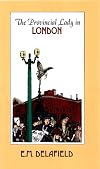
E.M. Delafield (pen name of Elizabeth Dashwood) does not get the credit she is due. And I include myself in this criticism. It wasn’t until this sequel to
Diary of a Provincial Lady that I realized it. So many women writers — ranging from D.E. Stevenson (in her Mrs Tim Of The Regiment and its sequels) to Erma Bombeck to Jean Kerr to Jen Mann and many, many, many more — owe Delafield a debt of gratitude for introducing the humorous mother slyly chronicling her daily life. Why, every show more other blog on the Internet is a variation of that theme!
In this second book, Delafield’s narrator gets bamboozled into taking a flat in London (ergo, the alternative title of The Provincial Lady in London), and hilarity ensues. Lady B. remains as insufferable as ever; friends Rose, Emma and Felicity also return, and the children remain as incorrigible as ever. In short, I loved every single word! Highly recommended.
Oh, and I nearly forgot! I did not commend Arthur Watts’ prescient drawings (original to the novel) in the first book, but I will here. They’re a wonderful addition. show less
Diary of a Provincial Lady that I realized it. So many women writers — ranging from D.E. Stevenson (in her Mrs Tim Of The Regiment and its sequels) to Erma Bombeck to Jean Kerr to Jen Mann and many, many, many more — owe Delafield a debt of gratitude for introducing the humorous mother slyly chronicling her daily life. Why, every show more other blog on the Internet is a variation of that theme!
In this second book, Delafield’s narrator gets bamboozled into taking a flat in London (ergo, the alternative title of The Provincial Lady in London), and hilarity ensues. Lady B. remains as insufferable as ever; friends Rose, Emma and Felicity also return, and the children remain as incorrigible as ever. In short, I loved every single word! Highly recommended.
Oh, and I nearly forgot! I did not commend Arthur Watts’ prescient drawings (original to the novel) in the first book, but I will here. They’re a wonderful addition. show less

"I am writing my Diary. Robert replies kindly but quite definitely that In his opinion That is a Waste of Time"
By sally tarbox on 5 Nov. 2013
Format: Paperback
Wonderful little 1930 work, cataloguing the minutiae of the narrator's life in a highly humorous and pithy manner.
From Our Vicar's wife and her lengthy visits
("she says...she won't keep me a minute. Tells me long story about the Vicar having a stye on one eye. I retaliate with Cook's sore throat. This leads to draughts, the heating show more apparatus in church, and news of Lady Boxe in South of France...She goes but turns back at the door to tell me about wool next the skin, nasal douching and hot milk last thing at night.")
to the narrator's taciturn husband, her children, problems with unruly servants, and constant irritations with patronising neighbour Lady B: even our Lady's final attempt at one-upmanship by announcing a forthcoming trip to France is spoilt by Lady B leaning out of her Bentley to offer to find out about quite inexpensive pensions.
Although this is set in a world vastly different from our own, every reader will recognise the people who make up this society.
The Virago edition, which I have, also contains 3 sequels, following our heroine to London, to America and lastly through the war.(which I've not yet read - I think one book at a time is probably sufficient.)
Light, but highly enjoyable and observant writing. show less
By sally tarbox on 5 Nov. 2013
Format: Paperback
Wonderful little 1930 work, cataloguing the minutiae of the narrator's life in a highly humorous and pithy manner.
From Our Vicar's wife and her lengthy visits
("she says...she won't keep me a minute. Tells me long story about the Vicar having a stye on one eye. I retaliate with Cook's sore throat. This leads to draughts, the heating show more apparatus in church, and news of Lady Boxe in South of France...She goes but turns back at the door to tell me about wool next the skin, nasal douching and hot milk last thing at night.")
to the narrator's taciturn husband, her children, problems with unruly servants, and constant irritations with patronising neighbour Lady B: even our Lady's final attempt at one-upmanship by announcing a forthcoming trip to France is spoilt by Lady B leaning out of her Bentley to offer to find out about quite inexpensive pensions.
Although this is set in a world vastly different from our own, every reader will recognise the people who make up this society.
The Virago edition, which I have, also contains 3 sequels, following our heroine to London, to America and lastly through the war.(which I've not yet read - I think one book at a time is probably sufficient.)
Light, but highly enjoyable and observant writing. show less
Lists
1910s (1)
Read This Next (1)
1930s (1)
Awards


You May Also Like


Associated Authors
Statistics
- Works
- 98
- Also by
- 17
- Members
- 4,012
- Popularity
- #6,287
- Rating
- 4.0
- Reviews
- 129
- ISBNs
- 193
- Languages
- 7
- Favorited
- 35
