

John A. Nagl
Author of Learning to Eat Soup with a Knife: Counterinsurgency Lessons from Malaya and Vietnam
About the Author
John A. Nagl is a U.S. Army Major currently stationed at Fort Riley, Kansas. He holds a M.Phil. and a D.Phil. in international relations from Oxford University.
Image credit: Defense Dept. photo by Gerry J. Gilmore
(defenselink.mil)
Works by John A. Nagl
Learning to Eat Soup with a Knife: Counterinsurgency Lessons from Malaya and Vietnam (2002) 490 copies, 9 reviews
Tagged
Common Knowledge
- Birthdate
- 1966
- Gender
- male
- Education
- University of Oxford (St. Antony's College, D.Phil. International Relations)
- Organizations
- US Army
Center for New American Security
The Haverford School - Nationality
- USA
- Associated Place (for map)
- USA
Members
Reviews
Learning to Eat Soup with a Knife: Counterinsurgency Lessons from Malaya and Vietnam by John A. Nagl
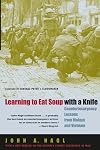
This book was recommended to me by a friend who also happens to be ex-SF and who has extensive combat and training experience. I thank him for the suggestion. I think this is the sort of book whose value depends in part on where you’re at going into it. While women like me were barred from the honor of serving, especially in combat arms, when I was young enough for my service to matter, I have had the privilege of studying the lessons of unconventional and guerrilla warfare extensively show more since the mid 1990s. Back then, while pursuing a doctorate in an unrelated subject, I had academic access to a great deal of excellent but neglected scholarship coming from the Army historical service and other places, much of which taught many of the general lessons of this book. And I’ve continued that study over the decades since. The author is certainly not wrong to point up the ongoing arrogance and amnesia one finds so often in Big Green and the highest levels of the United States government. I do think he is a bit off base in praising the “learning culture” of British armed forces as highly as he seems to, under emphasizing important differences between the Malayan Emergency and what became the Vietnam War. More importantly I think the 19 years of American combat involvement since this book was first published demonstrates a more fundamental truth about fighting insurgencies - no matter the level of tactical excellence achieved, you have to offer something the indigenous personnel want and believe will succeed and that they invest in, and do it early before your chances are lost forever (if you even have a chance). Tactical excellence is not a substitute for a viable strategic vision. Furthermore I have come to believe that some insurgencies are fundamentally literally incapable of being defeated by Western powers. We can change regimes, certainly. But the experiences of Afghanistan and Iraq certainly drive the limits of regime change, and the unpleasant sequelae, home with an exclamation point.
One finds in this book an earnest ongoing optimism that maybe next time the United States can study harder and learn more and then it’ll win these kinds of wars. While learning is imperative and this book underscores several methods of doing so, I think the fundamental optimism about winning-with-homework is misplaced in certain conflicts.
So I think this is a good book, very much worth reading as part of inquiries into COIN and military learning theory at the operational level. It might seem like a revolutionary book depending on where you are coming from in your studies. For me it simply is a good book, not a great or revolutionary one. show less
One finds in this book an earnest ongoing optimism that maybe next time the United States can study harder and learn more and then it’ll win these kinds of wars. While learning is imperative and this book underscores several methods of doing so, I think the fundamental optimism about winning-with-homework is misplaced in certain conflicts.
So I think this is a good book, very much worth reading as part of inquiries into COIN and military learning theory at the operational level. It might seem like a revolutionary book depending on where you are coming from in your studies. For me it simply is a good book, not a great or revolutionary one. show less
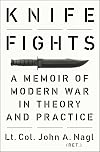
If you've been following the War on Terror, you probably know Nagl; Author of the influential Learning to Eat Soup with a Knife, one of the COINdinista who along with General Petraeus wrote the Army's first Counter-Insurgency field manual. Nagl is a classic soldier-scholar, seeing combat first in Desert Storm and then in post-2003 occupation of Iraq, and also a Rhodes scholar with a Masters and PhD from Oxford. As such Nagl's 'knife fights' aren't really about battle. They're about trying to show more shift the Pentagon over to counter-insurgency, working from within the Army as a speechwriter and training officer, and outside as founder and President of the Center for a New American Security. This is potentially a very interesting theme, but while Nagl has some fascinating things to say about his collaborators and obstacles, the quest to get the army on track in Iraq is obscured rather than clarified. Rumsfeld is the clear villain (he would not let the military use the word 'insurgency'). Petraeus is the clear hero for implementing COIN principles, but the day to day is rather vague. Compared to Adams' incredible "War of Numbers", there is relatively little about the decision-making and learning of the military.
It's interesting to see who Nagl thinks is toast and who's coming back, by the people he calls out and praises. Rumsfeld is obviously gone. Joe Biden is irrelevant. Petraeus will be coming back. Hillary has potential, or at least is someone you don't want to cross. One reviewer on Amazon said that this is Nagl's 2016 positioning book, and while that's uncharitable, it's not entirely unfair. Though Nagl is currently a school principle in Philadelphia (and claims to have a commitment for several more years due to his son), he has credibility as a Washington power-player with CNAS, and may be back for round two.
That is in some ways worrying, because this more than a memoir about taking the theory of counter-insurgency and applying it to practice. This is Nagl's chance to develop the strategy of COIN, particularly applying the events of the Arab Spring, and he doesn't do so with any particular insight. COIN principles require a major investment, 1 soldier per 50 locals, to build local security and institutions. COIN implies multi-year, multi-billion dollar investments. Meanwhile, the New World Disorder is expanding; in Syria, in the Ukraine, in West Africa. Caution about putting American soldiers on the ground is warranted, but for all Nagl's principles, there's little about building a capability for Military Operations Other than War into the Department of Defense. More tellingly, small strokes at the start of a conflict may be cheaper and more efficient than nation-building at the end (would ISIS have arisen if the Free Syrian Army had toppled Assad with American advisers in 2012?). The New World Disorder spreads quickly and unpredictably--how can the American Empire contain it, while still working within Constitutional limits? Not saying that Nagl should be perfectly predictive, but there's a particular dark irony to publishing a book that says "Iraq was the midterm, Afghanistan is the final" as Iraq War Round 3 erupts.
There are also some areas where tighter editing would helped. Nagl repeats himself more than once. He's a smart man, and evidently a nice one, he might be one of the few field grade officers with a sense of humor, but this book doesn't quite make it. Consider this a four star book that got dropped to three stars, either because Nagl isn't willing to tell us where to go next, or because he (more worryingly, for a strategic thinker) doesn't know. show less
It's interesting to see who Nagl thinks is toast and who's coming back, by the people he calls out and praises. Rumsfeld is obviously gone. Joe Biden is irrelevant. Petraeus will be coming back. Hillary has potential, or at least is someone you don't want to cross. One reviewer on Amazon said that this is Nagl's 2016 positioning book, and while that's uncharitable, it's not entirely unfair. Though Nagl is currently a school principle in Philadelphia (and claims to have a commitment for several more years due to his son), he has credibility as a Washington power-player with CNAS, and may be back for round two.
That is in some ways worrying, because this more than a memoir about taking the theory of counter-insurgency and applying it to practice. This is Nagl's chance to develop the strategy of COIN, particularly applying the events of the Arab Spring, and he doesn't do so with any particular insight. COIN principles require a major investment, 1 soldier per 50 locals, to build local security and institutions. COIN implies multi-year, multi-billion dollar investments. Meanwhile, the New World Disorder is expanding; in Syria, in the Ukraine, in West Africa. Caution about putting American soldiers on the ground is warranted, but for all Nagl's principles, there's little about building a capability for Military Operations Other than War into the Department of Defense. More tellingly, small strokes at the start of a conflict may be cheaper and more efficient than nation-building at the end (would ISIS have arisen if the Free Syrian Army had toppled Assad with American advisers in 2012?). The New World Disorder spreads quickly and unpredictably--how can the American Empire contain it, while still working within Constitutional limits? Not saying that Nagl should be perfectly predictive, but there's a particular dark irony to publishing a book that says "Iraq was the midterm, Afghanistan is the final" as Iraq War Round 3 erupts.
There are also some areas where tighter editing would helped. Nagl repeats himself more than once. He's a smart man, and evidently a nice one, he might be one of the few field grade officers with a sense of humor, but this book doesn't quite make it. Consider this a four star book that got dropped to three stars, either because Nagl isn't willing to tell us where to go next, or because he (more worryingly, for a strategic thinker) doesn't know. show less
There’s a bit of fluctuation between refreshing candor and “hey, I was wrong” vs some humble brags, but in all I enjoyed this book. It’s part memoir, part theory, part self justification. There’s some genuine wit and humor here, and overall I’d call it a worthy read and an interesting book end to “Learning to Eat Soup with a Knife.” As with all books written before our ignominious defeat in Afghanistan, it’ll break your heart a bit when he discusses possible outcomes and show more his hopes for those. show less
Learning to Eat Soup with a Knife: Counterinsurgency Lessons from Malaya and Vietnam by John A. Nagl
Really good, just like the new COIN field manual, and probably ultimately just as dangerously misleading.
Lists
You May Also Like


Statistics
- Works
- 3
- Members
- 568
- Popularity
- #44,050
- Rating
- 3.6
- Reviews
- 12
- ISBNs
- 16