

John R. Tunis (1889–1975)
Author of The Kid from Tomkinsville
About the Author
Series
Works by John R. Tunis
The Brooklyn Dodgers Series, Three Volumes in One: The Kid from Tomkinsville, Keystone Kids, and World Series (2013) 5 copies, 1 review
Rookie of the Year 3 copies
Keystone Kids 2 copies
The other side of the fence 1 copy
Silence Over Dunkerque C878 1 copy
A Measure of Independence 1 copy
Go, Team, Go! 1 copy
Associated Works
Tagged
Common Knowledge
- Canonical name
- Tunis, John R.
- Legal name
- Tunis, John Roberts
- Birthdate
- 1889-12-07
- Date of death
- 1975-02-04
- Gender
- male
- Education
- Harvard University
Boston University (Law School) - Nationality
- USA
- Birthplace
- Boston, Massachusetts, USA
- Place of death
- Essex, Connecticut, USA
- Associated Place (for map)
- USA
Members
Reviews

This was a re-read of a beloved baseball book I first read when I was in junior high. This book is YA material, but the writing is very good, indeed and I'm really happy I revisited The Kid. The book opens as Roy Tucker is leaving small-town Tomkinsville, Connecticut, to head off to baseball try-outs with the Dodgers. The book speeds us through two up and down seasons with the Bums from Brooklyn (in fact, the speed of events in the major leagues, the rise and fall and even disappearance of show more players, the changes brought about by sudden fame or sudden injury, is one of the book's main themes). Other than one or two characters, there's not much characterization here, but we see Tucker's transformation from a raw, scared farm boy to a more savvy, if still young, player over the course of the novel.
The book was written in 1940, so The Kid gives us an interesting peak into life and baseball 70(!) years ago. But the human emotions of fear, courage and determination have not changed and are very well portrayed, here. Disappointment, set-backs and injustices dog the characters. This book is not just a baseball lesson, but a life lesson. In fact, Philip Roth, in his long passage on The Kid from Tomkinsville in his novel, American Pastoral, refers to the work as "the boy's Book of Job." And yet the book is full of joy, as well.
Some of the language, especially the dialogue, will seem dated, and we are talking about a segregated major leagues, here (in fact, the only two mentions of African Americans are cringe-inducing), but that is one of the pitfalls of visiting other time periods. You see their warts, even, or especially, if they weren't perceived as such at the time. And there is some very interesting "inside baseball" intelligence provided, as well.
If you love baseball and have a desire to visit a bygone era, give this book a visit. You'll get a reminder of why this is one of the most beloved baseball books ever.
fyi, here is Roth's passage about The Kid from American Pastoral (you'll need to scroll down a bit or search on the page for "Tucker"). It is fascinating, but be warned that it contains a spoiler or two: http://www.randomhouse.com/catalog/displ... show less
The book was written in 1940, so The Kid gives us an interesting peak into life and baseball 70(!) years ago. But the human emotions of fear, courage and determination have not changed and are very well portrayed, here. Disappointment, set-backs and injustices dog the characters. This book is not just a baseball lesson, but a life lesson. In fact, Philip Roth, in his long passage on The Kid from Tomkinsville in his novel, American Pastoral, refers to the work as "the boy's Book of Job." And yet the book is full of joy, as well.
Some of the language, especially the dialogue, will seem dated, and we are talking about a segregated major leagues, here (in fact, the only two mentions of African Americans are cringe-inducing), but that is one of the pitfalls of visiting other time periods. You see their warts, even, or especially, if they weren't perceived as such at the time. And there is some very interesting "inside baseball" intelligence provided, as well.
If you love baseball and have a desire to visit a bygone era, give this book a visit. You'll get a reminder of why this is one of the most beloved baseball books ever.
fyi, here is Roth's passage about The Kid from American Pastoral (you'll need to scroll down a bit or search on the page for "Tucker"). It is fascinating, but be warned that it contains a spoiler or two: http://www.randomhouse.com/catalog/displ... show less
The Brooklyn Dodgers Series, Three Volumes in One The Kid from Tomkinsville, Keystone Kids, and World Series by John R. Tunis
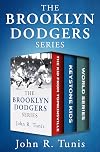
Can't help but wonder why they didn't get the novels in sequence. Beware: World Series picks up where The Kid from Tomkinsville ends. Keystone Kids follows. (Then four more novels, that aren't in this volume.)
My youthful reaction to these novels remains valid: Tunis just doesn't do it for me. That said, the premise of Keystone Kids makes it worth reading, though some of the character development seems pretty forced, as does Spike Russell's promotion to the manager position. About half of the show more novel is about people coming to terms with their prejudices. show less
My youthful reaction to these novels remains valid: Tunis just doesn't do it for me. That said, the premise of Keystone Kids makes it worth reading, though some of the character development seems pretty forced, as does Spike Russell's promotion to the manager position. About half of the show more novel is about people coming to terms with their prejudices. show less

This is the third and, as far as I know, final installment of this classis YA trilogy about Roy Tucker, ballplayer on the Brooklyn Dodgers of the 1940s. The first book, [The Kid from Tompkinsville], shows us Tucker's growth from a wet behind the ears youngster from a Connecticut farming town to a major leaguer. There are many of hard knocks along the way for young Roy, lots of adversity to overcome. Along the way, there's lot of exciting baseall described, as well. The second book, [World show more Series], takes Tucker and the Dodgers through an exciting fall classic.
The Kid Comes Back may well be the darkest of the three books. The first two were written in 1941, with WWII still a cloud looming on the horizon for America. This third book was written in 1946, and where the Kid comes back from is several years of hazardous and harrowing combat duty, some of which is described quite excitingly in the first third of the book. The next third of the book is the Kid trying to overcome a painful war injury. Finally we get Roy back on the field, where the problems of the ballplayers returning from the war that's interrupted their careers is explored somewhat. But now, also, we get back to baseball, and the tumult of a difficult multi-team pennant race.
These are, as I said, YA books. None of the characters, including Tucker, are drawn very deeply. The books, in addition to being exciting action/baseball stories, generally follow the theme of the value of hard work, to sticking to your goal despite any adversity a cruel universe might throw your way, and to remaining loyal to your friends and teammates.
As a set, they are a period piece, no doubt. I read them first when I was in the sixth grade or so, with WWII, and world portrayed in these books, while certainly part of the past, still seemed very much alive. WWII veterans, my parents' generation and, not coincidentally, the people who clearly remembered the Brooklyn Dodgers, were still very much an active force in the nation's daily consciousness.
Reading them now again as an adult, I frequently found myself wondering, "I wonder what I made of this scene as a kid? I wonder what I thought about that one?" Anyway, I don't want to make too much of all this. Essentially, it was lots of fun rereading these three books 45 or so years after my first reading. The writing is mannered, geared to a younger audience, and not all of the dialogue and colloquialisms ring true. Also, Tunis certainly takes the color line in baseball for granted, even dropping in a wince-inducing comments about "coloreds" once or twice per book. Nevertheless, I would recommend these three books, and certainly the first one, for anyone who loves baseball and baseball history, and who is also young at heart. show less
The Kid Comes Back may well be the darkest of the three books. The first two were written in 1941, with WWII still a cloud looming on the horizon for America. This third book was written in 1946, and where the Kid comes back from is several years of hazardous and harrowing combat duty, some of which is described quite excitingly in the first third of the book. The next third of the book is the Kid trying to overcome a painful war injury. Finally we get Roy back on the field, where the problems of the ballplayers returning from the war that's interrupted their careers is explored somewhat. But now, also, we get back to baseball, and the tumult of a difficult multi-team pennant race.
These are, as I said, YA books. None of the characters, including Tucker, are drawn very deeply. The books, in addition to being exciting action/baseball stories, generally follow the theme of the value of hard work, to sticking to your goal despite any adversity a cruel universe might throw your way, and to remaining loyal to your friends and teammates.
As a set, they are a period piece, no doubt. I read them first when I was in the sixth grade or so, with WWII, and world portrayed in these books, while certainly part of the past, still seemed very much alive. WWII veterans, my parents' generation and, not coincidentally, the people who clearly remembered the Brooklyn Dodgers, were still very much an active force in the nation's daily consciousness.
Reading them now again as an adult, I frequently found myself wondering, "I wonder what I made of this scene as a kid? I wonder what I thought about that one?" Anyway, I don't want to make too much of all this. Essentially, it was lots of fun rereading these three books 45 or so years after my first reading. The writing is mannered, geared to a younger audience, and not all of the dialogue and colloquialisms ring true. Also, Tunis certainly takes the color line in baseball for granted, even dropping in a wince-inducing comments about "coloreds" once or twice per book. Nevertheless, I would recommend these three books, and certainly the first one, for anyone who loves baseball and baseball history, and who is also young at heart. show less

A very exciting story about the Dunkirk evacuation and its aftermath. Laudably, it even has a female protagonist, a young Frenchwoman whose courage makes possible the escape of two British infantrymen trapped in occupied France. She insists that it's what any "Scout" would do. I don't want to quibble about the author's research, or perhaps it was an editor's blatant error, nor do I know anything about Guiding and Scouting in France, but when Sergeant Williams recalls his own daughter wearing show more her "Scout uniform", that cannot be attributed to Gisele's difficulty with English. No. Queen Elizabeth and Princess Margaret were Guides, and the British organization has been called Girl Guides since its formal inception. It made me wonder if the rest of the book was any more accurate and factual. It seemed authentic, but I don't know. show less
Lists
Awards


You May Also Like


Associated Authors
Statistics
- Works
- 36
- Also by
- 1
- Members
- 1,475
- Popularity
- #17,414
- Rating
- 3.9
- Reviews
- 10
- ISBNs
- 103
- Favorited
- 2