
Robert E. Lerner
Author of The Heresy of the Free Spirit in the Later Middle Ages
About the Author
Robert E. Lerner is Peter B. Ritzma Professor in the Humanities at Northwestern University. He is the author of books including The Age of Adversity, The Heresy of the Free Spirit, and the Feast of Saint Abraham and coauthor of Western Civilizations.
Works by Robert E. Lerner
Associated Works
Western Civilizations: Their History and Their Culture (1941) — some editions — 337 copies, 1 review
Political Ritual and Practice in Capetian France: Essays in Honour of Elizabeth A. R. Brown (Cultural Encounters in Late Antiquity and the Middle ... in Late Antiquity and the… (2021) — Contributor — 2 copies
Medievalia Et Humanistica: Studies in Medieval and Renaissance Culture, New Series No.12 (1984) — Contributor — 2 copies
Tagged
Common Knowledge
- Canonical name
- Lerner, Robert E.
- Birthdate
- 1940-02-08
- Gender
- male
- Education
- Princeton University (MA|1962|Ph.D|1964)
University of Chicago (BA|1960) - Occupations
- professor
historian
medievalist - Organizations
- Northwestern University
Western Reserve University - Awards and honors
- Medieval Academy of America (Fellow, 1990)
- Nationality
- USA
- Birthplace
- New York, New York, USA
- Places of residence
- Evanston, Illinois, USA
- Associated Place (for map)
- USA
Members
Reviews

Ernst Kantorowicz was one of the most influential medieval historians of the twentieth century, and one whose life more than merited a biography of his own: a bisexual dandy born into a wealthy Jewish family, a veteran of the First World War who began his academic career as part of a reactionary, homoerotic group of romantic nationalists, wrote a best-selling biography of the Emperor Frederick which became a cultural lodestone for Nazis during the 1930s, fled to the U.S. just before the show more outbreak of the Second World War, and became a professor at Berkeley where he hosted boozy, erudite dinners and was one of the lead activists to push back against the anti-Communist loyalty oaths of the 1950s.
Robert Lerner was well-placed to write this biography—himself a well-known medievalist, he draws on personal conversations and correspondence with many people who knew Kantorowicz personally. I find it hard to imagine this biography ever being surpassed. Yet despite the depth of Lerner's research, Kantorowicz himself remains an elusive subject, a bundle of contradictions (generous, witty, and determined to live life to the full, he was also a thorough-going misogynist and a snob) whose ideological shifts are difficult to track or categorise. Still, I finished the book rather thinking that that is how Kantorowicz himself would have wished it. show less
Robert Lerner was well-placed to write this biography—himself a well-known medievalist, he draws on personal conversations and correspondence with many people who knew Kantorowicz personally. I find it hard to imagine this biography ever being surpassed. Yet despite the depth of Lerner's research, Kantorowicz himself remains an elusive subject, a bundle of contradictions (generous, witty, and determined to live life to the full, he was also a thorough-going misogynist and a snob) whose ideological shifts are difficult to track or categorise. Still, I finished the book rather thinking that that is how Kantorowicz himself would have wished it. show less
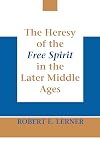
THE HERESEY OF THE FREE SPIRIT IN THE LATER MIDDLE AGES
The Heresy of the Free Spirit in the Later Middle Ages has been widely recognized as the standard work on the subject in any language. Robert E. Lerner examines this fourteenth-century European heresy as it appeared in its own age. He concludes that the Free-Spirit movement was not a tightly organized sect of anarchistic deviants, but rather a spectrum of belief that emphasized voluntary poverty and quietist mysticism.
The Heresy of the Free Spirit in the Later Middle Ages has been widely recognized as the standard work on the subject in any language. Robert E. Lerner examines this fourteenth-century European heresy as it appeared in its own age. He concludes that the Free-Spirit movement was not a tightly organized sect of anarchistic deviants, but rather a spectrum of belief that emphasized voluntary poverty and quietist mysticism.
Apr 19, 2024Spanish
Lists
You May Also Like


Associated Authors
Statistics
- Works
- 10
- Also by
- 4
- Members
- 197
- Popularity
- #111,409
- Rating
- 3.6
- Reviews
- 2
- ISBNs
- 19
- Languages
- 3
- Favorited
- 1