
Stephen Halliday
Author of The Great Stink of London: Sir Joseph Bazalgette and the Cleansing of the Victorian Metropolis
About the Author
Stephen Halliday is a writer, lecturer and broadcaster with a particular interest in Victorian London and the engineering works that created the city we know today. He has written for The Observer, The Guardian and the Financial Times, and has made several radio and television programmes based on show more his popular books. He also writes and reviews regularly for BBC History, The Times Higher Education and the Daily Telegraph. show less
Works by Stephen Halliday
The Great Stink of London: Sir Joseph Bazalgette and the Cleansing of the Victorian Metropolis (1999) 166 copies, 4 reviews
Underground to Everywhere: London's Underground Railway in the Life of the Capital (2001) 95 copies, 1 review
An Underground Guide to Sewers: or: Down, Through and Out in Paris, London, New York, &c. (2019) 54 copies
From 221B Baker Street to the Old Curiosity Shop: A Guide to London’s Literary Landmarks (2013) 13 copies
Tagged
Common Knowledge
- Gender
- male
- Occupations
- lecturer
marketing manager - Organizations
- Gresham College
Buckinghamshire Chilterns University College
Buckingham Business School - Short biography
- Stephen Halliday is a writer, lecturer and broadcaster with an interest in English Social History with particular reference to the history of London, of Victorian England and of the engineers who made nineteenth century cities safe and habitable. He has written for The Observer, The Guardian and Financial Timesand has made several radio and television programmes based on his books. He also writes and reviews regularly for BBC History, The Independent, The Literary review, The Times Higher and History Today. He regularly lectures on his research subjects, as reflected in his books, in London and elsewhere.
- Nationality
- UK
- Associated Place (for map)
- UK
Members
Reviews
The Great Stink of London: Sir Joseph Bazalgette and the Cleansing of the Victorian Metropolis by Stephen Halliday
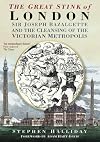
A biography of Sir Joseph Bazalgette, the engineer who designed and built the London sewer system. Fascinating, in a queasy sort of way. Given the obstacles involved, it's amazing that anything got done at all - much less an engineering work of such proportion.
Like everybody else, I got taught the story of John Snow and the "cholera pump" as a classic example of epidemiological detective work. Snow maps the distribution of cholera, it centers around a pump in Broad Street, the pump handle show more gets removed, cholera stops, it's waterborne, end of story. As The Great Stink of London clarifies, however, it wasn't - nobody important believed chlorea was waterborne. The prevailing wisdom was cholera was spread by "miasmas" - essentially, bad smells - and the miasmatics feel all over themselves demonstrating how Snow's map actually showed that that houses that smelled worst had the most cholera. Even after Koch found the cholera bacteria, there were people - notably, Florence Nightingale - who persisted in the miasmatic theory. Thus Bazalgette's work was not so much to make the Thames potable as to make it smell better.
Something that's absolutely incomprehensible to me is how Bazalgette and his engineers managed to convince the local politicians. Some of the larger London parishes had 1600 different elected or appointed bodies with public works responsibility. And none of them wanted to let somebody tear up their streets to put in sewers. How could anybody be patient and politically astute enough to deal with this? I would have been hurling myself across the conference table to bang heads against the wall after the first ten minutes. Makes me rethink some of my libertarian anti-big-government principles.
Another obstacle Bazalgette had to fight against was the persistent belief that sewage was valuable and should be collected and used, not treated and disposed of. Like many recycling schemes, the "valuable sewage" schemers simply looked at the expense of conventional fertilizer without taking into account collection, treatment and distribution costs for sewage-based manure.
A couple of (minor) complaints; I would have liked to have seen more discussion of the actual mechanics involved in building a Victorian sewer, and the cover illustration is just hideous. show less
Like everybody else, I got taught the story of John Snow and the "cholera pump" as a classic example of epidemiological detective work. Snow maps the distribution of cholera, it centers around a pump in Broad Street, the pump handle show more gets removed, cholera stops, it's waterborne, end of story. As The Great Stink of London clarifies, however, it wasn't - nobody important believed chlorea was waterborne. The prevailing wisdom was cholera was spread by "miasmas" - essentially, bad smells - and the miasmatics feel all over themselves demonstrating how Snow's map actually showed that that houses that smelled worst had the most cholera. Even after Koch found the cholera bacteria, there were people - notably, Florence Nightingale - who persisted in the miasmatic theory. Thus Bazalgette's work was not so much to make the Thames potable as to make it smell better.
Something that's absolutely incomprehensible to me is how Bazalgette and his engineers managed to convince the local politicians. Some of the larger London parishes had 1600 different elected or appointed bodies with public works responsibility. And none of them wanted to let somebody tear up their streets to put in sewers. How could anybody be patient and politically astute enough to deal with this? I would have been hurling myself across the conference table to bang heads against the wall after the first ten minutes. Makes me rethink some of my libertarian anti-big-government principles.
Another obstacle Bazalgette had to fight against was the persistent belief that sewage was valuable and should be collected and used, not treated and disposed of. Like many recycling schemes, the "valuable sewage" schemers simply looked at the expense of conventional fertilizer without taking into account collection, treatment and distribution costs for sewage-based manure.
A couple of (minor) complaints; I would have liked to have seen more discussion of the actual mechanics involved in building a Victorian sewer, and the cover illustration is just hideous. show less
The great stink of London : Sir Joseph Bazalgette and the cleansing of the Victorian metropolis by Stephen Halliday
A fascinating story and worthy tribute to Joseph Bazalgette, an under appreciated Victorian-era engineer responsible not only for designing and overseeing the construction of London's huge sanitary sewer system, but also the construction of Victoria, Chelsea and Albert Embankments, forever changing the face and character of central London. We take so much of our modern cities for granted, not realizing that entire rivers are flowing under the streets, blissfully unaware of the level of show more vision and commitment required to create an infrastructure that provides health and convenience. The writing style is breezy and lucid, although the author has a distracting habit of repetition. Certain factoids, such as "the embankments reclaimed 52 acres of land" are repeated over and over again, and several favorite quotes are repeated at least 3 times. show less
Underground to Everywhere: London's Underground Railway in the Life of the Capital by Stephen Halliday

The subtitle of Stephen Halliday’s book is deceptive, as it is less a social history of the London Underground than an overview of the development and management of the system. Amid copious illustrations, Halliday recounts its history from the development of the first lines in mid-Victorian Britain to the chronic challenges it faced at the end of the twentieth century. What emerges is a tale of ambitious schemes, extravagant promises, and a near-complete lack of coordination in its show more development. Originating as a series of private for-profit lines, the separate routes were consolidated into a single system by the mid-1930s.
Halliday presents the system’s development in a clear and straightforward manner, though one that feels too cursory for the intricacies involved. Much of the text is supplemented with information panels that address sub-topics and summarize particulars about the individual lines; these are useful but often repeat information from the main text. More beneficial are the numerous pictures, including several color plates. These demonstrate the visual heritage of the Underground, both in architecture and the many posters created over the decades designed to advertise its services. They help to make the book a useful source for anyone seeking to learn about the “Tube,” though one that offers only the most basic of introductions to the history of this enduring London institution. show less
Halliday presents the system’s development in a clear and straightforward manner, though one that feels too cursory for the intricacies involved. Much of the text is supplemented with information panels that address sub-topics and summarize particulars about the individual lines; these are useful but often repeat information from the main text. More beneficial are the numerous pictures, including several color plates. These demonstrate the visual heritage of the Underground, both in architecture and the many posters created over the decades designed to advertise its services. They help to make the book a useful source for anyone seeking to learn about the “Tube,” though one that offers only the most basic of introductions to the history of this enduring London institution. show less
The Great Stink of London: Sir Joseph Bazalgette and the Cleansing of the Victorian Metropolis by Stephen Halliday
I've always been fascinated by anything concerning the history of London, including the very workings of the infrastructure. I already knew Joseph Bazalgette's story and was amazed at the task he had before him. This book added to my knowledge by giving details such as what he was up against with local authorities and the typical "not in my backyard" camp. It may be too much information for some people's taste, but people who are fascinated by the things that most take for granted- this will show more give you a fix. show less
Lists
You May Also Like


Associated Authors
Statistics
- Works
- 24
- Members
- 612
- Popularity
- #41,085
- Rating
- 3.7
- Reviews
- 8
- ISBNs
- 50