

Thomas Heggen (1919–1949)
Author of Mister Roberts
About the Author
Disambiguation Notice:
Wikipedia lists Heggen's birth year as 1918, but the Library of Congress and the University of Minnesota (where he was a student and where his papers are held) list it as 1919.
Image credit: Courtesy of the NYPL Digital Gallery (image use requires permission from the New York Public Library)
Works by Thomas Heggen
Mister Roberts #2 1 copy
Mister Roberts #3 1 copy
Associated Works
Three Great Novels of World War II: Tales of the South Pacific by James A. Michener / Mister Roberts by Thomas Heggen / Battle Cry by Leon Uris (1985) 12 copies
The Tony winners: A collection of ten exceptional plays, winners of the Tony Award for the most distinguished play of the year (1977) — Contributor — 6 copies
50 Best Plays of the American Theatre, Volume 3 — Contributor — 1 copy
Tagged
Common Knowledge
- Legal name
- Heggen, Thomas Orlo
- Birthdate
- 1919-12-23
- Date of death
- 1949-05-19
- Gender
- male
- Education
- University of Minnesota
- Occupations
- novelist
- Organizations
- United States Navy
- Nationality
- USA
- Birthplace
- Fort Dodge, Iowa, USA
- Place of death
- New York, New York, USA
- Disambiguation notice
- Wikipedia lists Heggen's birth year as 1918, but the Library of Congress and the University of Minnesota (where he was a student and where his papers are held) list it as 1919.
- Associated Place (for map)
- USA
Members
Reviews
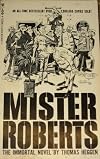
MISTER ROBERTS, by Thomas Heggen, is a book it felt strange to be reading in the year 2023. About the comedic escapades of the officers and crew aboard a Navy cargo ship in the Pacific in the waning days of WWII, it was first published in 1946 and was an immediate bestseller. Then Heggen helped write a stage adaptation that ran for several years on Broadway with Henry Fonda as the title character. And in 1955 it became an equally successful movie, again with Fonda in the starring role. I'm show more pretty sure I saw it at the Reed Theater (long-gone now) right here in my hometown, when I was about twelve. And probably again a time or two on TV. Because it all seems very familiar. And I can even picture Fonda, Jack Lemon (Ensign Pulver), and James Cagney (the Captain) from the movie. But I had never read the novel until now. The book has been in and out of print over the past 75 years, and is currently out there as a "classic Navy novel" from the Naval Institute Press. It is still a very funny story, except for the ending of course (which reminded me of that final TV episode OF M*A*S*H). What is not funny is now knowing that author Thomas Heggen took his own life in 1949, at age 29, at the height of the play's popularity, so he never saw the film version. About 40-some years ago I read a book called ROSS AND TOM, a dual bio of Ross Lockridge, whose lone success was the book/film RAINTREE COUNTY, and Tom Heggen. They were friends who both had enormous, unexpected success, and both were suicides. Go figure, huh?
I read the pb edition pictured here, a yellowing, tattered copy from 1966, found in a pile of old books in the house of a recently deceased neighbor. I'm glad I finally read the original print version. Still funny, but with some darkness in there too, especially in hindsight so many years later. Very highly recommended. (And RIP, Mister Heggen.)
- Tim Bazzett, author of the memoir, BOOKLOVER show less
I read the pb edition pictured here, a yellowing, tattered copy from 1966, found in a pile of old books in the house of a recently deceased neighbor. I'm glad I finally read the original print version. Still funny, but with some darkness in there too, especially in hindsight so many years later. Very highly recommended. (And RIP, Mister Heggen.)
- Tim Bazzett, author of the memoir, BOOKLOVER show less

A supposedly light-hearted look at a supply ship in the Pacific in the waning days of WWII that cleverly hides an anti-war message.
Mister Roberts is a young and idealistic man who quit medical school to get into the war. Unfortunately he finds himself in the backwaters and is desperate to get into the war. His requests for transfer, delivered monthly to Stupid, aka The Captain, get forwarded with a 'Not Recommended' referral and so Mister Roberts sits for 2 1/2 years.
The book is awash with show more deftly written characters. Small incidents are used to state universal truths. At one port of call it is discovered that the nurses' bathrooms are conveniently viewable with binoculars and telescopes. Two best friends have a blowup yet things are back to normal the next day. There are many batches of jungle juice brewed, medicinal alcohol is provided by Doc, and always the thoughts of home, women, and families are never far away.
In this case less is more. It could have been a 400 page book with more incidents and more characters, but at 221 pages it is just right. Everything of importance is covered, every joy and tragedy explained pithily, earnestly, without request for pity or sympathy. The men are no better and no worse than they should be. A marvelous book. show less
Mister Roberts is a young and idealistic man who quit medical school to get into the war. Unfortunately he finds himself in the backwaters and is desperate to get into the war. His requests for transfer, delivered monthly to Stupid, aka The Captain, get forwarded with a 'Not Recommended' referral and so Mister Roberts sits for 2 1/2 years.
The book is awash with show more deftly written characters. Small incidents are used to state universal truths. At one port of call it is discovered that the nurses' bathrooms are conveniently viewable with binoculars and telescopes. Two best friends have a blowup yet things are back to normal the next day. There are many batches of jungle juice brewed, medicinal alcohol is provided by Doc, and always the thoughts of home, women, and families are never far away.
In this case less is more. It could have been a 400 page book with more incidents and more characters, but at 221 pages it is just right. Everything of importance is covered, every joy and tragedy explained pithily, earnestly, without request for pity or sympathy. The men are no better and no worse than they should be. A marvelous book. show less

Probably all of us have seen the classic Mister Roberts play or movie. The book is better. It captures the mind-numbing tedium much better, and the humor is scorched with irony and paradoxical pain. The hero, Mr. Roberts, spends his time on board trying to leave the safety of his cargo transport's milk-runs, filing one transfer request after another, seeking the action of a war-ship.
The author, Thomas Heggens, was discovered drowned in his bathroom in 1949, an apparent suicide, despite, or show more perhaps because of, the huge financial success of the book and play.
The Reluctant was a cargo ship engaged to carry trucks and toothpaste on a regular run "from Tedium to Apathy and back; about five days each way. It makes an occasional trip to Monotony, and once it made a run all the way to Ennui, a distance of about two thousand miles from Tedium." It's staffed with wonderful characters. Ensign Keith, the Boston bluenose, believes the Navy commandments he learned in boot camp about officers being gentlemen, and he sing1ehandedly tries to remake the crew into something resembling a regulation Navy vessel- until the famous jungle juice incident. Lieutenant Roberts is a born leader, able to move easily among the enlisted men as well as the officers; competent, he wants nothing more than to get out of this phantom Navy and into the real war. He is hated by the captain for his ability. He is the instigator of many of the famous practical jokes played on the captain. The doctor is simultaneously a great medico and a loony quack, which would depend on the quantity of grain alcohol he had imbibed the night before. He might or might not prescribe aspirin for athlete's foot.
The book has several humorous moments: the discovery by one of the visiting nurses that she and her colleagues have been surreptitiously spied on by men on the Reluctant using the powerful range finder telescopes; the accidental firing of a live shell that nearly took the mast off a friendly ship after a party that somehow got a little out of hand; and the question whether throwing the captain's palm tree s over the side would result in their replacements being squared or doubled (figure that one out).
But war is overwhelmingly tragic and Roberts gets his wish. He is transferred to a destroyer. His former shipmates learn of his death during a Kamikaze attack just before the announcement of the end of the war. It wipes the smile right off your face. show less
The author, Thomas Heggens, was discovered drowned in his bathroom in 1949, an apparent suicide, despite, or show more perhaps because of, the huge financial success of the book and play.
The Reluctant was a cargo ship engaged to carry trucks and toothpaste on a regular run "from Tedium to Apathy and back; about five days each way. It makes an occasional trip to Monotony, and once it made a run all the way to Ennui, a distance of about two thousand miles from Tedium." It's staffed with wonderful characters. Ensign Keith, the Boston bluenose, believes the Navy commandments he learned in boot camp about officers being gentlemen, and he sing1ehandedly tries to remake the crew into something resembling a regulation Navy vessel- until the famous jungle juice incident. Lieutenant Roberts is a born leader, able to move easily among the enlisted men as well as the officers; competent, he wants nothing more than to get out of this phantom Navy and into the real war. He is hated by the captain for his ability. He is the instigator of many of the famous practical jokes played on the captain. The doctor is simultaneously a great medico and a loony quack, which would depend on the quantity of grain alcohol he had imbibed the night before. He might or might not prescribe aspirin for athlete's foot.
The book has several humorous moments: the discovery by one of the visiting nurses that she and her colleagues have been surreptitiously spied on by men on the Reluctant using the powerful range finder telescopes; the accidental firing of a live shell that nearly took the mast off a friendly ship after a party that somehow got a little out of hand; and the question whether throwing the captain's palm tree s over the side would result in their replacements being squared or doubled (figure that one out).
But war is overwhelmingly tragic and Roberts gets his wish. He is transferred to a destroyer. His former shipmates learn of his death during a Kamikaze attack just before the announcement of the end of the war. It wipes the smile right off your face. show less
If "The Caine Mutiny" was an expression of the reaction of under officers to military oppression, this is the bouncy expression. The novel was published in 1946, and was soon a Broadway play, and then a movie. It firmly moves the reader from one predictable affair to another but is a readable experience.
Lists
Awards


You May Also Like


Associated Authors
Statistics
- Works
- 6
- Also by
- 13
- Members
- 446
- Popularity
- #54,978
- Rating
- 3.6
- Reviews
- 11
- ISBNs
- 21