
A. Ya. Khinchin (1894–1959)
Author of Mathematical Foundations of Information Theory
About the Author
A. Y. Khinchin made significant contributions to probability theory, statistical physics, and several other fields. His elegant, groundbreaking work will prove of substantial interest to advanced undergraduates, graduate students, and professionals in the fields of statistics, probability, and show more operations research. Dover [2013] republication of the edition originally published by Charles Griffin Co., Ltd., London, and Hafner Publishing Company, New York, 1960. show less
Image credit: www.wikipedia.org
Works by A. Ya. Khinchin
Tagged
Common Knowledge
- Other names
- Chinčin, Aleksandr Ja
Хинчин, Александр Яковлевич - Birthdate
- 1894-07-19
- Date of death
- 1959-11-18
- Gender
- male
- Occupations
- mathematician
- Nationality
- Russia
- Associated Place (for map)
- Russia
Members
Reviews
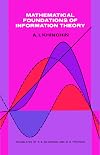
This book develops Information Theory slightly further than Claude Shannon did. Although Khinchin praises Shannon for going and producing the ideas of Information Theory by himself, he acknowledges that the cases presented by Shannon were rather limited in scope to simplify the solutions.
The book as a whole is divided into two major sections; the first is called The Entropy Concept in Probability Theory and the second is called On The Fundamental Theorems of Information Theory. Both of these show more were originally papers printed by academic journals in the Russian Language.
The book was interesting, but I did pick out another short one, this book was only 120 pages long. show less
The book as a whole is divided into two major sections; the first is called The Entropy Concept in Probability Theory and the second is called On The Fundamental Theorems of Information Theory. Both of these show more were originally papers printed by academic journals in the Russian Language.
The book was interesting, but I did pick out another short one, this book was only 120 pages long. show less
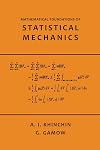
This book is quite challenging, but mostly because I don't know a lot about mathematics. If I knew more about grad and Lebesgue I suppose it would come out better. As I stand, I can't understand this book all that well, and I need to have a stepping stone for it. Sometimes being an autodidact is tough. No classes or anything really makes things complicated.
On the other hand, the book is written pretty well, it's mostly equations and text. Not a lot of pictures, it somewhat explains the units show more and symbols used, but I just don't have the background for it. Maybe if I revisit some Calculus and Linear Algebra and then come back to this book again. show less
On the other hand, the book is written pretty well, it's mostly equations and text. Not a lot of pictures, it somewhat explains the units show more and symbols used, but I just don't have the background for it. Maybe if I revisit some Calculus and Linear Algebra and then come back to this book again. show less
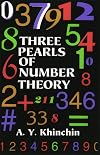
According to the opening preface of this book, Khinchin sent these Three Pearls of Number Theory to a former student recuperating during World War II. This is all the backstory that we are given for this. Khinchin claims that any schoolboy should be able to understand this stuff, but does admit that it is quite deep. It’s not that I don’t try to understand, but when I see the long lines of text that are supposed to denote numbers my attention wanders. It is rather shameful for me to say show more this. I guess a lack of structure really does have a bad part to it.
Anyway, this book was quite short; it measures a meager sixty-four pages in length. I would like to be able to understand what is going on with the proofs and all of that, so maybe I should revisit Velleman’s How To Prove It. show less
Anyway, this book was quite short; it measures a meager sixty-four pages in length. I would like to be able to understand what is going on with the proofs and all of that, so maybe I should revisit Velleman’s How To Prove It. show less
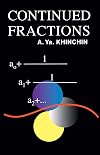
Very short but interesting. Does proofs and other things pertaining to Continued Fractions.
You May Also Like


Statistics
- Works
- 16
- Members
- 560
- Popularity
- #44,619
- Rating
- 3.7
- Reviews
- 7
- ISBNs
- 20
- Languages
- 1