
George Berkeley (1685–1753)
Author of Three Dialogues Between Hylas and Philonous
About the Author
Born and reared in Ireland, George Berkeley studied at Trinity College, Dublin, and then taught as a fellow there, eventually becoming Dean of Derry (1724) and Bishop of Cloyne (1734) in the Irish branch of the Anglican church. His primary philosophical interests included metaphysics and show more epistemology, the psychology of perception, philosophy of science, and natural theology. But he is best known for his defense of metaphysical idealism and denial of the existence of matter. Berkeley's best-known writings were produced relatively early in his life, between the ages of 24 and 28: They included Essay Towards a New Theory of Vision (1709), Treatise Concerning the Principles of Human Knowledge (1710), and Three Dialogues (1713). In 1728 Berkeley made a voyage to the United States in an unsuccessful attempt to found a college in Bermuda. He lived for two years at Newport, Rhode Island, and had a significant influence on American education, chiefly through his association with and donation of books to Yale University and his correspondence with Samuel Johnson, the first president of what is now Columbia University. (Bowker Author Biography) show less
Works by George Berkeley
Berkeley: Essays, principles, dialogues, with selections from other writings (1929) 83 copies, 1 review
Os Pensadores: Berkeley / Hume 12 copies
De Motu and the Analyst: A Modern Edition, with Introductions and Commentary (The New Synthese Historical Library) (1991) 11 copies
Saggio su una nuova teoria della visione-Trattato sui principi della conoscenza umana. Testo inglese a fronte (2004) 5 copies
Schriften über die Grundlagen der Mathematik und Physik (suhrkamp taschenbuch wissenschaft) (1985) 4 copies
Selected Writings 3 copies
Viaggio in Italia 3 copies
Essay, Principles, Dialogue 2 copies
A word to the wise: or, the Bishop of Cloyne's exhortation to the Roman Catholick clergy, of Ireland. The fourth edition. (2010) 2 copies
A Proposal for the Better Supplying of Churches in Our Foreign Plantations, and for Converting the Savage Americans to Christianity (2011) 2 copies
Manviya Gyan 2 copies
Сочинения 1 copy
Comentarios filosóficos. Introducción manuscrita a los Principios del conocimiento humano. Correspondencia con Johnson (1989) 1 copy
Œuvres choisies de Berkeley 1 copy
BERKLEY 1 copy
Associated Works
The Empiricists : Locke, An Essay Concerning Human Understanding (Abridged) ; Berkeley, Principles of Human Knowledge, and 3 Dialogues ; Hume, An Enquiry Concerning Human… (1961) — Contributor — 498 copies
English Philosophers of the Seventeenth and Eighteenth Centuries: Locke; Berkeley; Hume (2004) — Contributor — 235 copies, 2 reviews
Berkeley's Principles and Dialogues: Background Source Materials (Cambridge Philosophical Texts in Context) (2000) — Author — 17 copies
Tagged
Common Knowledge
- Canonical name
- Berkeley, George
- Birthdate
- 1685-03-12
- Date of death
- 1753-01-14
- Gender
- male
- Education
- Kilkenny College
Trinity College, Dublin - Occupations
- cleric
philosopher
academic - Organizations
- Church of England
Trinity College, Dublin - Nationality
- Ireland
UK - Birthplace
- Kilcrene, County Kilkenny, Ireland (Dysart Castle)
- Places of residence
- Dublin, Ireland
Newport, Rhode Island, USA
London, England, UK - Place of death
- Oxford, Oxfordshire, England, UK
- Burial location
- Christ Church Cathedral, Oxford, UK
Members
Reviews
Have you ever been to one of those parties where, at about 1.30 a.m., some want-to-be intellectual who, like yourself, has imbibed too frequently and slept too infrequently, insinuates himself next to you and asks, "If a tree falls in the forest, when nobody is there to hear; does it make a sound?"
I must have something about me that draws these pseudo philosophers into my orbit because it has happened sufficiently often for me to develop a means of dealing with the situation. I simply reply, show more "Yes." and move in the opposite direction as fast as my booze befuddled legs will take me. Not elegant, not witty, but effective.
Why do I bring this up now? Because, this book is the written version of how that stupid question develops, if one doesn't deal with the inquisitor promptly, and firmly.
It is pleasing to note that three hundred years ago some twonk could seriously propose, as an antidote to the flawed argument of Locke, that material objects do not exist. All that exists is our perception of them, given by God. What is less pleasing is the thought of another drunken know-it-all reworking the thesis at the next party that I attend: perhaps I'll take this book, sit him (why is it always a 'him'?) down in a corner and delight for the rest of the night/morning in wicked thoughts of what the next poor sap to be cornered by him will get.
You will notice that I gave this book one and a half stars; this was for the excellent introduction by G.J. Warnock: were I to possess the intelligence to have taken his excellent précis of the thoughts of Berkeley and Locke and deduced that all further effort would be waste, I might have at least doubled the star content of the review. So, who's the fool? show less
I must have something about me that draws these pseudo philosophers into my orbit because it has happened sufficiently often for me to develop a means of dealing with the situation. I simply reply, show more "Yes." and move in the opposite direction as fast as my booze befuddled legs will take me. Not elegant, not witty, but effective.
Why do I bring this up now? Because, this book is the written version of how that stupid question develops, if one doesn't deal with the inquisitor promptly, and firmly.
It is pleasing to note that three hundred years ago some twonk could seriously propose, as an antidote to the flawed argument of Locke, that material objects do not exist. All that exists is our perception of them, given by God. What is less pleasing is the thought of another drunken know-it-all reworking the thesis at the next party that I attend: perhaps I'll take this book, sit him (why is it always a 'him'?) down in a corner and delight for the rest of the night/morning in wicked thoughts of what the next poor sap to be cornered by him will get.
You will notice that I gave this book one and a half stars; this was for the excellent introduction by G.J. Warnock: were I to possess the intelligence to have taken his excellent précis of the thoughts of Berkeley and Locke and deduced that all further effort would be waste, I might have at least doubled the star content of the review. So, who's the fool? show less
Três diálogos muito bem escritos, em um embate divertido entre um imaterialista (idealista), defendendo a bizarra posição do autor (ser é ser percebido, tudo que existe, existe dentro de mentes), contra um curioso e incomodado materialista recalcitrante. Philonous emprega todas as variações da pentelhação "tudo é correlacionado", "tudo é para nós", "não há como pensar algo fora do pensamento, porque ao fazê-lo, estamos pensando o fora para nós, dentro do pensamento", enquanto show more mostra que um empirismo radical leva a negar a matéria, a existência exterior à mente, e afirmar Deus, a mente que a tudo percebe. (o que para os padrões atuais, soa, é claro, como "negar o pensamento científico") show less
Berkeley's alterations to justify the world's causes and effects by appealing to God is pitiful and contradicts his whole ontological argument. A couple of questions regarding his idea of transcendental being suffice to poke holes through his system and invalidate his whole philosophy: If God is truly transcends our senses, how could we possibly know that he perceives the world around us? How could a transcendental God even perceive anything despite the fact that it is flawless and show more ineffable? Berkeley's argument is extremely weak and unconvincing, it is no wonder that few have taken him seriously throughout the ages. show less
A Treatise Concerning the Principles of Human Knowledge (Dover Philosophical Classics) by George Berkeley
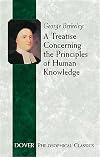
Out of Spinoza, Locke, Descartes, Hume and Berkeley, I certainly found Berkeley the most interesting; but, then, I am into Idealism, so it is to some degree understandable and indicates my bias really. Out of 17th-early 18th century philosophers, Berkeley intrigues me as much as Leibniz does. I might, if I were to expand philosophy to include quasi-mystical writers of the same era, include Swedenborg, Hutchinson, Boehme and Sterry.
Berkeley has often been misrepresented as being a show more philosopher that denied the existence of matter in the sense of real external objects. This is definitely not accurate. Some of his statements are ambiguous and can be wrenched from context and made to look like he supported the non-reality of the outside physical world, but, really, he denied the existence of matter in the philosophical sense of a substrate made up of abstracted accidents and qualities. Like other Idealists going back to Plato, Berkeley believed in a universal Spirit or Mind that necessitates that all reality is perceived and cannot exist apart from this perception. It is an interesting theory when one notes that quantum mechanics supports the notion that reality at the particle level does seem to presuppose an observer. It seems that there may be very current scientific support for Berkeley's supposition on some level.
It does seem that in the concluding remarks that Berkeley supports some kind of pantheism; at least, some of his statements appear to strongly support that reading. Pantheism I do not support, so I have some reservations about Berkeley's philosophy, but it is well worth studying at least. It is also interesting that Berkeley appears to have anticipated the pseudo-spiritual abstract philosophy of German Idealists like Hegel; of course, while anticipating it he was also against any such marriage of spirituality with abstract knowledge systems.
As it stands, Berkeley was a worth while read and I may revisit this work in the future. show less
Berkeley has often been misrepresented as being a show more philosopher that denied the existence of matter in the sense of real external objects. This is definitely not accurate. Some of his statements are ambiguous and can be wrenched from context and made to look like he supported the non-reality of the outside physical world, but, really, he denied the existence of matter in the philosophical sense of a substrate made up of abstracted accidents and qualities. Like other Idealists going back to Plato, Berkeley believed in a universal Spirit or Mind that necessitates that all reality is perceived and cannot exist apart from this perception. It is an interesting theory when one notes that quantum mechanics supports the notion that reality at the particle level does seem to presuppose an observer. It seems that there may be very current scientific support for Berkeley's supposition on some level.
It does seem that in the concluding remarks that Berkeley supports some kind of pantheism; at least, some of his statements appear to strongly support that reading. Pantheism I do not support, so I have some reservations about Berkeley's philosophy, but it is well worth studying at least. It is also interesting that Berkeley appears to have anticipated the pseudo-spiritual abstract philosophy of German Idealists like Hegel; of course, while anticipating it he was also against any such marriage of spirituality with abstract knowledge systems.
As it stands, Berkeley was a worth while read and I may revisit this work in the future. show less
Lists
Awards

You May Also Like
Associated Authors
Statistics
- Works
- 129
- Also by
- 17
- Members
- 3,578
- Popularity
- #7,083
- Rating
- 3.7
- Reviews
- 25
- ISBNs
- 318
- Languages
- 16
- Favorited
- 8