
Charles E. Gannon
Author of Fire with Fire
About the Author
Charles E. Gannon is associate professor of English at St. Bonaventure University
Image credit: Charles E. Gannon at Lunacon 2012
Series
Works by Charles E. Gannon
Rumors of War and Infernal Machines: Technomilitary Agenda-setting in American and British Speculative Fiction (2003) 11 copies, 1 review
Not For Ourselves Alone 2 copies
Endangerd Species 1 copy
Caine's Mutiny - eARC 1 copy
By the Book 1 copy
A Thing of Beauty 1 copy
The Power of Visions 1 copy
Associated Works
Tagged
Common Knowledge
- Birthdate
- 1960-03-17
- Gender
- male
- Nationality
- USA
- Birthplace
- Teaneck, New Jersey, USA
- Associated Place (for map)
- New Jersey, USA
Members
Reviews

1637: NO PEACE BEYOND THE LINE by Eric Flint & Charles E Gannon -- I am a great admirer of both authors, not merely for their success at crafting best-selling novels of politico-military SF, but for the gifted and generous men that they are. Both Eric Flint, of blessed memory, and, Dr. Charles E "Chuck" Gannon are menschen.
In this sequel to "1636: COMMANDER CANTRELL OF THE WEST INDIES" [2014], the 1632verse Caribbean storyline continues with the naval forces of the United States of Europe show more and their Dutch allies are reconstituting their strength following their disastrous losses at the Battle of Dunkirk and their loss of their Brazilian colonies. It is "uptime" 20th-century technology (observation balloons, military steamships, and advanced armaments) reconstructed in this alternate 17th-century by the displaced American Time refugees that prove decisive in their war with the longtime Spanish masters of the Caribbean Sea. Yet, Commander Eddie Cantrell and his allies learn the hard way, not to get cocky, since guile and intelligence -- not absent among their enemies--trumps technology and hubris.
There is great emphasis on the description and deployment of both adapted "uptime" (see above) and existing "downtime" (sailing) knowledge, technology, and skills. Eric and Chuck provide maps, and, thankfully, a Glossary of some (but not all) the relevant terms in the book. For the fans of the series, and history connoisseurs, this is delectable fodder. Yet, I can imagine this may overwhelm those more interested in the narrative rather than such technically and historically-accurate details.
One difficulty in conveying the horrors of modern technological warfare is its impersonality. Engaging an enemy from a distance, by cannon fire, bombs, and rockets lacks the emotional immediacy and intensity of direct face-to-face engagement. Thankfully, the climactic battle that occurs about the Isle of St. Maarten includes such immediacy. Before it, my favorite scenes were those that occurred on land by secondary characters, such as the confrontation with island slave holders attempting to publicly assert their dominance over their "human property," and a powerfully written scene, at gunpoint, between Eddie Cantrell's wife, Anne Carherine, and the wife of a slave holder while Anne Catherine investigated a friend's murder.
Our USE and Dutch heros continue to, both rapidly and at strategically-measured pace, advance 20th-century moral ideals of liberty, equality, and brother(and sister)hood over the false Divine Right supremacists of 17th-century Europe. Special emphasis is placed on correcting women's suffrage, and the book's women are some of my favorite characters.
The fate of the evacuated Jewish and Converso (Jewish converts to Christianity) refugees from Recife, Brazil (of particular interest to me) is not shared, however. Dr. Gannon shared with me, understandably, there was simply not room in this massive volume. Perhaps the next. 🙂 show less
In this sequel to "1636: COMMANDER CANTRELL OF THE WEST INDIES" [2014], the 1632verse Caribbean storyline continues with the naval forces of the United States of Europe show more and their Dutch allies are reconstituting their strength following their disastrous losses at the Battle of Dunkirk and their loss of their Brazilian colonies. It is "uptime" 20th-century technology (observation balloons, military steamships, and advanced armaments) reconstructed in this alternate 17th-century by the displaced American Time refugees that prove decisive in their war with the longtime Spanish masters of the Caribbean Sea. Yet, Commander Eddie Cantrell and his allies learn the hard way, not to get cocky, since guile and intelligence -- not absent among their enemies--trumps technology and hubris.
There is great emphasis on the description and deployment of both adapted "uptime" (see above) and existing "downtime" (sailing) knowledge, technology, and skills. Eric and Chuck provide maps, and, thankfully, a Glossary of some (but not all) the relevant terms in the book. For the fans of the series, and history connoisseurs, this is delectable fodder. Yet, I can imagine this may overwhelm those more interested in the narrative rather than such technically and historically-accurate details.
One difficulty in conveying the horrors of modern technological warfare is its impersonality. Engaging an enemy from a distance, by cannon fire, bombs, and rockets lacks the emotional immediacy and intensity of direct face-to-face engagement. Thankfully, the climactic battle that occurs about the Isle of St. Maarten includes such immediacy. Before it, my favorite scenes were those that occurred on land by secondary characters, such as the confrontation with island slave holders attempting to publicly assert their dominance over their "human property," and a powerfully written scene, at gunpoint, between Eddie Cantrell's wife, Anne Carherine, and the wife of a slave holder while Anne Catherine investigated a friend's murder.
Our USE and Dutch heros continue to, both rapidly and at strategically-measured pace, advance 20th-century moral ideals of liberty, equality, and brother(and sister)hood over the false Divine Right supremacists of 17th-century Europe. Special emphasis is placed on correcting women's suffrage, and the book's women are some of my favorite characters.
The fate of the evacuated Jewish and Converso (Jewish converts to Christianity) refugees from Recife, Brazil (of particular interest to me) is not shared, however. Dr. Gannon shared with me, understandably, there was simply not room in this massive volume. Perhaps the next. 🙂 show less
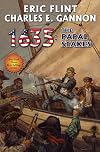
1635: THE PAPAL STAKES by Eric Flint & Charles E. Gannon --
This is the third of four novels of Eric Flint's 1632 series' Southern European storyline, following 1634: THE GALILEO AFFAIR and 1635: THE CANON LAW. While much continues from the earlier novels, it is not, imho, essential to have read these first, for the authors aptly catches the reader up-to-date, and each novel has its own unique conflict.
The Southern Europe storyline is, for the most part, distinct from the "Main" storyline show more begun with the original novel "1632." Cardinal, now "Pope", Borja has usurped the papacy and the Vatican from the true Pope, Pope Urban VIII who has fled Rome with the United States of Europe Ambassador Sharon Nichols, her husband, and others, pursued by Borja’s assassins.
There is plenty of action (especially of the direct face-to-face type where tension is high amid the slash of swords and the volleys of firearms and artillery both on land and sea) and also political intrigues and betrayals, but what makes this Southern European storyline uniquely interesting -- at least to me -- are the ecclesiastical debates before Pope Urban performed in formal conclave fashion despite the participants being on the run and in hiding. Nothing less than the future of the Roman Catholic Church of the 17th-century is to be decided in light of the "Ring of Fire" transition of the 21st-century town of Grantville, West Virginia to the past -- with all its future knowledge, ideals and religious and ethical beliefs that conflict with those of the 17th-century.
(1) Was the time displacement of Grantville and its citizens an act of Satan or not?
(2) Are the decrees of the future ecumenical councils and future Popes, particularly those of Pope John Paul and Vatican II that, among other things, recognized religious freedom, and, in Nostra Aetate, "reveres the work of God in all the major faith traditions" (including Judaism and Islam) applicable to the Church and Christians of the 17th-century.
The debates regarding the meaning of the Ring of Fire and the Vatican II decrees for the Church’s future are, for this student of Judaism, nearly Talmudic in their formal, respectful discourse. The skill with which Flint and Gannon relate these "battles" of words and reasoning are intense and enthralling. These theological-philosophical discussions are relevant not only to the characters and the world of the story but also to the reader and our world today. That they are conducted under the threat of pursuit and murder, as the climactic action-filled battle at the novel's end engagingly depicts, elevates the import and infinite value of the discussions.
While the book started a bit slow, perhaps, by the end of the work, I was in awe in how Eric and Chuck brought all these elements of high stakes physical and theological-philosophical conflicts together. Well done. show less
This is the third of four novels of Eric Flint's 1632 series' Southern European storyline, following 1634: THE GALILEO AFFAIR and 1635: THE CANON LAW. While much continues from the earlier novels, it is not, imho, essential to have read these first, for the authors aptly catches the reader up-to-date, and each novel has its own unique conflict.
The Southern Europe storyline is, for the most part, distinct from the "Main" storyline show more begun with the original novel "1632." Cardinal, now "Pope", Borja has usurped the papacy and the Vatican from the true Pope, Pope Urban VIII who has fled Rome with the United States of Europe Ambassador Sharon Nichols, her husband, and others, pursued by Borja’s assassins.
There is plenty of action (especially of the direct face-to-face type where tension is high amid the slash of swords and the volleys of firearms and artillery both on land and sea) and also political intrigues and betrayals, but what makes this Southern European storyline uniquely interesting -- at least to me -- are the ecclesiastical debates before Pope Urban performed in formal conclave fashion despite the participants being on the run and in hiding. Nothing less than the future of the Roman Catholic Church of the 17th-century is to be decided in light of the "Ring of Fire" transition of the 21st-century town of Grantville, West Virginia to the past -- with all its future knowledge, ideals and religious and ethical beliefs that conflict with those of the 17th-century.
(1) Was the time displacement of Grantville and its citizens an act of Satan or not?
(2) Are the decrees of the future ecumenical councils and future Popes, particularly those of Pope John Paul and Vatican II that, among other things, recognized religious freedom, and, in Nostra Aetate, "reveres the work of God in all the major faith traditions" (including Judaism and Islam) applicable to the Church and Christians of the 17th-century.
The debates regarding the meaning of the Ring of Fire and the Vatican II decrees for the Church’s future are, for this student of Judaism, nearly Talmudic in their formal, respectful discourse. The skill with which Flint and Gannon relate these "battles" of words and reasoning are intense and enthralling. These theological-philosophical discussions are relevant not only to the characters and the world of the story but also to the reader and our world today. That they are conducted under the threat of pursuit and murder, as the climactic action-filled battle at the novel's end engagingly depicts, elevates the import and infinite value of the discussions.
While the book started a bit slow, perhaps, by the end of the work, I was in awe in how Eric and Chuck brought all these elements of high stakes physical and theological-philosophical conflicts together. Well done. show less
Rumors of War and Infernal Machines: Technomilitary Agenda-setting in American and British Speculative Fiction by Charles E. Gannon

When you read as many academic monographs as I do, it's easy to hate them for their long sentences, long paragraphs, and unclear thinking. (All things, I should point out, that my own academic writing is prone to as much as anyone's.) Often one yearns for a book that has interesting ideas and writing that is merely acceptable. So I was very pleased when Gannon's book turned out to more more than acceptable, but good-- Gannon constructs a compelling narrative chock-full of interesting show more details.
The focus of his study is on near-future military science fiction: stories about the "next" war where the technology deployed does not yet exist (or has not yet been used), but plausibly could exist. He's interested in how these stories exploit contemporary anxieties, but also in how they affect them: science fiction about future wars can have a real effect on politics and policy. So mostly the book consists of a series of illustrations of how a future-war narrative drew on contemporary concerns, and then how it affected them. The book has two primary parts: chapters 1 through 4 cover British narratives of invasion published during the late Victorian and Edwardian periods (1871 to 1914) and chapters 5 through 10 are about American stories drawing on the Cold War and after (1950 to the present).
Obviously the first half was of more interest to me personally than the second. Gannon covers a number of familiar texts, giving probably the most thorough account of the highly influential The Battle of Dorking (1871) that I've read, a mere pamphlet which changed the shape of British politics-- its author was even elected to Parliament! Probably the best part was the chapter covering the work of William Le Queux, who drove around Britain in his motorcar to figure out the perfect invasion route for his newspaper serial The Invasion of 1910 (1906), but was forced by his publisher to plot a less plausible one that intersected more major population centers where newspapers could be sold. The Invasion of 1910 drew on a contemporary spy scare, but magnified it all out of proportion.
There's other famous stuff here too: The Great War of 189— (1893) by Admiral Philip Colomb, and much H. G. Wells, especially his "The Land Ironclads" (1903). It was fascinating to learn that the inventor of the tank, Ernest Swinton, was friends and collaborators with a writer of future-war fiction who wrote about tanks, Captain R. E. Vickers, who wrote the story "The Trenches" (1907). Gannon traces their relationship in detail from scant archival evidence to show a compelling connection between science fiction and the deployment of actual science fiction weaponry. The one real weakness of the first half is how much he glosses over everyone who wrote about the airplane before H. G. Wells, like George Griffith.
The second half of the book ought to have been less interesting to me because it's not "my" time period, but I still found much to enjoy, such as a persuasive discussion of Nevil Shute's On the Beach (1957) and its film adaptation mere weeks before I ended up teaching the book. Gannon argues that nuclear war fiction is important because the atom bomb has a destructive power beyond our ability to grasp in numbers: "the discourse of nuclear literature had traditionally relied upon images because a personally meaningful quantitative assessment of the bomb’s annihilatory powers is impossible" (129). As in the earlier section, Gannon delivers compelling connections between fiction and reality: the Eisenhower administration tried to suppress the film because they thought it would make the American people lose their nerve in the Cold War, President Truman carried a copy of Tennyon's future-war poem "Locksley Hall" (1835) with him and cribbed one of his speeches from a 1907 future-war magazine serial! Once the book moved past the atomic bomb, though, it sort of lost my interest.
Overall, a good book covering an interesting topic in a compelling fashion, and well written. I liked his breaking down of genres into subtypes, each with different purposes-- it's a good example of how to do genre-based criticism. The only bugbear of academic writing Gannon falls victim to is overuse of hyphens and parentheses in titles. "An Imperfect Future Tense(d): Anticipations of Atomic Annihilation in Post-War American Science Fiction" makes me wince a little, but "Cultural Casualties as Collateral Damage: The Fragment-ing/-ation Effects of Future-War Fantasies vs. Fictions" is unforgivable. show less
The focus of his study is on near-future military science fiction: stories about the "next" war where the technology deployed does not yet exist (or has not yet been used), but plausibly could exist. He's interested in how these stories exploit contemporary anxieties, but also in how they affect them: science fiction about future wars can have a real effect on politics and policy. So mostly the book consists of a series of illustrations of how a future-war narrative drew on contemporary concerns, and then how it affected them. The book has two primary parts: chapters 1 through 4 cover British narratives of invasion published during the late Victorian and Edwardian periods (1871 to 1914) and chapters 5 through 10 are about American stories drawing on the Cold War and after (1950 to the present).
Obviously the first half was of more interest to me personally than the second. Gannon covers a number of familiar texts, giving probably the most thorough account of the highly influential The Battle of Dorking (1871) that I've read, a mere pamphlet which changed the shape of British politics-- its author was even elected to Parliament! Probably the best part was the chapter covering the work of William Le Queux, who drove around Britain in his motorcar to figure out the perfect invasion route for his newspaper serial The Invasion of 1910 (1906), but was forced by his publisher to plot a less plausible one that intersected more major population centers where newspapers could be sold. The Invasion of 1910 drew on a contemporary spy scare, but magnified it all out of proportion.
There's other famous stuff here too: The Great War of 189— (1893) by Admiral Philip Colomb, and much H. G. Wells, especially his "The Land Ironclads" (1903). It was fascinating to learn that the inventor of the tank, Ernest Swinton, was friends and collaborators with a writer of future-war fiction who wrote about tanks, Captain R. E. Vickers, who wrote the story "The Trenches" (1907). Gannon traces their relationship in detail from scant archival evidence to show a compelling connection between science fiction and the deployment of actual science fiction weaponry. The one real weakness of the first half is how much he glosses over everyone who wrote about the airplane before H. G. Wells, like George Griffith.
The second half of the book ought to have been less interesting to me because it's not "my" time period, but I still found much to enjoy, such as a persuasive discussion of Nevil Shute's On the Beach (1957) and its film adaptation mere weeks before I ended up teaching the book. Gannon argues that nuclear war fiction is important because the atom bomb has a destructive power beyond our ability to grasp in numbers: "the discourse of nuclear literature had traditionally relied upon images because a personally meaningful quantitative assessment of the bomb’s annihilatory powers is impossible" (129). As in the earlier section, Gannon delivers compelling connections between fiction and reality: the Eisenhower administration tried to suppress the film because they thought it would make the American people lose their nerve in the Cold War, President Truman carried a copy of Tennyon's future-war poem "Locksley Hall" (1835) with him and cribbed one of his speeches from a 1907 future-war magazine serial! Once the book moved past the atomic bomb, though, it sort of lost my interest.
Overall, a good book covering an interesting topic in a compelling fashion, and well written. I liked his breaking down of genres into subtypes, each with different purposes-- it's a good example of how to do genre-based criticism. The only bugbear of academic writing Gannon falls victim to is overuse of hyphens and parentheses in titles. "An Imperfect Future Tense(d): Anticipations of Atomic Annihilation in Post-War American Science Fiction" makes me wince a little, but "Cultural Casualties as Collateral Damage: The Fragment-ing/-ation Effects of Future-War Fantasies vs. Fictions" is unforgivable. show less
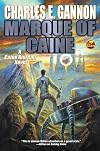
Charles E. Gannon is a mostly-hard-sci-fi writer whose books promise the thrills of the opening words in a Star Trek episode: “To explore strange new worlds/To seek out new life/And new civilizations/To boldly go where no man has gone before.” His Terran Republic series is a perennial runner-up in the Nebula Awards, and Marque of Caine was no exception. Its stalwart hero, Caine Riordan, like his Kirkian model, is the kind of guy who leads the away missions, ship-be-damned. His mission show more this time is to recover his lover Elena from an alien medical pod.
The action moves us from the warm seas of the Bahamas to a simulated universe in a distant star system. Gannon’s Consolidated Terran Republic is a world where “change was always uneven in distribution and irregular timing. Plenty still varied along social lines. Tidiness was transient.” This untidiness keeps his world believable and relatable. Even his ancient alien mentors seem fuddled at times.
But such a messy sprawl of a world has its downside. As almost every reviewer notes, this 500-page tome is too long and may put some readers into as deep a coma as poor Elena. But the action, with its clever critters and tech, kept me up and at it. show less
The action moves us from the warm seas of the Bahamas to a simulated universe in a distant star system. Gannon’s Consolidated Terran Republic is a world where “change was always uneven in distribution and irregular timing. Plenty still varied along social lines. Tidiness was transient.” This untidiness keeps his world believable and relatable. Even his ancient alien mentors seem fuddled at times.
But such a messy sprawl of a world has its downside. As almost every reviewer notes, this 500-page tome is too long and may put some readers into as deep a coma as poor Elena. But the action, with its clever critters and tech, kept me up and at it. show less
Lists
Awards


You May Also Like


Associated Authors
Statistics
- Works
- 39
- Also by
- 14
- Members
- 1,767
- Popularity
- #14,569
- Rating
- 3.7
- Reviews
- 51
- ISBNs
- 95