
Jack McDevitt
Author of The Engines of God
About the Author
Jack McDevitt (born 1935) is an American science fiction author whose novels frequently deal with attempts to make contact with alien races, and with archaeology or xenoarchaeology. He attended La Salle University, where a short story of his won the annual Freshman Short Story Contest and was show more published in the school's literary magazine, Four Quarters. He received a Master's degree in literature from Wesleyan University in 1971. Before becoming a full-time author, he was an English teacher, naval officer, Philadelphia taxi driver, customs officer and motivational trainer. His first published story was The Emerson Effect in The Twilight Zone Magazine in 1981. Two years later, he published his first novel, The Hercules Text, which won the Philip K. Dick Special Award. He won the 2006 Nebula Award for Best Novel for Seeker, the UPC International Prize for his novella Ships in the Night in 1991, and the John W. Campbell Memorial Award for best SF novel for Omega in 2003. (Bowker Author Biography) show less
Image credit: Jack McDevitt (by Vadaro, 2010)
Series
Works by Jack McDevitt
Henry James, This One's For You 11 copies
Cryptic [short story] 7 copies
Asimov's Science Fiction: Vol. 46, No. 3 & 4 [March/April 2022] (2022) — Contributor — 6 copies, 2 reviews
Asimov's Science Fiction: Vol. 45, No. 11 & 12 [November/December 2021] (2021) — Contributor — 5 copies
Promises to Keep 5 copies
The Far Shore 4 copies
The Candidate 4 copies
Time's Arrow 3 copies
Act of God 3 copies
Nothing Ever Happens In Rock City 3 copies
The Cat’s Pajamas 3 copies
Good Intentions 3 copies
Codice Hercules 3 copies
Lake Agassiz {short story} 2 copies
Black To Move 2 copies
Happy Birthday — Author — 2 copies
Kaminsky At War 2 copies
Deus Tex 2 copies
Windows 2 copies
The Tomb 2 copies
Melville On Iapetus 2 copies
Report From The Rear 2 copies
Indomitable 2 copies
Last Contact 2 copies
Tweak 2 copies
Never Despair 2 copies
Cruising Through Deuteronomy 2 copies
Ellie 2 copies
Dead In The Water 2 copies
Ajarändurid ei sure iial 1 copy
Collected Short Fiction 1 copy
Deepsix 1 copy
Variables 1 copy
Glory Days 1 copy
Blinker 1 copy
Midnight Clear 1 copy
Oculus 1 copy
Windrider 1 copy
The Hercules Test 1 copy
Tidal Effects 1 copy
Molly's Kids 1 copy
Valkyrie 1 copy
Enjoy the Moment 1 copy
Listen Up Nitwits 1 copy
Gus 1 copy
Waiting At The Altar 1 copy
Sunrise 1 copy
The Mission 1 copy
The Eagle Project 1 copy
Dutchman 1 copy
Riding with the Duke (short) 1 copy
Cosmic Harmony 1 copy
Ignition 1 copy
In The Tower 1 copy
The Last Dance 1 copy
Whistle 1 copy
Seeker [Excerpt] 1 copy
The Gold Signal 1 copy
Knock Knock [short story] — Author — 1 copy
Strange Pulp. May 2012 1 copy
Associated Works
Future Visions: Original Science Fiction Inspired by Microsoft (2015) — Contributor — 260 copies, 5 reviews
The Year's Best Science Fiction: First Annual Collection (1984) — Contributor — 148 copies, 1 review
Carbide Tipped Pens: Seventeen Tales of Hard Science Fiction (2016) — Contributor — 108 copies, 6 reviews
Time Machines: The Greatest Time Travel Stories Ever Written (1998) — Contributor — 82 copies, 5 reviews
Nebula Awards 24: SFWA's Choices for the Best Science Fiction and Fantasy 1988 (1990) — Contributor — 61 copies
A Cross of Centuries: Twenty-five Imaginative Tales About the Christ (2007) — Contributor — 32 copies, 2 reviews
Asimov's Science Fiction: Vol. 41, No. 11 & 12 [November/December 2017] (2017) — Contributor — 22 copies, 3 reviews
Isaac Asimov's Science Fiction Magazine: Vol. 13, No. 12 [December 1989] (1989) — Author — 14 copies
Analog Science Fiction and Fact: Vol. CXXII, No. 7 & 8 (July/August 2002) (2002) — Contributor — 14 copies, 1 review
Isaac Asimov's Science Fiction Magazine: Vol. 7, No. 4 [April 1983] (1983) — Contributor — 13 copies
The Loch Moose Monster: More Stories From Isaac Asimov's Science Fiction Magazine (1993) — Contributor — 13 copies
Isaac Asimov's Science Fiction Magazine: Vol. 7, No. 11 [November 1983] (1983) — Contributor — 13 copies
Isaac Asimov's Science Fiction Magazine: Vol. 11, No. 12 [December 1987] (1987) — Contributor — 12 copies
Isaac Asimov's Science Fiction Magazine: Vol. 8, No. 12 [December 1984] (1984) — Contributor — 12 copies
Isaac Asimov's Science Fiction Magazine: Vol. 10, No. 11 [November 1986] (1986) — Author — 11 copies
Asimov's Science Fiction: Vol. 44, No. 11 & 12 [November/December 2020] (2020) — Contributor — 4 copies
Starshipsofa Stories Vol 3 — Contributor — 4 copies
Aboriginal Science Fiction No. 55 & 56 Spring 1998 — Contributor — 1 copy
Tagged
Common Knowledge
- Legal name
- McDevitt, John Charles
- Birthdate
- 1935-04-14
- Gender
- male
- Education
- La Salle University
Wesleyan University - Occupations
- English teacher
naval officer
taxi driver
customs officer
motivational trainer
science fiction writer - Organizations
- Science Fiction and Fantasy Writers of America
- Nationality
- USA
- Birthplace
- Philadelphia, Pennsylvania, USA
- Places of residence
- Brunswick, Georgia, USA
Philadelphia, Pennsylvania, USA - Associated Place (for map)
- USA
Members
Discussions
Found: SF: First Contact story in Name that Book (December 2023)
Reviews
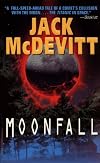
This book was, in a word, chaotic. And in a second word, preachy. It's actually very difficult to determine which of those two descriptors was more upsetting, as I went through the book. Around three-quarters of the way through, I had had more than enough, and I only finished reading to give the book a fair shake.
In all honesty, I rather wish I hadn't.
Let's start with how it was chaotic. This issue should be relevant to any reader, regardless of your philosophical bent.
The chaos begins with show more simple organization. It seems Mr. McDevitt wanted to have titled sections, but he also wanted smaller breaks within the story. His choice on how to resolve this? Ten titled "chapters" with anywhere between 3 and 13 smaller, enumerated breaks in each. Except that those enumerations restarted with each chapter. So either you had to read eighty pages at a sitting or remember both chapter number and section number, at which point, it would be easier just to dog-ear the page and stop whenever you want. This might not matter at all to some, but it's hardly conducive to a good reading experience, in my opinion. It's just a little sloppy.
But that is probably the least of McDevitt's crimes against fiction in this work. He introduces - and kills off - more characters than most movies have extras. In fact, he introduces so many that it's almost impossible to keep up with them - which is proven by the fact that McDevitt in fact does not keep up with them all. There are a few characters, introduced sporadically, which he mentions again only once or twice, or perhaps never returns to. And he kills so many characters over the course of the book that he finds himself in need of new ones about halfway through, and starts introducing more. Not only does all this make the book a crowded mass of names, places, and biographies appropriate for a dating site, but it cheapens the characters that do survive. Since anyone could die at any moment, whether they had been a narrative influence, present from the beginning of the book, or seemed integral to the story, I quickly stopped caring for anyone. The romance in the book is irrelevant and emotionless, because one or both characters could die at any moment, with neither drama nor reflection.
Tangential to that point is this one: Mr. McDevitt begins the book with a small number of characters and a setting to which he only returns twice in the entire remainder of the book, and only for a paragraph each time. Perhaps I am alone in my thinking here, but I have always believed that the first chapter, the first paragraph, the first character in a story has either a pivotal role or thematic importance. The characters in Mr. McDevitt's opening scene have neither. They are, to put it bluntly, completely irrelevant to the entire book.
Finally, let us examine the prose. For the most part, the book is in third-person omniscient - presumably so we can relate to characters who will soon be dead. But Mr. McDevitt does not appear comfortable writing death scenes, so nearly every death in the book is from an observer's perspective: "So-and-so never saw it coming," "She was dead before she knew it," "He died in the middle of a sentence." If Mr. McDevitt wanted us to care about any of these characters, he should have made their deaths more interesting. Instead, much of the book reads like a historical account of the time when the moon was destroyed by a rogue comet, and this list of people died, and this list lived, and that other list should have been executed for their religious fanaticism.
Which brings me to my second primary point: how the book was preachy. Mr. McDevitt evidently lacks the capacity to understand the mind of a person who has religious faith. For one thing, he asserts that religious people live easier lives than the non-religious, that this ignorance (as McDevitt sees it) is bliss, and that the biggest challenge a Christian must face is explaining away bad events as divine providence. Churches are ridiculous, and things which must be escaped. (See pages 330-331 for these points.)
Furthermore, there can be no intelligent religious people. McDevitt cannot imagine someone being both intelligent and religious; the two descriptors mutually exclusive in his mind. After all, the one religious character who is neither a terrorist nor laughably short-lived is Chaplain Mark Pinnacle, who became a pastor not because he had faith, but because he was rebelling against his father, and Pinnacle had plenty of doubts about the truth of religion. (See pages 160-161.)
Perhaps most telling is how Mr. McDevitt concludes this little escapade. Almost every character in the book, even staunch agnostics (which seem to be the majority of the population for his characters; there are few staunch atheists and no staunch religious protagonists, in spite of every character's concerns about what the silly, religious voters would think), was praying in the final chapter that the mission would succeed... and yet, in the end, the important thing for Charlie Haskell (probably the primary protagonist of the book) to remember is that failure in the mission would mean going back to "inventing religions to give meaning to disease-ridden, violent, pointless lives, and then becoming subjugated by the religions," going back "to refight all the battles against war and disease and superstition," when, "finally, the common effort was bearing fruit." (See page 531.) And of course, success led to the formation of a universal bond among all humankind "that transcended national and religious identities," so much that "even in Jerusalem" (that wretched hive of warmongering, according to the underlying tone), "at long last, an accommodation seemed to have been reached." (See page 544.)
And what's the basic principle of all this? That religion is, at best, backwards, barbaric, ignorant, and foolish. And at worst, it's both malicious and evil, and it seeks to destroy humanity with wars and death, and we need a "common misfortune," brought about not by any god or religious cause, not by karma or dogmatic punishment, but by chance, by Lady Luck, so that we can all come together and achieve world peace.
See? Preachy. And chaotic.
Another humorous quibble is with Mr. McDevitt's ability to predict the future. Writing this book in 1998, he was four years late on his estimation of the first African-American President, and his view of the future of the Internet and other technologies is somewhat lacking... not to mention the sad issue of NASA's defunding, pressing, not the government, but a wide range of private companies into the reaches of space. But of course, he can't be faulted for any of that. It's just fun to note. show less
In all honesty, I rather wish I hadn't.
Let's start with how it was chaotic. This issue should be relevant to any reader, regardless of your philosophical bent.
The chaos begins with show more simple organization. It seems Mr. McDevitt wanted to have titled sections, but he also wanted smaller breaks within the story. His choice on how to resolve this? Ten titled "chapters" with anywhere between 3 and 13 smaller, enumerated breaks in each. Except that those enumerations restarted with each chapter. So either you had to read eighty pages at a sitting or remember both chapter number and section number, at which point, it would be easier just to dog-ear the page and stop whenever you want. This might not matter at all to some, but it's hardly conducive to a good reading experience, in my opinion. It's just a little sloppy.
But that is probably the least of McDevitt's crimes against fiction in this work. He introduces - and kills off - more characters than most movies have extras. In fact, he introduces so many that it's almost impossible to keep up with them - which is proven by the fact that McDevitt in fact does not keep up with them all. There are a few characters, introduced sporadically, which he mentions again only once or twice, or perhaps never returns to. And he kills so many characters over the course of the book that he finds himself in need of new ones about halfway through, and starts introducing more. Not only does all this make the book a crowded mass of names, places, and biographies appropriate for a dating site, but it cheapens the characters that do survive. Since anyone could die at any moment, whether they had been a narrative influence, present from the beginning of the book, or seemed integral to the story, I quickly stopped caring for anyone. The romance in the book is irrelevant and emotionless, because one or both characters could die at any moment, with neither drama nor reflection.
Tangential to that point is this one: Mr. McDevitt begins the book with a small number of characters and a setting to which he only returns twice in the entire remainder of the book, and only for a paragraph each time. Perhaps I am alone in my thinking here, but I have always believed that the first chapter, the first paragraph, the first character in a story has either a pivotal role or thematic importance. The characters in Mr. McDevitt's opening scene have neither. They are, to put it bluntly, completely irrelevant to the entire book.
Finally, let us examine the prose. For the most part, the book is in third-person omniscient - presumably so we can relate to characters who will soon be dead. But Mr. McDevitt does not appear comfortable writing death scenes, so nearly every death in the book is from an observer's perspective: "So-and-so never saw it coming," "She was dead before she knew it," "He died in the middle of a sentence." If Mr. McDevitt wanted us to care about any of these characters, he should have made their deaths more interesting. Instead, much of the book reads like a historical account of the time when the moon was destroyed by a rogue comet, and this list of people died, and this list lived, and that other list should have been executed for their religious fanaticism.
Which brings me to my second primary point: how the book was preachy. Mr. McDevitt evidently lacks the capacity to understand the mind of a person who has religious faith. For one thing, he asserts that religious people live easier lives than the non-religious, that this ignorance (as McDevitt sees it) is bliss, and that the biggest challenge a Christian must face is explaining away bad events as divine providence. Churches are ridiculous, and things which must be escaped. (See pages 330-331 for these points.)
Furthermore, there can be no intelligent religious people. McDevitt cannot imagine someone being both intelligent and religious; the two descriptors mutually exclusive in his mind. After all, the one religious character who is neither a terrorist nor laughably short-lived is Chaplain Mark Pinnacle, who became a pastor not because he had faith, but because he was rebelling against his father, and Pinnacle had plenty of doubts about the truth of religion. (See pages 160-161.)
Perhaps most telling is how Mr. McDevitt concludes this little escapade. Almost every character in the book, even staunch agnostics (which seem to be the majority of the population for his characters; there are few staunch atheists and no staunch religious protagonists, in spite of every character's concerns about what the silly, religious voters would think), was praying in the final chapter that the mission would succeed... and yet, in the end, the important thing for Charlie Haskell (probably the primary protagonist of the book) to remember is that failure in the mission would mean going back to "inventing religions to give meaning to disease-ridden, violent, pointless lives, and then becoming subjugated by the religions," going back "to refight all the battles against war and disease and superstition," when, "finally, the common effort was bearing fruit." (See page 531.) And of course, success led to the formation of a universal bond among all humankind "that transcended national and religious identities," so much that "even in Jerusalem" (that wretched hive of warmongering, according to the underlying tone), "at long last, an accommodation seemed to have been reached." (See page 544.)
And what's the basic principle of all this? That religion is, at best, backwards, barbaric, ignorant, and foolish. And at worst, it's both malicious and evil, and it seeks to destroy humanity with wars and death, and we need a "common misfortune," brought about not by any god or religious cause, not by karma or dogmatic punishment, but by chance, by Lady Luck, so that we can all come together and achieve world peace.
See? Preachy. And chaotic.
Another humorous quibble is with Mr. McDevitt's ability to predict the future. Writing this book in 1998, he was four years late on his estimation of the first African-American President, and his view of the future of the Internet and other technologies is somewhat lacking... not to mention the sad issue of NASA's defunding, pressing, not the government, but a wide range of private companies into the reaches of space. But of course, he can't be faulted for any of that. It's just fun to note. show less
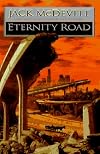
This one is a seamless combination of post-apocalyptic fiction with Tokeinesque quest fantasy. A community several generations past whatever broke the earth have an enduring myth about a quest to find some great knowledge that will help rebuild things. The myth is tied inextricably with books from the old world, as books have taken on a totem status in their cultural and spiritual life. One of the elders of the community dies, one with a fair bit of mystery surrounding him from a previous show more attempt to find the lost books, and he leaves one of those old, precious books – I only wish it had been something other than Twain – to someone unexpected. The heiress uses the book and the whispered rumors of the previous quest to put together her own party. The quest is wonderful, as it requires them to noodle through things left behind in order to survive – like, how do you break a malfunctioning and deadly sentry robot with logic rather than firepower. There’s even a hot-air balloon ride at the end of their quest.
The only criticism is that the ending feels rushed and a little anti-climactic. I would have liked this one to stretch out and have more meaning in the end. Sadly, McDevitt rushed through the final pieces of the quest and has never written about this world again apparently. Indeed, this book seems altogether unique, as the other books I’ve found by him seem much more of the space opera ilk.
4 ½ bones!!!!!
Highly recommended show less
The only criticism is that the ending feels rushed and a little anti-climactic. I would have liked this one to stretch out and have more meaning in the end. Sadly, McDevitt rushed through the final pieces of the quest and has never written about this world again apparently. Indeed, this book seems altogether unique, as the other books I’ve found by him seem much more of the space opera ilk.
4 ½ bones!!!!!
Highly recommended show less
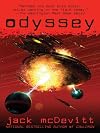
Odyssey, the fifth volume in Jack McDevitt’s Academy series, offers a fresh twist to some familiar space opera tropes. The premise is simple: Academy scientists on a station in another star system are building a machine to test the conditions that brought about the Big Bang. There is a non-zero chance that the experiment could destroy the entire cosmos. Mysterious aliens called moonriders seem to object.
Can Hutch and her team get the scientists off the station before they destroy the show more cosmos or the moonriders take them out? Hutch is now a middle-aged administrator whose piloting days are over, at least in this novel. She worries that the government may be about to defund the Academy and its space program. As one space entrepreneur says, in a line that makes one think of how NASA is funded, “But science doesn’t fly with the voters.” Another character notes with laudable snark, “The term congressional hearing is an oxymoron.”
The novel is also larded with fun future headlines that suggest things people worry about instead of the chances we could blow up the universe. For example, a bestselling novel has been written by an AI, and a group of religious fanatics claims to have found Noah’s ark on Mt. Ararat. The more things change … show less
Can Hutch and her team get the scientists off the station before they destroy the show more cosmos or the moonriders take them out? Hutch is now a middle-aged administrator whose piloting days are over, at least in this novel. She worries that the government may be about to defund the Academy and its space program. As one space entrepreneur says, in a line that makes one think of how NASA is funded, “But science doesn’t fly with the voters.” Another character notes with laudable snark, “The term congressional hearing is an oxymoron.”
The novel is also larded with fun future headlines that suggest things people worry about instead of the chances we could blow up the universe. For example, a bestselling novel has been written by an AI, and a group of religious fanatics claims to have found Noah’s ark on Mt. Ararat. The more things change … show less

Firebird is volume six of Jack McDevitt’s “Alex Benedict” series of archeological mysteries in a Science Fiction setting, a series that found its formula in its second volume and has stuck to it very closely since then. This novel, too, chugs along smoothly and comfortably along the rails laid down by previous volumes in the series - some things, however, are different this time round, and if Firebird doesn’t exactly deviate from the established formula it does expand on it show more somewhat.
This is most notable in the novel’s portrayal of its main protagonist, antique dealer Alex Benedict – we’ve been told that the is a very controversial figure in previous volume, but so far he has been presented as either unjustly maligned by envious colleagues or misunderstood by the general public; it is only now that we get a closer look on some of his more dubious business practices which might give some justification to his reputation and which even Alex’ business partner and the series’ narrator Chase Kolpath is uncomfortable with. And there even is some self-doubt as the novel progresses, which gives the character some much-needed depth.
Another change is that this time, while there still is the initial client who kicks things off with her request, she is not in the least bit mysterious, and there are no antagonists this time who send out assassin’s which Alex and Chase then need to avoid. Firebird is very low on action and focuses on the mystery instead (which is about the disappearing spaceships that have been a recurrent theme in the series since its first volume), and since this is what McDevitt does best the novel benefits considerably from it, making it the best instalment in the series for quite some time.
Another recurring also gets extensive treatment here, namely the AIs, but this I found to be very problematic. As I already wrote in my post on Echo, I am not convinced of McDevitt’s concept of Artificial Intelligence at all, because it’s too anthropomorphic - his AIs are basically humans who happen to live inside a box. In Firebird, Alex Benedict makes a stand for them receiving equal rights with humans, on the ground that AIs are basically just like humans. And that is where things become really problematic from an ethical point of view – because the attitude that someone has to be “like us” to be deserving of equal rights while it’s okay to deny them to anyone who is different from and other than us is highly questionable, and nowhere near as progressive as McDevitt seems to think it is.
The novel’s most glaring problem, however, is a very weird choice of names: It seems hardly credible that McDevitt never read or at the very least heard of Winnie-the-Pooh, so one can only wonder what moved him to call the disappeared physicist whose traces Alex and Chase follow in Firebird – Christopher Robin, of all possible names. For anyone who ever read the books or watched the movie (and one can assume that to be a vast majority of Firebird’s readers) this can’t help but conjure up rather unfortunate associations which fit neither McDevitt’s character nor his novel.
With all its issues, this volume still marks a return to form for this series, and after I had been almost ready to give up on it, I’m now actually looking forward to the next volume which promises some interesting developments in the wake of what happened in Firebird. show less
This is most notable in the novel’s portrayal of its main protagonist, antique dealer Alex Benedict – we’ve been told that the is a very controversial figure in previous volume, but so far he has been presented as either unjustly maligned by envious colleagues or misunderstood by the general public; it is only now that we get a closer look on some of his more dubious business practices which might give some justification to his reputation and which even Alex’ business partner and the series’ narrator Chase Kolpath is uncomfortable with. And there even is some self-doubt as the novel progresses, which gives the character some much-needed depth.
Another change is that this time, while there still is the initial client who kicks things off with her request, she is not in the least bit mysterious, and there are no antagonists this time who send out assassin’s which Alex and Chase then need to avoid. Firebird is very low on action and focuses on the mystery instead (which is about the disappearing spaceships that have been a recurrent theme in the series since its first volume), and since this is what McDevitt does best the novel benefits considerably from it, making it the best instalment in the series for quite some time.
Another recurring also gets extensive treatment here, namely the AIs, but this I found to be very problematic. As I already wrote in my post on Echo, I am not convinced of McDevitt’s concept of Artificial Intelligence at all, because it’s too anthropomorphic - his AIs are basically humans who happen to live inside a box. In Firebird, Alex Benedict makes a stand for them receiving equal rights with humans, on the ground that AIs are basically just like humans. And that is where things become really problematic from an ethical point of view – because the attitude that someone has to be “like us” to be deserving of equal rights while it’s okay to deny them to anyone who is different from and other than us is highly questionable, and nowhere near as progressive as McDevitt seems to think it is.
The novel’s most glaring problem, however, is a very weird choice of names: It seems hardly credible that McDevitt never read or at the very least heard of Winnie-the-Pooh, so one can only wonder what moved him to call the disappeared physicist whose traces Alex and Chase follow in Firebird – Christopher Robin, of all possible names. For anyone who ever read the books or watched the movie (and one can assume that to be a vast majority of Firebird’s readers) this can’t help but conjure up rather unfortunate associations which fit neither McDevitt’s character nor his novel.
With all its issues, this volume still marks a return to form for this series, and after I had been almost ready to give up on it, I’m now actually looking forward to the next volume which promises some interesting developments in the wake of what happened in Firebird. show less
Lists
Awards


You May Also Like


Associated Authors
Statistics
- Works
- 124
- Also by
- 79
- Members
- 20,919
- Popularity
- #1,034
- Rating
- 3.6
- Reviews
- 578
- ISBNs
- 320
- Languages
- 12
- Favorited
- 66