
David Mas Masumoto
Author of Epitaph for a Peach: Four Seasons on My Family Farm
About the Author
David Mas Masumoto, a third generation Japanese-American, attended the University of California at Berkeley and Douglas. "Epitaph for a Peach" details the stresses and successes of a year on his family's peach farm. "Country Voices: The Oral History of a Japanese American Family Farm Community" show more combines interviews and his own memories to detail the history experiences of Japanese-Americans, including America's "relocation camps" of World War II. Masumoto has won the James Clavell Japanese-American National Literary Award, the Julia Child Award, and the International Association of Culinary Professionals Award. (Bowker Author Biography) show less
Image credit: David Mas Masumoto
Works by David Mas Masumoto
Associated Works
A Fork in the Road: Tales of Food, Pleasure, and Discovery on the Road (2013) — Contributor — 115 copies, 2 reviews
The Colors of Nature: Culture, Identity, and the Natural World (2002) — Contributor — 103 copies, 1 review
Tagged
Common Knowledge
- Canonical name
- Masumoto, David Mas
- Other names
- Masumoto, Mas
- Birthdate
- 1954-01-20
- Gender
- male
- Education
- University of California, Berkeley (BA|Sociology)
University of California, Davis (MS|Community Development) - Occupations
- farmer
- Nationality
- USA
- Birthplace
- Del Rey, California, USA
- Places of residence
- Del Rey, California, USA
- Associated Place (for map)
- Del Rey, California, USA
Members
Reviews
Letters to the Valley: A Harvest of Memories (Great Valley Book) (Great Valley Book) by David Mas Masumoto
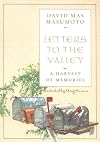
I'm from the great San Joaquin Valley of California. It's often forgotten about compared to the giants of Los Angeles and San Francisco, despite it's 400 miles in length. It's also much maligned, often with good reason, for stinking of manure and being long miles of nothing but agriculture and asthma.
But it's still my home, where I was raised, and now that I've been away for over eight years I can say I miss it.
The little tome of letters is an absolute treasure. Masumoto draws on what he show more calls the "spiritual geography" of the valley and address his family, friends, and neighbors. These letters, originally published in a Fresno Bee column, are brief and profound. Masumoto loves the land, and he loves his family, and he is all too aware of the once-tenuous ties between the two: his family was sent to internment camps during World War II, even as one of his uncles fought and died for the United States. He takes pride in working the land as his father once did, and he measures a day of summer's work in the number of shirts he has soaked with sweat. And it's all for love. Doug Hansen's realistic watercolor illustrations add beauty to each letter.
To me, to someone homesick for family and place, this felt like a daily devotional. I read each letter and I knew the smell of the dust in the air and the exact feel of the sun. Odd as it may seem, it also made me think a lot of my Grandpa who died in 1991. I know he would have loved this book, and that made me enjoy it even more. show less
But it's still my home, where I was raised, and now that I've been away for over eight years I can say I miss it.
The little tome of letters is an absolute treasure. Masumoto draws on what he show more calls the "spiritual geography" of the valley and address his family, friends, and neighbors. These letters, originally published in a Fresno Bee column, are brief and profound. Masumoto loves the land, and he loves his family, and he is all too aware of the once-tenuous ties between the two: his family was sent to internment camps during World War II, even as one of his uncles fought and died for the United States. He takes pride in working the land as his father once did, and he measures a day of summer's work in the number of shirts he has soaked with sweat. And it's all for love. Doug Hansen's realistic watercolor illustrations add beauty to each letter.
To me, to someone homesick for family and place, this felt like a daily devotional. I read each letter and I knew the smell of the dust in the air and the exact feel of the sun. Odd as it may seem, it also made me think a lot of my Grandpa who died in 1991. I know he would have loved this book, and that made me enjoy it even more. show less
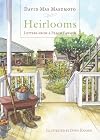
Heirlooms is a beautiful tribute to the "other California," the great central valley. The letters in this book all come from Masumoto's column in The Fresno Bee and demonstrate his love for the valley, his affection for his family, and his connections with his Japanese and farmer roots. I didn't find the letters quite as moving as those in the preceding volume Letters to the Valley, but they were still thought-provoking. My background is very different from Masumoto's; his family came over show more from Japan a century ago and dealt with internment during World War II, even as one of his uncles fought and died for America in France. However, we have much in common: grandparents who fought with the land and loved the battle, and memories of a quaint valley upbringing that can't be replicated anywhere else in the country. It made me especially happy to see my hometown of Hanford mentioned several times, too. I've been living all over America in the nine years since I left California, and it's comforting to my true home celebrated and acknowledged.
Doug Hansen's watercolor illustrations brighten each of Masumoto's letters. I wouldn't mind owning some of his prints. I'm already eagerly anticipating Hansen's children's book Mother Goose in California that is set to come out in April. show less
Doug Hansen's watercolor illustrations brighten each of Masumoto's letters. I wouldn't mind owning some of his prints. I'm already eagerly anticipating Hansen's children's book Mother Goose in California that is set to come out in April. show less
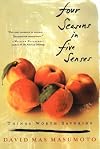
The author, David Mas Masumoto, is an organic farmer in the Central Valley town of Del Rey, CA. David carries on the family tradition of growing peaches and raisins. He converted his farming methods to organic farming when he realized the health hazards to his family caused by using inorganic pesticides. In his book he has captured the essence of what his farming means to him, not just the methods and mechanics but the philosophy and way of life he has come to value. He learned the art of show more cultivation from his father, a Japanese-American farmer. Through the use of stories, he relates his experiences and those of his family.
Focusing on the five senses he takes us on a sensory journey through the process of producing crops of peaches, taking them from his fields to the consumer. Each of the five sections of the book, devoted to one of the senses, begins with a stream of conscious list of vivid images and memories captured and communicated with grace, emotion and poetry.
Part One, “The Art of Seeing,” takes us into the fields to see trees filled with blossoms, trees laden with fruit, workers during the harvest. Part Two, “The Art of Listening,” communicates the sounds and the silences encountered in the fields and in nature. Part Three, “The Art of Taste,” describes in detail how to eat, no, savor, a freshly picked peach in a way that triggers personal memories of summers spent with fruit juices dripping off childhood chins. It makes me want to run to the nearest Farmer’s Market. Part Four, “The Art of Smell,” brings to mind the scents of honest labor, of dusty nature, of soil, mud, rain. I am reminded of how my sense of smell opens the world to me. Then in Part Five, “The Art of Touch, I experienced a deep appreciation of hands as he shares stories and images of his mother’s "farm wife" hands. These are just a few of the images and events captured throughout the book.
At the end of the book, I was left with a profound understanding and appreciation of the dignity of farming and those who dedicate their energies to the profession. But more than that, was my appreciation for the gifts of my body, of my senses that bring the experience of life to me in a rich, tangible way, and of nature and the world we inhabit. The distractions of my modern, urban existence and the pace at which I move through my days often result in an anesthetizing of these doorways of experience.
This book reminded me of Diane Ackerman's books, “A Natural History of the Senses” (which Mas references in his book) and “Cultivating Delight.” Both authors have the unique ability to convey the richness of our natural world and the act of living through poetic prose. show less
Focusing on the five senses he takes us on a sensory journey through the process of producing crops of peaches, taking them from his fields to the consumer. Each of the five sections of the book, devoted to one of the senses, begins with a stream of conscious list of vivid images and memories captured and communicated with grace, emotion and poetry.
Part One, “The Art of Seeing,” takes us into the fields to see trees filled with blossoms, trees laden with fruit, workers during the harvest. Part Two, “The Art of Listening,” communicates the sounds and the silences encountered in the fields and in nature. Part Three, “The Art of Taste,” describes in detail how to eat, no, savor, a freshly picked peach in a way that triggers personal memories of summers spent with fruit juices dripping off childhood chins. It makes me want to run to the nearest Farmer’s Market. Part Four, “The Art of Smell,” brings to mind the scents of honest labor, of dusty nature, of soil, mud, rain. I am reminded of how my sense of smell opens the world to me. Then in Part Five, “The Art of Touch, I experienced a deep appreciation of hands as he shares stories and images of his mother’s "farm wife" hands. These are just a few of the images and events captured throughout the book.
At the end of the book, I was left with a profound understanding and appreciation of the dignity of farming and those who dedicate their energies to the profession. But more than that, was my appreciation for the gifts of my body, of my senses that bring the experience of life to me in a rich, tangible way, and of nature and the world we inhabit. The distractions of my modern, urban existence and the pace at which I move through my days often result in an anesthetizing of these doorways of experience.
This book reminded me of Diane Ackerman's books, “A Natural History of the Senses” (which Mas references in his book) and “Cultivating Delight.” Both authors have the unique ability to convey the richness of our natural world and the act of living through poetic prose. show less
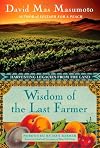
Third generation Japanese American farmer David Mas Masumoto writes this beautiful memoir of life on an organic peach and raisin farm with his family, in the wake of his father's stroke. Masumoto's father farmed before him and for years, farmed with him as he took the reigns on the farm. But after his stroke, David had to mentor his father on the farm, set limits and reteach him how to farm. Along the way there are stirring reflections on farming, mortality and life's fragility (in both its show more human and botanical forms). Great read! show less
Lists
Awards


You May Also Like


Associated Authors
Statistics
- Works
- 12
- Also by
- 3
- Members
- 745
- Popularity
- #34,103
- Rating
- 4.0
- Reviews
- 15
- ISBNs
- 27
- Languages
- 1
