
Jeffrey Bennett
Author of The Cosmic Perspective
About the Author
Jeffrey Bennett, winner of the 2013 American Institute of Physics Science Communication Award, holds a BA in biophysics from the University of California, San Diego, and an MS and PhD in astrophysics from the University of Colorado, Boulder. He is the lead author of several best-selling textbooks show more in astronomy, astrobiology, mathematics, and statistics and has written numerous award-winning books for the general public and children. show less
Image credit: Jeffrey Bennett
Series
Works by Jeffrey Bennett
What Is Relativity?: An Intuitive Introduction to Einstein's Ideas, and Why They Matter (2014) 110 copies, 6 reviews
Beyond UFOs: The Search for Extraterrestrial Life and Its Astonishing Implications for Our Future (2008) 55 copies
Max Goes to the Moon: A Science Adventure with Max the Dog (Science Adventures with Max the Dog series) (2003) 54 copies, 3 reviews
Max Goes to Mars: A Science Adventure with Max the Dog (Science Adventures with Max the Dog series) (2003) 50 copies, 2 reviews
A Global Warming Primer: Answering Your Questions About The Science, The Consequences, and The Solutions (2016) 40 copies, 1 review
On the Cosmic Horizon: Ten Great Mysteries for Third Millennium Astronomy (Mysteries for the New Millennium) (2000) 35 copies, 1 review
Max Goes to Jupiter: A Science Adventure with Max the Dog (Science Adventures with Max the Dog series) (2008) 31 copies, 1 review
Max Goes to the Space Station: A Science Adventure with Max the Dog (Science Adventures with Max the Dog series) (2013) 19 copies, 1 review
Essentials of Using and Understanding Mathematics: A Quantitative Reasoning Approach (2002) 7 copies
Cosmic Perspective Media Update with MasteringAstronomy(TM) and Voyager SkyGazer Planetarium Software, The (4th Edition) (2006) 6 copies
Student Study Guide and Solutions Manual for Using and Understanding Mathematics (Pearson Custom Mathematics) (2010) 3 copies
Essential Cosmic Perspective Plus MasteringAstronomy with eText, The -- Access Card Package (7th Edition) (2014) 2 copies
Cosmic Perspective, The, Books a la Carte Plus Mastering Astronomy with Pearson eText -- Access Card Package (8th Edition) (2016) 2 copies
Introduction to Astronomy The Solar System and the Search for Life Beyond Earth (Second Custom Edition for the University of Michigan) (2010) 2 copies
Essential Cosmic Perspective, The, Books a la Carte Plus Mastering Astronomy with Pearson eText -- Access Card Package (8th Edition) (2017) 2 copies
Modified Mastering Astronomy with Pearson eText -- Standalone Access Card -- for The Cosmic Perspective (2016) 1 copy
The Modified Mastering Astronomy with Pearson eText -- Standalone Access Card -- for Cosmic Perspective (9th Edition) (2019) 1 copy
Essential Cosmic Prespective, Books a la Carte, Modified MasteringAstronomy with eText and Access Card (7th Edition) (2014) 1 copy
The Mastering Astronomy with Pearson eText -- Standalone Access Card -- for Essential Cosmic Perspective (8th Edition) (2017) 1 copy
The Comsic Perspective Third Edition (2004) Specially Produced for Western Kentucky University (2005) 1 copy
The Cosmic Perspective 7th edition (Second Custom Edition for University of California Berkeley) (2014) 1 copy
Calentamiento global: ¿ Qué nos dice la ciencia? ¿Qué consecuencias tiene? ¿ Qué soluciones existen?: 14 (Educación) (2019) 1 copy
Max viaja a Júpiter: Una aventura de ciencias con el perro Max (Science Adventures with Max the Dog series) (Spanish Edition) (2018) 1 copy
Modified Mastering Astronomy with Pearson eText -- Standalone Access Card -- for Life in the Universe (2016) 1 copy
Cosmic Perspective Plus MasteringAstronomy with eText -- Access Card Package (7th Edition) (Bennett Science & Math Titles) (2013) 1 copy
Jubilant Praise 1 copy
Jubilant Prasie-for piano 1 copy
Student's Guide and Solutions Manual to Accompany Using and Understanding Mathematics: A Quantitive Reasoning Approach (1998) 1 copy
MasteringAstronomy with Pearson EText Student Access Code Card for the Essential Cosmic Perspective (ME Component) (2010) 1 copy
Tagged
Common Knowledge
- Other names
- Bennett, Jeffrey O.
- Birthdate
- 1958-11-25
- Gender
- male
- Education
- University of Colorado, Boulder (PhD|Astrophysical Planetary and Atmospheric Sciences)
University of Colorado, Boulder (MS|Astrophysical Planetary and Atmospheric Sciences)
University of California, San Diego (BA|Biophysics) - Organizations
- American Astronomical Society
American Geophysical Union
Astronomical Society of the Pacific
Authors Guild
Mathematical Association of America
National Numeracy Network (show all 9)
National Science Teachers Association
Textbook and Academic Authors Association
American Association for the Advancement of Science - Nationality
- USA
- Associated Place (for map)
- USA
Members
Reviews
What Is Relativity?: An Intuitive Introduction to Einstein's Ideas, and Why They Matter by Jeffrey Bennett
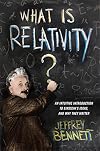
Targeted (presumably) for high school and early college students, this is about the clearest explanation of the implications of relativity I've come across. Many of the thought experiments he uses are familiar (clocks, rubber sheets, etc.), but his talent for clear language make them seem almost intuitive. For an easy introduction to a difficult subject, you can't do much better.
What Is Relativity?: An Intuitive Introduction to Einstein's Ideas, and Why They Matter by Jeffrey Bennett
Received via NetGalley and Columbia University Press for an completely unbiased review.
Jeffrey Bennett is no Brian Greene, but then again his own method of explaining basic physic principals seems to weave its way into its own set of followers. What is Relativity? Special Relativity? Why is it important for scientists that Einstein created Relativity, and what can it be used for? These are a few of the questions that Mr Bennett covers in his brief book of a mere 192 pages.
This concise book show more includes some images of fundamental principles (how the universe is shaped, or how we perceive the universe), and has limited explanations of each diagram. It would be fantastic if Bennett extrapolated in common terms on certain ideas (the creation of binary stars, for instance) because unless the reader has read a few other physics books, or taken classes in physics, they would probably have found it confusing. The discussion of specific measurements surrounding the gravity and pressure specific types of stars can maintain before falling in on themselves seemed a bit more complicated than necessary, if at all necessary.
I would have liked to see more emphasis on why black holes were so very important to the Relativity discussion. Although Bennett does prove his thesis that Relativity is indeed important to every day life, and the exploration/understanding of outer space, he fails to truly integrate his black hole discussions into the broader picture. If any future edits of this book are done, it would be beneficial to more clearly connect black holes to the thesis before continuing on with the structures and natures of the universe.
I would suggest this book to any physics or space junkie who doesn't want to wade through Einstein's own books, and wants a concise and direct introduction of all things Relative. show less
Jeffrey Bennett is no Brian Greene, but then again his own method of explaining basic physic principals seems to weave its way into its own set of followers. What is Relativity? Special Relativity? Why is it important for scientists that Einstein created Relativity, and what can it be used for? These are a few of the questions that Mr Bennett covers in his brief book of a mere 192 pages.
This concise book show more includes some images of fundamental principles (how the universe is shaped, or how we perceive the universe), and has limited explanations of each diagram. It would be fantastic if Bennett extrapolated in common terms on certain ideas (the creation of binary stars, for instance) because unless the reader has read a few other physics books, or taken classes in physics, they would probably have found it confusing. The discussion of specific measurements surrounding the gravity and pressure specific types of stars can maintain before falling in on themselves seemed a bit more complicated than necessary, if at all necessary.
I would have liked to see more emphasis on why black holes were so very important to the Relativity discussion. Although Bennett does prove his thesis that Relativity is indeed important to every day life, and the exploration/understanding of outer space, he fails to truly integrate his black hole discussions into the broader picture. If any future edits of this book are done, it would be beneficial to more clearly connect black holes to the thesis before continuing on with the structures and natures of the universe.
I would suggest this book to any physics or space junkie who doesn't want to wade through Einstein's own books, and wants a concise and direct introduction of all things Relative. show less
What Is Relativity?: An Intuitive Introduction to Einstein's Ideas, and Why They Matter by Jeffrey Bennett
Do you know everything about the Theory of Relativity? Then this book is not for you. However, if you are like me, and know little-to-nothing about Relativity but are highly intrigued by the topic, then this new book by Jeffrey Bennett may be just what you are looking for. Bennett takes the reader through the reality of the universe on a quest to understand why “black holes don’t suck”.
Bennett’s tone makes the book approachable. He uses humor well and writes in a way that minimizes show more the daunting nature of this topic. He takes the average reader though a complex subject with ease and depth. Bennett’s use of thought experiments helps to make the topics discussed accessible but also is the one area that can get overwhelmingly complex at times. This is to be expected. Bennett, while writing at an introductory level, is covering a topic that is contrary to what is the common understanding of much of the universe. Needless to say, you can get quite lost in the consequences of these ideas.
I saw comments about the mathematics in the book being complex but I couldn’t disagree more. Add to that the fact that all of the math used is supplemental to the text and you really don’t need any grip on mathematics to completely understand the points he makes throughout.
Gravitational redshifting, time running slower in gravity, tidal forces, event horizons, singularity, Special Theory of Relativity, General Theory of Relativity, and on and on and on. This book covers much that is quite interesting. Why would it literally take forever to cross the event horizon? What do ocean tides have to do with entering a black hole? What is actually “relative” in the Theory of Relativity? How is acceleration related to gravity and what effect does this have on our understanding of space and time?
I read mostly books from a Christian perspective so this might seem like a break from my normal routine of theology books. But it is not really. Too often Christians run away from the natural sciences because so many of the ideas seem to be competing or contrary to their own. This is sad. If the Bible is true, which it is, all truth is God’s truth. We should never be afraid to learn something new, even if it were to contradict something we have thought we understood. God is found in the truth and gaining a deeper understanding of His creation should only lead to greater praise and awe and worship. Bennett’s book led me to this and I am appreciative of that.
After reading this book I am an expert on Relativity. Nah, just kidding. But I do have a firmer grasp of much and many more questions I want to learn about. You really cannot ask for more from an introductory text than that. Black holes don’t suck. Neither does this book. :-D It is actually quite good.
***I received a review copy of this book from the publisher through NetGalley. show less
Bennett’s tone makes the book approachable. He uses humor well and writes in a way that minimizes show more the daunting nature of this topic. He takes the average reader though a complex subject with ease and depth. Bennett’s use of thought experiments helps to make the topics discussed accessible but also is the one area that can get overwhelmingly complex at times. This is to be expected. Bennett, while writing at an introductory level, is covering a topic that is contrary to what is the common understanding of much of the universe. Needless to say, you can get quite lost in the consequences of these ideas.
I saw comments about the mathematics in the book being complex but I couldn’t disagree more. Add to that the fact that all of the math used is supplemental to the text and you really don’t need any grip on mathematics to completely understand the points he makes throughout.
Gravitational redshifting, time running slower in gravity, tidal forces, event horizons, singularity, Special Theory of Relativity, General Theory of Relativity, and on and on and on. This book covers much that is quite interesting. Why would it literally take forever to cross the event horizon? What do ocean tides have to do with entering a black hole? What is actually “relative” in the Theory of Relativity? How is acceleration related to gravity and what effect does this have on our understanding of space and time?
I read mostly books from a Christian perspective so this might seem like a break from my normal routine of theology books. But it is not really. Too often Christians run away from the natural sciences because so many of the ideas seem to be competing or contrary to their own. This is sad. If the Bible is true, which it is, all truth is God’s truth. We should never be afraid to learn something new, even if it were to contradict something we have thought we understood. God is found in the truth and gaining a deeper understanding of His creation should only lead to greater praise and awe and worship. Bennett’s book led me to this and I am appreciative of that.
After reading this book I am an expert on Relativity. Nah, just kidding. But I do have a firmer grasp of much and many more questions I want to learn about. You really cannot ask for more from an introductory text than that. Black holes don’t suck. Neither does this book. :-D It is actually quite good.
***I received a review copy of this book from the publisher through NetGalley. show less
What Is Relativity?: An Intuitive Introduction to Einstein's Ideas, and Why They Matter by Jeffrey Bennett
This is a primer on the basic ideas of relativity. It includes great, illustrative cartoons and very little math. The author addresses many of the misconceptions people might have about concepts related to relativity because of pop culture and introduces some surprising ways relativity affects our daily lives.
Even though relativity is a topic I’ve been interested in since high school, I learned fascinating new facts from this book. The author made incredibly complex and counterintuitive show more concepts simple. He started with facts that made sense to me and built on them to make the odder results of relativity make sense too. I liked that he revisited the same thought experiments over and over. This made me comfortable with the ideas and helped me learn.
I liked that the author talked about the implications of relativity for our daily lives. He made a pretty convincing argument for why we should all care about the concepts he teaches here. I also loved that he taught the scientific method as he went. I think this is a book that would be perfect for introductory physics classes. It’s easy to follow and could inspire students to become interested in the topic.
This review first published on Doing Dewey. show less
Even though relativity is a topic I’ve been interested in since high school, I learned fascinating new facts from this book. The author made incredibly complex and counterintuitive show more concepts simple. He started with facts that made sense to me and built on them to make the odder results of relativity make sense too. I liked that he revisited the same thought experiments over and over. This made me comfortable with the ideas and helped me learn.
I liked that the author talked about the implications of relativity for our daily lives. He made a pretty convincing argument for why we should all care about the concepts he teaches here. I also loved that he taught the scientific method as he went. I think this is a book that would be perfect for introductory physics classes. It’s easy to follow and could inspire students to become interested in the topic.
This review first published on Doing Dewey. show less
Awards


You May Also Like


Associated Authors
Statistics
- Works
- 81
- Members
- 1,439
- Popularity
- #17,871
- Rating
- 3.9
- Reviews
- 22
- ISBNs
- 268
- Languages
- 3