
Judith R. Goodstein
Author of Feynman’s Lost Lecture; The Motion of Planets Around the Sun
Works by Judith R. Goodstein
Feynman’s Lost Lecture; The Motion of Planets Around the Sun (1996) — Editor — 599 copies, 10 reviews
Tagged
Common Knowledge
- Birthdate
- 1939-07-08
- Gender
- female
Members
Reviews
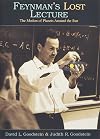
Richard Feynman will always be my favorite geek. I’ve read at least three of his books, but have never heard him speak anywhere, although he was the principle investigator of the Challenger disaster and there was much televised about that. The edition of this lecture was a CD that was available from my local library, no book. Other than the poor quality of the original recording transferred from the tape, I found his talk to be excellent.
I never studied Physics in school, but read a few show more books on the subject over the years, especially when my interest in Astronomy hit a fevered pitch around twenty-five years (or more) ago. Fortunately, I have a gift for all-things-mathematical, and was able to follow his lecture while driving at 70 mph up the highway. Planetary Motion explained in Plane Geometry – and done so eloquently! Then he follows that up with (if I recall correctly) an explanation of Rutherford’s Law (the scattering of subatomic particles) using PG again! When the lecture was over, the tape recorder was left running for another fifteen minutes as students came up to him and asked questions about various aspects of his lecture. He was generous to a fault with his time and his enthusiasm, and worked out the misunderstanding/answers with them.
Feynman speaks in the same style as he writes. Engaging would be a good word to start with. It was thrilling to hear him make comments to himself, give brief asides about a point he had just made, off-the-cuff remarks… The man was as brilliant as they come, and endlessly curious.
I can’t comment about the book because it is not available to me. So, suffice to say that if you have a half-way decent background in Math, you could probably learn from listening to the CD. If you have a nerdy side to you, you’ll probably like this more than you’d prefer to admit. I wish I had more professors with his level of enthusiasm when I went to college! show less
I never studied Physics in school, but read a few show more books on the subject over the years, especially when my interest in Astronomy hit a fevered pitch around twenty-five years (or more) ago. Fortunately, I have a gift for all-things-mathematical, and was able to follow his lecture while driving at 70 mph up the highway. Planetary Motion explained in Plane Geometry – and done so eloquently! Then he follows that up with (if I recall correctly) an explanation of Rutherford’s Law (the scattering of subatomic particles) using PG again! When the lecture was over, the tape recorder was left running for another fifteen minutes as students came up to him and asked questions about various aspects of his lecture. He was generous to a fault with his time and his enthusiasm, and worked out the misunderstanding/answers with them.
Feynman speaks in the same style as he writes. Engaging would be a good word to start with. It was thrilling to hear him make comments to himself, give brief asides about a point he had just made, off-the-cuff remarks… The man was as brilliant as they come, and endlessly curious.
I can’t comment about the book because it is not available to me. So, suffice to say that if you have a half-way decent background in Math, you could probably learn from listening to the CD. If you have a nerdy side to you, you’ll probably like this more than you’d prefer to admit. I wish I had more professors with his level of enthusiasm when I went to college! show less
Feynman's Lost Lecture: The Motions of Planets Around the Sun: Motion of Planets Around the Sun by Richard Feynman
At this late stage one has to wonder if there can be any worthwhile material by or about Feynman that hasn't already been published - the answer is, in this case, yes - but this doesn't offer a tremendous amount that would be new to dedicated Feynman fans. It's really for completests and neither a great nor terrible place to start for newcomers.
For just such newbies to Feynman I will briefly disclose that he was a Nobel Prize winning theoretical physicist who worked on the Manhattan Project show more in his youth and became famous not only for his professional skill but his quirky and irreverent public persona and his capabilities as an educator, both of the general public and of student physicists.
This lecture was omitted from the famous three volumes of lectures based on a two year undergrad introductory course that Feynman taught at Caltech. It is a demonstration of the fact that planets orbit the sun in elipses if Newton's Law of Gravitation is correct and perturbations from all the other planets are ignored - using only plane geometry. Since only a few diagrams and notes from the lecture remained, along with a voice recording of it, it was quite a task to reconstruct the proof, which as is pointed out by Feynman himself is, whilst elementary, not simple. That said, the explanation of the demonstration could not be clearer and anybody who can follow school level geometry will be fine. Because there are a large number of diagrams, what appears to be a lengthy (and therefore possibly intimidating) wodge of physics is in fact something you could read and understand in a couple of hours easily.
Additionally to the reconstruction and explanation of the proof, there is a mini-biography of Feynman which is best (as always) when telling anecdotes, not history, a transcript of Feynman delivering the lecture and a brief history of the relevant discoveries about the nature of the solar system, gravity and the way things move. show less
For just such newbies to Feynman I will briefly disclose that he was a Nobel Prize winning theoretical physicist who worked on the Manhattan Project show more in his youth and became famous not only for his professional skill but his quirky and irreverent public persona and his capabilities as an educator, both of the general public and of student physicists.
This lecture was omitted from the famous three volumes of lectures based on a two year undergrad introductory course that Feynman taught at Caltech. It is a demonstration of the fact that planets orbit the sun in elipses if Newton's Law of Gravitation is correct and perturbations from all the other planets are ignored - using only plane geometry. Since only a few diagrams and notes from the lecture remained, along with a voice recording of it, it was quite a task to reconstruct the proof, which as is pointed out by Feynman himself is, whilst elementary, not simple. That said, the explanation of the demonstration could not be clearer and anybody who can follow school level geometry will be fine. Because there are a large number of diagrams, what appears to be a lengthy (and therefore possibly intimidating) wodge of physics is in fact something you could read and understand in a couple of hours easily.
Additionally to the reconstruction and explanation of the proof, there is a mini-biography of Feynman which is best (as always) when telling anecdotes, not history, a transcript of Feynman delivering the lecture and a brief history of the relevant discoveries about the nature of the solar system, gravity and the way things move. show less
The title is irresistable. But, like most of my "reading Feynman" projects, it's more work than I thought it would be. He is, after all, a physicist.
But, it's not a bad lecture and it comes with a story about how it was reconstructed. So, it's another labor of love for a man who makes us proud to be human.
It's approximately the same level of material that's in Six Easy Pieces. I think I would've liked it better if I'd heard it before SEP. As it is, it was a lot of money for "just one more show more lecture".
I'd say, "Get it if you're considering getting SEP". It's a taste of what you're getting yourself into. show less
But, it's not a bad lecture and it comes with a story about how it was reconstructed. So, it's another labor of love for a man who makes us proud to be human.
It's approximately the same level of material that's in Six Easy Pieces. I think I would've liked it better if I'd heard it before SEP. As it is, it was a lot of money for "just one more show more lecture".
I'd say, "Get it if you're considering getting SEP". It's a taste of what you're getting yourself into. show less
This is a highly engaging lecture, but you have to work to 'get' the argument that Mr. Feymann makes regarding the elliptical orbit of our planets. This is a very rewarding book, which features a CD of Mr. Feymann 'proving' the shape of orbits using relatively simple math.
You May Also Like


Associated Authors
Statistics
- Works
- 4
- Members
- 642
- Popularity
- #39,292
- Rating
- 3.9
- Reviews
- 10
- ISBNs
- 21
- Languages
- 5