
Iain McGilchrist
Author of The Master and His Emissary: The Divided Brain and the Making of the Western World
About the Author
Works by Iain McGilchrist
The Master and His Emissary: The Divided Brain and the Making of the Western World (2009) 1,082 copies, 14 reviews
The Matter With Things: Our Brains, Our Delusions, and the Unmaking of the World (2021) 210 copies, 4 reviews
Nederlands Dans Theater & Complicité : Figures in Extinction : 5-8 November 2025 {programme} (2025) — Contributor — 1 copy
Tagged
Common Knowledge
- Birthdate
- 1953
- Gender
- male
- Occupations
- psychiatrist
philosopher
neuroscientist - Nationality
- UK
- Associated Place (for map)
- UK
Members
Reviews
The Matter With Things: Our Brains, Our Delusions, and the Unmaking of the World by Iain McGilchrist

I write book reviews all the time; with a good book, it is easy to find something to say. But with a great work, the task becomes nearly impossible. You find yourself wondering, "how could I say something more useful than the totality of what the work already inherently expresses?" Or, "won't I be banalizing or flattening the work by trying to sum it up?"
After six months of trying to write a book review that rises to the occasion, I've concluded that I've failed, so I'm writing this show more instead.
I read these books during a four-month period. Concurrently, I read McGilchrist's earlier work, "The Master and His Emissary," and listened to over forty hours of discussion about "The Matter with Things" on McGilchrist's YouTube channel.
I would warn those of you contemplating skimming the work: brain hemisphere science is perennially perverted and oversimplified. One of the reasons that this text is so massive is that the subject demands a high degree of rigor and nuance. One of my teachers, Carol Sanford, says, when you're entering a school, you need to take in the entirety of it. It is easy for us to uplift the things we agree with and minimize or ignore the things we don't agree with or don't understand. But when we do this, not only are we not learning anything new, we're also undermining the wholeness of whatever we're studying in a parasitic fashion. So please, commit and dive in, but don't test the water first.
I had actually been recommended this book when it came out, but it took me a year to pick it up. I have an allergy for the mechanistic and cybernetic analogies rife in neuroscience. I assumed this book would be more of the same. I was wrong. After the second ringing endorsement, I decided I should put my reservations aside and give it a try. Very quickly I came to see, what most people call "neuroscience" comes from a paradigm propagated by the left hemisphere of our brains.
A few foundations:
* All known organisms with brains, even those with only 180 neurons, have a right and a left brain hemisphere which behave in roughly the same way
* In simple terms, the left hemisphere is focused on automation, on processes, on mechanisms. The right hemisphere is focused on gestalt perception, on somatics, and on mystery.
* What the left hemisphere isn't aware of "doesn't exist." The clinical term for the lies the left hemisphere fabricates is called "confabulating."
* The right hemisphere acknowlegdes what it doesn't know, and is able to delegate (sometimes to the left hemisphere). The left hemisphere doesn't have this capacity.
The book is split into three sections:
I. The clinical science regarding the hemispheric function of the brain
II. Four windows of truth: science, reason, intuition, and imagination (each of which have right- and left-hemisphere aspects).
III. The metaphysics possible with these foundations (time, flow and turbulence, sense of the sacred, etc.)
Like any great work, as soon as you read this book, you'll start seeing everything through a brain hemisphere lens, because it is a totalizing framework.
Also like any great work, the gravity of McGilchrist's subject always means that the manifestation of his written material will have some shortcomings. I felt like the introduction to Part II, where McGilchrist scaffolded the structure of the brain hemispheres on the myth of the two brothers was brilliant. Where my own writing on the subject has fallen flat is that I have not yet found a myth through which to structure my writing; and I think that McGilchrist's work would be even more powerful if he had leaned more fully into myth in the creation of this book. McGilchrist also cites Indra's Net, which does seem to be one of the best analogies for the work, but doesn't explore the full depth of this analogy. Also, although McGilchrist calls out the fundamental importance of imagination and intuition, the vast majority of the text, by word count, is dedicated to science and reason. If anything, given our cultural bias towards science and reason and away from intuition and imagination, I wish this emphasis had been reversed.
This book feels akin to a threshold crossing, a trail, and initiation: you come out on the other side of reading it transformed.
I have numerous questions:
* What can the brain hemisphere lens illuminate about the nature of psychedelics?
* When does consciousness and mindfulness complement intuitive and somatic knowing? When does it undermine?
* How can we bring about a cultural evolution that restores balance between the brain hemispheres? Does the left hemisphere always "win" in a race towards mutually assured destruction?
To illustrate the impact of this book on my life, I'll end by noting: I find myself spending more time listening to music again. As a teenager, music was a central part of meaningfulness in my life. Reading this book has reminded me: the most important things in life don't need justification. We will know their value and priority if we allow ourselves to trust our intuition. show less
After six months of trying to write a book review that rises to the occasion, I've concluded that I've failed, so I'm writing this show more instead.
I read these books during a four-month period. Concurrently, I read McGilchrist's earlier work, "The Master and His Emissary," and listened to over forty hours of discussion about "The Matter with Things" on McGilchrist's YouTube channel.
I would warn those of you contemplating skimming the work: brain hemisphere science is perennially perverted and oversimplified. One of the reasons that this text is so massive is that the subject demands a high degree of rigor and nuance. One of my teachers, Carol Sanford, says, when you're entering a school, you need to take in the entirety of it. It is easy for us to uplift the things we agree with and minimize or ignore the things we don't agree with or don't understand. But when we do this, not only are we not learning anything new, we're also undermining the wholeness of whatever we're studying in a parasitic fashion. So please, commit and dive in, but don't test the water first.
I had actually been recommended this book when it came out, but it took me a year to pick it up. I have an allergy for the mechanistic and cybernetic analogies rife in neuroscience. I assumed this book would be more of the same. I was wrong. After the second ringing endorsement, I decided I should put my reservations aside and give it a try. Very quickly I came to see, what most people call "neuroscience" comes from a paradigm propagated by the left hemisphere of our brains.
A few foundations:
* All known organisms with brains, even those with only 180 neurons, have a right and a left brain hemisphere which behave in roughly the same way
* In simple terms, the left hemisphere is focused on automation, on processes, on mechanisms. The right hemisphere is focused on gestalt perception, on somatics, and on mystery.
* What the left hemisphere isn't aware of "doesn't exist." The clinical term for the lies the left hemisphere fabricates is called "confabulating."
* The right hemisphere acknowlegdes what it doesn't know, and is able to delegate (sometimes to the left hemisphere). The left hemisphere doesn't have this capacity.
The book is split into three sections:
I. The clinical science regarding the hemispheric function of the brain
II. Four windows of truth: science, reason, intuition, and imagination (each of which have right- and left-hemisphere aspects).
III. The metaphysics possible with these foundations (time, flow and turbulence, sense of the sacred, etc.)
Like any great work, as soon as you read this book, you'll start seeing everything through a brain hemisphere lens, because it is a totalizing framework.
Also like any great work, the gravity of McGilchrist's subject always means that the manifestation of his written material will have some shortcomings. I felt like the introduction to Part II, where McGilchrist scaffolded the structure of the brain hemispheres on the myth of the two brothers was brilliant. Where my own writing on the subject has fallen flat is that I have not yet found a myth through which to structure my writing; and I think that McGilchrist's work would be even more powerful if he had leaned more fully into myth in the creation of this book. McGilchrist also cites Indra's Net, which does seem to be one of the best analogies for the work, but doesn't explore the full depth of this analogy. Also, although McGilchrist calls out the fundamental importance of imagination and intuition, the vast majority of the text, by word count, is dedicated to science and reason. If anything, given our cultural bias towards science and reason and away from intuition and imagination, I wish this emphasis had been reversed.
This book feels akin to a threshold crossing, a trail, and initiation: you come out on the other side of reading it transformed.
I have numerous questions:
* What can the brain hemisphere lens illuminate about the nature of psychedelics?
* When does consciousness and mindfulness complement intuitive and somatic knowing? When does it undermine?
* How can we bring about a cultural evolution that restores balance between the brain hemispheres? Does the left hemisphere always "win" in a race towards mutually assured destruction?
To illustrate the impact of this book on my life, I'll end by noting: I find myself spending more time listening to music again. As a teenager, music was a central part of meaningfulness in my life. Reading this book has reminded me: the most important things in life don't need justification. We will know their value and priority if we allow ourselves to trust our intuition. show less
The Master and His Emissary: The Divided Brain and the Making of the Western World by Iain McGilchrist
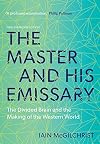
I'm amazed that I didn't learn of this book sooner! It came out in 2009, and I just got around to it in 2022. I picked it up because I was reading McGilchrist's new text, "The Matter with Things," and he said it picked up where his last book left off, so I thought it a good idea to pick up this earlier work.
I'm generally hesitant to pick up literature written by neuroscientists. This is because much of what is available out there looks at the brain as a machine. I was relieved to find that show more McGilchrist has none of this tenor, and one of the points of this book is to establish that neuroscience that looks at the brain as a machine is bad science!
The basic premise of the book is that the left and right hemispheres of our brain each inhabit a coherent paradigm, but that these two perspectives can often be at odds with one another, and which hemisphere gets priority has a huge bearing not just on our lives, but on the future of civilization and the planet.
All known organisms with brains have two hemispheres. Generally speaking the left hemisphere of our brain is concerned with instrumentalism and control, and the right hemisphere is concerned with relationship and animism. To speak to McGilchrist' philosophical argument, he posits that much of the arc of Western Civilization has given priority to the left hemisphere. He tracks the work of philosophers going back centuries that intuits hemispheric difference.
During and since reading the book, I've been applying McGilchrist's theory in other fields. How does hemispheric difference help to structure and inform different spiritual traditions, educational epistemologies, and schools of thought. This is a very rich field, and I hope that McGilchrist and others apply these theories broadly, as I think they have a lot to offer us in a wide range of different fields.
If you are going to read both books, at least in the science half (the first half) of each book, there is a lot of repetition. show less
I'm generally hesitant to pick up literature written by neuroscientists. This is because much of what is available out there looks at the brain as a machine. I was relieved to find that show more McGilchrist has none of this tenor, and one of the points of this book is to establish that neuroscience that looks at the brain as a machine is bad science!
The basic premise of the book is that the left and right hemispheres of our brain each inhabit a coherent paradigm, but that these two perspectives can often be at odds with one another, and which hemisphere gets priority has a huge bearing not just on our lives, but on the future of civilization and the planet.
All known organisms with brains have two hemispheres. Generally speaking the left hemisphere of our brain is concerned with instrumentalism and control, and the right hemisphere is concerned with relationship and animism. To speak to McGilchrist' philosophical argument, he posits that much of the arc of Western Civilization has given priority to the left hemisphere. He tracks the work of philosophers going back centuries that intuits hemispheric difference.
During and since reading the book, I've been applying McGilchrist's theory in other fields. How does hemispheric difference help to structure and inform different spiritual traditions, educational epistemologies, and schools of thought. This is a very rich field, and I hope that McGilchrist and others apply these theories broadly, as I think they have a lot to offer us in a wide range of different fields.
If you are going to read both books, at least in the science half (the first half) of each book, there is a lot of repetition. show less
The Master and His Emissary: The Divided Brain and the Making of the Western World by Iain McGilchrist
And we have a winner for best non-fiction of 2024. This is really a game-changing book for me.
The right brain is primary, and the left brain merely its emissary; yet the left brain often takes over, thinks HE is the master, and becomes a bully. All these decades I've thought of myself as left-brained, extremely so, maybe pathologically so. Maybe I just have to get the thing back on a leash. Maybe it just went haywire in my adolescence and I let it start getting away with murder.
The book show more begins with neuroscience and then deep dives - deep, DEEP dives - into the history of civilization, art, and science. I had no choice but to zone out for a lot of it; artistic discussions over my head, foreign language quotes not translated until the endnotes. This was 600 pages of heavy duty. But when I could glean what he was saying, it was a fascinating perspective.
My New Year's resolution - in addition to "stop getting mad when people call me" - is to see if I can put my left brain back in its place. You serve at my pleasure, left brain. show less
The right brain is primary, and the left brain merely its emissary; yet the left brain often takes over, thinks HE is the master, and becomes a bully. All these decades I've thought of myself as left-brained, extremely so, maybe pathologically so. Maybe I just have to get the thing back on a leash. Maybe it just went haywire in my adolescence and I let it start getting away with murder.
The book show more begins with neuroscience and then deep dives - deep, DEEP dives - into the history of civilization, art, and science. I had no choice but to zone out for a lot of it; artistic discussions over my head, foreign language quotes not translated until the endnotes. This was 600 pages of heavy duty. But when I could glean what he was saying, it was a fascinating perspective.
My New Year's resolution - in addition to "stop getting mad when people call me" - is to see if I can put my left brain back in its place. You serve at my pleasure, left brain. show less
The Master and His Emissary: The Divided Brain and the Making of the Western World by Iain McGilchrist

A marvelous, herculean tome which points in the direction of how and where multidisciplinary studies could and should be heading in cogsci. and elsewhere. Even just the footnotes are a fountain of material, a meta-study in themselves. McGhilchrist's fundamental thesis, that the left hemisphere, (perhaps moreso the prefrontal cortex, dorsolateral and dorsomedial, in terms of extrinsic processing) operates more in abstraction and inhibits our more contextual right-side processing is largely show more well-supported, though he does rely, I think, too much on modularity and not enough on networks. Which is to be expected, given the rapidity of change in and arrival of new data in the field. The book does, however, pretty much require at least a general familiarity of the brain and a fair amount of general cultural to read comfortably, being more than a mouthful. Hell, it's a truckload. show less
Lists
Awards


You May Also Like


Associated Authors
Statistics
- Works
- 8
- Members
- 1,386
- Popularity
- #18,546
- Rating
- 4.3
- Reviews
- 20
- ISBNs
- 22
- Languages
- 2
- Favorited
- 4