
Adam Kuper
Author of Anthropology and Anthropologists: The Modern British School
About the Author
Adam Kuper is a Centennial Professor at the London School of Economics and Political Science and a Visiting Professor at Boston University. His books include Culture: The Anthropologists Account (1999), The Reinvention of Primitive Society (2005) and Incest and Influence: The Private Life of show more Bourgeois England (2009). show less
Works by Adam Kuper
The Museum of Other People: From Colonial Acquisitions to Cosmopolitan Exhibitions (2023) 77 copies, 1 review
The Museum of Other People: From Colonial Acquisitions to Cosmopolitan Exhibitions (2024) 9 copies, 1 review
Associated Works
The Cambridge History of Science, Volume 7: The Modern Social Sciences (1991) — Contributor — 47 copies
Tagged
Common Knowledge
- Canonical name
- Kuper, Adam
- Legal name
- Kuper, Adam Jonathan
- Birthdate
- 1941-12-29
- Gender
- male
- Education
- University of Cambridge (D.Pjil)
University of Witswatersrand - Occupations
- social anthropologist
professor - Organizations
- London School of Economics and Political Science
Brunel University
Leiden University
University College London
Makerere University - Awards and honors
- Fellow, British Academy (2000)
Huxley Memorial Medal (2007)
Rivers Memorial Medal (2000) - Nationality
- South Africa (birth)
UK - Birthplace
- Johannesburg, Union of South Africa
- Places of residence
- Muswell Hill, London, England, UK
- Associated Place (for map)
- Muswell Hill, London, England, UK
Members
Reviews
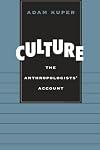
As Kuper states, “The core of this book is … an evaluation of what has been the central project in postwar American cultural anthropology” (x). More explicitly, in the first part of the book, he details the French and German ideals of culture that grew out of the Enlightenment. “Part Two: Experiments” looks at how Clifford Geertz, David Schneider, and Marshall Sahlins respectively have constructed anthropologies of culture in response to various intellectual influences. As he show more explains in the moving introduction, he lived through South Africa during the Apartheid when the very concept of culture was used to legitimize the most inhumane kinds of violence and racism imaginable. Because of this, Kuper is very much a skeptic when it comes to any kind of belief that use of the word “culture” communicates any objective, essential quality about people or the way they live their lives.
As I hinted at above, the argument starts in Europe, and migrates across the Atlantic Ocean. Kuper suggests that German intellectuals (Mannheim, Jaspers, and Mann more recently, but the concept dates back to Herder) believed in Kultur or Bildung – a kind of “cultured state by way of a process of education and spiritual development” which is “bounded in time and space and is coterminous with a national identity” (30). The French version of culture, with its haughty, transnational cosmopolitanism and materialism was perceived to be a direct threat to local distinctive cultures.
Kuper then goes on to detail Talcott Parson’s conception of culture as a tripartite endeavor between the psychologist, anthropologist, and sociologist, each of whom would understand culture as a semiological system of how we use symbols. He calls Geertz a Parsonian, and takes him to task for analyzing signs and symbols outside of social structure. He gives a detailed account of Geertz’s hermeneutical account of the Balinese cockfight in his book “The Interpretation of Cultures,” suggesting that Geertz’s lack of sociological concern in his anthropology leaves only an idealist approach to interpretation which is radically separated from social conditions.
David Schneider, the second anthropologist Kuper takes up, is known for his study of kinship relations. However, he completely divorced this pursuit from anything like an idea of “relationship” or “blood lines.” It should be noted that this is a fairly extreme version of relativism that not even many anthropologists adopt, and Kuper goes to lengths to point this out. Schneider makes the somewhat peculiar statement that “since it is perfectly possible to formulate … the cultural construct of ghosts without actually visually inspecting even a single specimen, this should be true across the board and without reference to the observability or non-observability of objects that may be presumed to be the referents of the cultural referents” (133). For Schneider, culture is wholly symbolic and arbitrary.
The best part of the chapter on Marshall Sahlins is Kuper’s retelling of Sahlins’ debate with Gananath Obeyesekere, the Princeton professor of anthropology. At the heart of the debate was the nature of rationality of “native peoples” (the debate specifically focused around Captain Cook and the Hawaiian Islands). Obeyesekere maintained that anything short of admitting that native people and Westerners think similarly is another way of saying that they are hopefully different, irrational, and uncivilized. Sahlins, however, holds that the rationality of native peoples is wholly and completely unknowable to those in the Occident. The closing chapters of the book are scathing rebukes of postmodernism, and especially its influence on the American anthropological tradition in the 1980s and 1990s, claiming that it has “a paralyzing effect on the discipline [of anthropology]” (223).
The twentieth century has certainly given the reader plenty of reasons to look askance at the very notion of culture. However, I am not sure that I am ready to completely do away with it as a powerful explanatory tool, no matter how diaphanous it may occasionally seem. I would definitely recommend the book for anyone interested in trends in twentieth-century American anthropology, and especially their intellectual genealogies. Whatever conclusions you have drawn about culture and what it means, I can guarantee you that this book will challenge them, and will do so thoughtfully. show less
As I hinted at above, the argument starts in Europe, and migrates across the Atlantic Ocean. Kuper suggests that German intellectuals (Mannheim, Jaspers, and Mann more recently, but the concept dates back to Herder) believed in Kultur or Bildung – a kind of “cultured state by way of a process of education and spiritual development” which is “bounded in time and space and is coterminous with a national identity” (30). The French version of culture, with its haughty, transnational cosmopolitanism and materialism was perceived to be a direct threat to local distinctive cultures.
Kuper then goes on to detail Talcott Parson’s conception of culture as a tripartite endeavor between the psychologist, anthropologist, and sociologist, each of whom would understand culture as a semiological system of how we use symbols. He calls Geertz a Parsonian, and takes him to task for analyzing signs and symbols outside of social structure. He gives a detailed account of Geertz’s hermeneutical account of the Balinese cockfight in his book “The Interpretation of Cultures,” suggesting that Geertz’s lack of sociological concern in his anthropology leaves only an idealist approach to interpretation which is radically separated from social conditions.
David Schneider, the second anthropologist Kuper takes up, is known for his study of kinship relations. However, he completely divorced this pursuit from anything like an idea of “relationship” or “blood lines.” It should be noted that this is a fairly extreme version of relativism that not even many anthropologists adopt, and Kuper goes to lengths to point this out. Schneider makes the somewhat peculiar statement that “since it is perfectly possible to formulate … the cultural construct of ghosts without actually visually inspecting even a single specimen, this should be true across the board and without reference to the observability or non-observability of objects that may be presumed to be the referents of the cultural referents” (133). For Schneider, culture is wholly symbolic and arbitrary.
The best part of the chapter on Marshall Sahlins is Kuper’s retelling of Sahlins’ debate with Gananath Obeyesekere, the Princeton professor of anthropology. At the heart of the debate was the nature of rationality of “native peoples” (the debate specifically focused around Captain Cook and the Hawaiian Islands). Obeyesekere maintained that anything short of admitting that native people and Westerners think similarly is another way of saying that they are hopefully different, irrational, and uncivilized. Sahlins, however, holds that the rationality of native peoples is wholly and completely unknowable to those in the Occident. The closing chapters of the book are scathing rebukes of postmodernism, and especially its influence on the American anthropological tradition in the 1980s and 1990s, claiming that it has “a paralyzing effect on the discipline [of anthropology]” (223).
The twentieth century has certainly given the reader plenty of reasons to look askance at the very notion of culture. However, I am not sure that I am ready to completely do away with it as a powerful explanatory tool, no matter how diaphanous it may occasionally seem. I would definitely recommend the book for anyone interested in trends in twentieth-century American anthropology, and especially their intellectual genealogies. Whatever conclusions you have drawn about culture and what it means, I can guarantee you that this book will challenge them, and will do so thoughtfully. show less

The history of ethnological museums was interesting. However, I was disappointed in his condescension and typical Western superior attitude to people from elsewhere and their right and ability to care for their own cultural resources. It was quite infuriating.
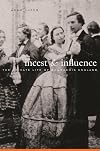
Scrutinizes cousin marriages and other related by blood unions from Jane Austen's characters to the Darwin family and the great families of the Victorian era.
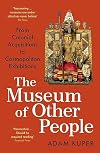
Initially with Taka and British Museum Team - will be in EPA Technical Library SWS - Shelved at : 756 / also have digital copy
Awards


You May Also Like


Associated Authors
Statistics
- Works
- 21
- Also by
- 2
- Members
- 584
- Popularity
- #42,937
- Rating
- 3.8
- Reviews
- 5
- ISBNs
- 75
- Languages
- 5