

Riane Eisler
Author of The Chalice and The Blade
About the Author
Riane Eisler is president of the Center for Partnership Studies and author of The Chalice and the Blade, Sacred Pleasure, Tomorrow's Children, and The Power of Partnership
Image credit: From author's website.
Works by Riane Eisler
Sacred Pleasure: Sex, Myth, and the Politics of the Body--New Paths to Power and Love (1995) 305 copies, 1 review
The Partnership Way: New Tools for Living and Learning, Healing Our Families, and Our World (A Practical Companion for "the Chalice and the Blade") (1990) 107 copies
Nurturing Our Humanity: How Domination and Partnership Shape Our Brains, Lives, and Future (2019) 14 copies
Transforming Interprofessional Partnerships: A New Framework for Nursing and Partnership-Based Health Care (2014) 8 copies
Von der Herrschaft zur Partnerschaft. Weibliches und männliches Prinzip in der Geschichte (1991) 4 copies
Chalice and the Blade, The 1 copy
Associated Works
You Are Being Lied To: The Disinformation Guide to Media Distortion, Historical Whitewashes, and Cultural Myths (2001) — Contributor, some editions — 739 copies, 4 reviews
Tagged
Common Knowledge
- Birthdate
- 1931-07-22
- Gender
- female
- Education
- University of California (Sociology, Law)
- Organizations
- Center for Partnership Studies (President)
the Spiritual Alliance to End Intimate Violence - Nationality
- Austria (birth)
- Birthplace
- Vienna, Austria
- Places of residence
- Vienna, Austria
Cuba
California, USA - Associated Place (for map)
- Vienna, Austria
Members
Reviews
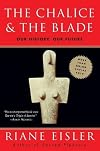
The premise of The Chalice and the Blade is intriguing: author Riane Eisner posits that there were peaceful, egalitarian, Goddess-worshiping cultures before recorded history, but these exemplary societies were wiped out by cruel, male-dominated hordes that worshiped warlike, masculine gods. Eisner relies on a few archaeologists and a lot of conjecture to make her case. She equates Goddess worship with elevated status for women, and ignores examples from non-Western cultures such as Japan, show more China, and India, where goddesses are venerated but the position of actual women is low.
I don’t have enough knowledge of ancient civilizations to refute Eisner's thesis, but it seems to me to be oversimplified and based on too many unsupported assumptions and generalizations. If I had read this book as an idealistic young adult, I would have eaten it up, but now it just doesn't ring true to me. show less
I don’t have enough knowledge of ancient civilizations to refute Eisner's thesis, but it seems to me to be oversimplified and based on too many unsupported assumptions and generalizations. If I had read this book as an idealistic young adult, I would have eaten it up, but now it just doesn't ring true to me. show less
I enjoyed this book more than I expected to. First of all, it did NOT insist - in fact, it refuted - the notion of a matriarchal prehistory. It said nice things about the life of Jesus. But it showed what living in a hierarchal culture has done to our species and our world in very blunt terms. It also ended on a hopeful note. I would read more by this author.
A seminal, life-changing book. I cannot recommend it enough. Recent archaeology shows that during and before Crete (7000 to 3500 BC) we were a peaceful, nurturing, partnership society. Mostly vegan. Women had high status and often ruled. The great Goddess was worshipped.
Then the barbarians from the edges [like north of the Black Sea] invaded. They brought with them a dominator culture with warfare, slavery, meat eating, rule by men only and the dark ages. Women became property, like cattle. show more Our culture has been the same ever since.
Eisler makes a convincing argument that until we address women's issues, nothing else will improve. Similar arguments are made in _The World Peace Diet-, but he blames everything on the culture of eating meat. show less
Then the barbarians from the edges [like north of the Black Sea] invaded. They brought with them a dominator culture with warfare, slavery, meat eating, rule by men only and the dark ages. Women became property, like cattle. show more Our culture has been the same ever since.
Eisler makes a convincing argument that until we address women's issues, nothing else will improve. Similar arguments are made in _The World Peace Diet-, but he blames everything on the culture of eating meat. show less
When I read this it was my first encounter with revisionist feminist anthropology. Eisler makes the case women and men enjoyed equal status in Neolithic times. To support her thesis she looks at designs on ancient pottery and cave drawings. Maybe as a layperson unfamiliar with her field of study and that of her critics, I can more easily accept her theories since I don't have a vested interest in protecting any similar scholarship, as tends to happen in academic circles. Her theories are show more refreshing and encouraging and support the refreshing notion that women haven't always been subjugated by men but were at one time actually revered and respected. show less
Lists
Awards


You May Also Like


Associated Authors
Statistics
- Works
- 22
- Also by
- 8
- Members
- 2,766
- Popularity
- #9,273
- Rating
- 3.8
- Reviews
- 36
- ISBNs
- 71
- Languages
- 11
- Favorited
- 2