
Marija Gimbutas (1921–1994)
Author of The Language of the Goddess
About the Author
Works by Marija Gimbutas
Associated Works
Weaving the Visions: New Patterns in Feminist Spirituality (1989) — Contributor — 387 copies, 2 reviews
Myth in Indo-European Antiquity (Publications of the UCSB Institute of Religious Studies) (1974) — Contributor — 12 copies
When Worlds Collide: Indo-Europeans and Pre-Indo-Europeans- The Bellaio Papers (Linguistica Extranea, Studia 19) (1990) — Contributor — 10 copies
To Illustrate the Monuments: Essays on Archaeology Presented to Stuart Piggott on the Occasion of his Sixty-Fifth Birthday (1976) — Contributor — 8 copies
Tagged
Common Knowledge
- Legal name
- Gimbutas, Marija Alseikaitė
- Other names
- Alseikaitė, Marija Birutė
Gimbutienė, Marija - Birthdate
- 1921-01-23
- Date of death
- 1994-02-02
- Gender
- female
- Education
- Aušra Gymnasium, Kaunas, Lithuania
Vytautas Magnus University, Kaunas, Lithuania
University of Vilnius
Tübingen University
University of Heidelberg
University of Munich - Occupations
- archaeologist
ethnologist
professor (Archaeology) - Organizations
- Harvard University
University of California, Los Angeles - Nationality
- Lithuania (birth)
USA - Birthplace
- Vilnius, Lithuania
- Places of residence
- Boston, Massachusetts, USA
Vienna, Austria
Munich, Bavaria, Germany
Kaunas, Lithuania
Innsbruck, Austria - Place of death
- Los Angeles, California, USA
- Burial location
- Petrašiūnai Cemetery, Kaunas
Members
Reviews
The Language of the Goddess: Unearthing the Hidden Symbols of Western Civilization by Marija Gimbutas

I bought this book last year, after winning Harald Haarmann's Roots of Ancient Greek Civilization as an Early Reviewer. Haarmann, based on linguistic studies, argues that "Old Europe" – the peoples of Europe prior to the arrival of Indo-Europeans – significantly influenced the language and culture of the Indo-European arrivistes. Haarmann's study of paleo-Greek linguistics was superb, and Haarmann expressed his own admiration for the archeomythological work of Marija Gimbutas.
I gave show more Haarmann's Roots of Ancient Greek Civilization 5***** but I'm giving Gimbutas's Language of the Goddess 3½***. I have some skepticism of Haarmann's view of "Old Europe" as an Edenic paradise, but that's a relatively minor flaw that isn't overemphasized by Haarmann. In contrast, Gimbutas too often reads like "New Age" speculation.
Additionally, Haarmann's study is based on very specific linguistic analysis while Gimbutas goes "all over the place" with interpretations of pottery and statuary designs that tend, in my view, to be far too speculative given our limited knowledge of "Old Europe" and its cult of the Goddess. In fact, I wonder if there even was a single Goddess cult as opposed to a multiplicity of cultic practices.
This particular book is lavish in its design and very generously illustrated. Some might even complain that it approaches the "coffee table" level, but I found Gimbutas's illustrations and photographs very appropriate and demonstrate her vast command of the factual evidence (as opposed, however, to the conclusions which she draws, which tend toward the speculative).
Caution: Despite its highly pictorial nature, this book is not a quick read and you should expect to read just a couple or three short chapters at a time if you don't want to be overwhelmed in details. show less
I gave show more Haarmann's Roots of Ancient Greek Civilization 5***** but I'm giving Gimbutas's Language of the Goddess 3½***. I have some skepticism of Haarmann's view of "Old Europe" as an Edenic paradise, but that's a relatively minor flaw that isn't overemphasized by Haarmann. In contrast, Gimbutas too often reads like "New Age" speculation.
Additionally, Haarmann's study is based on very specific linguistic analysis while Gimbutas goes "all over the place" with interpretations of pottery and statuary designs that tend, in my view, to be far too speculative given our limited knowledge of "Old Europe" and its cult of the Goddess. In fact, I wonder if there even was a single Goddess cult as opposed to a multiplicity of cultic practices.
This particular book is lavish in its design and very generously illustrated. Some might even complain that it approaches the "coffee table" level, but I found Gimbutas's illustrations and photographs very appropriate and demonstrate her vast command of the factual evidence (as opposed, however, to the conclusions which she draws, which tend toward the speculative).
Caution: Despite its highly pictorial nature, this book is not a quick read and you should expect to read just a couple or three short chapters at a time if you don't want to be overwhelmed in details. show less
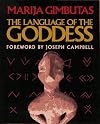
There is one good reason to own this book - the illustrations and, I suppose, the reference material at the back but it is not to be taken seriously theoretically.
Gimbutas was a romantic eccentric, part of whose importance is that she fuelled the rise of the matriarchal myth in feminism and in neo-paganism.
It must not be forgotten, however, that she was a serious academic and the flaw here is merely one of shifting from the evidence, rather imaginatively if inappropriately, to a 'grand show more narrative'.
The book thus leaps from probabalistic evidence-based social science to becoming part of a world of possibilian intellectual myth-making, of ideology, and eventually of the nonsense spouted by Californian earth mothers.
It is also the world of Campbell, Graves and Jung, and of the earnest desire to believe in lost Golden Ages, simplicity and better times ahead if we all, well, just believed that we were not as we are.
The book encapsulates this well. It is lavish and beautifully produced but it is also filled on page after page with assertions that simply cannot be justified by the data provided on the page.
There are huge leaps in time and space and the many ways to interpret a wavy line or a spiral are sacrificed to the demands of theory.
In the end, I found this book just plain sad. Vast amounts of intellectual labour and hard work have gone into something which is just as mythological as that which it purports to explain - lovely for non-dualist romantics with no sense of history but not taking the rest of us much further forward.
Worse, just as Marx did not intend the labour camps nor Jesus the Vatican, this book has spawned a very malign form of matriarchalism that enhances gender divisions and binary thinking.
Matriarchal feminism, like exaggerated rewritings of 'witch' history, creates an intellectual laziness in its followers and has introduced yet another reason for irrationalism in a world that badly needs critical thinking.
I have an immense amount of time for neo-paganism and magical thinking but these are weakened if they follow the religions of the book in perverting the past and the actualities of the human condition for 'religious effect'.
The high point of matriarchal feminism is probably now peaking with the narcissism of the decaying baby-boomers. Perhaps Gimbutas' work simply appeared at just the right cultural moment and should be seen as a phenomenon worthy of study in that context.
However, the work is presented here not as mythology but as archaeology and anthropology. Although it contains much of value, some of it stimulating and useful in the detail, it does not present a plausible case for a pre-Indo-European continent-wide goddess religion ousted by nomad warrior males. Common sense alone says that humanity is more complex than that simple model.
There may yet be truths within the myth but the superstructure does not justify the dreamy-eyed New Age posturings of Campbell in his introduction nor the socio-political assertions of modern day pagan 'jewish mommas' trying to escape daddy.
I do not usually like to quote Wikipedia at length, partly out of reliability concerns, but I think these criticisms should stand for the record about the corpus as a whole because the very idea of the 'great goddess' must and should be returned to its status of irrational belief or mere inadequately evidenced hypothesis.
" Anthropologist Bernard Wailes comments to the New York Times that he considers Gimbutas "immensely knowledgeable but not very good in critical analysis. [...] She amasses all the data and then leaps from it to conclusions without any intervening argument." He said that most archaeologists consider her to be an eccentric. This assessment was corroborated by female colleagues of Gimbutas.
" David Anthony has disputed Gimbutas's assertion that there was a widespread matriarchal society prior to the Kurgan incursion, noting that Europe had hillforts and weapons, and presumably warfare, long before the Kurgan.
" Two early critics of the "Goddess" theory were Andrew Fleming and Peter Ucko. Ucko, in his 1968 monograph Anthropomorphic figurines of predynastic Egypt warned against unwarranted inferences about the meanings of statues. Ucko, for example, notes that early Egyptian figurines of women holding their breasts had been taken as 'obviously' significant of maternity or fertility, but the Pyramid Texts revealed that in Egypt this was the female sign of grief. Fleming, in his 1969 paper "The Myth of the Mother Goddess", questioned the practice of identifying neolithic figures as female when they weren't clearly distinguished as male, and took issue with other aspects of the "Goddess" interpretation of Neolithic stone carvings and burial practices.
" The 2009 book Knossos and the prophets of modernism by Cathy Gere examines the political influence on archaeology more generally. Through the example of Knossos on the island of Crete, which had been (incorrectly) represented as the paradigm of a pacifist, matriarchal and sexually free society, Gere claims that archaeology can easily slip into reflecting what people want to see, rather than teaching people about an unfamiliar past."
By way of balance, however, like Marx, Gimbutas may have been ill-served by her followers and her publishers and admirers. She was undoubtedly an able academic and researcher and I recommend this article which places her in some kind of context where we can respect her contribution: http://www.suppressedhistories.net/articles/eller2.html
However, it is also true that it is very difficult to separate the actual work of the woman from her appropriation by others and even a cursory review of the literature shows that many radicals are in a state of willing her if not to be true in fact to be true in principle. That is fatal ...
Gimbutas' tragedy is that she became a pawn in a bigger cultural war between the two main genders within the Western middle classes over resources in the public sector and in the struggle for advantage within left-liberal coalition-builders who aimed at political power.
It is now probably time for a more balanced perspective. We can have respect for her as an academic in the field who contributed to our thinking about archaeological meaning even if wrong-headedly and a determination, as we should in dealing with other part-originators of politically and culturally useful ideologies, to critique the woolly-mindedness and weak evidence behind the myth that arose.
The book remains in the library but with a very big health warning marked 'ideological - take care of your critical faculties'. show less
Gimbutas was a romantic eccentric, part of whose importance is that she fuelled the rise of the matriarchal myth in feminism and in neo-paganism.
It must not be forgotten, however, that she was a serious academic and the flaw here is merely one of shifting from the evidence, rather imaginatively if inappropriately, to a 'grand show more narrative'.
The book thus leaps from probabalistic evidence-based social science to becoming part of a world of possibilian intellectual myth-making, of ideology, and eventually of the nonsense spouted by Californian earth mothers.
It is also the world of Campbell, Graves and Jung, and of the earnest desire to believe in lost Golden Ages, simplicity and better times ahead if we all, well, just believed that we were not as we are.
The book encapsulates this well. It is lavish and beautifully produced but it is also filled on page after page with assertions that simply cannot be justified by the data provided on the page.
There are huge leaps in time and space and the many ways to interpret a wavy line or a spiral are sacrificed to the demands of theory.
In the end, I found this book just plain sad. Vast amounts of intellectual labour and hard work have gone into something which is just as mythological as that which it purports to explain - lovely for non-dualist romantics with no sense of history but not taking the rest of us much further forward.
Worse, just as Marx did not intend the labour camps nor Jesus the Vatican, this book has spawned a very malign form of matriarchalism that enhances gender divisions and binary thinking.
Matriarchal feminism, like exaggerated rewritings of 'witch' history, creates an intellectual laziness in its followers and has introduced yet another reason for irrationalism in a world that badly needs critical thinking.
I have an immense amount of time for neo-paganism and magical thinking but these are weakened if they follow the religions of the book in perverting the past and the actualities of the human condition for 'religious effect'.
The high point of matriarchal feminism is probably now peaking with the narcissism of the decaying baby-boomers. Perhaps Gimbutas' work simply appeared at just the right cultural moment and should be seen as a phenomenon worthy of study in that context.
However, the work is presented here not as mythology but as archaeology and anthropology. Although it contains much of value, some of it stimulating and useful in the detail, it does not present a plausible case for a pre-Indo-European continent-wide goddess religion ousted by nomad warrior males. Common sense alone says that humanity is more complex than that simple model.
There may yet be truths within the myth but the superstructure does not justify the dreamy-eyed New Age posturings of Campbell in his introduction nor the socio-political assertions of modern day pagan 'jewish mommas' trying to escape daddy.
I do not usually like to quote Wikipedia at length, partly out of reliability concerns, but I think these criticisms should stand for the record about the corpus as a whole because the very idea of the 'great goddess' must and should be returned to its status of irrational belief or mere inadequately evidenced hypothesis.
" Anthropologist Bernard Wailes comments to the New York Times that he considers Gimbutas "immensely knowledgeable but not very good in critical analysis. [...] She amasses all the data and then leaps from it to conclusions without any intervening argument." He said that most archaeologists consider her to be an eccentric. This assessment was corroborated by female colleagues of Gimbutas.
" David Anthony has disputed Gimbutas's assertion that there was a widespread matriarchal society prior to the Kurgan incursion, noting that Europe had hillforts and weapons, and presumably warfare, long before the Kurgan.
" Two early critics of the "Goddess" theory were Andrew Fleming and Peter Ucko. Ucko, in his 1968 monograph Anthropomorphic figurines of predynastic Egypt warned against unwarranted inferences about the meanings of statues. Ucko, for example, notes that early Egyptian figurines of women holding their breasts had been taken as 'obviously' significant of maternity or fertility, but the Pyramid Texts revealed that in Egypt this was the female sign of grief. Fleming, in his 1969 paper "The Myth of the Mother Goddess", questioned the practice of identifying neolithic figures as female when they weren't clearly distinguished as male, and took issue with other aspects of the "Goddess" interpretation of Neolithic stone carvings and burial practices.
" The 2009 book Knossos and the prophets of modernism by Cathy Gere examines the political influence on archaeology more generally. Through the example of Knossos on the island of Crete, which had been (incorrectly) represented as the paradigm of a pacifist, matriarchal and sexually free society, Gere claims that archaeology can easily slip into reflecting what people want to see, rather than teaching people about an unfamiliar past."
By way of balance, however, like Marx, Gimbutas may have been ill-served by her followers and her publishers and admirers. She was undoubtedly an able academic and researcher and I recommend this article which places her in some kind of context where we can respect her contribution: http://www.suppressedhistories.net/articles/eller2.html
However, it is also true that it is very difficult to separate the actual work of the woman from her appropriation by others and even a cursory review of the literature shows that many radicals are in a state of willing her if not to be true in fact to be true in principle. That is fatal ...
Gimbutas' tragedy is that she became a pawn in a bigger cultural war between the two main genders within the Western middle classes over resources in the public sector and in the struggle for advantage within left-liberal coalition-builders who aimed at political power.
It is now probably time for a more balanced perspective. We can have respect for her as an academic in the field who contributed to our thinking about archaeological meaning even if wrong-headedly and a determination, as we should in dealing with other part-originators of politically and culturally useful ideologies, to critique the woolly-mindedness and weak evidence behind the myth that arose.
The book remains in the library but with a very big health warning marked 'ideological - take care of your critical faculties'. show less
The Language of the Goddess: Unearthing the Hidden Symbols of Western Civilization by Marija Gimbutas
This is a reference-style book which proposes many cultural interpretations of the decorative aspects in pottery. The referenced pottery and archaeological digs were from various sites in Europe, the Near East and The British Isles.
I enjoyed the matriarchal myths the author reported and attributes to neo-pagan practices but in all honesty, there were next to no supporting documents or citations to validate her remarks. Such speculative ideas seem out of place here, when there are no data to show more justify the assertions. The over-arching hypothesis of a culture of The Goddess is unsubstantiated, perhaps more a case of 'away with the fairies' in support of the author's favoured notion. Gimbutas' earlier anthropological work was apparently very sound, so this departure was a surprise, even to her colleagues in archaeology (consult the Wikipedia entry for more perspectives).
Despite these drawbacks, I learned more about the symbolism on the inscribed pottery shards. These were validated with the cultural practices of those times. The data help understand hand-embroidery in textiles that appeared in more recent centuries which alludes to these ancient origins. show less
I enjoyed the matriarchal myths the author reported and attributes to neo-pagan practices but in all honesty, there were next to no supporting documents or citations to validate her remarks. Such speculative ideas seem out of place here, when there are no data to show more justify the assertions. The over-arching hypothesis of a culture of The Goddess is unsubstantiated, perhaps more a case of 'away with the fairies' in support of the author's favoured notion. Gimbutas' earlier anthropological work was apparently very sound, so this departure was a surprise, even to her colleagues in archaeology (consult the Wikipedia entry for more perspectives).
Despite these drawbacks, I learned more about the symbolism on the inscribed pottery shards. These were validated with the cultural practices of those times. The data help understand hand-embroidery in textiles that appeared in more recent centuries which alludes to these ancient origins. show less

By developing a more penetrating but just as rigorous methodology, Gimbutas fills in the "story" of the transition from the Neolithic to the Bronze Age in European antiquity. She combined excavation archeology with Linguistics and the study of Myth, coining the terms "archeomythology", "Old Europe" (gynocentric pre-androcratic communities), and "Kurgan".
She brings light to the very concept of "civilization". Not only 600+ pictures of the artifacts, not only charts and timelines showing show more perspective and flows, but scaled drawings of structures and communities clarified by the extensive excavations.
Abundant irrefutable evidence that "civilization" flourished in Old Europe between 6500 and 3500 BC (and in Crete until 1450 BC), and this period was characterized by art, refinement, cleanliness, trade, and No War.
Widespread fighting and fortification building became a way of life from the Bronze Age up until now, but this is "not the case in the Paleolithic and Neolithic". There are NO depictions of arms or torture in the Cave Paintings. Gimbutas shows that the Neolithic period with large towns and peace was not "pre-civilization".
Also, compare the agricultural site at Catal Huyuk, in Anatolia (hog domestication), with hundreds of temples and paintings in all of them and not one scene of warfare or torture [xi].
The book is written as a tool to "refocus our collective memory. The necessity for this has never been greater as we discover that the path of 'progress' is extinguishing the very conditions for life on earth." {In case anyone asks why we study the past. Why we look for our present and future potential.} show less
She brings light to the very concept of "civilization". Not only 600+ pictures of the artifacts, not only charts and timelines showing show more perspective and flows, but scaled drawings of structures and communities clarified by the extensive excavations.
Abundant irrefutable evidence that "civilization" flourished in Old Europe between 6500 and 3500 BC (and in Crete until 1450 BC), and this period was characterized by art, refinement, cleanliness, trade, and No War.
Widespread fighting and fortification building became a way of life from the Bronze Age up until now, but this is "not the case in the Paleolithic and Neolithic". There are NO depictions of arms or torture in the Cave Paintings. Gimbutas shows that the Neolithic period with large towns and peace was not "pre-civilization".
Also, compare the agricultural site at Catal Huyuk, in Anatolia (hog domestication), with hundreds of temples and paintings in all of them and not one scene of warfare or torture [xi].
The book is written as a tool to "refocus our collective memory. The necessity for this has never been greater as we discover that the path of 'progress' is extinguishing the very conditions for life on earth." {In case anyone asks why we study the past. Why we look for our present and future potential.} show less
Lists
Awards


You May Also Like


Associated Authors
Statistics
- Works
- 26
- Also by
- 7
- Members
- 1,550
- Popularity
- #16,613
- Rating
- 3.9
- Reviews
- 16
- ISBNs
- 49
- Languages
- 5
- Favorited
- 5

