

Emanuel Tov
Author of Textual Criticism of the Hebrew Bible
About the Author
Emanuel Tov, Ph.D. (1974), Hebrew University, Jerusalem is J.L. Magnes Professor of Bible emeritus at that University. He has published many monographs on the textual criticism of the Hebrew Bible and Qumran, and was the editor-in-chief of the Dead Sea Scrolls publication project.
Works by Emanuel Tov
The Greek and Hebrew Bible: Collected Essays on the Septuagint (Supplements to Vetus Testamentum) (1999) 36 copies
Scribal Practices and Approaches Reflected in the Texts Found in the Judean Desert (Studies on the Texts of the Desert of Judah) (2004) 21 copies
Discoveries in the Judaean Desert. Volume VIII: The Greek Minor Prophets Scroll from Nahal Hever, 8HevXIIgr: The Seiyal Collection I (1990) 8 copies
The Story of David and Goliath : textual and literary criticism : papers of a joint research venture (1986) 7 copies
Hebrew Bible, Greek Bible, and Qumran: Collected Essays (Texts and Studies in Ancient Judaism) (2008) 7 copies
Textual Criticism of the Hebrew Bible, Qumran, Septuagint: Collected Essays (Supplements to Vetus Testamentum) (2015) 6 copies
The Septuagint translation of Jeremiah and Baruch : a discussion of an early revision of the LXX of Jeremiah 29-52 and Baruch 1:1-3:8 (1976) 5 copies
The Dead Sea Scrolls on Microfiche: A Comprehensive Facsimile Edition of the Texts from the Judean Desert (1993) 4 copies
Biḳoret nusaḥ ha-Miḳra: Pirḳe mavo (Sifriyat ha-Entsiḳlopedyah ha-Miḳraʼit) (Hebrew Edition) (1989) 2 copies
Jewish Greek Scriptures 1 copy
Studies in Textual Criticism: Collected Essays (5) (Supplements to Vetus Testamentum, 197) (2024) 1 copy
The Text-Critical Use of the Septuagint in Biblical Research, Revised and Enlarged Second Edition 1 copy
ביקורת נוסח המקרא 1 copy
Associated Works
Pomegranates and Golden Bells: Studies in Biblical, Jewish, and Near Eastern Ritual, Law and Literature in Honor of Jacob Milgrom (1995) — Contributor — 42 copies
The New Cambridge History of the Bible: Volume 1, From the Beginnings to 600 (2013) — Contributor — 37 copies
The community of the renewed covenant : the Notre Dame Symposium on the Dead Sea Scrolls (1994) — Contributor — 23 copies
Scripture in Transition: Essays on Septuagint, Hebrew Bible, and Dead Sea Scrolls in Honour of Raija Sollamo (Supplements to the Journal for the Study of Judaism) (2008) — Contributor — 13 copies
Flores Florentino: Dead Sea Scrolls and Other Early Jewish Studies in Honour of Florentino Garcia Martfnez (Supplements to the Journal for the Study of Judaism) (2007) — Contributor — 10 copies
A Teacher for All Generations (2 vol. set) (Supplements to the Journal for the Study of Judaism) (2011) — Contributor — 9 copies
The Melbourne Symposium on Septuagint Lexicography (Septuagint and Cognate Studies Series) (English and Ancient Greek Edition) (1990) — Contributor — 9 copies
The ancient synagogue from its origins until 200 C.E. : papers presented at an international conference at Lund University, October 14-17, 2001 (2003) — Contributor — 9 copies
Authoritative Scriptures in Ancient Judaism (Supplements to the Journal for the Study of Judaism) (2010) — Contributor — 9 copies
Semitic Papyrology in Context: A Climate of Creativity. : Papers from a New York University Conference Marking the Retirement of Baruch A. Levine (Culture and History of the… (2003) — Contributor — 8 copies
Pentateuchal Traditions in the Late Second Temple Period: Proceedings of the International Workshop in Tokyo, August 28-31, 2007 (Supplements to the Journal for the Study of… (2012) — Contributor — 7 copies
Things Revealed: Studies In Early Jewish And Christian Literature In Honor Of Michael E. Stone (Supplements to the Journal for the Study of Judaism) (2004) — Contributor — 7 copies
Sibyls, Scriptures, and Scrolls: John Collins at Seventy (Supplements to the Journal for the Study of Judaism) (2016) — Contributor — 6 copies
Prayer and Poetry in the Dead Sea Scrolls and Related Literature: Essays in Honor of Eileen Schuller on the Occasion of Her 65th Birthday (Studies of the Texts of Thedesert of… (2011) — Contributor — 6 copies
Empsychoi logoi--religious innovations in antiquity studies in honour of Pieter Willem van der Horst (2008) — Contributor — 6 copies
Current Research and Technological Developments on the Dead Sea Scrolls: Conference on the Texts from the Judean Desert, Jerusalem, 30 April 1995 (Studies on the Texts of the… (1996) — Contributor — 6 copies
Biblical Perspectives: Early Use and Interpretation of the Bible in Light of the Dead Sea Scrolls: Proceedings of the First International Symposium of ... (Studies on the Texts of… (1998) — Contributor — 5 copies
Celebrating the Dead Sea Scrolls: A Canadian Collection (Society of Biblical Literature: Early Judaism and Its Literature) (2011) — Contributor — 5 copies
Go Out and Study the Land Judges 18:2: Archaeological, Historical and Textual Studies in Honor of Hanan Eshel (Supplements to the Journal for the Study of Judaism) (2011) — Contributor — 4 copies
Rewritten Bible after fifty years : texts, terms, or techniques? : a last dialogue with Geza Vermes (2014) — Contributor — 3 copies
Time to Prepare the Way in the Wilderness: Papers on the Qumran Scrolls by Fellows of the Institute for Advanced Studies of the Hebrew University, ... (Studies on the Texts of the… (1994) — Contributor — 3 copies
The Quest for Context and Meaning: Studies in Biblical Intertextuality in Honor of James A. Sanders (1997) — Contributor — 3 copies
After Qumran: Old and Modern Editions of the Biblical Texts (Bibliotheca Ephemeridum Theologicarum Lovaniensium) (2012) — Contributor — 2 copies
Tagged
Common Knowledge
- Birthdate
- 1941
- Gender
- male
- Education
- Harvard University (Ph.D 1973)
Hebrew University of Jerusalem (BA 1964, MA 1967) - Occupations
- professor
editor-in-chief (DSSPP) - Organizations
- Hebrew University of Jerusalem
Dead Sea Scrolls Editorial Team
Dead Sea Scrolls Publication Project - Nationality
- Netherlands (birth)
Israel - Birthplace
- Amsterdam, Netherlands
- Places of residence
- Amsterdam, Netherlands (birth)
- Associated Place (for map)
- Amsterdam, Netherlands
Members
Reviews
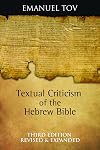
Reading "Textual Criticism of the Hebrew Bible" by Emanuel Tov was both a joy and a challenge. I thoroughly enjoyed immersing myself in the world of the Hebrew Bible. Ancient manuscripts, Dead Sea Scroll finds, ancient versions, textual variants — all of these things stir the Bible-geek in me. At the same time, the state of current scholarship with regard to the Old Testament text can be a bit troubling to an evangelical Christian. While the New Testament stands affirmed by numerous show more manuscript discoveries to the extent that almost all textual critics can agree on the vast majority of the minute details of the text, the same cannot be said for the Hebrew Old Testament.
Emanuel Tov takes readers of all scholastic levels by the hand as he surveys the field of Old Testament textual criticism. This third edition of his classic textbook, explains things for the novice and scholar alike. Careful footnotes and innumerable bibliographic entries will impress the scholar, while charts, graphs and numerous glossaries keep the would-be scholar feeling like he is getting somewhere. I have no problem admitting that I am one of the would-be scholars, with barely a year of Hebrew under my belt. Yet I was able to work my way through this book, becoming sharper in my Hebrew and awakening to the many facets of the intriguing study of OT textual criticism.
Tov has departed from a more traditional stance in his earlier versions, opting instead to follow the evidence from the Dead Sea Scrolls and contemporary studies. He manages to keep away from a fatal skepticism, however, arguing that textual evaluation still has merit. The aim is still to recover the earliest possible text, but the recognition that there are often two or three competing literary editions of the text complicate the matter. An example would be the different editions of Jeremiah, with the Septuagint (LXX) Greek version differing drastically from the Hebrew Masoretic Text (MT). 1 Samuel provides another example with a Dead Sea Scroll offering perhaps a third different competing literary edition. Tov points out the two very different versions of the story of David and Goliath and Hannah’s prayer as he expounds on the problem.
Rather than trying to solve each exegetical or specific textual problem, Tov aims to illustrate the challenges facing the would-be textual critic. He surveys the textual data, and reconstructs the history of the text – giving more attention to the accidents of history, such as the destruction of the Jewish state in A.D. 70, as weighing into the nature of the textual evidence we have. Rather than the Masoretic Text gradually gaining dominance, it was the de facto winner of the “text wars”. The LXX-style Hebrew texts (which the Dead Sea Scrolls and other finds have confirmed existed), were ignored by the Jews as Christianity had owned the LXX as its own. The Samaritans had their version of the Pentateuch, and the existence of a variety of other text forms, such as those found at Qumran (the DSS) were forgotten with the cessation of a normal state of existence for Jewish people. The Masoretic text found itself with little real competition and over the years came to be further refined and stable. I should clarify here, that this is not to downplay the Masoretic text, as it manifestly preserves very ancient readings, and Tov repeatedly affirms the remarkable tenacity of the MT. Instead, Tov is saying that the majority position the MT holds among the textual evidence and in the minds of the Jewish communities in the last 1800 years should not prejudice the scholar to consistently prefer MT readings. Tov in fact claims that text types, such as are commonly discussed in NT textual criticism, are largely irrelevant in dealing with the OT text. Internal considerations are key in textual evaluation. I will let Tov explain further:
"Therefore, it is the choice of the most contextually appropriate reading that is the main task of the textual critic…. This procedure is as subjective as can be. Common sense, rather than textual theories, is the main guide, although abstract rules are sometimes also helpful."(pg. 280)
Tov’s textbook goes into glorious detail concerning all the orthographic features that make up paleo-Hebraic script, and the square Hebrew script we are familiar with. His knowledge is encyclopedic, to say the least. The numerous images of manuscripts that are included in the back of the book are invaluable. His discussion on the orthographic details of the text should convince even the most diehard traditionalists, that the vowel points and many of the accents were later additions to the text, inserted by the Masoretes. Some still defend the inspiration of the vowel points, but Tov’s explanation of numerous textual variants that flow from both a lack of vowel points and from the originality of paleo-Hebraic script (and the long development of the language and gradual changes in the alphabet, and etc.) close the door against such stick-in-the-mud thinking.
Tov’s book details the pros and cons of different Hebrew texts, as well as discussing electronic resources and new developments in the study of textual criticism. His work is immensely valuable to anyone interested in learning about textual criticism, and of course is required for any textual scholars seeking to do work in this field.
Tov doesn’t add a theology to his textual manual, however. And this is what is needed to navigate OT textual criticism. After having read Tov, I’m interested in seeing some of the better evangelical treatments of the textual problems of the Hebrew Bible. I believe we have nothing to fear in facing textual problems head on. Seeing different literary editions of the text can fill out our understanding of the underlying theology of the Bible as we have it. Some of the work of John H. Sailhamer illustrates this judicious use of contemporary scholarship concerning the literary strata of the text.
Tov’s book is not law, and he sufficiently qualifies his judgments. He stresses that textual criticism, especially for the Old Testament, is inherently subjective. It is an art. And those who don’t recognize that, are especially prone to error in this field. This book equips the student to exercise this art in the best possible way. Tov walks the reader through evaluating competing textual variants, and his study will furnish the careful reader with all the tools to develop their own approach to the text. Tov’s findings won’t erode the foundations of orthodox theology. I contend that they will strengthen it. As with NT textual criticism, paying attention to the textual details has unlooked-for and happy consequences. It strengthens exegesis, and allows for a greater insight into the meaning of the text. And it can build one’s faith.
Bible-geeks, aspiring scholars, teachers and students alike will benefit from this book. Understanding the current state of OT textual criticism puts many of the NT textual debates into perspective. Christians don’t know their Old Testaments well enough, and studying the text to this level is rare indeed. I encourage you to consider adding this book to your shelf, and making it a priority to think through the challenges surrounding the text of the Hebrew Bible.
Disclaimer: This book was provided by Fortress Press. I was under no obligation to offer a favorable review. show less
Emanuel Tov takes readers of all scholastic levels by the hand as he surveys the field of Old Testament textual criticism. This third edition of his classic textbook, explains things for the novice and scholar alike. Careful footnotes and innumerable bibliographic entries will impress the scholar, while charts, graphs and numerous glossaries keep the would-be scholar feeling like he is getting somewhere. I have no problem admitting that I am one of the would-be scholars, with barely a year of Hebrew under my belt. Yet I was able to work my way through this book, becoming sharper in my Hebrew and awakening to the many facets of the intriguing study of OT textual criticism.
Tov has departed from a more traditional stance in his earlier versions, opting instead to follow the evidence from the Dead Sea Scrolls and contemporary studies. He manages to keep away from a fatal skepticism, however, arguing that textual evaluation still has merit. The aim is still to recover the earliest possible text, but the recognition that there are often two or three competing literary editions of the text complicate the matter. An example would be the different editions of Jeremiah, with the Septuagint (LXX) Greek version differing drastically from the Hebrew Masoretic Text (MT). 1 Samuel provides another example with a Dead Sea Scroll offering perhaps a third different competing literary edition. Tov points out the two very different versions of the story of David and Goliath and Hannah’s prayer as he expounds on the problem.
Rather than trying to solve each exegetical or specific textual problem, Tov aims to illustrate the challenges facing the would-be textual critic. He surveys the textual data, and reconstructs the history of the text – giving more attention to the accidents of history, such as the destruction of the Jewish state in A.D. 70, as weighing into the nature of the textual evidence we have. Rather than the Masoretic Text gradually gaining dominance, it was the de facto winner of the “text wars”. The LXX-style Hebrew texts (which the Dead Sea Scrolls and other finds have confirmed existed), were ignored by the Jews as Christianity had owned the LXX as its own. The Samaritans had their version of the Pentateuch, and the existence of a variety of other text forms, such as those found at Qumran (the DSS) were forgotten with the cessation of a normal state of existence for Jewish people. The Masoretic text found itself with little real competition and over the years came to be further refined and stable. I should clarify here, that this is not to downplay the Masoretic text, as it manifestly preserves very ancient readings, and Tov repeatedly affirms the remarkable tenacity of the MT. Instead, Tov is saying that the majority position the MT holds among the textual evidence and in the minds of the Jewish communities in the last 1800 years should not prejudice the scholar to consistently prefer MT readings. Tov in fact claims that text types, such as are commonly discussed in NT textual criticism, are largely irrelevant in dealing with the OT text. Internal considerations are key in textual evaluation. I will let Tov explain further:
"Therefore, it is the choice of the most contextually appropriate reading that is the main task of the textual critic…. This procedure is as subjective as can be. Common sense, rather than textual theories, is the main guide, although abstract rules are sometimes also helpful."(pg. 280)
Tov’s textbook goes into glorious detail concerning all the orthographic features that make up paleo-Hebraic script, and the square Hebrew script we are familiar with. His knowledge is encyclopedic, to say the least. The numerous images of manuscripts that are included in the back of the book are invaluable. His discussion on the orthographic details of the text should convince even the most diehard traditionalists, that the vowel points and many of the accents were later additions to the text, inserted by the Masoretes. Some still defend the inspiration of the vowel points, but Tov’s explanation of numerous textual variants that flow from both a lack of vowel points and from the originality of paleo-Hebraic script (and the long development of the language and gradual changes in the alphabet, and etc.) close the door against such stick-in-the-mud thinking.
Tov’s book details the pros and cons of different Hebrew texts, as well as discussing electronic resources and new developments in the study of textual criticism. His work is immensely valuable to anyone interested in learning about textual criticism, and of course is required for any textual scholars seeking to do work in this field.
Tov doesn’t add a theology to his textual manual, however. And this is what is needed to navigate OT textual criticism. After having read Tov, I’m interested in seeing some of the better evangelical treatments of the textual problems of the Hebrew Bible. I believe we have nothing to fear in facing textual problems head on. Seeing different literary editions of the text can fill out our understanding of the underlying theology of the Bible as we have it. Some of the work of John H. Sailhamer illustrates this judicious use of contemporary scholarship concerning the literary strata of the text.
Tov’s book is not law, and he sufficiently qualifies his judgments. He stresses that textual criticism, especially for the Old Testament, is inherently subjective. It is an art. And those who don’t recognize that, are especially prone to error in this field. This book equips the student to exercise this art in the best possible way. Tov walks the reader through evaluating competing textual variants, and his study will furnish the careful reader with all the tools to develop their own approach to the text. Tov’s findings won’t erode the foundations of orthodox theology. I contend that they will strengthen it. As with NT textual criticism, paying attention to the textual details has unlooked-for and happy consequences. It strengthens exegesis, and allows for a greater insight into the meaning of the text. And it can build one’s faith.
Bible-geeks, aspiring scholars, teachers and students alike will benefit from this book. Understanding the current state of OT textual criticism puts many of the NT textual debates into perspective. Christians don’t know their Old Testaments well enough, and studying the text to this level is rare indeed. I encourage you to consider adding this book to your shelf, and making it a priority to think through the challenges surrounding the text of the Hebrew Bible.
Disclaimer: This book was provided by Fortress Press. I was under no obligation to offer a favorable review. show less

Desde a sua publicação inicial em 1992, a obra Textual Criticism of the Hebrew Bible se estabeleceu como o indispensável texto acadêmico competente e referência sobre o assunto. Nesta edição, Emanuel Tov incorporou totalmente os insights dos últimos vinte anos intensos de estudos acadêmicos, incluindo novas perspectivas sobre os textos bíblicos entre os manuscritos bíblicos do Deserto da Judeia agora publicados. Aqui o estudante encontrará uma introdução bem organizada para os show more recursos e prática da crítica textual; o estudioso encontrará uma penetrante discussão programática criteriosa dos seus métodos. A obra é rica em novas discussões e novos destaques. O resultado é uma apresentação notavelmente lúcida sobre uma disciplina complexa, atrativa e de constante mudança. show less
Ensaios Reunidos Sobre a Septuaginta A série Supplements to Vetus Testamentum abrange toda a extensão de estudos do Antigo Testamento. Inclui os estudos sobre a Septuaginta, pesquisas relevantes de ugarítico para o estudo do Antigo Testamento, estudos hebraicos, estudos sobre a antiga história e sociedade israelitas e estudos sobre a história da disciplina. Há tanto obras individuais quanto volumes coletivos, estes últimos incluem os Proceedings of the Triennial International show more Congresses of the International Organization for the Study of the Old Testament. Este volume contém trinta e oito estudos dedicados à Septuaginta. Escritos por Emanuel Tov, um expert reconhecido em nível internacional sobre a referida versão bíblica clássica e a sua relação com a Bíblia Hebraica. A experiência do autor sobre tais tópicos é baseada em mais de três décadas de trabalho no Hebrew University Bible Project (HUBP), no projeto Computer Assisted Tools for Septuagint Studies (CATSS) e em cursos anuais sobre a Septuaginta ministrada na Universidade Hebraica de Jerusalém. Tais estudos, originalmente publicados entre 1971 e 1997, tratam dos seguintes assuntos: tópicos gerais, lexicografia, técnicas de tradução e exegese da Septuaginta, crítica textual e literária da Bíblia Hebraica e as revisões da Septuaginta. Todos os estudos incluídos nesta obra foram revisados, ampliados ou, em alguns casos, encurtados de maneira considerável; e integram estudos que apareceram posteriormente após a redação original dos mesmos. show less
You May Also Like


Associated Authors
Statistics
- Works
- 31
- Also by
- 28
- Members
- 685
- Popularity
- #36,933
- Rating
- 4.1
- Reviews
- 6
- ISBNs
- 55
- Languages
- 4