
About the Author
Kim John Payne M.Ed, is a leading teacher, parent educator and family counsellor. He and his team have trained over 1,00,0 Simplicity Parenting counsellors, coaches and group leaders around the world. His books have been translated into over 40 languages. A father of two, Kim lives in Massachusetts show more with his children and wife Katharine who illustrated this book. show less
Works by Kim John Payne
Simplicity Parenting: Using the Extraordinary Power of Less to Raise Calmer, Happier, and More Secure Kids (2009) 756 copies, 16 reviews
The Soul of Discipline: The Simplicity Parenting Approach to Warm, Firm, and Calm Guidance- From Toddlers to Teens (2015) 57 copies, 2 reviews
Being at Your Best When Your Kids Are at Their Worst: Practical Compassion in Parenting (2019) 50 copies, 1 review
Emotionally Resilient Tweens and Teens: Empowering Your Kids to Navigate Bullying, Teasing, and Social Exclusion (2022) 21 copies
The Soul of Discipline: The Simplicity Parenting Approach to Warm, Firm, and Calm Guidance -- From Toddlers to Teens (2021) 13 copies
The Social Inclusion Approach; c.3 3 copies
How to Stop Being Teased and Bullied 3 copies
Egyszerűbb gyermekkor hogyan neveljünk nyugodtabb, boldogabb, magabiztosabb gyerekeket? (2013) 3 copies
The Soul of Discipline: The Simplicity Parenting Approach to Warm, Firm, and Calm Guidance—from Toddlers to Teens (2023) 1 copy
Daha Sade Bir Hayat 1 copy
Auklėjimas paprastumo dvasia: viskas, ko reikia, kad užaugintume ramesnius, laimingesnius, savimi labiau pasitikinčius vaikus (2021) 1 copy
Simplicity Parenting 1 copy
Tagged
Common Knowledge
There is no Common Knowledge data for this author yet. You can help.
Members
Reviews

Nagyon szerettem már az Egyszerűbb gyermekkort is a szerzőtől, és ez a könyve is szemléletformáló. Bár a végére úgy éreztem, nem emlékszem belőle semmire, mégis eszembe jutnak adott helyzetben az ötletek. Nekem az ilyesmi példákkal sokkal jobban megragad, úgyhogy ezek egyáltalán nem zavartak, sőt. Még a kamaszokhoz való hozzáállásból (ami egyelőre nem aktuális) is sok minden megmaradt. Remélem, tudom úgy csinálni, hogy az én gyerekem se szálljon be az show more autóba, ami majd két kanyar múlva felkenődik egy fára.
Végigveszi azt is, hogyan változnak ciklikusan a nevelési divatok. A nagyon szigorúan kontrollált gyerekek felnőve egyáltalán nem szabnak határokat a saját gyerekeiknek, akiknek így nincs mibe kapaszkodni, akkora felelősséget és szabadságot kapnak túl korán, amit egyszerűen nem bírnak el. Nem korlát, hanem kerítés.
Szembesít rossz berögződésekkel, és gyanús, hogy ez alapján tanácsolta Hintafa (akinek a kölcsönzést is köszönöm) a reggeli meseolvasást, mert a nehezen ébredő gyereket nem lehet futtában ébreszteni, miközben már rohangálunk fel-alá, hogy időben elkészüljünk. Korábban kell kelni hozzá, neki is, de megéri a nyugodt napkezdés. Ugyanígy nem lehet kirántani semmilyen tevékenységből, hiába tudjuk mi már egy ideje, hogy indulni kell valahova, haladni az esti rutinnal stb, a kicsi gyerek ezeket még nem tudja követni. A napokat sem, nincs a fejében a hét, hogy most lesz ovi vagy nem (pedig már jelöljük a naptáron is, előbb-utóbb meglesz az). Szóval észben kell tartani a gyerek aktuális fejlettségi szintjét, és ahhoz igazodni, mindig, nem nagyobbként kezelni a kisebbet, nem kicsinyíteni a nagyot (csak ha okot ad rá), ezekben nagyon jól segít, végigveszi a szakaszokat, elmagyarázza nagy vonalakban az agyi fejlettséget is, hogy ne várjunk olyasmit attól a kölöktől, amire egyszerűen még nem képes. Nagyon sok frusztrációt spórolunk meg így mindannyiunknak. Amit eddig sikerült beépítenem, az nyugodtabb közös időt ad, biztonságot és kötődést erősít. Az előző könyvét is, ezt is ajánlom mindenkinek. show less
Végigveszi azt is, hogyan változnak ciklikusan a nevelési divatok. A nagyon szigorúan kontrollált gyerekek felnőve egyáltalán nem szabnak határokat a saját gyerekeiknek, akiknek így nincs mibe kapaszkodni, akkora felelősséget és szabadságot kapnak túl korán, amit egyszerűen nem bírnak el. Nem korlát, hanem kerítés.
Szembesít rossz berögződésekkel, és gyanús, hogy ez alapján tanácsolta Hintafa (akinek a kölcsönzést is köszönöm) a reggeli meseolvasást, mert a nehezen ébredő gyereket nem lehet futtában ébreszteni, miközben már rohangálunk fel-alá, hogy időben elkészüljünk. Korábban kell kelni hozzá, neki is, de megéri a nyugodt napkezdés. Ugyanígy nem lehet kirántani semmilyen tevékenységből, hiába tudjuk mi már egy ideje, hogy indulni kell valahova, haladni az esti rutinnal stb, a kicsi gyerek ezeket még nem tudja követni. A napokat sem, nincs a fejében a hét, hogy most lesz ovi vagy nem (pedig már jelöljük a naptáron is, előbb-utóbb meglesz az). Szóval észben kell tartani a gyerek aktuális fejlettségi szintjét, és ahhoz igazodni, mindig, nem nagyobbként kezelni a kisebbet, nem kicsinyíteni a nagyot (csak ha okot ad rá), ezekben nagyon jól segít, végigveszi a szakaszokat, elmagyarázza nagy vonalakban az agyi fejlettséget is, hogy ne várjunk olyasmit attól a kölöktől, amire egyszerűen még nem képes. Nagyon sok frusztrációt spórolunk meg így mindannyiunknak. Amit eddig sikerült beépítenem, az nyugodtabb közös időt ad, biztonságot és kötődést erősít. Az előző könyvét is, ezt is ajánlom mindenkinek. show less
Nagyon szerettem már az Egyszerűbb gyermekkort is a szerzőtől, és ez a könyve is szemléletformáló. Bár a végére úgy éreztem, nem emlékszem belőle semmire, mégis eszembe jutnak adott helyzetben az ötletek. Nekem az ilyesmi példákkal sokkal jobban megragad, úgyhogy ezek egyáltalán nem zavartak, sőt. Még a kamaszokhoz való hozzáállásból (ami egyelőre nem aktuális) is sok minden megmaradt. Remélem, tudom úgy csinálni, hogy az én gyerekem se szálljon be az show more autóba, ami majd két kanyar múlva felkenődik egy fára.
Végigveszi azt is, hogyan változnak ciklikusan a nevelési divatok. A nagyon szigorúan kontrollált gyerekek felnőve egyáltalán nem szabnak határokat a saját gyerekeiknek, akiknek így nincs mibe kapaszkodni, akkora felelősséget és szabadságot kapnak túl korán, amit egyszerűen nem bírnak el. Nem korlát, hanem kerítés.
Szembesít rossz berögződésekkel, és gyanús, hogy ez alapján tanácsolta Hintafa (akinek a kölcsönzést is köszönöm) a reggeli meseolvasást, mert a nehezen ébredő gyereket nem lehet futtában ébreszteni, miközben már rohangálunk fel-alá, hogy időben elkészüljünk. Korábban kell kelni hozzá, neki is, de megéri a nyugodt napkezdés. Ugyanígy nem lehet kirántani semmilyen tevékenységből, hiába tudjuk mi már egy ideje, hogy indulni kell valahova, haladni az esti rutinnal stb, a kicsi gyerek ezeket még nem tudja követni. A napokat sem, nincs a fejében a hét, hogy most lesz ovi vagy nem (pedig már jelöljük a naptáron is, előbb-utóbb meglesz az). Szóval észben kell tartani a gyerek aktuális fejlettségi szintjét, és ahhoz igazodni, mindig, nem nagyobbként kezelni a kisebbet, nem kicsinyíteni a nagyot (csak ha okot ad rá), ezekben nagyon jól segít, végigveszi a szakaszokat, elmagyarázza nagy vonalakban az agyi fejlettséget is, hogy ne várjunk olyasmit attól a kölöktől, amire egyszerűen még nem képes. Nagyon sok frusztrációt spórolunk meg így mindannyiunknak. Amit eddig sikerült beépítenem, az nyugodtabb közös időt ad, biztonságot és kötődést erősít. Az előző könyvét is, ezt is ajánlom mindenkinek. show less
Végigveszi azt is, hogyan változnak ciklikusan a nevelési divatok. A nagyon szigorúan kontrollált gyerekek felnőve egyáltalán nem szabnak határokat a saját gyerekeiknek, akiknek így nincs mibe kapaszkodni, akkora felelősséget és szabadságot kapnak túl korán, amit egyszerűen nem bírnak el. Nem korlát, hanem kerítés.
Szembesít rossz berögződésekkel, és gyanús, hogy ez alapján tanácsolta Hintafa (akinek a kölcsönzést is köszönöm) a reggeli meseolvasást, mert a nehezen ébredő gyereket nem lehet futtában ébreszteni, miközben már rohangálunk fel-alá, hogy időben elkészüljünk. Korábban kell kelni hozzá, neki is, de megéri a nyugodt napkezdés. Ugyanígy nem lehet kirántani semmilyen tevékenységből, hiába tudjuk mi már egy ideje, hogy indulni kell valahova, haladni az esti rutinnal stb, a kicsi gyerek ezeket még nem tudja követni. A napokat sem, nincs a fejében a hét, hogy most lesz ovi vagy nem (pedig már jelöljük a naptáron is, előbb-utóbb meglesz az). Szóval észben kell tartani a gyerek aktuális fejlettségi szintjét, és ahhoz igazodni, mindig, nem nagyobbként kezelni a kisebbet, nem kicsinyíteni a nagyot (csak ha okot ad rá), ezekben nagyon jól segít, végigveszi a szakaszokat, elmagyarázza nagy vonalakban az agyi fejlettséget is, hogy ne várjunk olyasmit attól a kölöktől, amire egyszerűen még nem képes. Nagyon sok frusztrációt spórolunk meg így mindannyiunknak. Amit eddig sikerült beépítenem, az nyugodtabb közös időt ad, biztonságot és kötődést erősít. Az előző könyvét is, ezt is ajánlom mindenkinek. show less
Simplicity Parenting: Using the Extraordinary Power of Less to Raise Calmer, Happier, and More Secure Kids by Kim John Payne
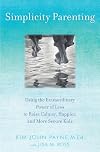
I loved this book for both the practical suggestions (backed by both formal research and informal observation) and for its tone.
Since I began reading this book, I've made some concrete changes in our home environment, including reducing the number of toys and books my children have easy access to (I put many into a "library" in our basement until I can work up the courage to donate/sell/throw away), reducing the number of scheduled activities I have for my children, and implementing some show more basic daily routines, most notably the "flute-practice-after-breakfast" routine.
There have been some small but noticeable changes in the way my children go about their days in the weeks since I've made these changes. We've had fewer arguments about flute practice, and my daughter (age 6.5) has been practicing more regularly and with more joy. She's even begun initiating flute practice on her own without my even prompting her!
My children, especially my 2yo son, are playing imaginatively with everyday objects more than they were before, making an empty toy bin into a car for the stuffed toys and things like that.
And my daughter has lightened up about the order in which we use the colored plastic cups and flatware. She used to scream at me and my husband if we forgot and gave her a blue cup before the green cup. The order was green, light blue, dark blue, yellow, orange, pink, pink, and woe betide the parent who tried to go out of order. There were no discussions about the cups, and we made no changes directly related to the cups, she just stopped getting angry with us about them. Which has been quite a relief.
Of course, my son has also decided that the toy room is much too neat, so he goes in and up-ends three or four toy bins at a time into the middle of the room. That's not so cool, but at least it doesn't take long to pick everything up.
I was already in the habit of simplifying our home, but this book really helped give me the confidence to cut deeper, and to remove toys and books without my children's input about which we kept and which we got rid of. The books were a real change for me, though. I knew the kids (and I) were somewhat overwhelmed by the number of books on their shelves, but I felt like I just couldn't get rid of any of them. Books are unequivocally good, right? But once I halved the number of books, they've been much more engaged with the ones they have left. And they don't even seem to notice that any are missing.
One area that I'm going to try to work on a little bit more is verbal clutter. From the book:
"In our era of spin and counterspin, when words are parsed and split, where news stands beside opinion and embraces blogs, meaning is often drowned out. Just as it's hard to cherish a toy lost in the middle of a mountain of play things, when we say less, our words mean more."
Although I fear that if I really take that to heart, I might blog a lot less.
The tone of the book was the real refreshing piece, though. Payne clearly delights in childhood and the whimsy of children. His anecdotes and suggestions are peppered with images of children interacting with each other and with adults and the funny and adorable things they do and say. I felt a sense of peace and well-being reading such a sunny view of childhood. Not that Payne isn't realistic about the struggles of parenting and children's sometimes not-so-desirable actions, he just doesn't focus on them. He treats children as human beings to be loved and guided rather than creatures to be trained and manipulated, and "misbehavior" as a sign that something in the child's environment might do with some changing.
Payne talks about how one of the biggest differences between parenting now and parenting a generation ago is how much data about our children we have available and how many "experts" we have to consult to make sure we're doing this really big job right. But in this, too, he offers reassurance.
"For all of the measures we now have at our fingertips, by and large children defy them by being both more 'normal' and more extraordinary than any scientific measure, or means of quantifying them."
This rings true to me, and it promotes the freedom we as parents have to love our kids and to let go of worrying that we're not giving them an "ideal" childhood, whatever that might be.
The only thing that I thought was a little lacking was that Payne is very much focused on two-working-parent homes. As a stay-at-home mom who homeschools, I would have kind of liked a little bit of information directed towards me or that at least reflected my demographic. However, I know I'm in a pretty tiny minority, so I don't hold it against the author for not including me and my friends. His suggestions are significant and applicable even to those of us who do not see our specific situations in his case studies. show less
Since I began reading this book, I've made some concrete changes in our home environment, including reducing the number of toys and books my children have easy access to (I put many into a "library" in our basement until I can work up the courage to donate/sell/throw away), reducing the number of scheduled activities I have for my children, and implementing some show more basic daily routines, most notably the "flute-practice-after-breakfast" routine.
There have been some small but noticeable changes in the way my children go about their days in the weeks since I've made these changes. We've had fewer arguments about flute practice, and my daughter (age 6.5) has been practicing more regularly and with more joy. She's even begun initiating flute practice on her own without my even prompting her!
My children, especially my 2yo son, are playing imaginatively with everyday objects more than they were before, making an empty toy bin into a car for the stuffed toys and things like that.
And my daughter has lightened up about the order in which we use the colored plastic cups and flatware. She used to scream at me and my husband if we forgot and gave her a blue cup before the green cup. The order was green, light blue, dark blue, yellow, orange, pink, pink, and woe betide the parent who tried to go out of order. There were no discussions about the cups, and we made no changes directly related to the cups, she just stopped getting angry with us about them. Which has been quite a relief.
Of course, my son has also decided that the toy room is much too neat, so he goes in and up-ends three or four toy bins at a time into the middle of the room. That's not so cool, but at least it doesn't take long to pick everything up.
I was already in the habit of simplifying our home, but this book really helped give me the confidence to cut deeper, and to remove toys and books without my children's input about which we kept and which we got rid of. The books were a real change for me, though. I knew the kids (and I) were somewhat overwhelmed by the number of books on their shelves, but I felt like I just couldn't get rid of any of them. Books are unequivocally good, right? But once I halved the number of books, they've been much more engaged with the ones they have left. And they don't even seem to notice that any are missing.
One area that I'm going to try to work on a little bit more is verbal clutter. From the book:
"In our era of spin and counterspin, when words are parsed and split, where news stands beside opinion and embraces blogs, meaning is often drowned out. Just as it's hard to cherish a toy lost in the middle of a mountain of play things, when we say less, our words mean more."
Although I fear that if I really take that to heart, I might blog a lot less.
The tone of the book was the real refreshing piece, though. Payne clearly delights in childhood and the whimsy of children. His anecdotes and suggestions are peppered with images of children interacting with each other and with adults and the funny and adorable things they do and say. I felt a sense of peace and well-being reading such a sunny view of childhood. Not that Payne isn't realistic about the struggles of parenting and children's sometimes not-so-desirable actions, he just doesn't focus on them. He treats children as human beings to be loved and guided rather than creatures to be trained and manipulated, and "misbehavior" as a sign that something in the child's environment might do with some changing.
Payne talks about how one of the biggest differences between parenting now and parenting a generation ago is how much data about our children we have available and how many "experts" we have to consult to make sure we're doing this really big job right. But in this, too, he offers reassurance.
"For all of the measures we now have at our fingertips, by and large children defy them by being both more 'normal' and more extraordinary than any scientific measure, or means of quantifying them."
This rings true to me, and it promotes the freedom we as parents have to love our kids and to let go of worrying that we're not giving them an "ideal" childhood, whatever that might be.
The only thing that I thought was a little lacking was that Payne is very much focused on two-working-parent homes. As a stay-at-home mom who homeschools, I would have kind of liked a little bit of information directed towards me or that at least reflected my demographic. However, I know I'm in a pretty tiny minority, so I don't hold it against the author for not including me and my friends. His suggestions are significant and applicable even to those of us who do not see our specific situations in his case studies. show less
Simplicity Parenting: Using the Extraordinary Power of Less to Raise Calmer, Happier, and More Secure Kids by Kim John Payne
The author, a former Waldorf teacher, manages to convey the best elements of Waldorf as it applies to family life without getting into anything I disagree with. I skimmed some chapters, but feel that it was reasonably concise nonetheless. It's a good piece of encouragement for anyone wanting to simplify their family life by decluttering, inserting breathing room into over-packed schedules, and creating low-key grounding points in the family's routine. I especially liked the way the author show more explained how simple, non-fussy, and un-ritualistic these moments of re-connecting could be -- less about lighting biodynamic candles and more about simply being present for your kids in a reliable, mostly predictable way. show less
Lists
You May Also Like


Statistics
- Works
- 24
- Members
- 1,004
- Popularity
- #25,689
- Rating
- 4.1
- Reviews
- 21
- ISBNs
- 33
- Languages
- 3