

Peter M. Bowers (1918–2003)
Author of Boeing Aircraft Since 1916
About the Author
Works by Peter M. Bowers
Lockheed Constellation: Design, Development, and Service History of all Civil and Military Constellations, Super Constellations, and Starliners (1992) 30 copies
Forgotten Fighters/2 and Experimental Aircraft U.S. Army 1918-1941 (An Aerofact book) (1971) 22 copies
Associated Works
Tagged
Common Knowledge
- Birthdate
- 1918-05-15
- Date of death
- 2003-04-27
- Gender
- male
- Nationality
- USA
- Birthplace
- San Francisco, California, USA
- Associated Place (for map)
- California, USA
Members
Reviews

This book is one of many titles written by noted American aviation writer Peter M. Bowers, one of four books produced by the author for the Putnam Aeronautical Library--the other three deal with U.S. military and naval aircraft and the Boeing aircraft line. The Curtiss book is more difficult to find on the used book market, although this book, as are the others in the Putnam series, have been published by different houses over the years since the 1960's. My copy of "Curtiss Aircraft show more 1907-1947" is from the Naval Institute Press and published in 1987.
This is no small book at 625 pages, although more than a hundred of the pages are devoted to several appendices that attempt to track the individual serial numbers of aircraft built by Curtiss over its forty-year history. The heart of this book are the 14 unnumbered chapters into which Bowers attempts to organize Curtiss' chaotic history. The author attempts to do this by describing the company at certain dates, its significant personalities, and its facilities, followed by presentations of the aircraft built in that era. In his research of the company, Bowers found a 1935 catalog that in some cases applied contemporary designations for old Curtiss products. In other cases, like aircraft bought by the Army and Navy, Bowers follows the customers' designations, illogical though they be at times.
As an engineer for Boeing for more than three decades, Bowers is well-qualified in writing the technical descriptions of Curtiss aircraft. To keep this book at a reasonable length, the aircraft descriptions are tight in their phrasing, so a potential reader should have some sense of aviation technology. However, the book seems disorganized at times, at least to me, as I think this reflects the nature of Curtiss' surviving records when Bowers researched them. Bowers' need to use the flawed 1935 Curtiss catalog is one manifestation of that tendency.
Bowers' experience at Boeing impacts this book in another way. Despite available information that depicts Curtiss (particularly its post-1929 Curtiss-Wright organization) as a failing business, unable to adapt to new technology and design concepts, Bowers staunchly defends Curtiss and states that the problems were driven by unreasonable customer (ie Army and Navy) demands and changes. While Bowers no doubt faced similar issues at Boeing during his career there, the historic record shows that the Curtiss-Wright companies formed in 1929 was nowhere near as competent as the original business founded by Glenn Curtiss, while Bowers' Boeing adapted and thrived.
"Curtiss Aircraft 1907-1947" is a worthy addition to the Putnam Aeronautical Library, covering a noteworthy aviation pioneer that made singular contributions to aviation history but was unable to sustain itself. show less
This is no small book at 625 pages, although more than a hundred of the pages are devoted to several appendices that attempt to track the individual serial numbers of aircraft built by Curtiss over its forty-year history. The heart of this book are the 14 unnumbered chapters into which Bowers attempts to organize Curtiss' chaotic history. The author attempts to do this by describing the company at certain dates, its significant personalities, and its facilities, followed by presentations of the aircraft built in that era. In his research of the company, Bowers found a 1935 catalog that in some cases applied contemporary designations for old Curtiss products. In other cases, like aircraft bought by the Army and Navy, Bowers follows the customers' designations, illogical though they be at times.
As an engineer for Boeing for more than three decades, Bowers is well-qualified in writing the technical descriptions of Curtiss aircraft. To keep this book at a reasonable length, the aircraft descriptions are tight in their phrasing, so a potential reader should have some sense of aviation technology. However, the book seems disorganized at times, at least to me, as I think this reflects the nature of Curtiss' surviving records when Bowers researched them. Bowers' need to use the flawed 1935 Curtiss catalog is one manifestation of that tendency.
Bowers' experience at Boeing impacts this book in another way. Despite available information that depicts Curtiss (particularly its post-1929 Curtiss-Wright organization) as a failing business, unable to adapt to new technology and design concepts, Bowers staunchly defends Curtiss and states that the problems were driven by unreasonable customer (ie Army and Navy) demands and changes. While Bowers no doubt faced similar issues at Boeing during his career there, the historic record shows that the Curtiss-Wright companies formed in 1929 was nowhere near as competent as the original business founded by Glenn Curtiss, while Bowers' Boeing adapted and thrived.
"Curtiss Aircraft 1907-1947" is a worthy addition to the Putnam Aeronautical Library, covering a noteworthy aviation pioneer that made singular contributions to aviation history but was unable to sustain itself. show less

A treasury of the odd, the absurd, the ingenious in heavier-than-air craft. Bowers describes these planes and their history, advantages and failings. Fact-filled guide covers everything from the Wright Flyer and the Taylor Aerocar to the Ryan Vertijet and the Lockheed Sr-71 Blackbird. Grouped in categories by their most prominent feature, you'll find hundreds of unusual and fascinating flying machines. Canard aircraft; Tandem-Wing aircraft; Tailless aircraft; Delta wings; Rotary wings; other show more wing shapes; where to put the engine? twin fuselages; monoplane-biplane conversions, Convertaplanes; Flying automobiles etc. This is a pictorial account of over 75 years of "far-out" flying machines. Illustrated with over 300 photos, many of which are rare. Chapter titles include: Where to put the Engine Minor markings on end pages.?; Monoplane-Biplane Convertibles; Flying Automobiles; Slightly Unorthodox and more. show less
A collection of brief articles originally published in the AOPA Pilot magazine.
In them, Mr. Bowers tells you the story of more than 70 types of classic American general aviation (plus a few airlines like the Boeing 40 and Ford trimotor) aircraft from Jennys to classic WACOs, to Cubs, to the Mooney Mite.
There are also a few brief essays of "I didn't know that" topics like early types of control systems and how the tail skid was developed.
In them, Mr. Bowers tells you the story of more than 70 types of classic American general aviation (plus a few airlines like the Boeing 40 and Ford trimotor) aircraft from Jennys to classic WACOs, to Cubs, to the Mooney Mite.
There are also a few brief essays of "I didn't know that" topics like early types of control systems and how the tail skid was developed.
Scale Aircraft Drawings: Vol. I - World War I (From the Publishers of Model Airplane News) by Peter M. Bowers
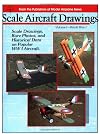
Superb collection of scale drawings of WWI aircraft, engines and armaments. The drawings are the work of "master illustrators", including Wylam, Nye, Larsen and Karlstrom. Also features many examples of early aviation photography.
"For the scale modeler, this book is invaluable. For the historian, it's a collector's dream. For the aviation-minded, modeler or not, it's a fascinating collection of winged history."
Contents
AIRCRAFT
Albatros DI to DVI; Ansaldo SVA-1; Antoinette VII; show more Armstrong-Whitworth FK8; Bleriot XI; Boeing MB-3A; Bristol F2B Fighter; Chance Vought VE-7, VE-9, & UO-1; Curtiss Jenny JN-4 - JN-6H; Curtiss Model D; deHavilland DH1; deHavilland DH4; Fokker Dr.I Triplane; Fokker DVII; Fokker EV/DVIII; Hansa-Brandenburg CI; Hansa-Brandenburg W29; Junkers DI; Loening M-8; Nieuport Nighthawk; Pfalz DIII; Pfalz DXII; RAF SE5a; RAF SE5a Squadron Markings; Salmson Bomber 2 A2; Siemens-Schuckert DIV; Sopwith Camel; Sopwith Dolphin 5F1; Sopwith Snipe 7F1; Spad SVII C1; Spad SXIA-2; Spad SXIII C1; Standard J-1; Thomas Morse S-4B, C, & E; Wright 1903 Flyer, Model A, & Model B
ENGINES
Clerget; Hispano-Suiza; Mercedes 160hp & 180 hp; Siemens-Halske
ARMAMENT
Lewis Machine Gun; Vickers Machine Gun; Air Bombs show less
"For the scale modeler, this book is invaluable. For the historian, it's a collector's dream. For the aviation-minded, modeler or not, it's a fascinating collection of winged history."
Contents
AIRCRAFT
Albatros DI to DVI; Ansaldo SVA-1; Antoinette VII; show more Armstrong-Whitworth FK8; Bleriot XI; Boeing MB-3A; Bristol F2B Fighter; Chance Vought VE-7, VE-9, & UO-1; Curtiss Jenny JN-4 - JN-6H; Curtiss Model D; deHavilland DH1; deHavilland DH4; Fokker Dr.I Triplane; Fokker DVII; Fokker EV/DVIII; Hansa-Brandenburg CI; Hansa-Brandenburg W29; Junkers DI; Loening M-8; Nieuport Nighthawk; Pfalz DIII; Pfalz DXII; RAF SE5a; RAF SE5a Squadron Markings; Salmson Bomber 2 A2; Siemens-Schuckert DIV; Sopwith Camel; Sopwith Dolphin 5F1; Sopwith Snipe 7F1; Spad SVII C1; Spad SXIA-2; Spad SXIII C1; Standard J-1; Thomas Morse S-4B, C, & E; Wright 1903 Flyer, Model A, & Model B
ENGINES
Clerget; Hispano-Suiza; Mercedes 160hp & 180 hp; Siemens-Halske
ARMAMENT
Lewis Machine Gun; Vickers Machine Gun; Air Bombs show less
You May Also Like


Associated Authors
Statistics
- Works
- 53
- Also by
- 2
- Members
- 727
- Popularity
- #34,930
- Rating
- 4.0
- Reviews
- 15
- ISBNs
- 43